

Got an experience you want to write about? Maybe it’s the day you finally spoke up in class, a trip that went completely sideways, or a talk with your grandparent that changed how you see your whole family. Here’s the thing though — remembering what happened is the easy part. The actual work is turning that memory into a story that has a real beginning, an actual problem in the middle, and an ending that lands. Narrative essays aren’t just “write down what happened in order.” You’ve got to pick which details matter, keep the sequence flowing naturally, and let the reader feel why this moment stuck with you.
This guide walks through the whole thing — what narrative essays actually are, the types you might end up writing, how to pick a topic that doesn’t fall flat, a writing process that actually makes sense step by step, and a full sample essay I’ll break down piece by piece so you can see how it all comes together.
What Are Narrative Essays?
So what’s a narrative essay, really? At its core, it’s one focused story, usually something from your own life, told with enough structure that it means something by the end. You’ve got characters, a setting, some kind of conflict, and a bit of reflection at the close — that’s what helps the reader get not just what happened, but why you’re even telling them about it. Most of the time your teacher wants something true, pulled from real life, though a few assignments will let you build a scene that’s made up. Doesn’t matter which one you’re doing. The job is the same either way: lay things out clearly enough that someone else can follow along and actually understand it.
Here’s where people trip up, though. Just describing a trip, step by step, isn’t really a narrative. That’s a timeline. A real narrative essay zooms in on one experience, builds some tension around it, and ties the ending back to something bigger than just “this happened, then that happened.” That’s the difference between telling a story and just reporting events.
Why Are Narrative Essays Important?
You’ll run into narrative essays everywhere — school, college apps, even casual writing — because they teach a skill the other essay types skip over: turning a random experience into something that actually means something. In class, they help you practice building a scene, reflecting honestly, and writing in your own voice instead of a stiff academic one. On a college application, a narrative can show off resilience or curiosity or good judgment way better than a list of your accomplishments ever could.
A quick example helps here. Say a student writes about forgetting their lines during a school play. That essay isn’t really about the play at all. It’s about what it felt like to freeze up in front of everyone, and more importantly, what they did right after. That one small moment can tell you more about a person than some huge dramatic event would.
Types of Narrative Essays
How these get classified depends a lot on who’s teaching the class, so think of these as common buckets rather than some official, locked-in list.
Personal Narrative
This one’s about your own experience and what you walked away with. It’s the go-to type for most school and college work since it’s the easiest to build on genuine reflection — you already lived it, you just have to shape it.
Autobiographical Narrative
This usually spans a bigger chunk of your life instead of just one scene, often connecting a few related experiences into one bigger pattern.
Historical Narrative
This tells the story of something that really happened in the past, even if you weren’t there to see it yourself, using the same scene-building tricks as a personal story.
Biographical Narrative
Pretty similar to a historical narrative, except it’s centered on someone else specifically — their choices, their life, what shaped them.
Travel Narrative
This ties a trip together with observation and reflection, usually built around one specific journey instead of a general “here’s everywhere I went” rundown.
Descriptive Narrative
This one leans heavily on sensory description, so you’re painting a vivid picture of a place, a person, or a specific moment. But that description’s job is to back up the story, not take its place. No matter how much vivid imagery you pack in, you still need a real conflict and a turning point somewhere in there, otherwise you’ve just written a pretty paragraph with nothing actually happening in it.
Literacy Narrative
This type zeroes in on your relationship with reading, writing, or language in general. Could be about learning to read when you were a kid, wrestling with a writing assignment that kicked your butt, discovering you actually love books, or finally feeling solid speaking a second language. What sets it apart from a regular personal narrative is the focus — it’s specifically about how reading, writing, or communicating in some way shaped who you ended up becoming.
Some teachers also allow fictional or creative narratives, where the story doesn’t have to be literally true as long as it still follows the usual narrative structure.
What Are the Critical Elements of Narrative Essays?
Six things hold a narrative together, and honestly they work best when they’re connected instead of treated like a checklist you tick off.
Plot is just what happens. Characters are whoever’s involved, even if that’s only you and one other person. Setting is where and when it all takes place. Conflict is whatever problem or tension is pushing the story forward. The turning point is the moment something shifts. And reflection is what you figured out afterward, once you had time to think about it.
Here’s how that plays out in real life. Picture a student writing about getting lost on a school trip. The setting — some unfamiliar street in a city they don’t know — builds the unease. The conflict, no phone signal and no friends in sight, ramps up the tension. And the reflection, realizing they actually handled it calmly, is what gives the whole story a point. Pull out any one of those pieces and the thing just falls flat.
Narrative Essay Topics: Ideas to Get You Started
The best topic isn’t automatically the biggest thing that’s ever happened to you. It’s whatever has a specific moment attached to it, enough detail to actually describe, and some kind of real outcome. A small, specific memory usually beats a huge, vague one every time.
Personal growth and self-discovery
- A time you changed your opinion about someone
- The moment you realized you’d become more independent
- A decision that taught you responsibility
- A time you had to admit you were wrong
- A choice you made without anyone’s help
- A habit you had to break
- A moment you felt proud of something small
Challenges and mistakes
- A failure that changed how you approached a goal afterward
- The day an unexpected problem wrecked your plans
- A fear you finally decided to face head-on
- A moment when you almost gave up
- A mistake you had to explain to someone
- A time you had to start over from scratch
- A setback that turned out to be useful later
Family, friendship and relationships
- A conversation with a family member that stuck with you
- The first time you met a close friend
- A misunderstanding that changed how you saw a relationship
- A family tradition you learned to appreciate
- An unexpected conversation with a relative
- A moment when a friend stood up for you
- A friendship that began in an unexpected way
School and college experiences
- Your first day at a new school
- A classroom moment that changed your confidence
- A group project that fell apart
- A teacher who changed your perspective
- The day you had to work with a difficult classmate
- A presentation or test that didn’t go as planned
- A moment you realized you understood something for the first time
Travel and memorable moments
- A trip that turned into an unexpected adventure
- Getting lost somewhere unfamiliar
- A family trip you still think about
- The first time you traveled somewhere alone
- A journey that taught you patience
- A day that started badly but ended well
- An unexpected act of kindness from a stranger
Still stuck turning one of these into an actual plan before you start writing? This guide on building an essay plan that grabs attention early is worth a look before you dive into a draft.
How to Write Narrative Essays: A Step-by-Step Guide
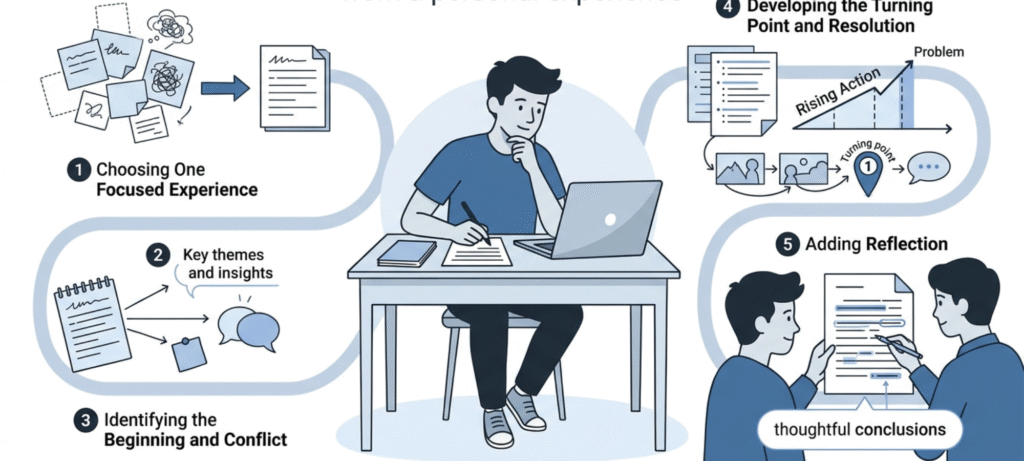
Picking a topic is one thing. Actually shaping it into a story that works is a whole different skill. Here’s a process that builds step on step instead of just throwing advice at you.
Step 1: Choose One Focused Experience
Grab a memory that has a clear beginning, some kind of complication, and an outcome. Don’t try to cover years of your life or a bunch of unrelated things at once. If you can’t sum up the moment in a sentence or two, it’s probably too big.
Step 2: Identify the Central Message
Ask yourself what you actually want the reader to walk away understanding. This isn’t about forcing some cheesy moral onto your story. It’s just about knowing why this particular memory is worth telling in the first place.
Step 3: Build a Simple Outline
Start with a beginning that sets up the situation, then rising action showing what made things hard or interesting, a turning point where things shift, and an ending that reflects on what happened. Mapping this out before you write saves you a lot of headaches later.
| Story Stage | Example: First Public Presentation |
|---|---|
| Beginning | The student is preparing to speak |
| Conflict | They become nervous when called forward |
| Turning point | They forget their opening lines |
| Resolution | They pause, take a breath, and continue |
| Reflection | They realize confidence develops through practice |
One thing worth knowing: a turning point doesn’t have to be some huge dramatic event. Something as small as pausing instead of panicking can shift a story’s direction just as much as a big moment would.
Step 4: Write Scenes Instead of Summarizing
This is where a lot of drafts fall apart. Compare “I was nervous before my presentation” to “I looked at the first line on the screen, but the words seemed to move every time I tried to read them.” The second one actually puts you in the moment instead of just telling you how someone felt.
Step 5: Add Dialogue and Sensory Detail, Carefully
A bit of dialogue, a smell, a sound — small things like that can make a scene feel real. Just don’t make up details you can’t actually back up or remember clearly. Readers can usually tell when something’s been faked, and it kills the trust you’ve built.
Step 6: Revise and Proofread
Go back and check the timeline, your tense, your point of view, and whether your opening and ending actually connect to each other in some way.
Are Narrative Essays Written in First Person?
Most personal narrative essays stick to first person since you’re literally telling your own story from your own point of view. Words like “I,” “me,” and “my” let the reader see what you saw, thought, and felt in the moment. Historical and biographical narratives sometimes switch to third person instead, since those are telling someone else’s story rather than your own. Whatever your specific assignment asks for, go with that.
How to Start Narrative Essays: Hooks and Opening Examples
An opening really has one job: make someone want to keep reading. There are four approaches that tend to work well, and each one does its own thing.
Starting in the middle of the action looks like this: “The bus doors closed just as I realized my backpack was still sitting on the pavement.” Right away, that raises a question the reader needs answered.
Opening with dialogue works a bit differently: “I told myself I wouldn’t cry, but the moment my father opened the door, I knew I couldn’t keep that promise.” You drop straight into an emotional moment without any setup at all.
Leading with a surprising detail does something similar: “I had practiced the speech seventeen times, yet forgot my own name when I reached the microphone.” That gap between all the preparation and the sudden failure instantly makes someone curious.
Starting with a brief reflection sets a different tone: “For years, I thought being independent meant never asking anyone for help.” Right off the bat, it hints that the story’s heading toward some kind of shift in understanding.
Any of those four beats a generic opener like “This is a story about the time I learned something important,” which basically spoils what’s coming instead of pulling the reader in.
Narrative Essay Structure: Introduction, Body and Conclusion
Every section of a narrative essay has its own job to do.
| Section | What It Should Do |
|---|---|
| Introduction | Establish the situation and draw the reader in |
| Body | Develop events, conflict, and the turning point |
| Conclusion | Show the outcome and explain why it matters |
Don’t just string events together one after another in the body. The early paragraphs should set the scene and get the conflict on the table. The middle part is where that tension keeps building. By the time you hit the last body paragraph, that’s usually where the turning point or resolution happens. The conclusion is where you step back and reflect on what it all actually meant.
Now, how should you order it? For most personal narrative assignments, going chronologically is just the easiest route readers can follow things exactly as they happened without getting lost. You can get fancier and open on a dramatic moment, then flash back to fill in how you got there, but that only works if the time jumps are easy to track. If someone has to stop and figure out when something’s happening, that’s your cue the structure needs fixing.
Do Narrative Essays Need a Thesis Statement?
Short answer: not really, at least not the classic kind. You won’t usually find the same argumentative thesis here that you’d see in a persuasive or analytical essay. What a personal narrative tends to have instead is more of a central idea or guiding insight think of it less as a claim you’re defending and more like a theme that runs underneath the whole story.
That said, always check your specific prompt first. Some teachers still want an explicit thesis statement even for a narrative assignment, and whatever the prompt says wins over any general advice here.
A guiding idea might sound like: “Learning to ask for help was harder for me than finishing the assignment itself.” That’s not a thesis in the formal sense, but it gives the whole story something to hang onto.
Transition Words for Narrative Essays
Transitions keep readers oriented as your story moves through time. Grouping them by what they actually do makes them way easier to use naturally instead of leaning on the same word over and over.
| Purpose | Examples |
|---|---|
| Beginning | At first, one morning, before long |
| Sequence | Next, afterward, meanwhile |
| Time shift | Later that day, years earlier, by then |
| Unexpected event | Suddenly, without warning, unexpectedly |
| Result | As a result, eventually, because of this |
| Reflection | Looking back, in the end, I realized |
Relying on “then” for every single transition is a pretty common habit, and it makes a story feel stiff fast. Mixing it up across these categories keeps the pacing from feeling repetitive.
Narrative Essays Examples: A Sample and Breakdown
Some good examples of personal narrative essays include a story about overcoming stage fright, learning to ride a bike, making a hard decision, or discovering something you didn’t know about a family member. Here’s a full sample built around one of these situations, with a breakdown right after.
The Day I Finally Asked for Help
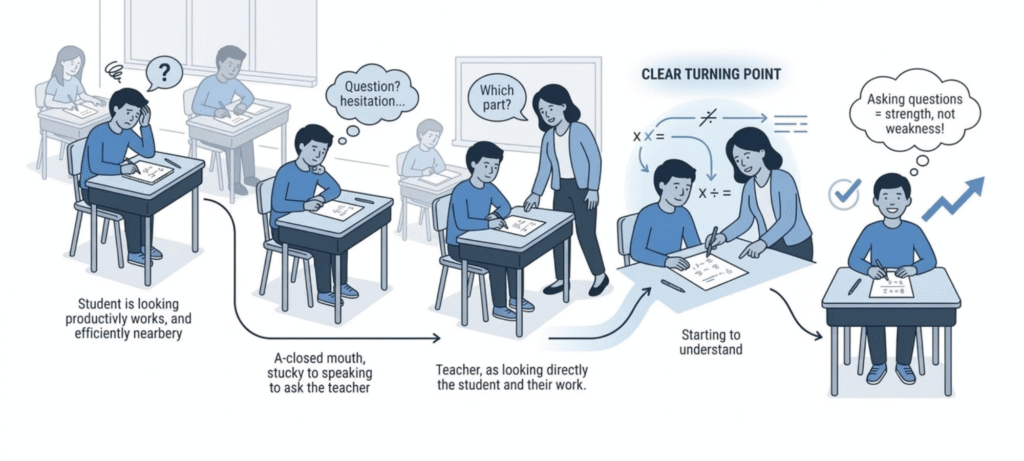
I’d been staring at the same math problem for twenty minutes, and it still made zero sense. The numbers on the page might as well have been written in another language. Around me, everyone else had already moved on to the next page, pencils moving steadily, and nobody else seemed stuck the way I was. I kept rereading the instructions, half hoping they’d somehow rearrange themselves into something I actually understood, but they never did.
Asking for help just wasn’t on the table in my head. I’d blown it up into something way bigger than it actually was, totally convinced that needing to ask meant I wasn’t smart enough to be in that class to begin with. So I kept faking it, pencil scratching across scrap paper, numbers going nowhere, while the clock ticked closer to the end of the period.
By the time the bell rang, I hadn’t finished a single problem. I shoved my notebook into my bag, hoping to slip out before anyone noticed, but my teacher caught my eye and asked me to stick around for a minute. My stomach dropped instantly. I was already bracing for a lecture about falling behind, maybe even a note home.
Instead, she just leaned against her desk and asked, “What part lost you?” I pointed at the second line of the problem, waiting for the disappointment I was sure was coming. She looked at it for a second, then walked me through it out loud, slowly, step by step. It clicked almost right away, way faster than I expected. What actually stuck with me afterward wasn’t the math itself. It was how simple the whole thing turned out to be once I stopped treating a basic question like some kind of confession.
After that, I started raising my hand more. Not because every lesson suddenly made sense, but because I’d finally figured out that asking a question wasn’t the weakness I’d convinced myself it was for so long.
Breakdown of the sample:
| Narrative Element | Where It Appears |
|---|---|
| Hook | The student stuck on the math problem while everyone else moves on |
| Setting | The classroom, near the end of class |
| Conflict | Fear of appearing unintelligent by asking a question |
| Dialogue | The teacher asking what part was confusing |
| Turning point | The teacher walks through the problem and it clicks |
| Reflection | The narrator realizes asking questions isn’t failure |
Notice this one doesn’t rely on some huge, dramatic life event. That’s on purpose. The best narrative essays examples usually prove that an ordinary moment, told well, can carry just as much weight as something major.
A literacy narrative can follow basically the same shape with a different focus. Picture a kid who avoided reading out loud in class for years, dead sure everyone would notice how slowly they sounded out each word, until a librarian handed them a book on a topic they actually cared about, and suddenly reading stopped feeling like a performance. Same structure underneath it all: a conflict rooted in fear, a small turning point, and a reflection on what shifted.
How Long Are Narrative Essays?
Length really comes down to the assignment, your grade level, and what the piece is actually for. These are just typical ranges, not hard rules: a short classroom assignment usually runs 500 to 1,000 words, a high school essay often lands somewhere between 500 and 1,500 words, and a college assignment might stretch to 1,000 to 2,000 words or more. Whatever your instructor asks for always beats any general guidance you read online, including this.
Frequently Asked Questions
What are narrative essays?
Narrative essays are pieces of writing that tell a focused story, usually about a personal experience or meaningful event. They use characters, setting, conflict, and reflection to help readers understand what happened and why it mattered.
Are narrative essays written in first person?
Most are, since they’re grounded in personal experience, but historical or biographical narratives can work in third person depending on whose story is being told.
What are some examples of narrative essays?
Common examples include a personal narrative about overcoming a fear, a travel narrative about a trip that didn’t go as planned, a literacy narrative about learning to read confidently, and a reflective narrative about a conversation that changed your perspective.
What makes a narrative essay interesting?
A clear conflict, specific sensory detail, and an honest turning point, rather than a dramatic event told flatly.
Can a narrative essay be fictional?
Sometimes, if the assignment allows it. Most school and college prompts expect a true personal experience unless stated otherwise.
What is the difference between a narrative and a descriptive essay?
A narrative essay tells a story with events, conflict, and reflection. A descriptive essay focuses mainly on creating a vivid picture of a person, place, or moment, without necessarily building toward a change.
How do you choose a good narrative essay topic?
Look for a specific moment with enough detail to build scenes, a real complication, and something you can honestly reflect on, rather than the single biggest event you can think of.
Conclusion
Strong narrative essays aren’t just a record of what happened. They’re focused stories that use real details, a clear sequence of events, and honest reflection to show why an experience actually mattered. Pick something you can still picture clearly in your head, build it scene by scene instead of summarizing it, and let the ending grow naturally out of what happened rather than bolting on some lesson at the end.
If you want more help going from a blank page to a finished outline before you start any essay, Purdue’s general writing resources and the UNC Writing Center’s tips and tools are both solid, free resources worth keeping bookmarked next to this one.