
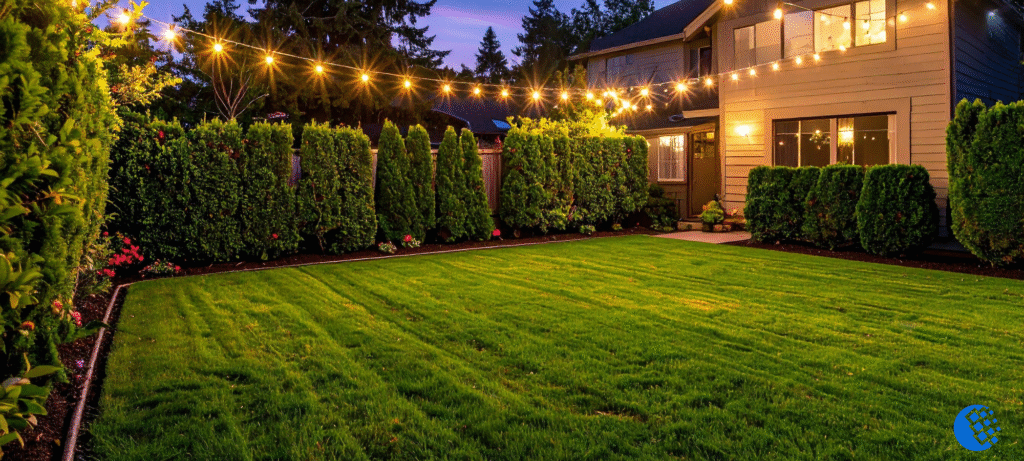
A Seneca homeowner I met last spring had fed his Zoysia and Fescue lawn out of a bag for eleven years. He had also scorched two brown stripes across the front yard, which is why he started calling the landscaping companies seneca sc neighbors actually recommend. His question was the right one. He wanted to know how to tell a real turf-management program from a truck that sprays something green and leaves an invoice in the door, and the honest answer is that a scheduled program matched to your grass type costs less across a year than the guesswork it replaces.
The Bag And Sprayer Routine That Keeps Failing
The routine fails in a predictable order. Bag fertilizer goes down at whatever rate feels about right, the hose-end sprayer dilutes to whatever the water pressure decides, and the thatch layer underneath keeps building because nothing in that routine ever touches it. The case we see most often is a lawn that looks fine in April and reads thin and streaky by mid August.
The bag on the shelf does not know your yard. It knows an average.
Label rates matter more than most homeowners realize. The federal labeling rule from the EPA states that using a product in a manner inconsistent with its labeling is a violation of Federal law. Doubling the rate on stubborn nutsedge is not thoroughness. It is off-label, and on Zoysia it is how you buy a bare spot that takes most of a season to fill.
What A Licensed Applicator Does Differently
Start with what is legally off the table for you. Restricted Use Pesticides are limited under 40 CFR 152.160 through 152.175 to a certified applicator, and they are not sold to the general public. Apply every product exactly as its label directs, wear what the label says to wear, keep kids and pets off treated turf for the interval it states, and never tank-mix two chemicals because a forum thread said it works. South Carolina also requires a commercial license to apply lawn chemicals for hire, so ask for the number.
The second difference is what the program actually treats. A spray truck treats blades. A licensed program treats soil, which is why a real one opens with a soil test. The Associated Press, citing 2023 research in PNAS, reported that soil is estimated to be home to 59% of all life on Earth, the most biodiverse habitat we have. Compaction, pH and thatch decide whether Fescue holds through August, and those get corrected with aeration, verti-cutting and overseeding on a calendar.
The True Yearly Cost Of Going It Alone
Run the numbers on your own shed. Say four bags of fertilizer at $52 each, so $208. Two hose-end weed controls at $24 apiece adds $48, a soil test kit runs $18, renting a core aerator for a Saturday is $85, and overseeding 6,000 square feet of Fescue takes 30 pounds of seed at $4.50 a pound for another $135. Comes to $494 all in, in a season where nothing goes wrong.
Against that, a scheduled program priced per application already carries the equipment and the license. If your lot is under roughly 4,000 square feet and holds one grass type, a careful DIY routine can hold the line. Above that, or with Zoysia and Fescue splitting one yard, the program usually wins, which is the comparison worth raising with the landscaping companies Seneca SC homeowners already trust.
While we are on money quietly wasted, mulch belongs in the same conversation. The Associated Press published gardening guidance in May 2026 putting the ideal mulch depth at 3 to 4 inches, kept a few inches back off trunks and stems. Piling it higher helps nobody. That is a bed problem, not a turf problem, so back to the lawn.
Questions Worth Asking Before You Sign
Vetting a provider is easier than it sounds, because the answers sort themselves fast. A real program answers with grass types, dates and rates. A spray truck answers with a monthly price, then moves on.
- Which grass types are on my lot, and what does the schedule look like for each one? A good answer separates Zoysia from Fescue and gives you months, not seasons.
- Who holds the commercial applicator license, and can I have the number? A good answer produces it on the spot.
- Are you soil testing before the first application, and will I see the results? A good answer names pH and a correction plan.
- How are aeration, verti-cutting and overseeding priced, and are they inside the program or extra? A good answer puts a per-service figure in writing.
One more thing is worth listening for. If they say aeration can happen any time you like, that is a tell, because timing follows the grass. Warm-season Zoysia and cool-season Fescue do not want the same calendar, and the company willing to tell you no on a June overseeding is the one paying attention.
Choosing A Program You Will Not Regret
The homeowner with the two brown stripes signed a program that August, aerated in September, and overseeded his Fescue two weeks later. The stripes filled. What changed was less the chemistry than the calendar, plus a licensed applicator choosing the rate. Ask those four questions, get the license number, insist on the soil test, and one phone call tells you whether you are buying a plan or a visit.