
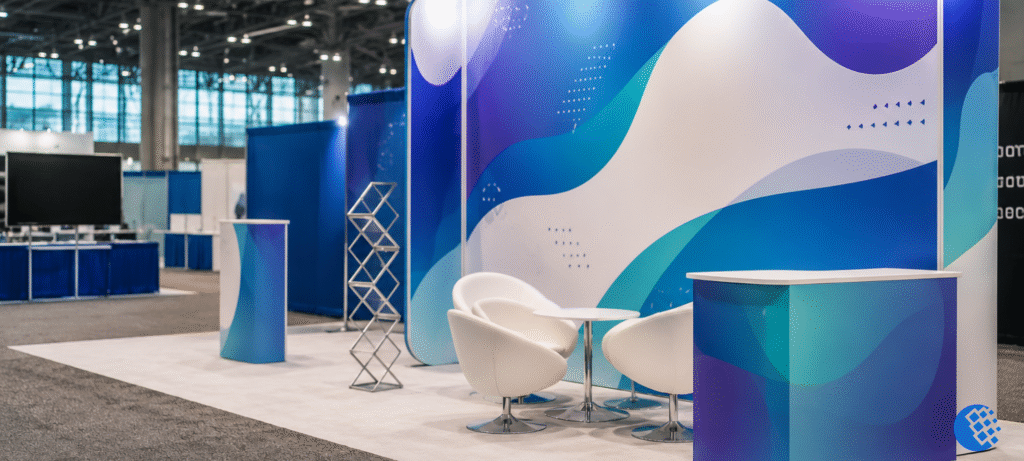
How much does a booth graphic actually cost when the first print run comes out wrong? For a mid-size edtech vendor heading to a New York education conference, the answer arrives twice. Once on the original print order, and again on a rush reprint five days before the truck rolls toward the Javits Center. Print is usually the smallest line on an exhibit budget and the one that fails loudest. Teams sourcing a custom trade show booth new york attendees will remember tend to price the aluminum frame first and leave the panels for last. Paying for accurate color and the right substrate at the start costs less than reprinting a muddy panel later, and the math is not close.
Where Booth Graphic Budgets Actually Go
Large-format print is priced by the square foot, and the spread between substrates is wider than most first-time exhibitors expect. A 10 by 8 foot backwall is 80 square feet of graphic. Tension fabric, rigid panels, and direct-to-substrate UV printing all land at different numbers, and the cheapest of them rarely survives three shows in a crate. What we see most often is a budget built around the frame, with panels quoted late and approved fast. That is the order in which mistakes get made.
Ten years ago the default was a vinyl banner on a solvent machine, and a slight color shift was something exhibitors lived with. Today a printer with a calibrated workflow can hold one brand blue across fabric and rigid panels in the same booth. The equipment changed. Purchasing habits did not, which is why a 2016 mindset still shows up on 2026 print orders.
The Hidden Cost Of Reprinting Muddy Panels
Run the numbers on one wall. Say the backwall graphic is 160 square feet at $9 per square foot, so the first print run is $1,440. The proof comes back muddy, the brand blue reads purple, and the reprint goes in at 48 hours notice with a 40 percent expedite premium, which is $2,016. Add $185 for overnight freight into Manhattan and $250 in overtime for an install crew waiting on the panel. That comes to $3,891 for a wall that should have cost $1,440. The reprint bill shows up wearing rush charges, and none of it buys a better booth. It buys the same booth, late.
Show floors are getting busier, not quieter. The Trade Show News Network reported in June 2026 that Automate 2026 in Chicago drew more than 50,000 attendees and 1,230 exhibitors, its best attended edition ever. A custom trade show booth New York attendees walk past in a hall that crowded gets a few seconds of attention, and a washed out panel spends those seconds explaining itself. Reprinting fixes the panel. It never buys back the traffic that already walked by a half finished wall.
Color Accuracy Is Cheaper Than A Redo
Color accuracy is a process, not a promise. A printer with a calibrated profile for each substrate can proof your brand color on the actual material before the full run. Ask for a physical drawdown instead of a PDF on somebody else’s monitor. In practice this usually means one extra day in the schedule and roughly $60 in proofing cost, set against a four figure reprint risk.
Substrate choice matters about as much as ink does. Fabric hides seams and packs down small, while rigid panels hold fine type better under booth lighting. I could go on about crate design, since crates are where perfectly good panels get creased, but that is a different budget line. Back to print. The audience for those panels is more senior than most exhibitors assume, and a survey of 251 exhibitors published in Frontiers in Psychology found 47.2 percent of the companies were represented at the show by their top leadership.
Spending Once Instead Of Twice In New York
The cheap version of this is not the low bid. It is the print order that goes out once, on the right material, with color signed off before the press runs. For an edtech vendor at Javits, that call beats shaving the gap between two frame quotes, because the panels are what the room actually reads. Budget the graphics like they are the booth, because from across the aisle they are. Then spend the show talking to educators instead of chasing a courier.