
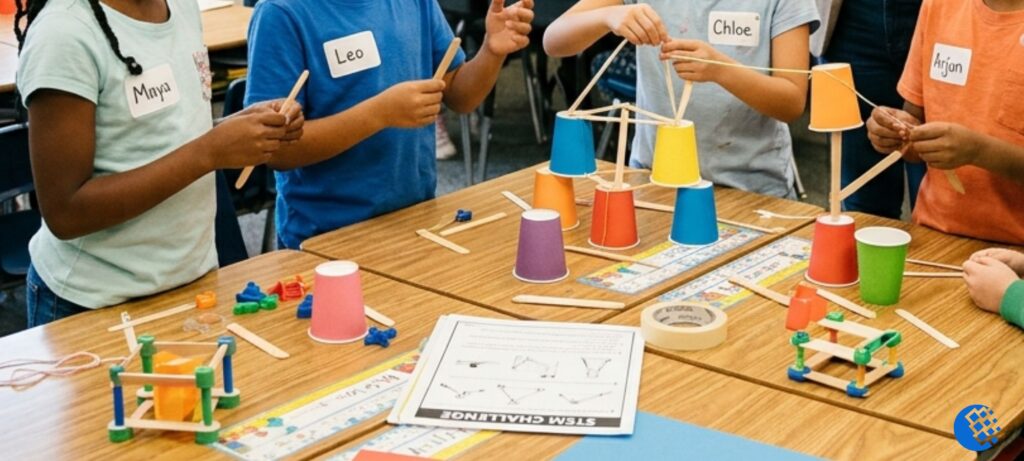
Twenty-five eight-year-olds. One group project. Somebody’s crying, somebody’s declared themselves “team captain forever,” and you’re wondering how this class ever survives a fire drill. If that sounds familiar, you already understand why team building games for elementary students matter — they’re the practice reps kids never get anywhere else.
I’ve run these during rainy indoor recess, right before state testing when the room needed a reset, and on ordinary Tuesday afternoons when the class just felt off for no obvious reason. Some worked instantly. A few flopped hard enough that I still remember the exact class period. This guide is built from both kinds of experience, not just a list of activities that sound good on paper.
Key Takeaways
- Match games to context: Team building games for elementary students work best when tailored directly to grade level, group size, time, and available space.
- No equipment needed: Great no-equipment options exist for almost every situation—including active indoor games for rainy or high-energy days when students can’t go outside.
- Keep field days moving: Field day formats thrive on short, rotating stations rather than one single, long activity.
- Debrief to lock in learning: A quick reflection session right after the game is what turns play into real character growth—skip the debrief, and most of the social-emotional value evaporates.
- Play year-round: Rotating new games weekly—instead of saving team building exclusively for the first week of September—builds a significantly stronger classroom culture across the entire school year.
Table of Contents
- Why Team Building Games for Elementary Students Matter
- Benefits of Team Building Games for Elementary Students
- How to Choose Team Building Games for Elementary Students
- Best Team Building Games at a Glance
- 45 Best Team Building Games (by Category)
- Games by Grade Level
- Games by Time Available
- Games by Group Size
- Games by Skill Developed
- Full Comparison Table
- Games Without Any Equipment
- Indoor vs Outdoor Games
- Mistakes I See Teachers Make
- Games That Failed in My Classroom
- Signs a Team Building Game Is Actually Working
- How I Adapt Activities for Kindergarten
- What to Do if Students Refuse to Participate
- Frequently Asked Questions
Why Team Building Games for Elementary Students Matter
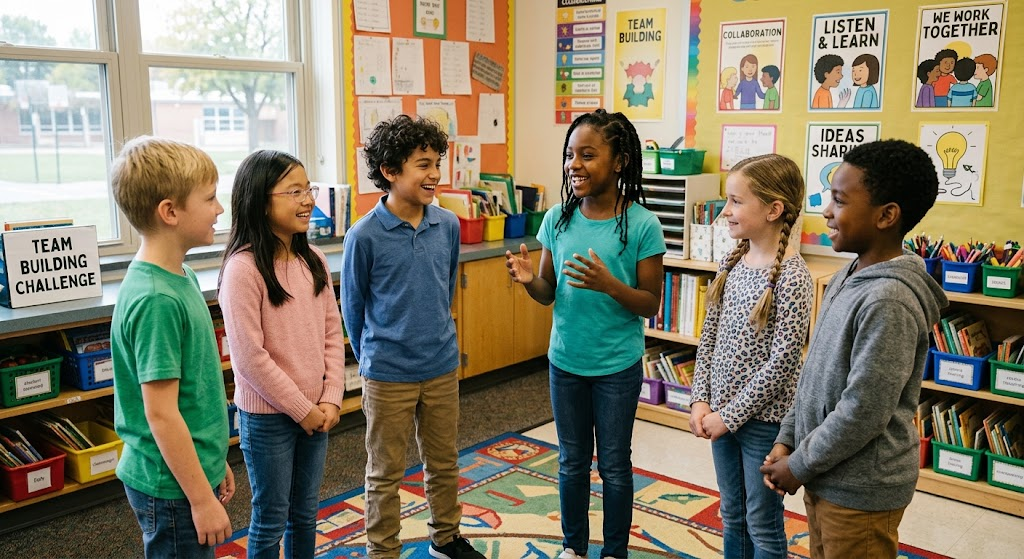
Teamwork isn’t something kids arrive with. It gets built, slowly, through repetition.
A six-year-old who’s never had to wait for a partner’s turn, or explain a shape without pointing at it, doesn’t develop that patience from a worksheet. That takes practice, and practice needs somewhere low-stakes enough that getting it wrong is fine.
Here’s what these games actually train:
- Listening before reacting
- Taking turns leading
- Handling frustration when a plan falls apart
- Speaking up without steamrolling the group
- Trusting a classmate they’d never normally sit with
Teachers who run these consistently — not just during the first week of school — tend to notice fewer conflicts during unstructured stretches like recess or the walk to lunch. That lines up with what the Collaborative for Academic, Social, and Emotional Learning (CASEL) has documented for years: structured cooperative play is one of the cheapest, most effective ways to build social-emotional competency in young children. Frameworks like Responsive Classroom and Positive Behavior Supports (PBIS) lean on the same principle — give children repeated, low-pressure chances to practice the behavior you actually want to see more of. Some schools blend this with Whole Brain Teaching routines, which use similar call-and-response structures to keep large groups engaged during transitions.
Quick Take: Team building games for elementary students work because they turn abstract social skills — patience, listening, leadership — into something kids can physically practice in a five-minute activity, not just hear about in a lesson.
Benefits of Team Building Games for Elementary Students
| Benefit | Classroom Impact |
|---|---|
| Stronger communication | Learners practice giving and following clear instructions |
| Better classroom culture | Fewer cliques, more mixed friendships |
| Reduced behavior issues | Structured play channels energy productively |
| Higher engagement | Kids participate more willingly in group work later |
| SEL growth | Builds empathy, patience, and self-regulation |
| Improved problem-solving | Groups practice trial-and-error thinking together |
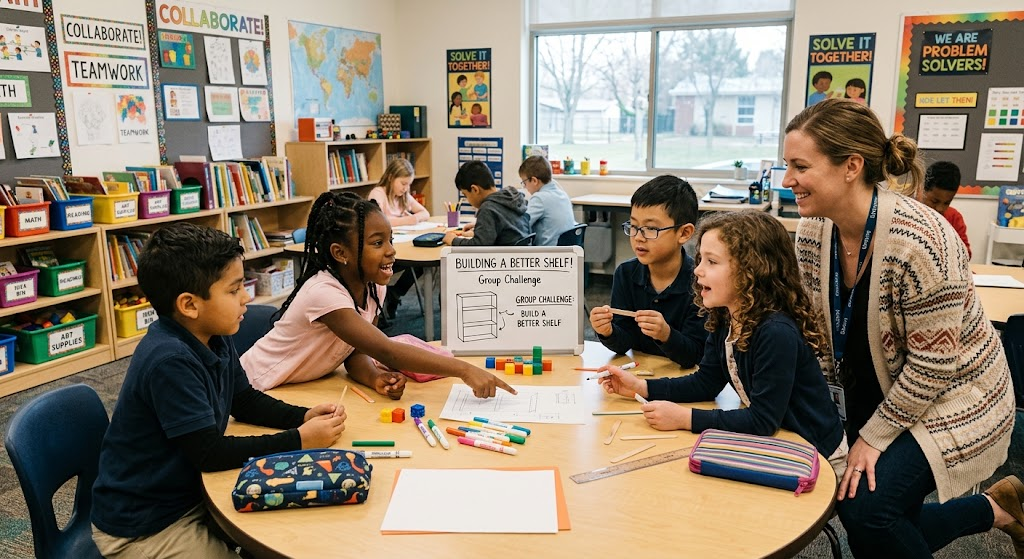
One benefit that rarely makes these lists: confidence. I’ve watched a kid who never raises a hand during a math discussion turn into the calmest planner in the group during a build challenge. That shift changes how classmates see that student for the rest of the year. It’s not a small thing, and it’s usually not something you can predict ahead of time — which is part of why these activities are worth running regularly instead of once a semester.
How to Choose Team Building Games for Elementary Students
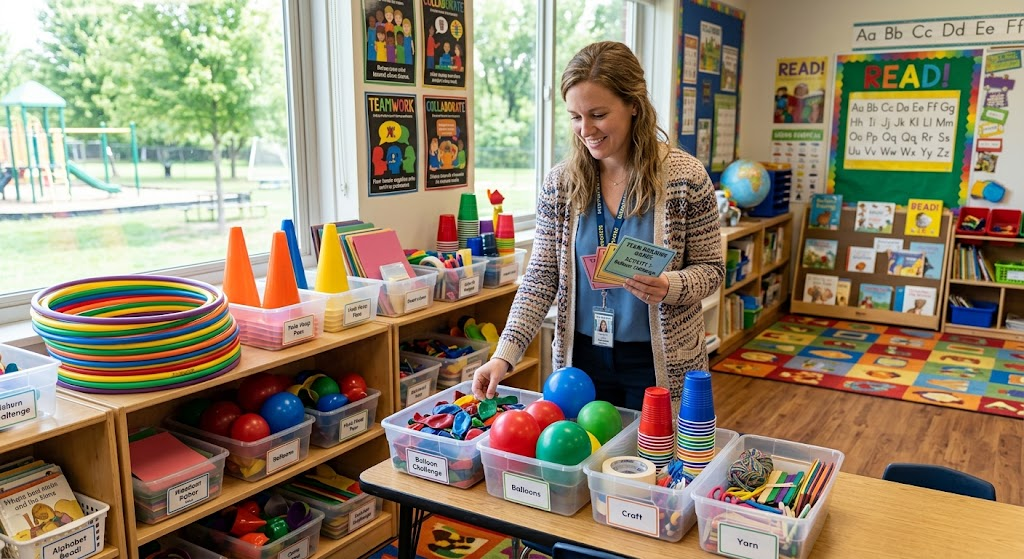
Before grabbing an activity off any list, run through five quick questions.
Age and grade first — kindergartners need simpler rules than fifth graders. Class size matters more than people expect, too; a 12-student group and a 30-student group are basically different logistics problems. Then there’s materials. Some days you’ve got tape, hula hoops, and a supply closet. Other days you’ve got nothing but floor space and forty minutes before the assembly starts.
Indoor or outdoor changes everything. So does the time you actually have — five minutes before dismissal calls for something different than a full PE block. And underneath all of it: what are you actually trying to build? Communication? Trust? Or are you just trying to burn energy productively on a Friday afternoon before a long weekend?
Once those five things are settled, picking from the list below takes about ten seconds.
Best Team Building Games at a Glance
Quick Answer — best overall: Human Knot, Marshmallow Tower, and Silent Line Up cover the widest range of grades, group sizes, and settings, which is why they show up on almost every list of team building games for elementary students.
- Human Knot — no equipment, works for almost any grade
- Marshmallow Tower — best for problem-solving and STEM tie-ins
- Silent Line Up — quick, nonverbal, great for morning meeting
- Blind Guide — strongest trust-building option
- Hula Hoop Pass — active indoor pick for rainy days
45 Best Team Building Games for Elementary Students
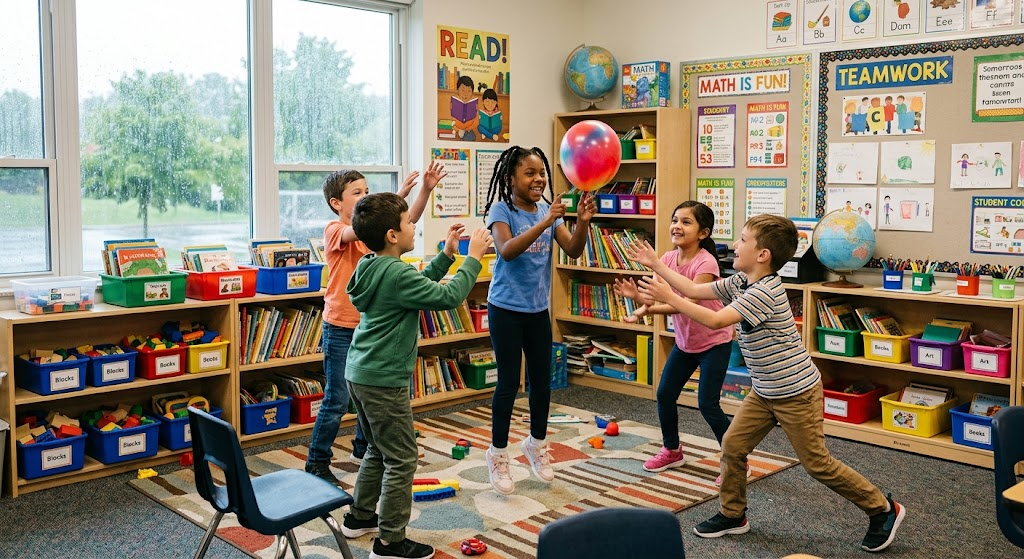
No Prep Games
These need nothing but space and willing participants — perfect for rainy indoor recess or a five-minute reset before a lesson.
1. Human Knot. Last spring, I used this with a mixed third-grade class right after lunch, when the energy in the room was unusually high. The first attempt fell apart completely — everyone talked over each other and nobody could tell whose hand was whose. On the second try, one student suggested picking a single speaker to call out directions, and the group finished in half the time. That moment taught the class more about teamwork than the actual knot did. If I could only keep one activity on this list, it would be this one.
2. Silent Line Up. Line up by birth month or height, no talking allowed.
3. Birthday Line. Same idea, focused entirely on nonverbal communication.
4. Would You Rather. A light discussion prompt that gets quiet kids talking in pairs — works well for morning meeting or the last five minutes before lunch.
5. Find Someone Who. A scavenger-hunt-style mixer built around a simple trait checklist.
6. Two Truths and a Lie. Works from first grade through fifth, though the lies get noticeably more creative by fourth grade.
Quick Take: No-prep games are the fastest way to fill a sudden gap in the schedule — an assembly running long, a rainy indoor recess, a substitute day — without needing a single supply.
Active Indoor Team Building Games for Elementary Students
When the weather (or the schedule) traps everyone inside, active indoor team building games for elementary students bridge the gap between movement and structure.
7. Balloon Keep Up. Small groups keep a balloon off the floor using only soft taps. I tried this one after indoor recess during a downpour and expected chaos. Instead, the quietest group in the class ended up coordinating better than anyone else — they paused to make a plan before the balloon even went up, which surprised me more than it should have.
8. Hula Hoop Pass. A circle holds hands and passes a hoop around without breaking the chain.
9. Paper Chain Challenge. Groups race to build the longest paper chain from a single sheet of paper.
10. Cup Stack Challenge. Teams stack and unstack cups using a string-and-rubber-band rig, no hands touching the cups directly.
11. Blind Builder. One student describes a shape verbally; a blindfolded partner tries to build it with blocks.
12. Marshmallow Tower. In fourth grade, the marshmallow almost always becomes the actual problem. Most teams build a tall tower first and remember the marshmallow at the last second, and the whole thing collapses. Watching them redesign together — usually with about ninety seconds left on the clock — is where the real teamwork shows up. Twenty spaghetti sticks, one marshmallow, one yard of tape, one shared goal.
Quick Take: Active indoor team building games for elementary students work best in short 10–15 minute bursts, since the energy they generate is hard to sustain much past that.
Outdoor Games
13. Relay Race. The gym-class staple, endlessly adaptable.
14. Capture the Flag. Strategy plus sprinting, better suited to upper elementary.
15. Tug of War. Simple, and still a genuine test of coordinated effort.
16. Nature Scavenger Hunt. Teams search for items on a list within a bounded area.
17. Three-Legged Race. Forces two kids to literally move in sync, whether they want to or not.
18. Team Obstacle Course. Groups navigate a course together, sometimes tethered by rope.
Team Building Games for Elementary Students Field Day
Field day is where team building games for elementary students get their biggest stage all year. These work best as rotating stations, cycling small groups through every 8–10 minutes so nobody gets bored standing in line.
19. Sponge Relay. Teams shuttle water using only a soaked sponge.
20. Water Bucket Challenge. Race to fill a bucket using cups passed hand to hand.
21. Egg Carry Relay. Balance an egg on a spoon across a course without dropping it — the giggling starts before anyone even moves.
22. Giant Puzzle Race. Teams assemble an oversized floor puzzle against the clock.
23. Parachute Games. A classic parachute, used for wave games, popcorn ball tosses, and cooperative lifts.
24. Sack Race. Chaotic, occasionally undignified, always a crowd favorite for any team building games for elementary students field day rotation.
25. Cone Relay. Teams weave through cones while carrying an object between two players.
Quick Take: For field day specifically, station rotations of 8–10 minutes keep energy high without any single game overstaying its welcome.
Problem-Solving Games
26. Escape Room (Classroom Version). A locked box with clues tied to a current lesson topic.
27. STEM Build Challenge. Build a bridge, tower, or boat from limited materials.
28. Lego Tower. A tighter, faster version of the STEM challenge using building bricks.
29. Hidden Object Mission. Teams solve riddles to locate hidden classroom items.
30. Treasure Hunt. A sequence of clues leading to a final prize or message. This one takes more setup than most on this list, but the payoff — kids actually strategizing about which clue to tackle first — makes it worth the extra ten minutes of prep.
Trust Building Games
31. Blind Guide. One student wears a blindfold and navigates a simple path using only a partner’s verbal directions.
32. Minefield. Partners guide a blindfolded teammate through a floor scattered with soft obstacles.
33. Mirror Partner. Partners mimic each other’s movements in real time — always ends in at least one fit of giggles.
34. Trust Walk. A short guided walk relying entirely on a partner’s spoken instructions.
Communication Games
35. Telephone. The message-distortion game. Still funny after decades, and still a good way to demonstrate why clear instructions matter.
36. Story Circle. Learners build a story one sentence at a time.
37. Picture Back-to-Back. One student describes a picture; a partner draws it without seeing the original.
38. Build from Directions. A student gives verbal-only instructions for building a shape out of blocks.
Small Group Games (5–10 students)
39. Compliment Chain. Each participant passes along a specific compliment to a peer.
40. Group Storytelling with Props. A small circle builds a story using random objects as prompts.
41. Mini Marshmallow Challenge. A scaled-down version for smaller table groups.
Large Classroom Games (20–35 students)
42. Giant Human Knot. Same concept as the original, scaled up for the whole homeroom.
43. Class Web. A ball of yarn passed around a circle while each student shares something personal, forming a visual “web” of connection by the end.
44. Whole-Class Silent Sort. Sorting the entire class by a trait, silently, in under three minutes — harder than it sounds with 30 kids.
45. Beach Ball Question Toss. A beach ball with written prompts, tossed around for quick reflection questions.
Games by Grade Level
| Grade | Best Fit Games |
|---|---|
| Kindergarten | Silent Line Up, Mirror Partner, Compliment Chain |
| Grade 1 | Balloon Keep Up, Two Truths and a Lie, Story Circle |
| Grade 2 | Hula Hoop Pass, Paper Chain Challenge, Trust Walk |
| Grade 3 | Human Knot, Marshmallow Tower, Blind Guide |
| Grade 4 | STEM Build Challenge, Capture the Flag, Escape Room |
| Grade 5 | Giant Human Knot, Team Obstacle Course, Treasure Hunt |
Most of these flex up or down a grade with small rule tweaks. Shorten the timer for younger children. Add a strategy twist for the older ones. It doesn’t need to be more complicated than that.
Games by Time Available
| Time Available | Good Options |
|---|---|
| 5 minutes | Silent Line Up, Would You Rather, Two Truths and a Lie |
| 10 minutes | Human Knot, Hula Hoop Pass, Compliment Chain |
| 20 minutes | Marshmallow Tower, STEM Build Challenge, Team Obstacle Course |
If the bell is about to ring, don’t reach for anything on the 20-minute list — a half-finished Marshmallow Tower left standing overnight is its own kind of classroom chaos.
Games by Group Size
| Group Size | Good Options |
|---|---|
| Pairs | Mirror Partner, Trust Walk, Picture Back-to-Back |
| Small groups (5–10) | Compliment Chain, Mini Marshmallow Challenge, Group Storytelling |
| Whole class | Human Knot, Class Web, Silent Line Up |
| Large classes (25+) | Giant Human Knot, Whole-Class Silent Sort, Beach Ball Question Toss |
Games by Skill Developed
| Skill | Games |
|---|---|
| Communication | Blind Guide, Build from Directions, Telephone |
| Leadership | Marshmallow Tower, STEM Build Challenge, Giant Human Knot |
| Trust | Trust Walk, Minefield, Blind Guide |
| Listening | Silent Line Up, Story Circle, Picture Back-to-Back |
| Decision Making | Escape Room, Treasure Hunt, STEM Build Challenge |
| Problem Solving | Marshmallow Tower, Lego Tower, Hidden Object Mission |
| Conflict Resolution | Human Knot, Tug of War, Team Obstacle Course |
| Creativity | Group Storytelling with Props, Story Circle, Class Web |
Full Comparison Table
| Game | Time | Materials | Grades | Indoor | Outdoor | Skill |
|---|---|---|---|---|---|---|
| Human Knot | 10 min | None | 2–5 | ✔ | ✔ | Problem Solving |
| Marshmallow Tower | 20 min | Spaghetti, tape, marshmallow | 3–5 | ✔ | Leadership | |
| Silent Line Up | 5 min | None | K–5 | ✔ | ✔ | Listening |
| Blind Guide | 10 min | Blindfold | 2–5 | ✔ | ✔ | Trust |
| Hula Hoop Pass | 10 min | Hula hoop | K–3 | ✔ | Cooperation | |
| Sack Race | 15 min | Sacks | K–5 | ✔ | Coordination | |
| Escape Room | 20 min | Locked box, clues | 4–5 | ✔ | Decision Making |
Games Without Any Equipment
A rainy Monday with nothing in the supply closet? These work with nothing but the group itself:
- Human Knot
- Silent Line Up
- Birthday Line
- Two Truths and a Lie
- Mirror Partner
- Story Circle
- Compliment Chain
- Would You Rather
- Class Web (one ball of yarn, if you count that)
- Whole-Class Silent Sort
- Find Someone Who
- Telephone
- Trust Walk
- Giant Human Knot
- Beach Ball Question Toss (any soft ball works)
Indoor vs Outdoor Games
| Factor | Indoor Games | Outdoor Games |
|---|---|---|
| Weather dependency | None | High |
| Noise level | Needs management | Rarely an issue |
| Space needed | Limited | Larger |
| Best for | Rainy days, short windows | Field day, elementary PE, recess |
| Examples | Balloon Keep Up, Marshmallow Tower | Relay Race, Tug of War |
Mistakes I See Teachers Make
Making it too competitive is the biggest one — once winning becomes the whole point, cooperation quietly disappears. Skipping clear instructions is another; kids need the rules modeled, not just read off a card.
Picking the wrong difficulty backfires both directions. Too easy, and the class checks out in under a minute. Too hard, and they give up before really trying. Letting it run too long is a quieter mistake — ten focused minutes almost always beats thirty scattered ones, especially on a Friday afternoon when attention is already thin.
Then there’s the one that gets skipped constantly: the debrief. Without a thirty-second “what worked, what didn’t” conversation afterward, the actual lesson doesn’t stick. Overlooking shy participants is common too — some kids need a specific role handed to them, not just an open invitation to “join in.” And obviously, ignoring safety basics matters most with blindfolded activities, which need a cleared, supervised space every single time. For teachers who are also managing broader behavior systems, this connects directly to classroom management routines, since a well-run game can reinforce the same expectations as the rest of the day.
Games That Failed in My Classroom
Not everything works. Capture the Flag once turned into a genuine argument about boundary lines that ate ten minutes of recess renegotiating rules — worth trying again with clearer markers, but rough the first time through. I also tried a full Escape Room build with second graders once, way too early for that age group. The clues assumed a reading level most of the class didn’t have yet, and half the room lost interest within five minutes. Lesson learned: match the reading demands to the actual grade in front of you, not the grade you wish they were reading at.
A Treasure Hunt attempt during a rainy indoor recess also fell apart because the clues sent groups to the same three spots at once, causing a pileup by the classroom sink. Small logistics detail, big disruption.
Signs a Team Building Game Is Actually Working
You’ll usually notice it before the activity even ends. Kids start negotiating roles without being told to. Someone who normally stays quiet starts giving directions. The noise level shifts from scattered chatter to focused problem-talk — a different kind of loud. If a group asks to “try that again” without being prompted, that’s usually the clearest sign the activity landed.
How I Adapt Activities for Kindergarten
Kindergartners need shorter timers, more modeling, and fewer moving parts. Mirror Partner works well because it’s entirely visual — no verbal instructions to misunderstand. Silent Line Up needs a demonstration first, not just an explanation, or half the class will just start talking anyway. Compliment Chain works, but I keep the prompt extremely narrow (“say one nice thing about their shoes” beats an open-ended compliment) or the whole thing stalls out in silence.
What to Do if Students Refuse to Participate
It happens — usually two students who just don’t want to work together that day. Don’t force the pairing immediately. Give them a smaller, lower-stakes role first, like timekeeper or materials handler, so they’re inside the activity without the pressure of direct collaboration. Most of the time, proximity does the rest of the work on its own within a few minutes. If it doesn’t, a quick one-on-one check-in after class beats a public power struggle every time.
Teacher Tips for Running These Games Well
- Set a visible timer so kids know exactly when the activity ends.
- Establish one or two ground rules before starting — “everyone gets a turn to talk” works for almost anything.
- Debrief with two or three quick questions, not a full class discussion.
- Rotate group assignments regularly so friend groups don’t calcify.
- Keep a small supply bin (yarn, cups, tape, a beach ball) so no-prep isn’t your only option on a given day.
Pairing games with a light reward system helps too — if you’re building one out, 75 Free Incentives for Students has low-cost ideas that work well alongside a team-based classroom structure. And for a broader activity bank beyond this list, 25 Children’s Team Building Games breaks down more options by age and setting — useful if you’ve burned through your usual rotation by February.
Frequently Asked Questions
What are the best team building games for elementary students?
Human Knot, Marshmallow Tower, and Hula Hoop Pass consistently perform best because they scale across grade levels and need little to no equipment.
What is the easiest team building game?
Silent Line Up. No materials, no explanation beyond “line up by birthday, no talking,” and it works from kindergarten through fifth grade.
Which team building games need no equipment?
Human Knot, Silent Line Up, Mirror Partner, and Story Circle all run on nothing but the group itself — no supplies, no prep time.
What team building games work in small classrooms?
Compliment Chain, Mini Marshmallow Challenge, and Group Storytelling with Props all work well with tighter spaces and smaller groups of five to ten.
What games are best for first grade?
Balloon Keep Up, Two Truths and a Lie, and Story Circle tend to land well with six- and seven-year-olds, since none require much reading or complex multi-step instructions.
How do you teach teamwork in elementary school?
Mostly through repetition — short, structured activities run weekly, followed by a quick debrief, so cooperation becomes a practiced habit rather than a one-time lesson.
What are active indoor team building games for elementary students?
Balloon Keep Up, Paper Chain Challenge, and Cup Stack Challenge all get kids moving without needing outdoor space, which makes them ideal for rainy days.
What are good field day team building games?
Sponge Relay, Egg Carry Relay, and Parachute Games all work well in a team building games for elementary students field day station rotation, since they’re fast, visual, and easy to run with rotating small groups.
What’s a good no-prep team building activity for a substitute day?
Silent Line Up or Two Truths and a Lie — both run without materials and without much explanation, which matters when a substitute doesn’t know the class routines yet.
What team building games work for 10 to 12 year olds?
Escape Room, STEM Build Challenge, and Capture the Flag suit that slightly older range better, since they lean on strategy and multi-step problem solving rather than simple physical cooperation.
How long should team building games last?
Most work best in 10–15 minute windows, debrief included. Longer than that, and younger students tend to drift.
Can they be used in morning meetings?
Yes. Compliment Chain, Two Truths and a Lie, and Would You Rather all fit comfortably into a 5–10 minute morning meeting slot.
How often should teachers use them?
Once or twice a week keeps the benefits consistent without eating into instructional time.
Which games improve communication specifically?
Blind Guide, Build from Directions, and Picture Back-to-Back are built almost entirely around verbal instruction and active listening.
Do team building games help with classroom behavior?
Teachers who use them consistently often report smoother transitions and fewer conflicts during unstructured time, since students get regular, low-stakes practice cooperating.
Can these games be tied to SEL standards?
Yes — most map directly onto the five core competencies outlined by CASEL, particularly relationship skills and social awareness.
Conclusion
None of this needs a big budget or a special training day. What it takes is a rotating bank of team building games for elementary students, a few minutes of setup, and enough patience to let kids struggle just long enough to figure things out together. Pick two or three from this list, try them this month, and keep whatever actually fits your class — the ones that flop are just as informative as the ones that land.