

If you’re wondering what is a 7/8 grade, the short answer is that you earned 7 points out of a possible 8. That works out to 87.5%. In most schools, that lands around a B+. The exact letter depends on your school’s grading scale, and the GPA depends on it even more. So treat any GPA number you see as a rough guide, not a fixed answer.
This guide covers what the score actually means, how to convert it, and which questions to ask your teacher before you rely on a letter or GPA. It also explains why “7/8 grade” can mean something quite different in some places. Let’s start with the basics.
What Is a 7/8 Grade? A Quick Answer
A 7/8 grade means you scored seven points on something worth eight points. Usually that means you got seven questions right and missed one. Sometimes it means you earned most of the marks across a few questions.
Here’s the short version:
| Measure | Result |
|---|---|
| Percentage | 87.5% |
| Decimal | 0.875 |
| Fraction | 7/8 |
| Points missed | 1 out of 8 |
| Typical letter grade | B+ on a common plus/minus scale |
| Rough GPA estimate | About 3.3 on some 4.0 scales |
The percentage is the one number you can count on, because it follows a fixed formula. The letter and GPA change from school to school.
How to Turn 7 Out of 8 Into a Percentage
The math is simple. Divide the points you earned by the total possible points, then multiply by 100.
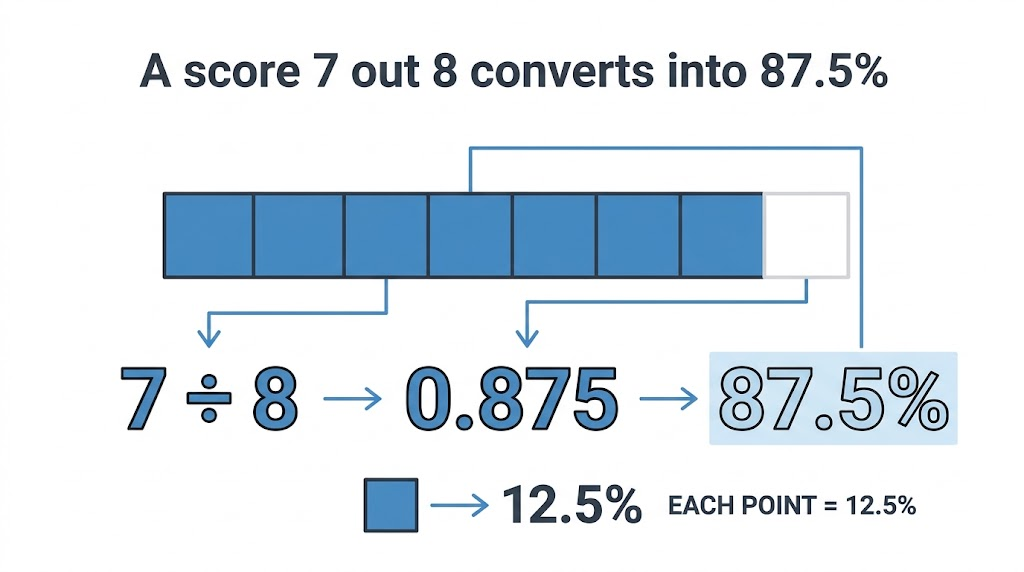
Start with 7 ÷ 8, which equals 0.875. Multiply that by 100 and you get 87.5%. After you’ve done it a couple of times, you’ll probably be able to work it out in your head.
There’s an even quicker way for this kind of test. On an 8-point test, each point is worth 12.5%, because 100 divided by 8 is 12.5. Seven points gives you 7 × 12.5, which is 87.5. Missing one point costs you 12.5%.
The same idea works for any score out of eight. Here’s how the common ones break down:
| Score out of 8 | Percentage |
|---|---|
| 4/8 | 50% |
| 5/8 | 62.5% |
| 6/8 | 75% |
| 7/8 | 87.5% |
| 8/8 | 100% |
These numbers assume every question carries equal weight. If your teacher gave one question double points, the math changes, and you’d need to add up the points differently.
If your test has a different total, the steps stay the same. Say someone scored 16 out of 20. That’s 16 ÷ 20 = 0.8, or 80%. For more examples like that, see What Is 16 Out of 20?, which walks through a similar conversion.
What Letter Grade Is a 7 Out of 8?
So what is a 7/8 grade on a letter scale? Usually a B+. The honest answer is that it depends on the scale your school uses.
On a common US-style plus/minus scale, 87.5% usually falls into the B+ range. The table below shows how many schools divide the grades, though the exact cutoffs vary:
| Letter grade | Illustrative percentage range |
|---|---|
| A | 93–100% |
| A− | 90–92% |
| B+ | 87–89% |
| B | 83–86% |
| B− | 80–82% |
Treat this table as an example, not a universal rule. Some schools start the B+ band at 88%. Others round first, so 87.5% becomes 88% and still lands in B+. A few schools draw their lines in different places, and in rare cases a score like this gets labelled A−.
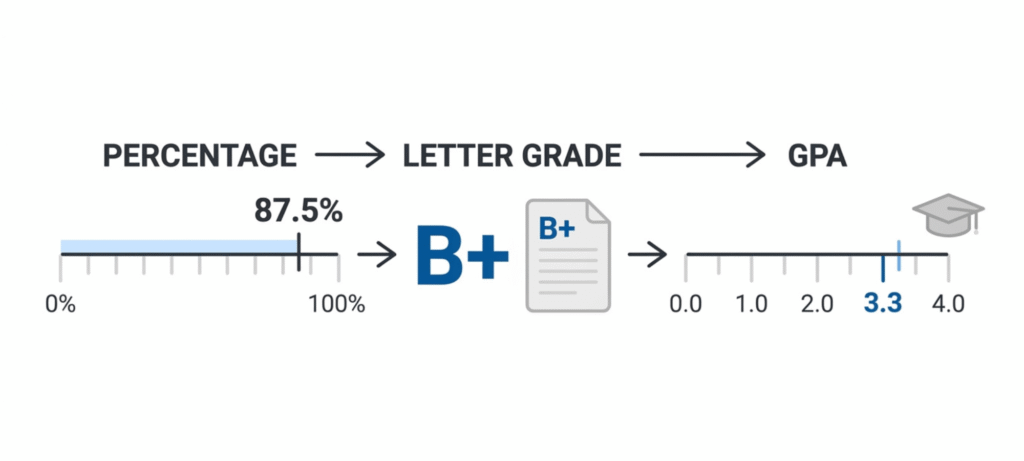
On a scale without plus or minus grades, the same 87.5% is usually just a B. The logic is the same, but the bands are wider.
That’s why you shouldn’t rely on a letter from a website alone. Your school’s grading policy, usually in the student handbook or on the course syllabus, is what counts. If you’re not sure which scale your class uses, ask your teacher. If you want to see how percentages usually get grouped, our guide on how percentage scores affect student grades explains the reasoning behind common cutoffs.
Is 7/8 a Good Grade?
Yes, 7/8 is a good score on most grading systems. You picked up most of the points. 87.5% sits well above the pass marks at most schools, and your teacher will read it the same way: you got the material, you slipped once.
But “good” is personal, isn’t it? It depends on what you were aiming for. Say your target is an A, and your school starts the A at 90%. Then 87.5% falls just short. Close, though. One more right answer on the next test could push you over the line, so look hard at the question you missed.
One wrong answer doesn’t define you. It’s usually a small, specific thing. A formula you mixed up. A word you skimmed past. A step you skipped in your working. Fix that one gap and you’ve probably fixed most of the problem.
Don’t judge it in isolation either. Look at your other results. If you keep landing around 7 out of 8, that’s steady, reliable performance. But if you normally get 8 out of 8 and this was the odd one out? Ask yourself why. Was the question genuinely tricky, or were you rushing?
What Missing One Point Really Means
When you score 7 out of 8, one point is missing. That point is worth 12.5% of the assessment.
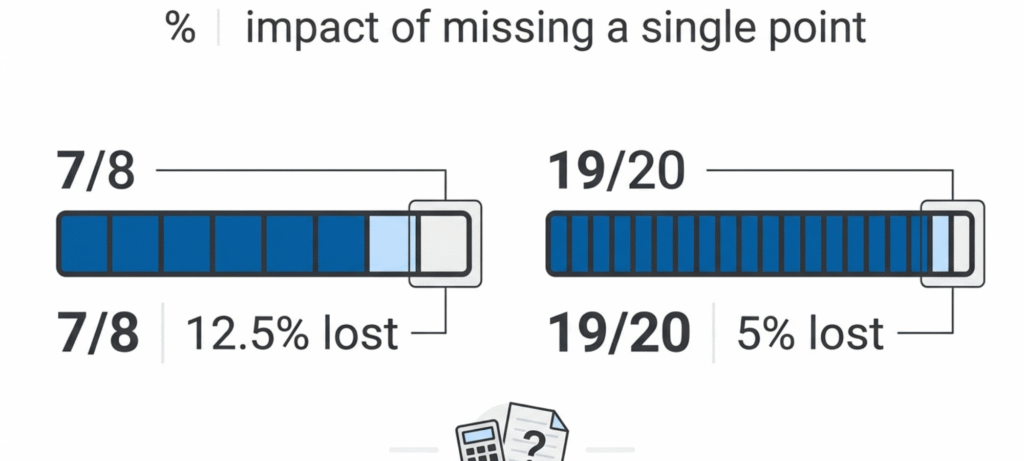
The size of that loss depends on how many points the whole test is worth. On an 8-point quiz, one missed point costs 12.5%. On a 20-point test, one missed point costs only 5%. So a single mistake looks much bigger on a short quiz than on a longer exam.
Here’s a realistic example. Say a student solves a word problem correctly but makes a small multiplication error in the final step. The method was right, but the answer was wrong, and that one slip cost a point. The fix in this case isn’t more studying of the concept. It’s checking the final calculation before moving on.
Compare that with a student who lost the point because they didn’t understand how to set up the problem. That student needs more practice with the concept, not more checking.
So when you review a 7/8 score, ask yourself a few questions. Did I understand the idea? Did I read the question carefully? Did I make a careless slip? Each answer points to a different fix. Sorting them out is more useful than just feeling bad about the lost point.
Tips to Get Full Marks Next Time
Seven out of eight is a good result, but if you want all eight points next time, a few habits make a real difference.
Start by reviewing your mistake properly. Don’t just look at the right answer and move on. Work out why you lost the point. Was it a concept you didn’t fully understand, a word you skimmed, or a careless arithmetic slip? Your answer tells you what to practise.
Check your work before you hand it in. A quick second pass over the final step catches most small slips. It’s often the easiest point to win back.
Practise similar questions, especially the type you got wrong. Then leave it for a few days and try that same question again, no peeking at the solution. Get it right twice? Then you’ve most likely closed the gap.
Watch your time during the test. Burn too many minutes on one question and you’ll lose two or three easier ones later. Stuck? Mark it, move on, and come back if there’s time left.
Read each question twice. Seriously. A lot of lost points come from answering a slightly different question than the one asked. One missed “not,” a wrong unit, or half of a two-part question left blank, and the point is gone even though you understood everything.
Ask your teacher about the question you missed. Most of them are glad to walk you through where your reasoning went off track, and that quick chat usually beats any general tip you’ll read online.
Curious how one extra point would shift your overall course grade? Try our final grade calculator. A small improvement can add up faster than you’d think across a whole term.
What GPA Is a 7/8 Grade?
GPA is where most of the confusion starts. Why? Because there’s no single formula that turns a percentage into a GPA. Every school makes its own call on how letter grades or percentages map to grade points.
Take a typical US school on a 4.0 scale. A B+ is worth 3.3, a B is usually 3.0, and an A− comes in at 3.7. Some schools tweak those numbers, like giving a B+ a 3.5. Others run weighted scales for honors or advanced classes, and that can push the number past 4.0. A few skip letter grades altogether and work out GPA straight from percentages.
So is 3.3 a fair ballpark for a 7/8 grade? Yes. But it isn’t your official GPA. For the exact figure, open your school’s grading policy or look up the GPA scale in your student portal. And if you’re combining several course grades into one overall GPA, it gets messy fast. Go slowly. Check each step against your school’s rules.
Applying to college? Admissions offices often recalculate GPA their own way. What they care about is the grades printed on your transcript, so those are the numbers that count. Want some background on how US schools usually handle grades and GPA? The National Center for Education Statistics is a good place to start.
Where You Might See a 7/8 Score
A 7 out of 8 score shows up in more places than most people expect. Common examples include:
- Classroom quizzes, which teachers use to check recent lessons
- Weekly tests in subjects like math, science, or languages
- Homework or problem sets that are graded question by question
- Online learning platforms, which often score multiple-choice quizzes automatically
- Practice exams used to prepare for finals or entrance tests
- Introductory college courses that use frequent short assessments
Wherever the score comes from, the math stays the same. Whether it’s a paper quiz or an online test, 7 out of 8 is still 87.5%. What changes is how much the assessment counts toward your final grade, and that’s up to your teacher.
Does 7/8 Mean a GCSE Grade or a School Grade Level?
The phrase “7/8 grade” can mean a few different things, so it’s worth separating them.
Most people searching this term want a test score. That’s what this article covers. Seven points on an eight-point assessment equals 87.5%.
Some readers, especially in the UK, are thinking of GCSE grades. GCSEs use a 9 to 1 system in England. Grade 7 and grade 8 are both high grades within that system. The regulator, Ofqual, oversees how these qualifications are awarded. GCSE grades are based on the whole subject and the full exam, not on a single test. If you’re looking at a GCSE result, the official grade boundaries for your exam board give you the accurate answer.
Others mean 7th grade or 8th grade, which are school year levels. In the United States, these are usually middle school years for students roughly 12 to 14 years old. They describe which year a student is in, not how well they did on anything.
So if your question is about a test or homework score, the answer is 87.5%. If it’s about a GCSE result or a school year, you’ll need the rules for that particular system.
Frequently Asked Questions
What is a 7/8 grade percentage?
It’s 87.5%. Divide 7 by 8 and multiply by 100.
Is a 7/8 grade a passing grade?
In most schools, yes. It’s well above the usual pass marks. Each school, course, and country sets its own pass line, though, so check your institution’s policy if you need the exact cutoff.
What letter grade is a 7/8 grade?
Usually a B+ on a plus/minus scale, or a B on a scale without plus or minus. Your school’s scale has the final say.
What GPA is a 7/8 grade?
There isn’t one universal GPA for a 7/8 grade. Many 4.0 scales map a B+ to about 3.3, but your school’s conversion table is the right reference.
How do I calculate a 7 out of 8 grade as a percentage?
Divide 7 by 8 and multiply by 100, which gives 87.5%. Or multiply 7 by 12.5, since each point is worth 12.5% on an 8-point test.
Is a 7/8 grade a good score?
On most grading systems, yes. Whether it’s good for you depends on your target grade and your school’s scale.
Conclusion
So, what is a 7/8 grade in the end? It’s 87.5%, and on many common scales that means a B+. The exact letter and GPA depend on your school’s policy, so check the grading guide before you draw firm conclusions. Use the percentage as your starting point, look at the one question you missed, and confirm your school’s scale if you need a precise answer.