

Think about it: most professional societies and trade associations pour a ton of time and money into building member benefits, setting up certification programs, and fighting for their industry on Capitol Hill. Yet, it’s wild how many of these same groups leave search engine optimization (SEO) completely off their radar or treat it like some minor technical chore.
Here’s the cold truth: you can build the most incredible resource hub or the most massive professional network on the planet, but it won’t matter a bit if the people who actually need your help can’t find it. Now that search engines are weaving in generative AI and changing the whole way information gets sorted online, understanding why associations can not ignore seo has become absolutely critical for keeping your membership growing and keeping your organization relevant for the long haul.
Why Associations Can Not Ignore SEO
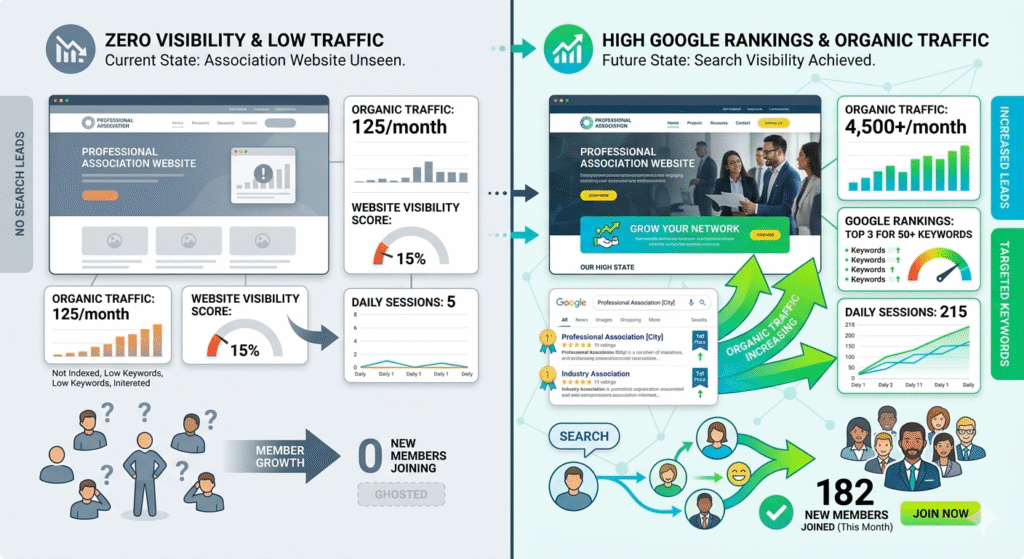
Quick Answer: Associations cannot ignore SEO because modern search engines and generative AI platforms are the primary channels professionals use to find industry certifications, regulatory updates, and training. Optimizing your digital presence secures steady membership growth, establishes topical authority, reduces dependency on paid ads, and prevents commercial competitors from capturing your audience.
For decades, membership organizations could just coast on old-school word-of-mouth networks, direct mail flyers, and their big annual conferences to bring in fresh faces. But times have changed completely. Today’s professionals look for quick answers to their everyday work headaches online long before they even know your specific organization exists. If your website isn’t set up to show up right when they start asking those initial questions, your association stays invisible to the very people you want to reach.
How Professionals and Potential Members Find Associations Today

The simple truth is that almost nobody joins a trade association or a professional society by typing your exact homepage URL into their browser. Instead, their journey starts with a basic, unbranded search for an answer to a problem.
The Problem-First Search Path
When a professional hits a rough patch at work, runs into a new legal hurdle, or wants to move up the career ladder, they search for the exact issue they are dealing with. Let’s say you run a trade association for construction safety. You probably publish excellent, in-depth OSHA updates, compliance checklists, and training manuals. When a safety manager jumps online to look up “new OSHA fall protection standards 2026,” they aren’t looking for your association’s brand name—they just want that compliance data so they can do their job. If your website ranks at the top for these specific industry searches, you instantly build trust. You get to introduce your brand to thousands of professionals before you even mention a membership pitch.
The Rise of Multi-Modal and Conversational Queries
The numbers don’t lie: data shows that roughly 68% of all online experiences start with a search engine, and the way people type into those search bars is getting incredibly conversational. Instead of typing short, robotic keywords, people are throwing full paragraphs at AI assistants or using voice search on their phones to ask highly specific questions. They are asking things like, “What are the continuing education requirements for structural engineers in Ohio after the recent board update?” If you want a slice of that traffic, your content can’t just be a wall of text—it needs to be structured perfectly to clear up these complex, multi-layered questions.
How SEO Supports Core Association Goals
A lot of folks look at search engine optimization as just a marketing trick to get random clicks on a website. In reality, it directly feeds into the core business model that keeps a modern membership organization alive.
1. Membership Growth
Think of organic search as a steady, automated pipeline for fresh sign-ups. By creating helpful, targeted content funnels, you show up right in front of non-members at the exact moment they are looking for your specific area of expertise.
2. Event Registration
Getting people to show up for your annual conference or regional workshops is a constant hustle. By optimizing your event landing pages, you make sure they pop up whenever professionals search for industry networking events, specific keynote topics, or continuing education credits happening near them.
3. Certification Programs
Certifications are often a massive chunk of an association’s revenue. If your organization offers the absolute gold standard credential in your field, your website needs to own the number one spot for searches like “how to become a certified clinical research coordinator” or “best supply chain certifications.”
4. Sponsorship Revenue
Corporate sponsors are always looking for eyeballs, specifically from a highly targeted audience. When you can log into tools like Google Analytics and Google Search Console and literally prove to sponsors that your pages sit at the very top of Google for high-value industry terms, you can charge a premium for digital ad spots, sponsored webinars, and event partnerships.
5. Industry Influence
Associations are meant to lead and shape the future of their industries. When your policy briefs, whitepapers, and position statements rank number one for trending debates, journalists, lawmakers, and corporate executives will naturally look to your organization as the definitive voice.
6. Advocacy Campaigns
When an important bill is up for a vote or a huge regulatory shift is on the horizon, you need public support and member mobilization fast. Good SEO lets you catch the wave of traffic surrounding these trending political and regulatory issues, pointing people straight to your action pages, petitions, or grassroots toolkits.
SEO Builds Industry Authority and Trust (E-E-A-T)
Search engine optimization isn’t about stuffing keywords into a page anymore. It’s about proving to both picky search algorithms and real human readers that your organization has real-deal Experience, Expertise, Authoritativeness, and Trustworthiness (E-E-A-T).
Google genuinely loves content written by real, verified experts, which gives associations a massive leg up on the competition. Your building is packed with subject matter experts, you run original research, and you literally write the industry standards. But if your website’s technical setup is a mess, or if you aren’t using proper Structured Data (schema markup), search engine crawlers can’t read your pages properly. That means your valuable insights get left out of Google’s global Knowledge Graph.
Why SEO Is No Longer Just About Google: The Shift to AEO and GEO
Getting found online isn’t a single-track game anymore. Today, you have to optimize your content so it plays nice with both classic search bars and new artificial intelligence models.
Answer Engine Optimization (AEO)
AEO is all about tailoring your content for “zero-click” searches. This is when a user gets a direct answer right at the top of the screen in a Featured Snippet or an FAQ dropdown without ever clicking a link to visit a website.
AEO Strategy: Break up your text with clear, straightforward headers followed by a direct answer. Putting a tight, 40–60 word wrap-up right after an H2 heading makes it incredibly easy for search algorithms to grab your text and drop it into a snippet block.
Generative Engine Optimization (GEO)
GEO is the process of styling your content so it gets included, summarized, and cited by AI engines like ChatGPT, Google Gemini, and Perplexity. These bots build their answers by combing through authoritative sites on the web. If your website uses a clear system of Topic Clusters and defines your Entity SEO relationships properly, these AI models will explicitly drop links to your association as their trusted source.
Common SEO Mistakes Associations Make
We see tons of membership organizations struggle to get traction online, and usually, it’s because of old habits that are baked right into the traditional association playbook.
Over-Focusing on Internal Jargon
Associations love to organize their websites around internal committee names, departmental charts, and stuffy academic phrases that regular people never actually type into a search bar. If your menu links and titles say something like “Committee on Division 4 Technical Frameworks” instead of “Commercial HVAC Installation Best Practices,” your target audience will never, ever find you.
Paywalling 100% of Valuable Resources
It makes total sense that you want to guard your premium member perks. But locking every single article, industry report, and guide behind a strict login screen creates a total digital blind spot. Search bots can’t create usernames and passwords to crawl your site. If everything is hidden, your organic traffic footprint drops to zero. A much smarter move is a “freemium” model: leave your introductory guides, basic definitions, and high-level summaries open to the public. This creates an open marketing funnel that naturally points interested users right to your Membership Management Software sign-up pages.
Practical Search Strategies Associations Should Implement
To turn your website into a reliable engine for new member acquisition, your marketing team should focus on a few highly effective structural tweaks.
Create Comprehensive Topic Clusters
Stop just tossing random blog posts into the wind. Instead, build interconnected resource hubs. Create a comprehensive pillar page about a massive industry topic (like Professional Development in Healthcare Administration) and link it down to narrower, deeply supportive sub-articles (such as SEO for Associations, Association Content Marketing Strategy, and How SEO Helps Associations Attract Members). This internal linking network signals to search engines that you possess deep, unmatched topical authority.
                  [ Pillar Page ]
         (Core Industry Resource Hub)
             /          |          \
            /           |           \
           ▼            ▼            ▼
     [Sub-Article] [Sub-Article] [Sub-Article]
     (Cluster 1)   (Cluster 2)   (Cluster 3)
Implement Proper Structured Data
Think of schema markup as code that acts as a translator for search engines. By applying specific structured data to your job boards, upcoming event pages, and certification directories, you help Google show your content with eye-catching visual elements in rich snippets, which instantly boosts your click-through rates.
Keep Past Event Pages Alive
Don’t just delete an annual conference page the day after the closing remarks. Instead, pivot that exact URL into an evergreen archive landing page filled with key takeaways, photo reels, and a waiting list signup for next year. This keeps all the valuable page authority the URL earned during months of pre-event marketing.
To make sure your technical settings align perfectly with current search quality rules, take a look at the official Google Search Essentials Guidelines, which lays out the core rules for keeping your content healthy and indexable. For a broader look at modern operational tactics, the ASAE Center for Association Leadership offers great blueprints on how modern nonprofits can navigate digital shifts.
Frequently Asked Questions
Will AI replace SEO for associations?
Not at all. AI engines like ChatGPT and Google AI Overviews don’t just invent original industry data out of thin air—they source it directly from trusted websites. Associations that focus heavily on SEO will become the foundational sources these AI tools cite, keeping your brand visible.
What is the difference between SEO and GEO?
Traditional SEO focuses on getting your web pages to rank higher in regular search engine layouts. Generative Engine Optimization (GEO) is all about writing and structuring your content so that AI models easily pull your data and link back to your site inside their chat answers.
How long does SEO take for associations?
While cleaning up technical bugs on your site can show quick results, building a complete content library and establishing real topical authority usually takes about three to six months to show a significant jump in organic traffic and new member sign-ups.
Can small associations benefit from SEO?
Absolutely. Smaller associations often have an easier time ranking for highly specific, niche industry terms than massive commercial media operations. Nailing these hyper-focused long-tail keywords lets smaller groups pull in a perfectly targeted, deeply relevant audience.
Conclusion
Associations can no longer treat search engine optimization as a low-priority IT task or an optional marketing checkbox. Every single day, thousands of professionals are online looking for the exact training, legislative updates, and peer networks you provide. Realizing why associations can not ignore seo is the vital first step toward claiming the top spot on search result pages and AI answer engines. It’s how you ensure your organization remains the undisputed voice of your industry for years to come.