There’s a reason people say school is like a second home. Childhood gets swallowed up there in a big way, and it’s not just lessons filling that time. Kids laugh, fight, make up, and somewhere in all of it, figure out who they’re becoming. By the time that last bell rings each day, a room full of desks stops being just a room. It’s turned into something familiar.
And nobody’s claiming this literally, to be clear. A school was never meant to stand in for your family, and no desk is replacing a dinner table anytime soon. What people are really getting at is belonging — that particular feeling of walking somewhere and having someone know your name, already knowing which hallway empties out at lunch, or having a teacher clock that you’re having a rough day before you’ve said a single word.
What follows here covers what this phrase actually means, why it still holds up, what shapes a school into feeling this way in the first place, plus a ready-made essay, a speech, and a batch of quotes you can put to use right away.
What Does It Mean When We Say School Is Like a Second Home?
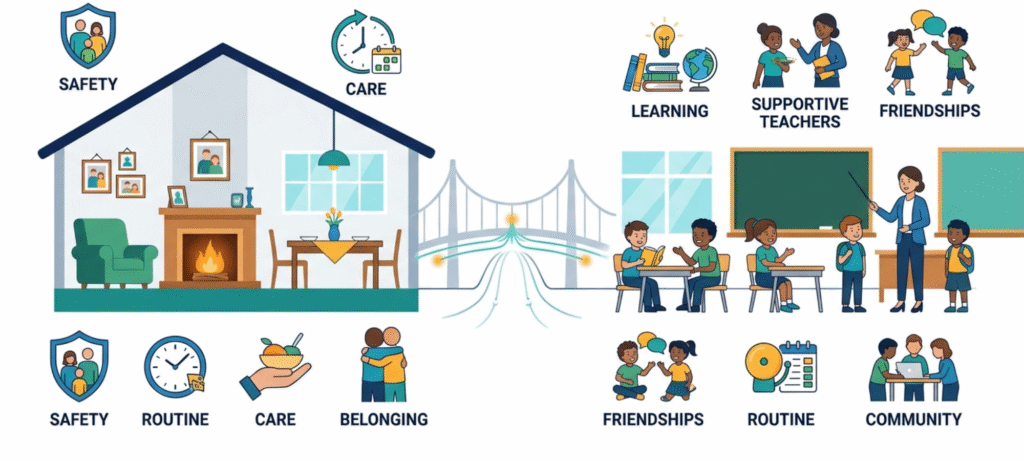
At the most basic level, it means school gives you a lot of what a good home gives you. Safety. Routine. People who genuinely care what happens to you. Space to mess up without the whole world caving in.
Look at the time involved. Most students are at school six to eight hours a day, five days a week, for over a decade of their life. Then add homework, practice, club meetings, the odd school trip, and the number only grows. That’s not a place you visit now and then. That’s a place you actually live a big part of your life in.
Familiarity does the rest. You know your seat without being told. You know the library gets cold around third period, and that the corner near the science block always smells faintly of chemicals. You know exactly which teacher lets you redo an assignment and which one flat out won’t. That’s the kind of detail people usually only know about their own house.
One thing worth saying clearly though. Calling school a second home doesn’t mean it outranks your actual family, or that kids should spend even more time there. It just means a school can add belonging, structure and support on top of what home already gives. The two aren’t competing with each other.
What Is the Difference Between Home and School?
It’s worth drawing a clear line here, so this comparison doesn’t come across like school and home are somehow the same thing.
Home is where family bonds actually live — personal care, love with no strings attached, the people who knew you long before you could even talk. That’s the territory parents and caregivers cover, and nothing about school is designed to step into that space.
School operates on different terms entirely. It centers on education and pulls you into a much bigger social world. All of a sudden you’re surrounded by dozens of kids your own age, plus adults whose job is guiding and teaching rather than raising you. Teachers matter, sure, but what they do is fundamentally not what a parent does.
Where the two overlap is in offering safety, structure, and a sense of belonging — just through different channels. Home delivers that through family. School delivers it through routine, teachers, and friendships. Calling school a “second home” was never meant as a literal claim; it’s borrowing the warmth wrapped up in the word “home” to describe something school offers alongside it, not instead of it.
Why Is School Like a Second Home?
A few different things stack up here, and honestly, they feed into each other.
Students Spend a Huge Part of the Day There
The math alone makes the case. You wake up, get there, and the next several hours belong to school. Lessons, break, lunch, more lessons, maybe practice after. Somebody else wrote your timetable, and that rhythm becomes normal faster than you’d expect.
Time builds attachment whether anyone plans it or not. The building that holds your daily routine ends up holding your memories too.
Teachers Become Trusted Adults
A good teacher does way more than just teach the syllabus. They notice when a usually chatty kid goes quiet. They tell a struggling student that one bad test isn’t a verdict on their intelligence. They hand out advice that has nothing to do with the subject they teach.
This is really the heart of the whole idea. When students have a teacher they trust, they tend to feel more comfortable asking for help, joining in during class, and bouncing back when something goes wrong. That’s basically mentorship, and it looks a lot like what a caring relative does at home.
Friendships Make the Building Familiar
Ask any adult what they remember from school. You’ll rarely get a list of topics they studied. You’ll get people. The friend who sat with you at lunch for three years straight. The group project that somehow turned into a real friendship. The classmate whose jokes made an unbearable subject bearable.
Shared experience is the glue here. Sports days, exam panic, a teacher’s catchphrase that the whole class ends up repeating for a joke, a school trip that went slightly sideways. All of that bonds people, and slowly turns a bunch of classrooms into an actual community.
A Sense of Belonging Grows Over Time
Belonging is really what separates a school kids merely tolerate from one they feel part of. It comes from being included, having some kind of role, being accepted for who you are instead of despite it.
A kid who feels like they belong will join things. Put their hand up. Try out for the play. Sit with a different group sometimes. A kid who doesn’t feel that way tends to shrink back, and the same building that feels like home to their classmates ends up feeling more like an obligation to them. This is exactly why school culture gets so much attention from educators.
Students Learn Life Skills, Not Only Subjects
Home teaches responsibility, patience, sharing, and how to handle disagreements. School does the same thing, just without ever putting it on a lesson plan.
Group work teaches you how to negotiate. Losing a match teaches you how to lose gracefully. Missing a deadline teaches you what a consequence feels like. Standing up and speaking in front of a class builds a kind of nerve that pays off for years. None of it shows up on a report card, but all of it is part of why people keep making this second home comparison.
Familiar Routines Create Comfort
This part gets skipped in most articles on the topic, which is a bit strange, because routine is a huge part of what makes any place feel like home.
Same gate every morning. Same corridor. The same teacher who kicks off every lesson the exact same way. Predictable routines can make the school day feel a lot more manageable, especially for younger kids and anyone who struggles with sudden change. When you can picture the shape of your day before it even starts, the day just feels easier to handle.
What Makes a School Feel Like a Second Home?
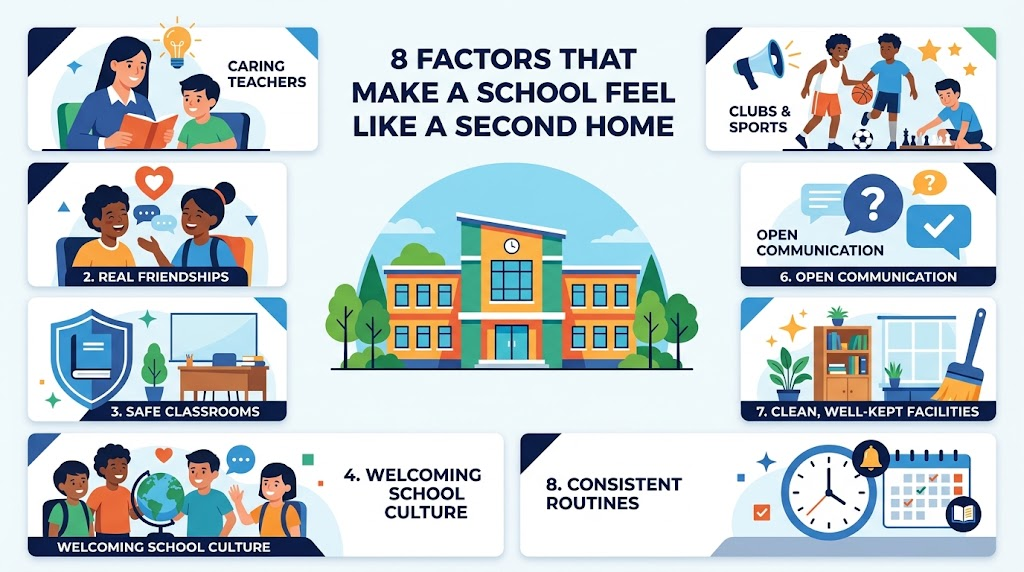
Not every school pulls this off, and it’s worth being specific about what actually separates the ones that do.
Caring teachers build trust and confidence, and they’re the reason kids feel okay admitting when they’re lost.
Real friendships create connection and give students an actual reason to look forward to Monday.
Safe classrooms, both physically and emotionally, let kids take risks in their thinking without worrying they’ll be laughed at.
A welcoming school culture builds inclusion, so new students and quieter students don’t just drift.
Clubs, sports and activities give kids a way to belong that isn’t tied to exam scores.
Open communication means a struggling child actually knows who to talk to.
Clean, well kept facilities support concentration more than most people give them credit for.
Consistent routines create the familiarity that keeps the whole thing feeling steady.
That last pair is worth slowing down on. A welcoming school environment isn’t just about friendly classrooms and nice teachers. Students also need adults they feel comfortable approaching, clear expectations they can actually follow, respectful relationships, and spaces where they get to participate rather than just sit and watch. Physical conditions matter too. Overheating, bad ventilation, constant noise and poor lighting all genuinely affect how well kids can concentrate, show up, and perform, something research on classroom environments has pointed out again and again. A warm school culture goes a long way, but it can’t fully make up for a classroom where nobody can think straight. If you’re a parent weighing your options, this checklist on choosing the right school is worth a look before you visit, since these details are easy to miss on a quick tour.
How Teachers Help Make School Feel Like Home
Teachers honestly carry more of this than most people give them credit for.
It’s the small stuff that does most of the work. Remembering that a student plays cricket on Saturdays and actually asking how the match went. Greeting kids by name at the door. Noticing when someone who always hands work in on time suddenly hasn’t.
Then there’s how failure gets handled. A teacher who treats a bad result as information rather than a character flaw teaches a kid that trying is safe. That one habit alone can shape how a child deals with difficulty for years afterward.
Celebrating progress, not just top marks, matters just as much. The student who climbed from 40 percent to 58 percent worked a lot harder than the one who coasted along at 90, and pointing that out loud is exactly the kind of thing students still remember at reunions.
And teachers set the emotional temperature of the whole room. Whether questions feel welcome. Whether a wrong answer gets laughed at or not. Whether disagreements get handled with some respect. Teachers who build that kind of atmosphere on purpose will find plenty of practical ideas in this guide to creating an interactive learning environment, where participation is something you actually design for instead of just hoping happens.
How Friends and Classmates Make School a Second Home
If you asked students to rank this stuff, friendship would probably come first.
Lunch tables, inside jokes, the shared misery of a subject nobody likes, that group chat that exists purely to complain about homework. None of that is a distraction from school. For most kids, it basically is the school experience.
Classmates also carry each other academically in ways teachers don’t always see. Someone explains a concept in the blunt, simple way a friend actually understands. Someone lends their notes after you’re out sick. Someone says exactly the right thing that stops a friend from giving up on a subject completely.
And then there are the shared memories. A sports final that came down to the wire. A performance that nearly fell apart. A trip where everything went wrong and somehow became the funniest story later. Those are the stories people mean when they say they miss school, and they’re exactly why this comparison lands emotionally, not just logically.
How School Becomes Part of Our Memories
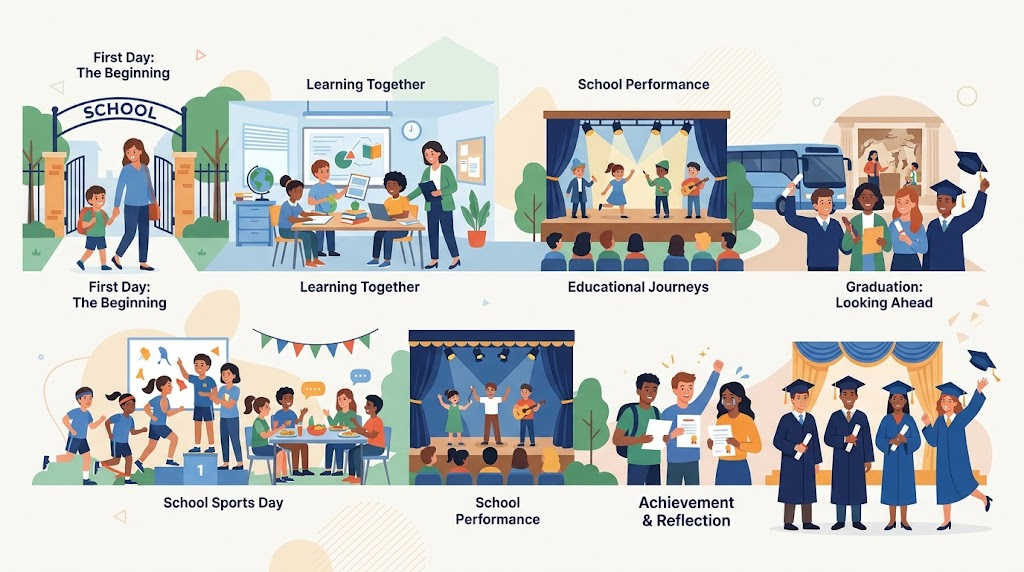
Ask anyone about their childhood and school comes up almost immediately, usually before anything else does.
The first day, standing at the gate a little terrified. That one teacher who somehow made a boring subject interesting. The classmate who became a lifelong friend without either of you noticing it happen. School trips that went sideways in ways you still laugh about. Sports days, school plays, the panic before exams, celebrations when results finally came in. Even the small, silly stuff sticks around, like a classroom joke nobody outside your year would ever get.
Graduation ends up being the moment all of it hits at once. And that’s really the whole point of calling school a second home. It’s not just where you learned things. It’s where a big chunk of your actual life happened.
Can School Really Be a Second Home for Every Student?
Here’s where being honest matters more than sounding nice.
The answer is no, not automatically.
Some kids deal with bullying, and a building full of people who make you feel unsafe isn’t a home by any definition. Some feel isolated because they don’t fit in with whoever the dominant group is. Some face discrimination. Some are studying in schools with genuinely poor facilities, where noise, heat or overcrowding wear them out before learning even starts. Some are under so much academic pressure that school becomes a source of stress rather than comfort.
So the phrase describes something that’s possible, not something guaranteed. School becomes like a second home when certain conditions are actually met, and those conditions get built on purpose by the adults running the place. Belonging is the result of good practice. It’s not just handed out by default.
Saying that plainly actually makes the compliment mean more, not less. A school that’s earned this description has genuinely done the work to earn it.
School Is Like a Second Home: 10 Lines
Quick, simple lines students can use for a short writing task or a classroom speech.
- School is a really important part of every student’s life.
- We spend many hours learning and growing there.
- Teachers guide us the way caring mentors would.
- Friends make school life so much more enjoyable.
- We learn teamwork and responsibility along the way.
- School gives us a safe place to learn and grow.
- We take part in sports and other activities together.
- We build memories with our classmates every single day.
- School helps us become more confident and independent.
- That’s really why school can feel like a second home.
School Is Like a Second Home: Short Essay
School is like a second home because it shapes a student’s day in almost every way a real home does. From morning to afternoon, students learn, play, eat, talk and grow inside the same familiar building, surrounded by the same familiar faces.
The first reason is time. Students spend more of their waking hours at school during term than almost anywhere else. That much time naturally builds attachment. A classroom that felt strange in September feels completely ordinary by November.
The second reason is people. Teachers guide students through their subjects, but they also encourage, correct and just listen. A supportive teacher can genuinely change how a student sees their own ability. Friends fill in the rest. They make dull lessons bearable, celebrate small wins, and turn ordinary days into memories worth keeping around.
The third reason is growth. School teaches responsibility, teamwork, patience and communication right alongside the actual subjects. Students learn to meet deadlines, work with people they didn’t choose, and speak in front of others. These lessons are quiet, but they stick.
Of course, school doesn’t replace a real home. It supports it. When a school is safe, welcoming and well run, it gives students a second place where they genuinely feel they belong.
And that’s really what the phrase means. Not that school is home, but that a good school can offer some of the same warmth, structure and sense of belonging that home gives, during the exact years a child needs it most.
School Is Like a Second Home: Speech
Good morning everyone.
Today I want to talk about something simple. Our school is like a second home.
Think about how much of our lives happens right here. We arrive early in the morning, and by the time we leave, most of the day is already gone. We learn here, we eat here, we play here, we grow up here. Year after year, the same corridors and classrooms end up shaping who we are.
Our teachers are a big part of that. They explain things until we actually get them. They notice when we’re struggling. They push us when we’re being lazy and encourage us when our confidence dips. Beyond the subjects, they teach us how to behave, how to try again, how to respect people.
Our friends are the other big part. We share lunch, jokes, group projects, and results we’d rather forget. We argue and then sort it out. We remember school not because of the syllabus, but because of the people we went through it with.
School also teaches us things no textbook covers. Responsibility. Teamwork. Patience. How to stand up and speak in front of a room, which is exactly what I’m doing right now.
So when I say school is my second home, what I mean is this is a place where I feel like I belong, where I’m supported, and where I’m slowly becoming the person I’m going to be.
Thank you.
School Is Like a Second Home Quotes
These are original lines, safe to use for a speech, a card, a display board, or a school magazine.
School becomes a second home the moment learning is joined by belonging.
A familiar classroom quietly turns into a childhood memory.
Teachers guide the mind while friendships make the day worth remembering.
Home teaches you who you are. School shows you who you could become.
A school earns the word home through safety, patience and small daily kindness.
The bell ends the lesson. The memories stick around long after it.
Belonging is the one subject no timetable ever lists, yet every student needs.
Some buildings just hold classrooms. The best ones hold people who actually notice you.
How to Make School Feel More Like a Second Home
For teachers. Learn names quickly and actually use them. Ask about things outside the syllabus. Make questions feel safe by never mocking a wrong answer. Recognise effort out loud. Give quieter students structured ways to contribute so participation isn’t just a popularity contest.
For schools. Keep classrooms clean, ventilated and well lit, since comfort and concentration go hand in hand. Take bullying reports seriously and act on them visibly. Fund clubs and sports so kids who aren’t top of the class still have somewhere they belong. Write policies that treat students with respect, then actually follow them.
For students. Include the person sitting alone. Help a classmate who missed a week of school. Join something, even if it’s not your obvious strength. Treat the building and staff with the same care you’d want shown to your own house.
For parents. Ask about the social side of the day, not just the academic one. Stay in touch with teachers before small problems turn into big ones. Take facilities seriously when choosing a school, since a child can’t really focus in a room that’s too hot, too loud, or too crowded.
School Is Like a Second Home: 10 Main Reasons
- Students spend a large share of their waking hours there.
- Teachers act as trusted adults who guide and support them.
- Friendships form and deepen over the years.
- Familiar routines create comfort and ease anxiety.
- Students become part of a wider school community.
- The environment supports personal growth alongside academic growth.
- Life skills like teamwork, responsibility and communication develop naturally.
- Clubs, sports and activities create shared experiences.
- Positive classrooms encourage participation and confidence.
- School creates memories that stick around for decades.
FAQs
What does it mean when people say school is like a second home?
It means school offers belonging, safety, routine and supportive relationships the same way a good home does. Students spend so much time there with teachers and classmates that the place becomes familiar and genuinely meaningful, without ever replacing family.
Why is school called a second home?
Time, people and routine, mostly. Students spend most of their day there, build long relationships with teachers and friends, and follow a predictable daily rhythm that slowly turns a building into familiar ground.
Why do students feel comfortable at school?
Familiarity does most of the work. Known faces, known routines, known expectations all reduce that background uncertainty. Add supportive teachers and real friendships, and comfort follows pretty naturally.
How do teachers make school feel like home?
By noticing individual students, encouraging the ones who are struggling, celebrating progress instead of only top marks, and keeping classrooms respectful enough that nobody’s afraid to be wrong.
How do friends make school a second home?
Through everyday shared experience. Lunch, jokes, group projects, sports, and covering for each other academically all build the kind of bond that makes a building feel like somewhere you actually want to be.
What makes a school environment welcoming?
Inclusion, emotional and physical safety, clean and healthy facilities, activities kids can actually access, and adults who communicate openly rather than shutting conversations down.
Is school really a second home for every student?
No, honestly. Bullying, isolation, discrimination, poor facilities and heavy academic pressure can all get in the way. The phrase describes what a supportive school can offer, not something that’s automatically true everywhere.
How do you write an essay about school being a second home?
Start by defining the idea, then give three or four clear reasons like time spent, teachers, friendships and personal growth. Add one or two specific examples, admit that school supports home rather than replacing it, and close by circling back to the central idea.
How do you give a speech on this topic?
Greet your audience, state the idea in one clear sentence, cover teachers, friends and personal growth with a quick example for each, and end with a note of gratitude. Keep it under three minutes and speak in your own voice, not a script that sounds borrowed.
Final Thoughts
School is like a second home when the right things are actually in place. Students who feel safe, supported and included, who trust at least one adult in the building, and who have friends worth showing up for, will describe their school that way without anyone even prompting them.
That feeling isn’t luck. It’s built by teachers who notice, by schools that keep conditions decent and take belonging seriously, and by students who choose to include people rather than leave them out. Get those three things working together, and the building stops being somewhere kids are simply sent. It becomes somewhere they actually belong, and that’s really the whole point of the phrase.