

Online examinations have changed the way schools, colleges, universities and training providers assess learners. The advantages of online examination include faster results, lower administrative workload, flexible access, easier record keeping, scalable delivery and a more paperless process. For students, digital exams can also make typing, editing and remote participation easier in some settings.
They are not automatically better for every subject or every learner, though. Internet access, device availability, accessibility, privacy, technical failures and academic integrity all still need to be worked out before a school or exam board leans on them heavily. This guide walks through where online exams genuinely help, where they fall short, and how AI is starting to change the picture in 2026.
Quick Answer
The main advantages of online examination are faster grading, reduced paper and administrative costs, flexible test delivery, easier record management, scalable assessment, quicker feedback and access to digital question banks. For students, online exams can also offer convenient access and easier editing of typed responses. How much of this actually shows up depends on reliable technology, accessible design and appropriate exam security: none of it is automatic just because a test moved online.
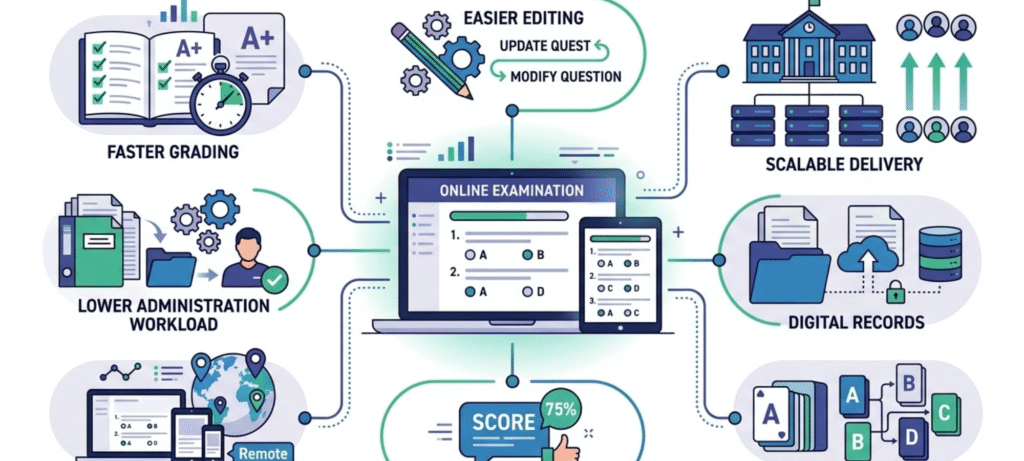
Advantages of Online Examination at a Glance
| Advantage | Who benefits | Why it matters |
|---|---|---|
| Faster grading | Students, teachers | Results can be available sooner for auto-scored questions |
| Lower administration | Institutions | Less printing and manual paperwork to manage |
| Flexible access | Students | Exams can be delivered remotely where the institution allows it |
| Easier editing | Students | Typed answers can be changed without rewriting a page |
| Scalable delivery | Institutions | A digital platform can support large cohorts |
| Digital records | Teachers, institutions | Results and responses can be stored and analysed later |
| Question randomisation | Institutions | Different test versions can support assessment integrity |
| Paper reduction | Institutions, environment | Less printing and physical paperwork overall |
| Faster feedback | Students | Some question types return results almost immediately |
| Assessment data | Teachers | Item-level analysis becomes easier to run |
What Is an Online Examination?
An online examination is any test or assessment delivered and, usually, scored through a digital platform rather than on paper in a supervised hall. That can mean a short quiz inside a learning management system, a full-length proctored certification exam, or a timed essay submitted through a portal. The format varies a lot, which is part of why “advantages” isn’t a single, fixed list: a multiple-choice quiz behaves very differently from a practical skills assessment once you put it online.
What Are the Advantages of Online Examination?
This is the core question most people searching this topic actually want answered, so here’s where the real detail lives.
1. Faster Grading and Results
Objective question types (multiple choice, matching, fill-in-the-blank with a fixed answer) can often be scored automatically the moment a student submits. That cuts out the stack of papers a teacher would otherwise carry home. Automatic grading works best for question types the system can score reliably; essays, extended responses and practical tasks usually still need a human marker, so “instant results” isn’t true across the board.
2. Saves Time for Students and Teachers
On the student side, there’s no travel for a remote exam, no standing around waiting for papers to be handed out, and submission is instant. On the teacher side, there’s less manual distribution and an easier path from marking to compiling a class result. This doesn’t mean every exam takes less time online. A long-answer paper still needs the same careful reading either way.
3. Reduces Paper and Printing Costs
Question papers, answer sheets, printing runs and physical storage all shrink when an exam moves online. But it’s worth being honest that online delivery isn’t free: platform fees, IT support, devices, internet access and invigilation software all cost something. The fair comparison is total cost, not just the printing line item.
4. Flexible Exam Delivery
This is one of the clearest wins for students, and it’s also a keyword people search directly: advantages of online examination for students. Remote participation, flexible scheduling where an institution permits it, and less travel all matter more for distance learners than for students already sitting in a classroom. The flexibility is real, but it’s set by the institution’s policy, not guaranteed by the technology itself.
5. Easier Editing and Typed Responses
Students can rearrange, delete and rewrite answers without crossing anything out or starting a page over. Typing can also ease the physical strain of prolonged handwriting for some students, which is a genuinely useful, underappreciated advantage that gets skipped in most generic lists.
6. Easier Record Keeping
Digital systems can hold onto responses, marks, timestamps, feedback and full attempt histories in a way paper never could. That matters at appeals time, for tracking a student’s progress across a term, or when an institution needs to show its working to an external body.
7. Scales to Large Numbers
A digital platform can support large cohorts without requiring the same amount of physical examination space, although server capacity, technical support and invigilation arrangements still have to scale with the number of candidates. It’s a genuine advantage for large-scale testing, though it isn’t quite the “same effort for 10 or 1,000” claim some vendor pages make.
8. Better Question Management
Question banks, randomised question order, difficulty tagging and topic categorisation are all easier to manage digitally than on paper. Randomising which questions each student sees is also one of the more practical tools institutions use to support assessment integrity, alongside secure browsers and identity checks.
9. More Useful Assessment Data
Item-level performance, time spent per question, and topic-by-topic results can help a teacher see exactly where a class is struggling, something a stack of marked papers doesn’t easily reveal. Not every platform offers this depth of analytics, so it’s a potential advantage rather than a guaranteed one.
10. Accessibility Features Can Help Some Students
Adjustable text size, screen-reader compatibility, keyboard navigation and typed rather than handwritten responses can genuinely help some students. But accessibility isn’t automatic: the platform itself has to actually support the assistive technology a student relies on, and locked-down exam software sometimes interferes with screen readers rather than helping them. This is worth checking before an exam, not after.
11. Faster Feedback Loops
For automatically scored assessments, students can sometimes see results or feedback within minutes, which is especially useful for low-stakes formative quizzes where the point is to catch gaps early rather than wait weeks for a grade.
12. More Paperless Workflows
Online exams can meaningfully cut paper, printing materials and some of the transport tied to running a traditional exam. It’s a real benefit, just not, on its own, proof that an institution has become “environmentally friendly” across the board.
Advantages of Online Examination for Students
Pulling the student-specific points together:
- Less travel required for remote exams
- Faster results on auto-graded question types
- Easier editing of typed answers
- Convenient access through a suitable digital device where remote testing is allowed
- Clear, reusable digital instructions
- Accessibility features where the platform genuinely supports them
- Quicker feedback on formative assessments
- Comfortable format for digitally confident learners
- Less physical paper to carry or lose
For students, the biggest advantages are usually convenience, faster results, easier answer editing and access to digital tools. But those benefits lean on reliable internet, a suitable device and an exam platform that’s actually built to be accessible: take any of those away and the advantage disappears fast. Exam stress doesn’t vanish just because the test is digital either; if anything, unfamiliar software can add a layer of its own, which is worth planning around with proper preparation before exam day.
Advantages of Online Examination System
At the system level (the software an institution runs, rather than the exam experience itself), the benefits look a little different:
- Centralised candidate administration
- Question bank management and randomisation
- Automated scoring for supported question types
- Reporting and analytics dashboards
- Flexible scheduling across cohorts
- Built-in security controls (secure browser, identity checks)
- Scalable delivery to large groups
- Audit trails and record keeping where supported by the system
The system itself creates benefits for administrators that students may never notice directly: an institution can get real administrative value from a good exam system even in subjects where the student-facing experience of sitting the test barely changes.
Advantages of Using Artificial Intelligence in Online Examination
AI is genuinely reshaping parts of digital assessment in 2026, though it’s worth separating what AI does well from what’s still hype.
Automated question generation can help teachers draft question variants faster, although every generated item should be reviewed for accuracy, difficulty, bias and alignment with the learning objective before it is used in an assessment.
Adaptive assessment. Some adaptive assessment systems can adjust question difficulty based on how a student is answering in real time, which is useful for diagnostic and placement testing.
Automated scoring support works reasonably well for structured or short-answer tasks, but shouldn’t be treated as reliable across every question type. That’s a good sanity check for anyone evaluating AI grading tools for teachers before rolling them out.
Proctoring signals, AI flagging unusual behaviour for a human to review, can support integrity, but the flag should always trigger a review, not an automatic penalty.
Question analysis tools can spot patterns in how students respond to specific items, which feeds back into better question design over time.
Challenges of Using AI in Online Examinations
The honest counterpart to the list above:
- False positives in AI-driven proctoring
- Student privacy concerns around monitoring and data retention
- Bias in how flagging systems treat different students
- Accessibility conflicts with locked-down or monitored software
- Limited transparency in how some scoring or detection tools reach a decision
- The risk of over-relying on automated flags instead of human judgement
AI can support academic-integrity controls, but it doesn’t stop cheating on its own, and treating it as a silver bullet tends to create new problems (privacy complaints, false accusations) faster than it solves old ones.
Disadvantages of Online Examination
A fair picture needs the other side too:
- Internet and device dependency: a connection or device failure can disrupt an online exam.
- Technical glitches mid-test, which can be disruptive and stressful.
- Digital literacy differences between students.
- Accessibility problems when a platform isn’t properly tested with assistive tech.
- Privacy concerns with webcam or browser-monitoring proctoring.
- Academic-integrity challenges that don’t fully disappear online.
- Not every assessment suits online delivery, particularly practical and vocational tasks.
- Setup and IT support costs, which offset some of the paper savings.
- Added stress from uncertainty about whether the tech will actually work.
- Limitations for group, collaborative or hands-on assessments.
Online Examination vs Traditional Examination
| Factor | Online | Traditional |
|---|---|---|
| Paper use | Low | Higher |
| Grading speed | Often faster for auto-scored questions | Usually manual |
| Travel | Often unnecessary for remote exams | Usually required |
| Technology dependency | High | Lower |
| Accessibility | Can offer useful features when designed well | Depends on physical arrangements |
| Scaling | Can support large cohorts digitally | Limited by physical capacity |
| Academic-integrity controls | Digital tools can be used | Physical invigilation |
| Privacy | Proctoring can introduce additional data and privacy concerns | Different privacy considerations |
| Practical exams | Less suitable for some hands-on tasks | Often more suitable |
| Feedback | Can be faster for auto-scored work | Often slower |
Neither format wins outright. The right choice depends on the subject, the cohort, and what’s actually available in terms of devices and connectivity.
When Does Online Examination Work Best?
Good fit: multiple-choice exams, quizzes, formative assessments, large-scale knowledge checks, remote or distance-learning cohorts, certifications with objective scoring, anything needing fast automated results.
Less straightforward: physical demonstrations, laboratory practicals, hands-on vocational assessment, and group performance evaluation, where an online format struggles to capture what actually matters.
How to Make an Online Examination Effective
A short practical checklist for institutions setting one up:
- Test the platform thoroughly before exam day.
- Give students clear, simple instructions in advance.
- Offer a practice test so the format isn’t a surprise.
- Check accessibility with real assistive technology, not just a checklist.
- Have a technical-support plan ready for exam day itself.
- Build a reliable, well-tagged question bank.
- Randomise questions where it genuinely adds value.
- Protect student data and be clear about what’s collected.
- Have a backup procedure for outages.
- Review any AI-flagged behaviour with a human before acting on it.
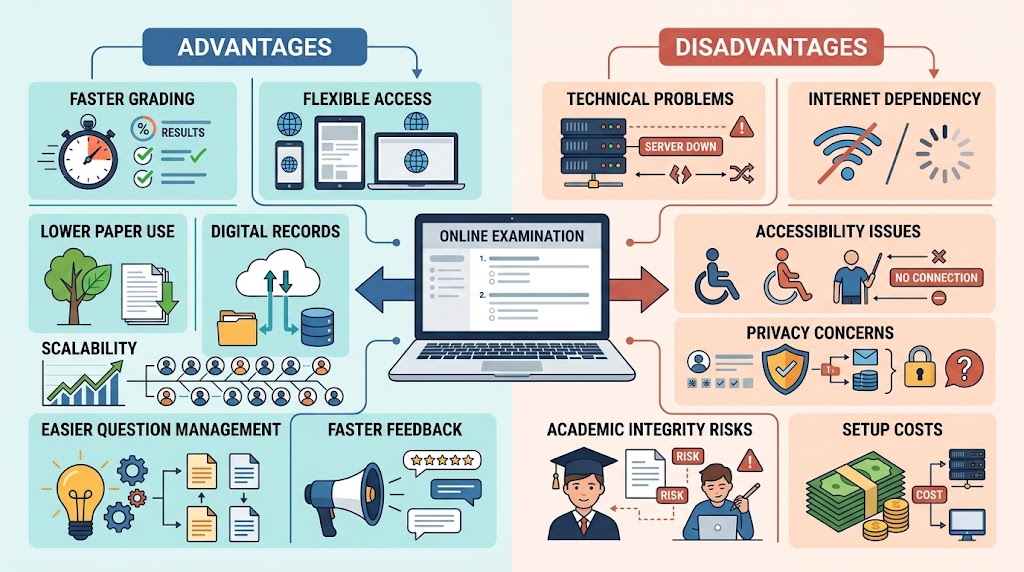
Online Exam Merits and Demerits
| Advantages | Disadvantages |
|---|---|
| Faster grading | Technical problems |
| Flexible access | Internet/device dependency |
| Lower paper use | Inconsistent accessibility |
| Digital records | Privacy concerns |
| Scalable | Setup and support costs |
| Easier question management | Not suitable for every assessment |
| Faster feedback | Academic-integrity challenges remain |
FAQs
What are the advantages of online examination?
Faster grading for objective questions, lower paper and admin costs, flexible delivery, easier record keeping, scalable assessment and quicker feedback are the main ones, with the size of the benefit depending on how well the platform is set up.
What are the advantages and disadvantages of online examination?
The main advantages are faster grading, flexible delivery, easier record keeping, lower paper use and scalable assessment. The main disadvantages include internet and device dependency, technical problems, accessibility issues, privacy concerns and challenges with academic integrity.
What are the advantages of online examination for students?
Mainly convenience, faster results, easier editing of typed answers, and access to accessibility features where the platform supports them, all of which depend on having a reliable device and connection.
What are the advantages of an online examination system?
Centralised administration, question bank management, automated scoring, reporting and analytics, and easier scaling to large cohorts.
What are the advantages of online examination in education?
Online examination can give educational institutions faster assessment workflows, easier record keeping, scalable delivery, digital question banks and quicker feedback for automatically scored assessments. For students, it can provide convenient access, easier editing and faster results where the technology and assessment design support those features.
What are the disadvantages of online examination?
Internet and device dependency, technical glitches, inconsistent accessibility, privacy concerns around proctoring, and unsuitability for hands-on or practical assessments.
Is online examination better than paper-based examination?
Neither is universally better. It depends on the subject, the assessment format, and whether students have reliable access to the technology involved.
How does online examination save time?
Mostly through automated grading of objective questions and eliminating travel for remote exams, though essays and practical tasks don’t see the same speed-up.
What are the advantages of AI in online examinations?
AI can support adaptive question difficulty, flag unusual behaviour for human review, and help analyse question performance, but it needs oversight rather than being left to make final decisions.
Are online exams secure?
Tools like question randomisation, secure browsers and identity checks can reduce some forms of misconduct, but no combination of tools eliminates cheating or security risk entirely.
Final Thoughts
The advantages of online examination are real, but they’re conditional: on reliable technology, accessible design, and an institution that’s actually tested its setup rather than assumed it works. Used well, online exams can save time, cut paper, and give teachers better data to work with. Used carelessly, they just move the old problems onto a new platform, which is roughly the conclusion Jisc’s ongoing digital assessment and accessibility work and UNESCO’s research on technology-based assessment both point toward: the technology helps most when accessibility, privacy and academic integrity are treated as part of the design, not an afterthought.