
What Is Secular Homeschool? A secular homeschool covers science, history, math, literature all the core subjects minus any religious framework dictating the lessons. This isn’t about turning your back on faith. It’s simply a choice to keep academics on one lane and belief on another, so kids come away with mainstream, evidence-based learning rather than lessons filtered through a single religious worldview.
Sounds straightforward, right? It gets messier once you actually start comparing curriculum. Some publishers slap “secular” on the cover but quietly soften topics like evolution. Others call themselves “neutral” when really they’re just dodging anything controversial. What’s printed on the label and what’s actually inside the book don’t always line up — and that mismatch is exactly where most parents get stuck.
This guide walks through what secular homeschooling really means, how it’s different from faith-based and neutral programs, how to check if a curriculum actually lives up to its label, roughly what it costs, and how to put together a plan that holds up from kindergarten all the way through high school.
At a Glance
- A secular homeschool teaches academic subjects using evidence based, religion neutral content. It does not ban religion from the house, only from the math book.
- Secular and neutral are not the same thing, and mixing them up is one of the biggest sources of confusion for new homeschoolers.
- Both religious and non religious families use secular curriculum, for different reasons.
- Free secular resources exist, but free does not automatically mean secular. Every resource needs the same check, paid or not.
- Fit depends less on a brand’s reputation and more on your child’s age, learning style, and how much structure you want to carry yourself.
What Is a Secular Homeschool?
A secular homeschool is home education where academic subjects are taught without religious doctrine shaping the content. In general, secular curriculum aims to teach subjects without promoting a particular religious doctrine, while using mainstream academic frameworks appropriate to each subject. Science lessons generally follow current scientific consensus, including evolution, geological time, plate tectonics, and modern cosmology. History draws on documented sources and multiple perspectives rather than a single religious lens. Literature gets read and discussed for craft and meaning, not as a vehicle for one tradition’s moral instruction.
Being secular does not mean religion is off limits everywhere. A secular curriculum can still teach about religion when it is academically relevant, such as in history, literature, culture, or comparative religion. The distinction is between studying religion as a subject and teaching one faith as religious truth.
None of this makes a household anti religious. Plenty of secular homeschoolers pray before dinner, attend services every week, and teach scripture at home. They simply treat that as its own subject, on its own time, separate from biology class. The word “secular” describes the curriculum’s approach to knowledge, not the family’s beliefs.
Families land on secular homeschooling from a few different directions:
- Non religious or atheist parents who want academics without any faith content
- Interfaith households where one religious curriculum would not represent either parent’s background
- Religious families who want mainstream science and history taught at school hours, and who handle faith formation themselves, on their own terms
- Parents who generally prioritize inclusive, multi perspective material over a single cultural or religious narrative
Once you understand the “why,” the next practical question is usually about the curriculum itself, since “secular homeschool” and “secular homeschool curriculum” are related but distinct.
What Is Secular Homeschool Curriculum?
Secular homeschool curriculum is the actual set of books, lessons, and materials used to teach academic subjects without religious framing. It is the how, where “secular homeschool” is the what.
A curriculum earns the label based on a few predictable pressure points:
- Science. Does it teach evolution, natural selection, geological time, and modern cosmology as settled science, or does it hedge, skip, or reframe them?
- History. Are events sourced from documented, multi perspective material, or is one religious or cultural viewpoint doing the narrating?
- Literature. Is a book chosen for its literary merit and ideas, or as a vehicle for a moral lesson tied to one belief system?
- Math. Usually the easiest subject to vet, since worldview rarely shows up in long division. Math curriculum is judged mostly on teaching method, not ideology.
The label alone will not tell you which of these a program delivers, which is why “secular” and “neutral” get confused so often.
Secular vs. Neutral vs. Faith Based Homeschool Curriculum
This is where most of the real confusion lives, so it is worth slowing down for.
Secular curriculum generally aims to teach mainstream, evidence based content directly, not simply leave religion out of it. Neutral curriculum also tends to skip religious doctrine, but the terminology is not standardized across publishers, and some programs described as neutral avoid a contested topic altogether rather than teaching the mainstream version of it. Faith based curriculum builds religious belief directly into academic instruction, so a science unit might present a specific creation account alongside or instead of evolutionary biology.
| Feature | Secular | Neutral | Faith Based |
|---|---|---|---|
| Religious instruction | No | Usually no | Yes |
| Science | Mainstream scientific framework | May omit disputed topics | May include faith based interpretation |
| Evolution | Taught per mainstream science | Sometimes omitted | Sometimes replaced |
| History | Multiple documented perspectives | Generally academic | May use a religious worldview |
| Religion as a subject | Studied as history and culture when relevant | Often minimized | Taught as belief |
| Main goal | Academic education without doctrine | Avoid religious content | Integrate faith with academics |
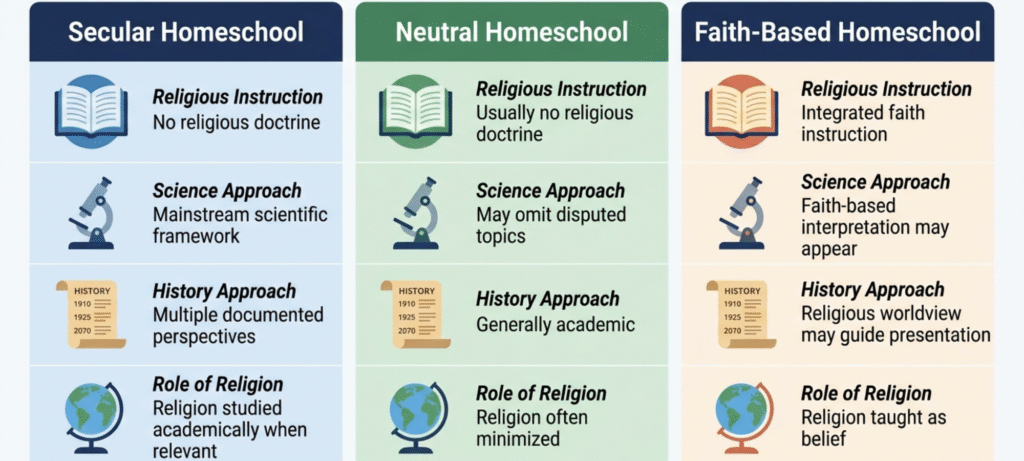
A curriculum described as neutral might leave out topics such as evolution rather than teaching them directly. Whether that makes the curriculum a good fit for a particular family depends on what the publisher means by “neutral” and what the family expects from a secular program. The label is a starting point, not proof. You still have to open the book.
How to Tell If a Curriculum Is Actually Secular
Because labels are unreliable, treat every “secular” claim as something to check rather than something to trust. A short checklist does most of the work.
Check the science scope and sequence, looking specifically for evolution, natural selection, genetics, geological time, and cosmology. If these topics are missing entirely rather than taught, that is worth noting, since omission is its own kind of framing.
Read the history approach, not just the topic list. Ask whether religions are presented as historical and cultural subjects, whether multiple perspectives show up, and whether any religious claims are treated as settled fact rather than belief.
Look past the student book and into the teacher’s guide. Religious framing often shows up in discussion prompts and teacher notes rather than the text a child reads directly.
Preview actual sample lessons, not just the publisher’s marketing page. A worldview statement on a website is a claim. A sample chapter is evidence.
Check for edition differences, since some publishers sell a faith based edition and a secular edition of the same base curriculum.
Read reviews from communities that specifically track secular content, not just general homeschool reviews, since general reviewers may not flag subtle religious framing at all.
Secular Curriculum Examples to Research
Rather than naming one program as “the best,” it helps to see the range of approaches families typically compare. Families researching literature based or nature focused options may come across programs such as Blossom and Root, while other families lean toward project based, online, or more structured approaches instead.
| Curriculum | General Approach | What to Verify |
|---|---|---|
| Blossom and Root | Nature and literature focused, gentle pacing | Current subject offerings and grade range |
| Build Your Library | Literature based | Grade and subject fit |
| Torchlight | Literature and inquiry based | Current editions |
| Oak Meadow | Structured, progressive | Current secular positioning |
| Moving Beyond the Page | Unit and project based | Age range |
| Time4Learning | Online, self paced | Current course catalog |
| TSHA | Framework based, hands on | Current curriculum offering |
These are examples to research, not a ranking. Fit depends on the child, the subject, the budget, and how much parent involvement you want. Verify current details directly on each publisher’s own site before buying, since programs update their scope and sequence over time and reviews can lag behind what is actually being sold.
If you want a structured, hands on option built specifically around secular academics, The School House Anywhere is one program worth researching directly.
How to Choose the Best Secular Homeschool Curriculum
There is no single “best” secular curriculum. What works depends on your child’s age, learning style, how much structure you want, screen tolerance, and budget.
| If you want… | Look for… |
|---|---|
| Literature based learning | Book centered curriculum with strong discussion guides |
| Hands on learning | Project based curriculum with physical materials |
| Low screen learning | Print based programs with manipulatives |
| Independent learning | Self paced digital programs |
| Flexible pacing | Open and go or modular curriculum |
| Teaching multiple children together | Family style, mixed age resources |
| A tight budget | Individual subject resources instead of a full bundle |
Some families lean literature based, building their year around rich books and discussion. Others do better with project based units their kids can build or investigate. Nature focused, gentle paced programs tend to suit younger elementary learners, while structured, standards aligned options give parents who want guidance, without a rigid script, more confidence. Online, self paced platforms work well for independent learners who like automated tracking, and gamified options can help pull in a reluctant student who needs extra motivation.
Free Secular Homeschool Curriculum: What You Can Use
Free secular resources exist, but treat “free” as a separate question from “secular.” A resource being free does not tell you anything about whether it is actually free of religious framing. Run every free resource through the same checklist you would use for anything you paid for.
Free options tend to fall into a few categories:
- Free complete curricula, such as full programs designed to be used without cost from the start.
- Free core materials with paid extras, where the base lessons are free but workbooks or add ons cost money.
- Free subject resources, like Khan Academy for math, CK-12 for science textbooks, or OpenStax for high school and early college level courses.
- Library resources, including reading lists, digital archives, and educational programming, which are often secular by design.
- Free supplementary practice, such as math drills, reading practice tools, and science videos that pair well with a paid core curriculum.
Because free does not guarantee secular, keep the checklist from the section above handy and apply it every time. A free science unit that quietly skips evolution is still not secular, no matter the price tag. Availability and licensing for specific free resources change fairly often, so it is worth confirming a resource is still active and still secular before building a term around it.
How Much Does Secular Homeschooling Cost?
Cost varies widely and is not determined by whether a curriculum is secular. Secular materials exist across free, low cost, and premium options, the same as faith based or neutral programs.
Typical expenses to plan for include individual subject purchases, full curriculum bundles, online subscriptions, co-op fees, field trips, lab materials for science, and extracurricular activities. Many families mix free and paid resources rather than buying one all in one package, which can keep costs down without sacrificing quality in the subjects that matter most to them.
Secular Homeschool Curriculum by Subject
Not every subject carries the same amount of worldview risk, so it helps to think about them separately rather than assuming one curriculum brand handles all of them equally well.
Science needs the closest look, since evolution, geological time, and cosmology are the topics most likely to get quietly altered or dropped. History needs almost as much scrutiny, because a single narrative voice can shape a child’s sense of “what happened” without ever mentioning religion directly. Math is largely worldview free and is best vetted on teaching method and pacing, such as mastery based versus spiral. Language arts and literature sit in the middle: grammar and phonics are usually neutral by nature, but reading lists and discussion prompts can carry a subtle slant worth checking. Geography, art, music, and foreign language rarely raise worldview concerns and can usually be chosen on quality and fit alone.
Because subjects carry different levels of risk, many secular homeschoolers mix and match. A strong, vetted science and history program alongside a math curriculum chosen purely for teaching style is common, rather than committing every subject to one bundle.
Can You Mix Different Secular Homeschool Curricula?
Yes, absolutely. There’s no rule saying a homeschool family has to stick with one publisher for everything. Plenty of parents pick one curriculum for math, a different one for science, and lean on library books or open resources for literature and history. Mixing things up like this often makes it easier to match each subject to what your child actually needs — just keep an eye on workload and teaching style across the different pieces so the whole week still flows together instead of feeling scattered.
Secular Homeschool Curriculum by Age and Grade
In the early elementary years, gentle and exploratory stuff tends to work best — think nature study, read-alouds, hands-on projects — rather than diving straight into heavy textbook work. By middle elementary, a clearer scope and sequence starts to matter more, especially for science and history, since kids at this age are sharp enough to notice gaps or things that don’t quite add up.
Middle school is usually when independent, self-paced learning becomes a real option, and this is also around when subject-specific curriculum starts making more sense than one all-in-one bundled program, simply because kids’ interests begin pulling in different directions.
High school tends to need more upfront planning. Families often have to think about transcripts, document coursework properly, and make sure subject requirements line up with whatever postsecondary path their child is aiming for. If college is part of the plan, it’s worth checking the actual requirements of the specific schools or programs in mind rather than assuming every college follows the same standards. And if a course comes through an online school or outside provider, it’s worth double-checking whether that provider is accredited or has recognized credentials — especially in cases where that could matter down the line.
What Is a Secular Homeschool Program?
“Curriculum” and “program” often get used like they mean the same thing, but they’re actually a bit different. Curriculum refers to the educational content itself — the books, lessons, and overall scope and sequence. A program, on the other hand, can include all of that plus extra layers of structure, like scheduling, teacher support, assessments, community access, or administrative help.
If you’re still weighing whether you want a bare-bones curriculum or something with more built-in support, it helps to look at how different online homeschool programs actually structure that support before you commit to one.
Put simply: curriculum is what you’re teaching, and a program is everything built around how you teach it. Some families just want the content and prefer building their own schedule and support system from scratch. Others prefer a program specifically because that extra structure — pacing help, a community of other homeschooling families — takes some of the decision fatigue off their hands.
Neither way is more “legitimate” homeschooling than the other. It really just comes down to a trade-off between having full control versus having built-in support.
What Is a Secular Homeschool Group or Co-op?
These two terms often get flattened together, but they solve slightly different problems.
A secular homeschool group is primarily social: families connecting for support, park days, field trips, and general community, without a shared curriculum or religious requirement to join.
A secular homeschool co-op goes a step further into shared instruction, where a group of families runs actual classes together, often with parents taking turns teaching subjects, splitting costs on materials, and coordinating a shared schedule.
When evaluating either one, it helps to ask directly how much parent involvement is expected, what it costs, whether classes are secular by design or just informally so, and how field trips and age groups are handled. A conversation with current members usually answers this faster than a website does.
How to Start a Secular Homeschool
Getting started is less about finding a perfect curriculum on day one and more about building a workable system you can adjust as you go.
- Check your state’s homeschool requirements first. Rules vary significantly by location. Some states require almost nothing, others require notification, testing, or portfolio review, and this changes over time, so verify current requirements with your own state’s education authority.
- Decide what actually matters to your family, such as academic rigor, flexibility, low screen time, or socialization, before comparing programs.
- Choose your core subjects first, typically reading, math, science, and history, and treat enrichment subjects like art or a second language as additions once the core is settled. Getting this part right early makes a real difference, and it’s worth reading up on how to build a strong academic foundation from home before locking in your subject list.
- Decide where you land on secular, neutral, or faith based, using the comparison above, so you are shopping with a clear filter.
- Select your actual materials, running each one through the secular checklist before buying.
- Build a realistic weekly schedule, meaning one you can sustain on a hard week, not only a good one.
- Track progress simply. Most secular homeschoolers lean on reading growth, written work, and projects rather than frequent formal testing, but check your state’s requirements here too.
What Does a Typical Secular Homeschool Day Look Like?
There is no single template, but a common rhythm looks something like a focused morning block for math and language arts while attention is freshest, followed by science or history as a shared lesson if multiple kids are being taught together, then an afternoon built around projects, reading, or outside time. Structured families might follow a set schedule down to the hour. Flexible families might just track whether today’s priorities got covered and let the order shift daily. Both are functioning homeschools. The shared thread is consistency over time, not a specific hourly layout.
Benefits of Secular Homeschooling
Clear, neutral academics stand out first. Science reflects current scientific consensus, history draws on documented, multi perspective sources, and literature gets explored for meaning rather than doctrine, giving kids a consistent academic foundation regardless of the family’s own beliefs.
It also works for a wide range of families. Non religious households, interfaith families, and religious families who want faith neutral academics can all use the same curriculum, discussing values separately on their own terms.
Many secular programs put a strong emphasis on thinking skills, leaning into questioning, evidence based reasoning, and discussion over rote memorization, which carries past any one subject.
Flexible, child centered pacing is another common benefit. Because there is no single ideological script to follow, families can slow down, speed up, or go deep on a particular interest without disrupting the whole plan.
Challenges of Secular Homeschooling
Finding curriculum that is genuinely secular is the most common friction point, since some programs claim neutrality while including subtle bias. Previewing lessons directly and leaning on communities that track secular content helps.
Decision overwhelm is real without a prescribed path. Picking a guiding framework early, whether literature based or project based, and starting small tends to cut through this faster than researching endlessly.
Socialization is a common worry, though homeschooling does not automatically prevent social interaction. Families generally need to plan for it intentionally, through co-ops, sports, clubs, libraries, community organizations, volunteer activities, or music and art programs, rather than assuming it happens on its own the way it might in a school building.
Staying consistent over a full year takes more planning than a single boxed curriculum would. Using a solid core program as a backbone, then supplementing rather than building everything from scratch, tends to be more sustainable.
Explaining the choice to relatives or former teachers can get tiring. Leading with outcomes, meaning what your kid is actually learning, usually settles more of this than a philosophical explanation of “secular” ever does.
Common Misconceptions About Secular Homeschooling
Can religious families use secular homeschool curriculum?
Yes, and it is more common than the name might suggest. Many religious and interfaith families deliberately choose secular academics so their kids learn mainstream science and multiple historical perspectives without a filter, then handle faith formation separately through church, family discussion, or dedicated religious study at home.
Is secular homeschooling the same as atheist homeschooling?
No. Secular describes the academic framework, not the family’s religious identity. A secular homeschool may be run by an atheist, agnostic, Christian, Muslim, Jewish, interfaith, or other family. The defining feature is that religious doctrine is not used as the framework for academic instruction.
What does non secular homeschool mean?
Non secular homeschool generally refers to education that builds a religious or faith based worldview directly into academic instruction, rather than teaching it as a separate subject. This umbrella covers Christian, Catholic, Jewish, Muslim, and other faith specific programs, and these are not interchangeable with one another any more than secular curricula all look alike. The specific publisher and materials still matter more than the broad category.
What does secular school mean, and how is it different from secular homeschool?
A secular school generally keeps a particular religion from governing its academic instruction, though religion may still come up as a subject of study, such as in comparative religion, history, or literature. A secular homeschool applies that same basic principle at home, parent led, without the institutional structure of a school around it. It is also worth separating this from how “secular” is used at a national level. A country’s constitutional relationship to religion is a different question from how any individual school or family teaches, and one does not determine the other.
How TSHA Fits Into a Secular Homeschool Approach
Some families want a curriculum alone, and others want a framework built around one. The School House Anywhere, known as TSHA, is one program built specifically for secular homeschooling, using the American Emergent Curriculum, referred to as AEC, as its academic foundation.
AEC provides the curriculum content, while TSHA provides structure around it, including hands on, low screen learning for children, parent support, and organization built into shorter thematic sessions rather than one long undifferentiated school year. Parents remain in charge of their child’s education throughout. TSHA does not enroll students or replace parental authority, it provides tools and structure that sit alongside it.
This kind of program tends to fit families who want a secular foundation without designing every unit from scratch, families teaching multiple ages together, and households that prefer low screen, hands on learning over a fully online model. Families who prefer to build their own year from individual resources may not need this kind of structure at all, and that is a reasonable choice too.
Frequently Asked Questions
What is a secular homeschool?
A secular homeschool is an educational approach that separates academics from religious instruction. Subjects like science, history, and literature are taught using evidence based, neutral content, without religious doctrine shaping the lessons.
What does secular homeschooling mean?
It means academic subjects are taught using mainstream, evidence based approaches rather than a particular faith’s teachings. Families can still practice religion outside of academic instruction.
Is secular homeschooling anti religious?
No. It is religion neutral, not opposed to faith. Families are free to teach religious beliefs outside of academic subjects if they choose to.
What is the difference between secular and neutral homeschool curriculum?
Secular curriculum generally teaches mainstream, evidence based content directly. Neutral curriculum also avoids religious doctrine, but the term is used inconsistently across publishers, and some neutral programs leave out contested topics rather than teaching the mainstream version.
How do I know if a curriculum is truly secular?
Preview the science and history lessons directly for framing, check the teacher’s guide and not just the student book, and read reviews from communities that specifically track secular content. A “secular” label alone is not proof.
What is a secular homeschool program?
A program can include curriculum plus extra structure, such as scheduling, teacher support, assessments, or community access. Curriculum is the content itself, a program is what is built around it.
What is a secular homeschool group?
A secular homeschool group is primarily social, connecting families for support and activities without requiring a shared curriculum or religion.
What is a secular homeschool co-op?
A secular homeschool co-op is a group of homeschooling families who organize shared classes, projects, or field trips together without requiring a religious curriculum or shared faith.
Can you use free secular homeschool curriculum?
Yes, though free resources still need the same secular content check as paid ones. Free does not automatically mean religion neutral.
Can you mix different secular homeschool curricula?
Yes. Many families use different publishers for different subjects rather than one all in one bundle, matching each subject to the child’s needs.
What does “secular homeschool mom” mean?
It is an informal phrase for a mother who educates her children at home using secular or religion neutral academic materials. It describes an educational approach rather than a particular religion, parenting philosophy, or homeschooling method.
Is secular homeschooling less structured than other approaches?
Not necessarily. It can be highly structured or very flexible. The defining feature is content neutrality, not how organized the schedule is.
Final Thoughts
What Is Secular Homeschool? It is an approach that keeps academic instruction separate from religious doctrine while allowing families to make their own decisions about faith, values, and religious education. There is no universal “best” secular curriculum, only the combination that fits your child’s age, your family’s pace, and the subjects that need the closest look.
Start with the checklist earlier in this guide, verify claims against actual sample lessons rather than marketing copy, and build outward from there.
For current, location-specific homeschool requirements, check directly with your state department of education.
For general legal and advocacy information about homeschooling rights, HSLDA, short for the Home School Legal Defense Association, is one commonly referenced resource, though it is an advocacy organization rather than a neutral government source.