

Check writing practice is the simplest way to learn how to fill out a personal check correctly before you use one for a real payment. It feels old fashioned in a world of tap to pay, but plenty of landlords, small clinics, contractors, and even some employers still expect a paper check. Getting the fields wrong on one can mean a delayed payment, a bounced deposit, or an awkward phone call explaining why the numbers don’t match.
Most people never actually sat through a lesson on this. Somebody watched a parent do it once, or they’re staring at a blank check right now trying to remember which line takes the numbers and which line takes the words. That gap is exactly why check writing practice keeps showing up in classrooms, financial literacy programs, and adult banking basics courses.
This guide covers what to learn, walks through a labeled example, gives you a full set of practice exercises with an answer key, a blank worksheet you can reuse, a check register example, safety tips, and a set of FAQ answers written for the exact questions people search.
What Is Check Writing Practice and What Should You Learn?
Check writing practice means rehearsing how to correctly complete a personal check: the date, the payee, the dollar amount written two different ways, an optional memo, and a signature. It’s less about memorizing a definition and more about building the habit so the actual writing becomes automatic when you need it.
The goal isn’t just knowing what a check looks like. It’s being able to fill one out quickly, accurately, and in a way that protects you from mistakes and from fraud.
What Are the Six Parts of a Check You Typically Fill Out?
A check has other printed elements too, things like the routing number, account number, check number, and the MICR line at the bottom, but you don’t fill those in. They’re already there.
The six fields you’re actually responsible for writing are:
- Date, top right
- Payee, the “Pay to the Order of” line
- Numeric amount, in the small dollar box
- Written amount, spelled out on the line below the payee
- Memo, bottom left, optional but useful
- Signature, bottom right
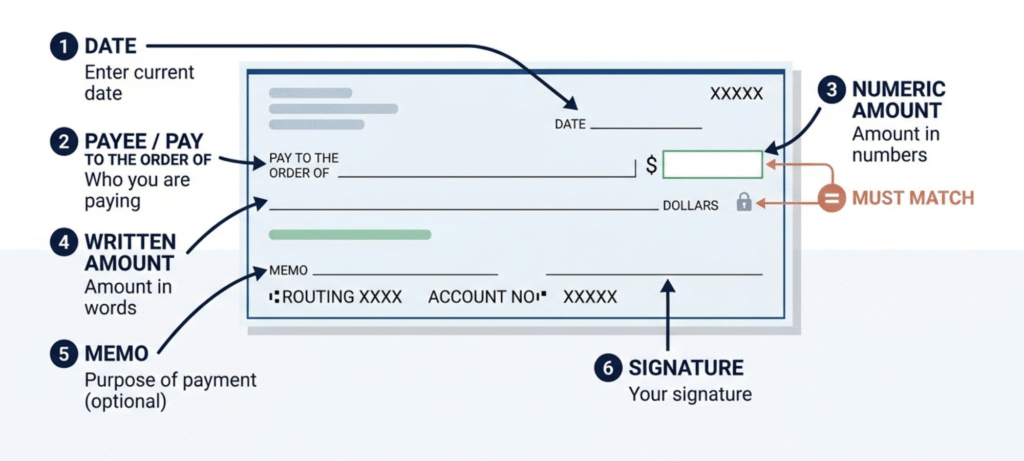
Learn these six by name before you try filling one out under pressure. Once naming them is automatic, the actual writing gets fast.
How to Write a Check Step by Step
1. Date
Write out the full month name rather than using digits. September 26, 2026 is harder to alter than 9/26/26. Either format is technically fine for your own records, but the spelled out version is the safer habit.
2. Payee
Write the payee’s full name or business name clearly and accurately. An unclear or incorrect payee name can create problems when the check is deposited or cashed, so avoid shorthand or nicknames you use in your head but nobody else recognizes.
3. Numeric Amount
This goes in the small box next to the dollar sign. Always include cents, even on a round number. Write $130.00, not $130. That trailing .00 closes the door on someone adding extra digits after your number.
4. Written Amount
This is the line most people get wrong. Spell out the dollars, then write the cents as a fraction over 100, like “and 40/100.” If there’s blank space left on the line after you finish, draw a line through it. That’s not decoration, it’s a fraud safeguard. Empty space is an open invitation for someone to add a word.
If the numeric amount and the written amount don’t match, the written amount generally controls under U.S. check law, subject to the specific circumstances and your bank’s own procedures. That’s a good reason to double check both amounts before you sign.
5. Memo
Optional, but it saves you later. “September rent” or “invoice 4471” turns a mystery withdrawal into something you can actually track down weeks later.
6. Signature
Sign using the signature your bank has on file. An unsigned check generally can’t be processed normally, so this step isn’t one to skip or rush.
Writing this cleanly and consistently is really a writing skill as much as a banking one. If you’re building out broader instruction around everyday writing precision, our breakdown of what counts as a writing convention covers some of the same underlying habits, spelling accuracy, consistent formatting, catching your own errors before they become someone else’s problem.
Check Writing Practice Example: Where Each Part Goes
Here’s a labeled example using a real scenario.
Payee: Green Valley Pharmacy
Date: September 26, 2026
Amount: $86.40
Memo: Prescription copay
Laid out the way it would appear on the check itself:
                                          September 26, 2026

Pay to the Order of:  Green Valley Pharmacy            $ 86.40

Eighty-six and 40/100 -------------------------------- dollars

Memo: Prescription copay                    Signature: _________
Notice the numeric amount and the written amount say the exact same thing. That agreement is the single most important accuracy check on the whole document.
How to Write Cents on a Check
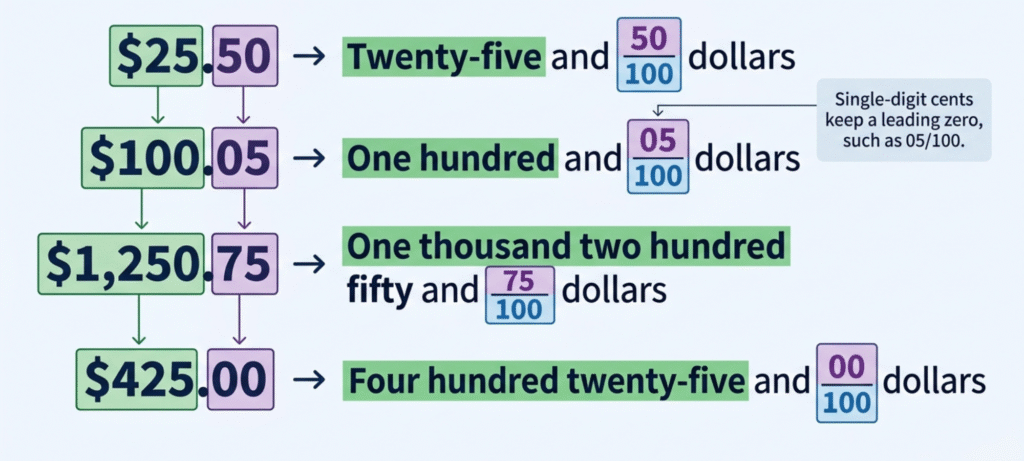
This trips up beginners more than any other field. Cents are written as a fraction over 100, directly after the spelled out dollar amount.
| Amount | Written Form |
|---|---|
| $25.50 | Twenty-five and 50/100 dollars |
| $100.05 | One hundred and 05/100 dollars |
| $1,250.75 | One thousand two hundred fifty and 75/100 dollars |
| $35.20 | Thirty-five and 20/100 dollars |
| $425.00 | Four hundred twenty-five and 00/100 dollars |
Notice that even when the cents are a single digit, like 05, the leading zero stays. “05/100” is correct. “5/100” reads as five cents, not fifty.
Check Writing Practice Exercises
Grab a blank check or a printed template and try these before checking the answer key.
Beginner
- Pay $25.00 to Green Market.
- Pay $48.50 to City Pharmacy.
- Pay $75.25 to Bright Internet Services.
Intermediate
- Pay $325.40 to ABC Auto Repair.
- Pay $1,250.00 to Lakeside Apartments.
- Pay $2,045.75 to Riverview HOA.
Challenge
- Pay $10,500.05 to Summit Contracting.
- Pay $999.99 to Northgate Supply.
- Pay $4,010.60 to Cedar Ridge Dental.
Write out the full written amount for each one, cents fraction included, before moving on.
Check Writing Practice Answer Key
- Twenty-five and 00/100 dollars
- Forty-eight and 50/100 dollars
- Seventy-five and 25/100 dollars
- Three hundred twenty-five and 40/100 dollars
- One thousand two hundred fifty and 00/100 dollars
- Two thousand forty-five and 75/100 dollars
- Ten thousand five hundred and 05/100 dollars
- Nine hundred ninety-nine and 99/100 dollars
- Four thousand ten and 60/100 dollars
If any of your cents fractions are missing the leading zero or the “/100,” that’s the single most common slip in check writing practice, and it’s an easy one to fix once you notice it.
Blank Check Writing Practice Worksheet
Use this layout to build your own reusable practice sheet.
Date: ________________________

Pay to the Order of: ___________________________   $ ____________

_________________________________________________ dollars

Memo: _____________________________   Signature: _________________
Practice scenario to try on it: Pay $245.75 to ABC Grocery on September 28, 2026. Fill in every field, then check that your numeric and written amounts match exactly.
Which Action Is a Good Check Writing Practice?
Question: Which of the following is a good check writing practice?
A. Leave unused space blank on the amount line
B. Sign a blank check in advance
C. Record the check in your check register immediately
D. Use pencil so mistakes are easy to fix
Answer: C. Recording the check the moment you write it is the habit that actually prevents overdrafts. People write a check, forget about it, and get surprised two weeks later when it clears and the balance is lower than expected.
A, B, and D should all be avoided. Blank space invites tampering. A presigned blank check is a standing invitation for fraud if it’s lost. Pencil erases, which defeats the entire purpose of a check being a permanent, alterable-only-by-fraud record. Use permanent blue or black ink instead.
Identify the Mistake: Check Writing Practice Exercises
Good for classrooms or self testing. Spot what’s wrong before reading the answer.
Scenario 1: A student writes $125.50 in the numeric box but writes “One hundred twenty-five and 05/100 dollars” on the written line.
What’s wrong: The two amounts don’t match. The written line says $125.05 while the numeric box says $125.50.
Scenario 2: A check is signed, dated, and the numeric amount is filled in, but the payee line is left blank.
What’s wrong: An unclear or missing payee can create problems when the check is deposited, and leaving it blank until later is a risk if the check is lost.
Scenario 3: The written amount line has extra blank space after “Fifty and 00/100 dollars” with no line drawn through it.
What’s wrong: Unused space should always be crossed out to prevent someone from adding extra words or numbers.
Check Register Practice
A check register is simply a running record of checks and other transactions, used to track the balance in a checking account. Without one, it’s easy to lose track of what’s actually cleared.
| Date | Check # | Payee | Amount | Balance |
|---|---|---|---|---|
| Sept. 26 | 101 | Green Valley Pharmacy | $86.40 | $913.60 |
| Sept. 28 | 102 | ABC Grocery | $245.75 | $667.85 |
Practicing this alongside the check itself turns the exercise into a full financial literacy activity instead of just a fill-in-the-blank task.
Managing a checking account well isn’t only about the paper side of it either. Understanding the benefits of online banking can help you monitor transactions in real time and catch a check clearing before your register even gets updated by hand.
Common Check Writing Mistakes
- Leaving blank space on the written amount line without crossing it out
- Mismatched numeric and written amounts
- Forgetting to sign, which the bank generally can’t process
- Using an outdated or incorrect date
- Vague or incomplete payee names
- Writing over a mistake instead of voiding and starting fresh
- Not recording the check anywhere, which leads to surprise overdrafts
A common real-world mistake is filling in only the numeric amount and leaving the written line blank entirely. It’s an easy field to forget when you’re rushing, and it’s often the one that causes a hold or a question from the bank.
How to Void a Check
If you make a mistake, don’t cross it out or write over it. Void it instead.
- Write “VOID” clearly across the front of the check, ideally in a couple of places
- Do not sign it
- Keep it for your own records, or destroy it securely if you don’t need it
- Never simply throw away a check that still shows your account information
Voiding takes ten seconds and avoids any confusion about whether a mistaken check might still be usable.
Check Writing Safety Tips
- Use permanent blue or black ink, never pencil
- Never sign a blank check in advance
- Never leave blank space on the amount line uncrossed
- Don’t leave checks unattended in a bag, car, or open desk
- Keep unused checks somewhere secure
- Protect your account and routing numbers the same way you’d protect a card number
- Monitor your account regularly rather than waiting for a statement
- Report anything suspicious to your bank promptly
- Securely destroy voided or unused checks rather than tossing them whole
General consumer banking guidance from resources like the Consumer Financial Protection Bureau covers similar habits around monitoring accounts and protecting personal financial information, and it’s worth a look if you want the broader consumer protection context.
Check vs Debit Card: What’s the Difference?
A check is a written authorization telling your bank to withdraw funds and pay a specific person or business. A debit card triggers an electronic transaction that usually clears almost immediately. Checks can take longer to clear, sometimes a few business days, which is exactly why recording them right away matters so much. Both require sufficient funds in the account, but a check gives you a short window where the payment hasn’t actually processed yet, and that window is where good record keeping earns its keep.
Check Writing Practice for Kids and Adults
For students, this is usually framed as a financial literacy exercise: identifying the six fields, spelling out numbers as words, and running through pretend scenarios with classroom money. Nobody’s handing a ten-year-old a real checkbook. This is about building the muscle memory before it matters for real.
For adults, it’s often a refresher, someone opening a first checking account, someone who’s used cards for a decade and suddenly needs to pay a deposit by check, or someone rebuilding budgeting habits as part of a broader financial plan. The mechanics don’t change with age. The stakes do.
Special education settings often use simplified templates with larger writing spaces and one field practiced at a time instead of the whole check at once, which works well for anyone who benefits from repeated, low-pressure practice before doing it for real.
Check Writing Practice for Students and Financial Literacy Classes
For a classroom setting, a full unit can include:
- Identifying each check field by name
- Matching numeric amounts to written amounts
- Completing blank checks from written scenarios
- Spotting intentional mistakes in sample checks
- Calculating a running balance after several transactions
- Completing a check register alongside the checks
- Solving real-world payment scenarios involving rent, bills, or purchases
This turns a single worksheet into a repeatable unit that covers spelling, math, and practical money management at the same time.
Free Check Writing Practice Resources
You don’t need to buy anything to practice this. A few practical options:
- A printable blank check template, like the worksheet layout above
- A check writing worksheet paired with the answer key from this guide
- A classroom activity using pretend payees and pretend balances
- Interactive digital practice where you fill in fields and check your own accuracy
- A simple check register template like the one shown earlier
Whatever format you use, the goal is repetition until the six fields become automatic.
Additional Checking Account Safety Resources
For readers who want the regulatory and consumer protection side of checking accounts, including how banks handle disputes, holds, and account security, the FDIC’s consumer resources are a useful next stop. They cover account protections at a level of detail that goes beyond what a single how-to guide can responsibly summarize.
Frequently Asked Questions
What is check writing practice?
It’s rehearsing how to correctly complete a personal check, covering the date, payee, numeric amount, written amount, memo, and signature.
How do you fill out a check for the first time?
Work through the six fields one at a time rather than trying to do the whole check at once. Start with the date and payee, then the numeric amount, then the written amount, then memo and signature last.
What do you write in the memo section of a check?
A short note about what the payment is for, like “rent” or an invoice number. It’s optional but makes tracking the payment much easier later.
How do you write cents on a check?
As a fraction over 100 after the spelled out dollar amount, such as “and 40/100 dollars,” always keeping a leading zero for single-digit cents.
What happens if the written amount and numeric amount don’t match?
The written amount generally controls under U.S. check law, but a mismatch can still cause delays or questions, so it’s better to catch it before signing.
Can you write a check in pencil?
No. Pencil can be erased and altered, which defeats the purpose of a check as a permanent record. Use permanent blue or black ink.
How do you void a check?
Write “VOID” clearly across the front, don’t sign it, and either keep it for your records or destroy it securely.
What should you do if you make a mistake on a check?
Void it and write a new one rather than crossing out or writing over the error.
What is a check register?
A running record of checks and other transactions used to track your checking account balance so you always know what’s actually available.
What is a good check writing practice?
Recording every check in your register as soon as it’s written, so your balance stays accurate and nothing bounces later.
Final Thoughts
Check writing practice comes down to six fields, one rule that the numbers and words have to match, and one habit, recording it immediately, that keeps your account accurate. Work through the exercises, the mistake-spotting scenarios, and the blank worksheet a few times, and the next time you actually need to write one for rent, a deposit, or a bill, it won’t feel like a test. It’ll just be another Tuesday.