

A student verification API lets businesses and applications check student related information programmatically instead of relying on manual document reviews. It sits between a signup form and a decision. A student types in an email or uploads a document, the API checks it against a data source, and the application gets back a result in seconds.
Not every student verification API verifies the same thing. Some only confirm that an email address belongs to a college domain. Others check live enrollment records. A few go further and validate physical or digital student ID cards. Mixing these up is the most common mistake businesses make when picking a provider, and it’s worth sorting out before building anything.
What Is a Student Verification API?
A student verification API is a software interface that lets an application verify student related information automatically, without a human checking documents by hand. Depending on the provider, it may check an academic email domain, current enrollment status, a student ID, uploaded documents, or degree and graduation records.
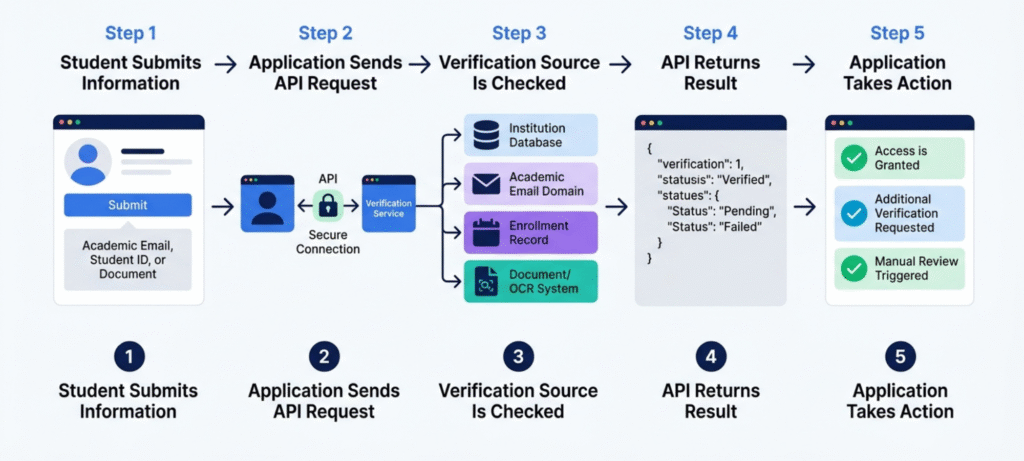
The basic flow looks like this:
- A user submits an email, ID, or document.
- The application sends that information to the API.
- The API checks it against an available data source (an institution’s email domain list, an enrollment database, a document scanning engine, and so on).
- The API returns a verification result.
- The application grants or denies access based on that result.
The important nuance: an academic email check does not prove someone is currently enrolled. It only proves the email belongs to an academic domain. Businesses choosing a provider should match the verification method to how much proof their use case actually needs. A small software discount and a scholarship payout don’t call for the same level of scrutiny.
How Does a Student Verification API Work?
Most implementations follow a similar technical pattern:
- The student enters an email, uploads a document, or logs in via SSO.
- The application sends an API request, usually a REST call authenticated with an API key.
- The provider routes the request to the right verification method based on what data is available for that institution or region.
- The provider checks the submitted data against its source: an email domain list, an enrollment record, or a document parsing pipeline.
- A JSON response comes back with a verification result and, depending on the provider, supporting fields like institution name or verification method.
- The application decides what to unlock, log, or flag for manual review.
A generic, illustrative response might look like this (not any specific provider’s actual format):
{
  "verification_status": "verified",
  "student_status": "enrolled",
  "institution": "example University",
  "verification_method": "enrollment_data",
  "verified_at": "2026-09-25T10:00:00Z"
}
Developers integrating this kind of API typically need to handle authentication, rate limits, webhooks for asynchronous results, and error responses for cases like an unsupported institution or an unreadable document.
Types of Student Verification APIs
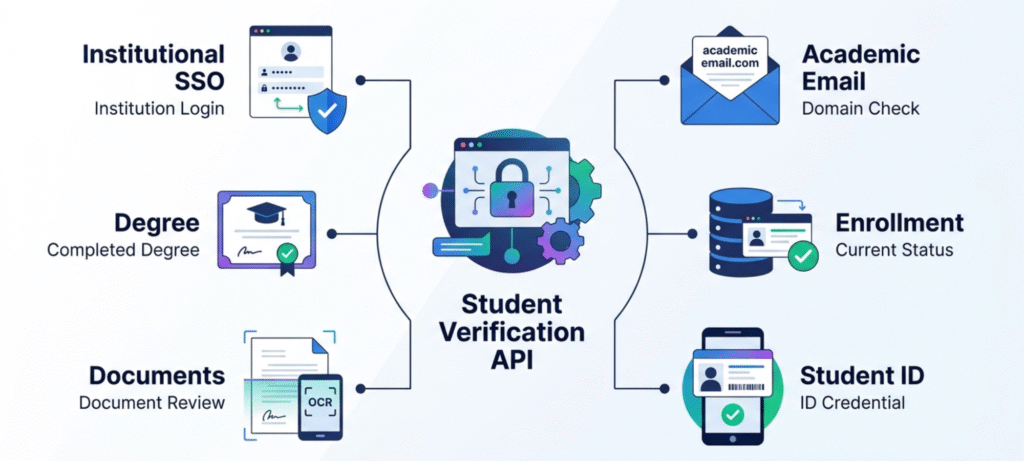
Verification providers generally build around one or more of these approaches. Knowing which type you’re dealing with matters more than knowing which vendor you’re dealing with.
Academic Email Verification API
Checks whether an email address or domain belongs to an academic institution. It’s the fastest and cheapest method, and the weakest signal. It confirms domain ownership, not that the person is currently enrolled.
Student Enrollment Verification API
Checks current or historical enrollment against institutional or aggregated data sources. This is a stronger signal than an email check because it’s tied to actual academic records rather than a domain pattern.
Student ID Verification API
Validates a physical or digital student ID card, sometimes covering formats like ISIC, ITIC, or a school’s own digital credential.
Student Document Verification API
Parses and checks uploaded paperwork such as enrollment letters, admission letters, or transcripts, usually with OCR plus a manual review fallback for anything the automated pass can’t resolve confidently.
Degree Verification API
Confirms a completed degree or credential, including graduation date and, where available, major or field of study. This is a separate question from current enrollment.
SSO or Institutional Account Verification
Verifies a student by having them log in directly through their school’s own authentication system. This tends to be a stronger signal than a domain check because the student is authenticating with the institution itself, not just supplying an address that happens to match a pattern.
Student Enrollment Verification API vs. Academic Email Verification
This is the distinction that trips people up most, so it’s worth spelling out clearly.
| Feature | Enrollment verification | Academic email verification |
|---|---|---|
| Confirms academic domain | Sometimes | Yes |
| Confirms current enrollment | Often, depending on provider | Not by itself |
| Data source | Institutional/enrollment data | Domain based email check |
| Best for | High confidence verification (scholarships, high value discounts) | Fast, low friction screening (software signups) |
| Typical implementation effort | Higher | Lower |
An enrollment verification API checks against enrollment or institutional data, so it can confirm someone is presently attending a school. An academic email verification API, like a simple domain check, just confirms the email is associated with a college or university, which is a much weaker signal. A .edu style address doesn’t guarantee the mailbox owner is a current student. The account could belong to an alum, a staff member, or someone using a stale address.
Current Enrollment vs. Historical Education Verification
These get conflated often, so it helps to separate them explicitly:
- Current enrollment. Is the person enrolled right now, this term?
- Historical enrollment. Did the person attend this institution during a specific past period?
- Degree verification. Did the person earn a particular degree, and when?
- Academic email verification. Is this email address associated with an academic institution at all, regardless of enrollment status?
Each of these answers a different question, and providers don’t always cover all four. This is also the same distinction the National Student Clearinghouse draws between its EnrollmentVerify and DegreeVerify services, covered in more detail below.
What Can a Student Verification API Verify?
Depending on the provider, a student verification API can check:
- Current enrollment, whether someone is actively enrolled, where the provider supports it
- Academic institution, which college or university a person is affiliated with
- Academic email, whether an email domain belongs to an academic institution
- Student ID, validity of a physical or digital student ID card
- Degree and graduation info, completed degrees and graduation dates
- Documents, enrollment letters, transcripts, admission letters, or certificates
- GPA or transcript data, where the provider and institution support it
Available fields vary by provider, geography, institution, and verification method, so it’s worth checking a provider’s current documentation before assuming a field is covered.
Student Verification API Use Cases
The category covers more ground than student discounts alone:
- Student discounts. Software, retail, streaming, and travel promos limited to verified students
- Education software and SaaS. Free or reduced price tiers for students and educators
- Scholarships. Confirming eligibility before disbursing funds
- Insurance. “Good student” programs and related benefits
- Campus services. Automating eligibility checks for on campus resources
- Marketplaces. Restricting certain listings or offers to verified students
Two additional categories are worth flagging as potential rather than universal fits: financial services eligibility and recruitment background checks can both involve student verification, but because they touch more sensitive eligibility decisions, they usually need a higher bar of proof and closer compliance review than a simple discount check.
For discount driven signups specifically, the typical flow is signup, verification, student pricing unlocked, periodic re-verification, since enrollment status changes every semester. Email only checks are often too weak for high value offers, since a stale or shared academic email can slip through.
How to Verify Student Status With a Student Verification API
There are a handful of common methods, each with different trade offs:
- Academic email check. Fast and cheap, but doesn’t confirm current enrollment.
- Institutional account or SSO login. A stronger signal, since the student authenticates directly through their school’s system.
- Document upload. A student submits an enrollment letter, transcript, or ID for the provider to parse and verify.
- Institutional/enrollment data source. The provider checks against enrollment records the institution shares.
- Student ID verification. Validating a physical or digital student ID, where supported.
Most providers combine two or three of these depending on the use case and the institution’s data availability.
Student Verification API vs. Student ID Verification API
These often get treated as the same thing. They’re not.
| Method | What it verifies | Main limitation |
|---|---|---|
| Student email verification | Academic email/domain | Doesn’t prove current enrollment |
| Student ID verification | Student ID/card | Card may be expired or hard to authenticate |
| Enrollment verification | Current/historical enrollment | Requires access to reliable enrollment data |
| Document verification | Submitted academic documents | Documents can require manual review |
| Degree verification | Completed credential | Doesn’t prove current student status |
A general “student verification API” is usually an umbrella term covering one or more of these methods. A student ID verification API is a narrower tool focused specifically on validating a physical or digital ID card.
Student Document Verification API, Including in India
A student document verification API checks submitted paperwork rather than a live database, useful in regions or institutions where enrollment data isn’t available through an automated feed. Common documents include student IDs, admission or enrollment letters, fee receipts, transcripts, and degree certificates.
Behind the scenes, this usually combines OCR to extract text, document classification, basic authenticity checks, and institution matching, with manual review as a fallback for edge cases the automated pipeline can’t resolve confidently.
For an API for student document verification in India specifically: document based verification tends to matter more in markets where a national enrollment database isn’t broadly accessible to third party APIs the way it is in the US. Businesses building for the Indian market should confirm directly with a provider which document types and institutions they actually support before committing. Coverage claims vary widely and change often.
National Student Clearinghouse Degree Verification API
The National Student Clearinghouse is a nonprofit organization that maintains one of the largest enrollment and degree data registries in the US, with participation from thousands of colleges and universities. Its verification services are organized around a few distinct products, not one single “API”:
- DegreeVerify. Confirms completed degrees for graduates, typically used by employers, background screening firms, and recruiters.
- EnrollmentVerify. Confirms current or historical enrollment status, outsourcing the request/response process the registrar’s office would otherwise handle manually.
- Web services / integrated data access. An option built for high volume requestors that need to check enrollment or degree status programmatically rather than one record at a time.
A few things worth keeping in mind before treating this as a plug and play API:
- Participating institutions. Coverage is broad in the US but not universal. Confirm a specific institution is participating before assuming it’s covered.
- Data limitations. DegreeVerify and EnrollmentVerify answer different questions. A degree check doesn’t tell you current enrollment status, and vice versa.
- Consent and privacy. Requests for this kind of data typically require the student’s consent or a permissible purpose under applicable privacy law, so this isn’t something to bolt onto a signup flow without reviewing the terms first.
For exact current pricing, endpoint details, and integration requirements, check the Clearinghouse’s own documentation directly rather than relying on secondhand summaries, since terms and coverage shift over time.
Student Verification API Providers
A few names come up repeatedly in this space:
| Provider | Verification approach | Best suited for |
|---|---|---|
| MeasureOne | Institutional/enrollment data, academic summary | Enrollment focused workflows, US/Canada |
| SheerID | Program based, multi method verification | Discount and eligibility programs |
| StudentVerification.dev | Academic email verification | Fast, low friction email checks |
| ApyHub | Academic email domain check | Simple API integrations |
| Proxi | Student/faculty verification via SSO | Low code, global coverage |
| Alive Verify | Digital student ID verification | ISIC/ITIC/IYTC style credentials |
This isn’t a ranking. The right fit depends entirely on how much proof your use case needs and which regions you’re serving. Before publishing any comparison like this on a live page, double check each provider’s current claims against their own documentation, since coverage and features change.
MeasureOne Student Verification API
MeasureOne positions itself around enrollment and academic summary data rather than a simple email check. Its documented endpoints support requests like enrollment status and academic summary, which can return information such as enrollment status, attendance, and completed degrees, depending on what the underlying institution shares. Some of MeasureOne’s service calls are asynchronous, using webhooks or a service context to retrieve results once processing completes, rather than returning everything in a single synchronous response. That’s a meaningful integration detail if you’re used to APIs that respond immediately.
SheerID Student Verification API
SheerID provides a REST API for program based verification, including student verification workflows. Its documentation covers starting a verification, submitting student information, and handling the different outcomes a request can land in, including a successful verification, a document upload request, or a pending review state. Student fields it documents include things like name, email, birth date, and organization.
On pricing, SheerID doesn’t publish one universal number. Like most providers in this category, cost depends on program structure, verification volume, and which methods are used. Getting an accurate figure means checking current commercial terms directly with the provider.
ApyHub Academic Email Verification API
A narrower tool focused specifically on the email/domain check: send an email address, get back whether it belongs to an academic institution. ApyHub’s own documentation is explicit that this confirms the email’s domain, not that the mailbox exists or that the person is currently a student, which lines up with the broader point made earlier about academic email checks being a weaker signal than enrollment verification.
StudentVerification.dev, Proxi, and Alive Verify
StudentVerification.dev focuses on fast academic email checks across a large claimed set of institutions. Proxi positions itself around low code, SSO based student and faculty verification across many countries. Alive Verify focuses on authenticating digital student identity credentials like ISIC, ITIC, and IYTC. As with the other providers listed here, confirm current coverage and supported credential types directly with each provider before building against their claims.
Student Verification API vs. Manual Verification
| Manual verification | API verification |
|---|---|
| Staff reviews documents by hand | Software handles the check automatically |
| Slower, doesn’t scale well | Faster, built for volume |
| Inconsistent across reviewers | Consistent logic applied every time |
| No integration with signup flow | Plugs directly into checkout/signup |
APIs don’t fully eliminate human review. Edge cases like unreadable documents, unsupported institutions, or ambiguous matches still tend to route to a manual queue. The realistic goal is reducing manual work, not removing it entirely.
How to Integrate a Student Verification API
A rough sequence for building this in:
- Choose the verification method (or combination) that matches your use case.
- Create a provider account and generate API credentials.
- Send a verification request with the required student fields.
- Handle the response, which may be synchronous or asynchronous depending on the provider.
- Process the outcome: success, failure, or a pending/document upload state.
- Add a document upload fallback for cases the primary method can’t resolve.
- Store only the minimal verification record needed, not the full underlying data.
- Set up re-verification on a schedule, since student status changes term to term.
Not every provider behaves the same way here. MeasureOne documents asynchronous service calls with webhooks, while SheerID’s REST flow can move through success, document upload, or pending states rather than a single immediate yes/no. Plan your integration around the specific provider’s response model rather than assuming a generic request/response pattern will fit every one.
Student Verification API Security and Privacy
Worth building in from day one, not bolting on later:
- User consent before collecting or sharing data
- Data minimization: only collect what the use case actually needs
- Encryption in transit and at rest
- API key security (never expose keys in frontend code)
- Defined data retention limits
- Access controls and audit logs
- A clear, accessible privacy policy
Be specific about what you’re actually sending to a provider. Fields like date of birth, student ID numbers, transcripts, and uploaded documents are more sensitive than an email address, and not every verification method needs all of them. Send only the fields the provider and the verification purpose actually require, and review the provider’s retention, security, consent, and data processing terms before integrating rather than after.
If you’re publishing student facing content or tools alongside this kind of integration, it’s also worth reading up on broader student data handling. See a teacher’s guide to keeping student data safe online and protecting student data during grading for adjacent context on handling this kind of information responsibly.
Common API Errors and Verification Failures
Typical errors developers run into:
400: missing or malformed request parameter401: invalid, missing, or revoked API key403: authenticated but not permitted to perform this action422: request understood but failed validation429: rate limit exceeded503/504: provider backend temporarily unavailable or timing out
Exact status codes vary by provider. MeasureOne, for example, documents a broader set including 400, 401, 403, 404, 405, 409, 422, and 500 responses for some of its endpoints, so don’t assume every provider uses an identical error scheme.
Other common failure modes include an unsupported institution, a document that’s unreadable or too low quality to parse, and an institution simply not being present in a provider’s database.
A sane failure path: retry with backoff, validate the input again, offer an alternate verification method, then route persistent failures to manual review rather than just blocking the user outright.
Common Mistakes When Implementing Student Verification
- Treating an academic email as proof of current enrollment
- Collecting more personal data than the use case requires
- Ignoring international institutions when the audience isn’t US only
- Skipping re-verification, so a graduate keeps a student discount indefinitely
- Exposing API keys in frontend/client side code
- Having no fallback method when the primary check fails
- Not tracking or reviewing failed verification attempts
- Assuming a provider covers every institution without checking
How to Choose a Student Verification API
Worth weighing before picking a provider:
- Verification depth needed: email only vs. enrollment vs. documents vs. ID
- Geographic coverage: US/Canada heavy vs. genuinely global
- Institution coverage: how many schools are actually supported
- Data freshness: how current the underlying records are
- Integration method: REST API, SDK, or hosted verification page
- Privacy and consent handling
- Security practices: encryption, key management, access controls
- False positive/negative rates
- Response time
- Pricing model
- Support for re-verification and webhooks
- Documentation quality
- Compliance requirements for your industry/region
FAQ
What is a student verification API?
It’s a software interface that lets an application check student related information, enrollment, academic email, ID, or documents, automatically instead of manually.
How does a student verification API work? A user submits information, the application sends it to the API, the provider checks it against a data source, and a verification result comes back, usually within seconds.
What is a student enrollment verification API?
A type of student verification API that checks current or historical enrollment data specifically, rather than just an email domain.
Can an API verify whether someone is currently a student?
Some can, if they check live enrollment data. An academic email check alone typically can’t confirm current status.
What is a student email verification API?
An API that checks whether an email address belongs to an academic institution’s domain, a fast but limited signal.
Is academic email enough to verify student status?
Not on its own. It confirms domain ownership, not current enrollment, so high value use cases usually need a stronger method.
What is the National Student Clearinghouse degree verification API?
It refers to verification built on DegreeVerify and related services from the National Student Clearinghouse, a nonprofit organization that maintains enrollment and degree records for thousands of US colleges and universities. It’s distinct from a simple email check and from current enrollment verification.
Does SheerID have a student verification API?
Yes. SheerID offers a REST API for program based student and other eligibility verification, documented on their developer site.
How much does a student verification API cost?
Pricing varies by provider, verification method, and volume. Most providers don’t publish a single flat rate, so check current commercial terms directly.
What is a student verification form? A form used to collect information or documents for verification, often manually or semi automatically processed. An API, by contrast, automates the exchange and processing of that verification data between systems directly.
Can student documents be verified through an API?
Yes. Document verification APIs typically use OCR and document classification, often with manual review for edge cases.
Is there a student verification API for India?
Coverage varies by provider. Document based verification tends to be more common in markets without a broad automated enrollment database, so confirm supported institutions directly with a provider.
What is a student ID verification API?
An API that validates a physical or digital student ID card, sometimes including formats like ISIC or ITIC.
Final Thoughts
The core thing to get right before choosing a provider or writing any integration code: decide how much proof your use case actually needs. A simple software discount can usually get by on an email check. A scholarship or financial benefit needs something closer to enrollment or document verification. A student verification API is most useful when the verification method matches the level of proof your application actually needs, not the other way around.