
Oxford term dates are easy to look up and surprisingly easy to misread. Search for them and you’ll find two sets of dates for the same term. Michaelmas 2026 shows up as 1 October to 17 December in one table and 11 October to 5 December in another. Neither is wrong. They measure different things.
I’ve gone through the University of Oxford’s official page line by line and rebuilt it below in a way that answers the questions people actually have. When does the next term start? What is “Full Term”? When should I really arrive? Do medics and MBAs follow the same calendar as everyone else? (They don’t.)
This page covers the University of Oxford only. It isn’t about Oxfordshire school holidays or Oxford Brookes University, which run on completely different calendars.
Oxford Term Dates 2026–27
For the 2026–27 academic year, start with the University’s published Dates of Term., so let’s start with the current academic year. These are the University’s formal Dates of Term, the wider window in which each term officially sits, as published on the University of Oxford’s official Dates of Term page.
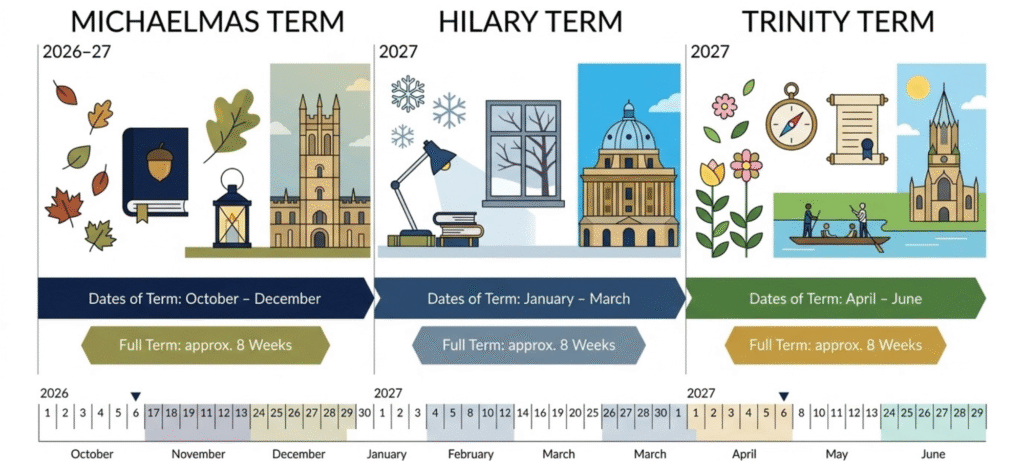
| Term | Dates of Term 2026–27 |
|---|---|
| Michaelmas 2026 | Thursday 1 October – Thursday 17 December |
| Hilary 2027 | Thursday 7 January – Saturday 20 March |
| Trinity 2027 | Tuesday 20 April – Tuesday 6 July |
If you only need a rough sense of when the university is “in session”, this table does the job. Most people want the next one down, though.
Oxford Full Term Dates 2026–27
Full Term is the eight-week core of each term, running Sunday of the first week to Saturday of the eighth. It’s the period most undergraduate teaching is built around, and it’s what students usually mean when they talk about term.
| Term | Full Term 2026–27 |
|---|---|
| Michaelmas 2026 | Sunday 11 October – Saturday 5 December |
| Hilary 2027 | Sunday 17 January – Saturday 13 March |
| Trinity 2027 | Sunday 25 April – Saturday 19 June |
Compare the two tables and the gap is obvious. Michaelmas Dates of Term run for about eleven weeks. Full Term is eight. That difference is the whole reason this topic confuses people, so I’ll come back to it in a moment.
Oxford Term Dates at a Glance: 2027–33
Oxford publishes Full Term and Dates of Term through 2032–33, which is handy if you’re planning a gap year, a deferred offer or a long-range family visit. I’ve kept the tables compact so you can scan them without scrolling forever.
Full Term dates
| Year | Michaelmas | Hilary | Trinity |
|---|---|---|---|
| 2027–28 | 10 Oct – 4 Dec 2027 | 16 Jan – 11 Mar 2028 | 23 Apr – 17 Jun 2028 |
| 2028–29 | 8 Oct – 2 Dec 2028 | 14 Jan – 10 Mar 2029 | 22 Apr – 16 Jun 2029 |
| 2029–30 | 7 Oct – 1 Dec 2029 | 13 Jan – 9 Mar 2030 | 28 Apr – 22 Jun 2030 |
| 2030–31 | 13 Oct – 7 Dec 2030 | 19 Jan – 15 Mar 2031 | 27 Apr – 21 Jun 2031 |
| 2031–32 | 12 Oct – 6 Dec 2031 | 18 Jan – 13 Mar 2032 | 25 Apr – 19 Jun 2032 |
| 2032–33 | 10 Oct – 4 Dec 2032 | 16 Jan – 12 Mar 2033 | 24 Apr – 18 Jun 2033 |
Dates of Term
| Year | Michaelmas | Hilary | Trinity |
|---|---|---|---|
| 2027–28 | 1 Oct – 17 Dec 2027 | 7 Jan – 25 Mar 2028 | 20 Apr – 6 Jul 2028 |
| 2028–29 | 1 Oct – 17 Dec 2028 | 7 Jan – 24 Mar 2029 | 20 Apr – 6 Jul 2029 |
| 2029–30 | 1 Oct – 17 Dec 2029 | 7 Jan – 25 Mar 2030 | 24 Apr – 6 Jul 2030 |
| 2030–31 | 1 Oct – 17 Dec 2030 | 7 Jan – 25 Mar 2031 | 20 Apr – 6 Jul 2031 |
| 2031–32 | 1 Oct – 17 Dec 2031 | 7 Jan – 20 Mar 2032 | 20 Apr – 6 Jul 2032 |
| 2032–33 | 1 Oct – 17 Dec 2032 | 7 Jan – 25 Mar 2033 | 20 Apr – 6 Jul 2033 |
One pattern worth noticing: the Dates of Term barely move from year to year, while Full Term shifts around by a week or so. If you’re planning several years ahead, Full Term is the one that will surprise you.
Oxford also lists the dates of Encaenia, the honorary degree ceremony held in Trinity term: Wednesday 23 June 2027, Wednesday 21 June 2028, Wednesday 20 June 2029, Wednesday 26 June 2030, Wednesday 25 June 2031 and Wednesday 23 June 2032. Notice that each one lands after Full Term has already finished. That’s a nice real-world example of Dates of Term stretching past the teaching weeks.
What Is the Difference Between Oxford Dates of Term and Full Term?
This is the section I’d bookmark if I were you.
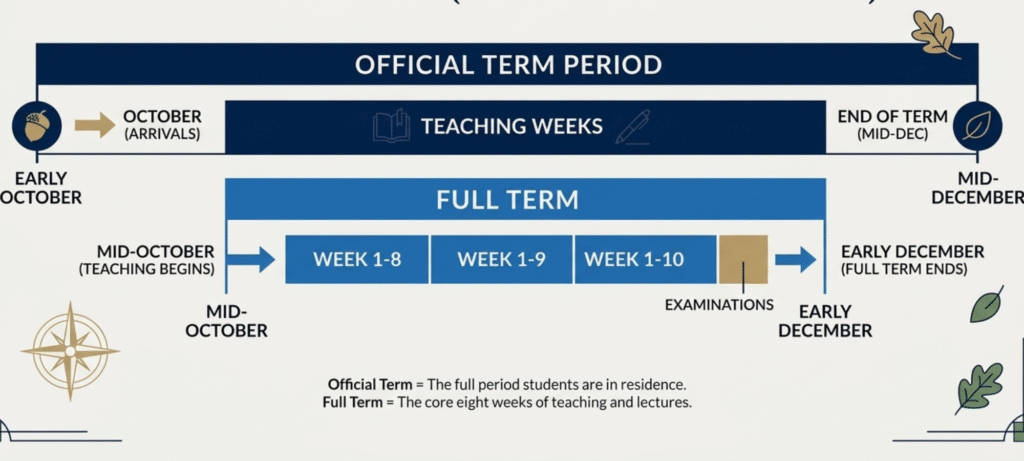
Dates of Term are the University’s formal, wider term periods. Full Term is the eight-week stretch inside each of them, the main teaching period. Oxford’s own page draws this line explicitly: the University makes a distinction between the two, and publishes both.
Take Michaelmas 2026:
- Dates of Term: 1 October to 17 December
- Full Term: 11 October to 5 December
So the formal term opens ten days before teaching properly begins, and runs almost two weeks after it ends. Those margins exist for good reasons. Freshers need to arrive and get settled. Some courses hold tutorials, collections (college exams sat at the start of term) or lab work either side of Full Term. Exams, in some subjects, happen after the eight weeks are done.
Quick way to remember it: Full Term is when the teaching is at full speed. Dates of Term is when the university officially considers itself open for that term.
If you’re comparing this to other calendars, Oxford’s eight teaching weeks per term look very short next to a typical school year. Our breakdown of how many weeks are in a school year makes the contrast clear. Oxford compresses a lot into those weeks, and that intensity is a big part of why the calendar matters so much to students.
What Are the Three Oxford Terms?
Oxford’s year is divided into three terms and three vacations. Each term has its own name.
Michaelmas is the autumn term, broadly October to December. It’s the first term of the academic year and the one where new students arrive.
Hilary is the winter-into-spring term, broadly January to March. It’s traditionally the coldest, greyest stretch, and students will tell you it feels the longest.
Trinity is the spring-into-summer term, broadly late April to June. Exams cluster here for many courses, and the weather usually improves right as everyone is buried in revision. Cruel timing.
The names are old and come from the church calendar. You don’t need the etymology to plan around them, so I’ll leave it there.
Many websites shorten all this to “Oxford uni term dates” or “Oxford University term dates”, and they’re all pointing at the same three terms.
What Is 0th Week at Oxford?
Oxford numbers the weeks of Full Term from 1 to 8. The week before First Week is widely called 0th Week (or Week 0), and the week after Eighth Week is often called Week 9. The numbering isn’t a separate official term. It’s the way people talk about the days around the eight-week core.
Using Michaelmas 2026 as the example:
- 0th Week begins Sunday 4 October
- First Week begins Sunday 11 October
- Eighth Week ends Saturday 5 December
- Week 9 begins Sunday 6 December
Why does this matter? Because Full Term “starts on a Sunday” only on paper. Plenty of things happen in 0th Week: freshers arrive, inductions run, libraries and departments open their doors properly, and some courses begin early. If you read the Full Term start date as the day you need to be in Oxford, you might arrive after things have already started.
Oxford University Vacations
Between the terms sit three vacations, which people commonly call:
- Christmas vacation, after Michaelmas and before Hilary
- Easter vacation, after Hilary and before Trinity
- Long Vacation, after Trinity and before the next Michaelmas, running through the summer
I’m deliberately not giving exact vacation dates, because Oxford doesn’t publish them as a separate table. They’re simply the gaps between terms. If you want to work out a vacation window, use the end of one term and the start of the next, and decide whether you’re counting from Full Term or Dates of Term. Counting from Full Term gives you a longer break. Counting from Dates of Term gives you the shorter, more cautious one.
Also, “vacation” doesn’t always mean “gone home”. Many students stay for project work, lab placements or dissertations, and some courses require it. The MBA, for instance, runs right through the Long Vacation.
Do All Oxford Students Follow the Same Term Dates?
No, and this trips up a lot of people.
The standard Full Term dates apply broadly, but the University also publishes extended terms for particular programmes in 2026–27. These include Part II Chemistry, Part II Materials Science, Part II Molecular and Cellular Biochemistry, Part C Cell and Systems Biology and Neuroscience, the clinical course for the Second BM, Graduate-Entry Medicine, the PGCE, the MBA and the Master of Public Policy.
A few examples from the official page show how far these can stray from the standard calendar:
- Chemistry Part II: Michaelmas runs from Thursday 24 September to Friday 18 December, and Trinity stretches to Saturday 10 July.
- PGCE: Michaelmas starts Monday 7 September.
- MBA: Michaelmas starts Monday 21 September, and the programme runs through the Long Vacation.
- Graduate-Entry Medicine, Year 2: Michaelmas begins as early as Friday 28 August.
- MPP: after Trinity, a Policy Report period runs from Monday 21 June to Monday 30 August.
I won’t reproduce every clinical table here. They’re long, they change, and the official page is the only version you should trust for them. Oxford also notes that extended-term dates may be subject to minor changes, so contact the departmental administrator if your course is on the list.
Do Oxford Colleges Have Different Term Dates?
The University sets the term calendar. Your college decides when you can actually move in, when you must be in residence and what happens during induction.
That’s a real difference in practice. A student can be required to arrive before Full Term begins, and college accommodation dates don’t always match the University’s tables. The University-wide dates are a starting point, not a substitute for the arrival instructions your college sends you. Oxford’s own guidance on student residency requirements explains what the University expects, and your college will fill in the specifics.
My rule of thumb: use the University table to plan the year, then wait for your college’s joining instructions before you lock in travel.
Can Teaching and Exams Happen Outside Full Term?
Yes, depending on the course.
Full Term is the main teaching period, not a hard wall around everything. Induction events, some teaching, collections and examinations can all fall outside those eight weeks. The extended-term tables above are the clearest proof: several courses run for far longer than eight weeks a term, and others start in summer or early September.
The practical lesson is simple. Don’t book a flight home for the day after Eighth Week ends and assume you’re finished. Check your own course handbook and exam timetable first. Exam dates are set by the faculty or department, and they can sit right on the edge of Full Term or beyond it.
How to Plan Around Oxford Term Dates
If you’re a student, a parent or someone arranging a visit, here’s how I’d use all this without overcomplicating it.
Travel and flights. Anchor to Dates of Term for arrival windows, then confirm with your college. For departures, wait until your exam or assessment timetable is out.
Accommodation. Ask your college for move-in and move-out dates in writing. Private lets should be aligned to the wider Dates of Term, not just Full Term, or you’ll pay for gaps.
Work and internships. The three vacations are the natural slots for summer or holiday work, but check for course requirements first, especially if you’re on an extended-term programme.
Family visits. Eighth Week is often exam-heavy in some subjects, and Trinity is a stressful stretch overall. Ask your student when they’d genuinely enjoy company.
Calendars. The University doesn’t provide these dates in another format, but the IT team at Wolfson College offers Oxford term date files in iCal, CSV and Google Calendar formats. Importing one saves you copying dates by hand.
FAQs
What are the Oxford term dates for 2026–27?
Oxford’s Full Term dates are Michaelmas 11 October to 5 December 2026, Hilary 17 January to 13 March 2027 and Trinity 25 April to 19 June 2027. The wider Dates of Term are 1 October to 17 December 2026, 7 January to 20 March 2027 and 20 April to 6 July 2027.
When does Oxford University start in 2026?
The formal Michaelmas Dates of Term begin on Thursday 1 October 2026, and Full Term begins on Sunday 11 October 2026. New students should follow their college’s arrival instructions, which can be earlier than either date.
What is the difference between Dates of Term and Full Term?
Dates of Term are the wider official term periods. Full Term is the eight-week main teaching period inside each one, running Sunday of First Week to Saturday of Eighth Week.
Do Oxford colleges have different term dates?
The University sets the term calendar, but colleges set their own move-in, induction and residence dates. Those can begin before Full Term.
Do all Oxford courses follow the same term dates?
No. Chemistry, Materials Science, clinical medicine, Graduate-Entry Medicine, the PGCE, the MBA and the MPP all have extended-term dates in 2026–27.
Are exams held outside Full Term?
Some are. Teaching, induction and examinations can take place outside the published Full Term dates, depending on the course, so always check your own timetable.
When is Oxford’s Long Vacation?
It’s the summer gap between Trinity and the following Michaelmas. Oxford doesn’t publish it as a separate table, so work it out from the end of Trinity to the start of the next Michaelmas.
Final Thoughts
If there’s one thing to take away from all these Oxford term dates, it’s this: check which set of dates you’re looking at. Full Term is the eight-week teaching core. Dates of Term is the wider official window. Your college, and sometimes your course, adds its own requirements on top.
For 2026–27, that means Michaelmas Full Term starts on 11 October, Hilary on 17 January and Trinity on 25 April, with the formal terms opening earlier and closing later. For anything beyond that, use the tables above as a planning aid and the University’s page as the final word.
And if you’re still deciding whether Oxford is on your radar at all, our guide to the Oxford Summer Scholars Programme acceptance rate is a good next read. It’s one of the few ways to experience the Oxford calendar first-hand before applying for a full degree.