
Try saying “squirrel” in front of a Spanish-speaking learner. You’ll see the wince. “Through” does it too, and so do “world,” “very” and “receipt.”
Ask around and most people will say the hardest words for Spanish speakers to say in English are the long, scary ones. Not really. It’s the small everyday words that cause the trouble, the ones that look totally harmless on the page. You read them fine. Then you say one out loud and your mouth stumbles. Laziness? No. Lack of effort? Also no. English just builds its words from sounds, letter groups and stress patterns that Spanish handles in a completely different way.
Curious how English stacks up against other languages in general? We looked at that in our post on whether English is one of the hardest languages to learn.
Below is a list of about 35 words, sorted by the specific problem hiding inside each one. Fix that one problem and a whole group of words gets easier at the same time. One caution: there’s no official ranking of the “hardest” words, so think of this as a map of the usual trouble spots, not a scoreboard.
What Are the Hardest Words for Spanish Speakers to Say in English?
If you’re hunting for the hardest words to say in English for Spanish speakers, these are the ones teachers and learners bring up again and again. The pronunciations use the International Phonetic Alphabet (IPA), a system where each symbol stands for exactly one sound.
| Word | IPA (American) | Why it’s tough |
|---|---|---|
| squirrel | /ˈskwɪrəl/ | Cluster, English R, weak ending |
| rural | /ˈrʊrəl/ | Two R sounds close together |
| through | /θruː/ | TH followed by R |
| world | /wɝːld/ | R-colored vowel, then two consonants |
| very | /ˈveri/ | V instead of B |
| fifths | /fɪfθs/ | Four consonants in a row |
| strength | /streŋkθ/ | Cluster plus TH |
| receipt | /rɪˈsiːt/ | Silent P |
| jewelry | /ˈdʒuːlri/ | J sound, fewer syllables than the spelling suggests |
| comfortable | /ˈkʌmftərbəl/ | Syllables that shrink |
| queue | /kjuː/ | Spelling much longer than the sound |
| schedule | /ˈskedʒuːl/ | Spelling, plus accent differences |
Read down that last column. No two words are hard for quite the same reason. One has a single odd sound. Another stacks several. A few just have spelling that misleads you. Once you know which kind of trouble you’ve got, you’re halfway to fixing it.
35 Hard English Words for Spanish Speakers to Practice
Here’s the full list in one place, each word paired with the thing to work on. You don’t need to tackle all 35 at once. Pick the group that matches your problem sound and start there.
| Word | Main problem | Practice focus |
|---|---|---|
| squirrel | R + cluster | Split into skwir + ul |
| rural | Repeated R | Slow R, then vowel, then R |
| world | R-colored vowel | were, then add ld |
| girl | R-colored vowel | gur, then soft L |
| bird | R-colored vowel | Short daily drill |
| through | TH + R | Slow th, slide to roo |
| three | TH | three / tree |
| thought | TH + vowel | Keep the TH from turning into T |
| clothes | TH + consonants | Soften the ending |
| months | Final cluster | Say month first |
| strength | Cluster + TH | Build up s, st, str |
| fifths | Final cluster | Short, light S at the end |
| sixths | Final cluster | Same as fifths |
| twelfths | Final cluster | Say twelfth, then add S |
| very | V | berry / very |
| vocabulary | V and B | Switch lip positions |
| available | V and B | Watch the second syllable |
| village | V + J | Lip on teeth, then /dʒ/ |
| jewelry | J + syllables | Two syllables, not three |
| judge | J | /dʒ/ at both ends |
| receipt | Silent P | Learn the sound separately |
| knife | Silent K | Start with the N |
| debt | Silent B | Say it like det |
| subtle | Silent B | Two syllables |
| island | Silent S | Starts like eye |
| salmon | Silent L | Drop the L |
| Wednesday | Spelling | Fewer syllables than written |
| queue | Spelling | Same sound as the letter Q |
| comfortable | Reduced syllables | Three beats, not four |
| temperature | Reduced syllables | Squeeze the middle |
| chocolate | Reduced syllables | Two beats |
| photography | Stress | Stress the second syllable |
| ship | Vowel | ship / sheep |
| sheep | Vowel | Longer, tighter vowel |
| focus | Vowel | Glide from “oh” toward “oo” |
Why English Pronunciation Is Hard for Spanish Speakers
Spanish spelling is generally more predictable than English spelling, so learners are often used to a close match between letters and sounds. English breaks that habit all the time. The two languages also build their sound systems differently.
You may have seen the claim that English has 44 sounds and Spanish has 24. Don’t lean on those figures. They change with the accent being measured and with how a linguist decides to count.
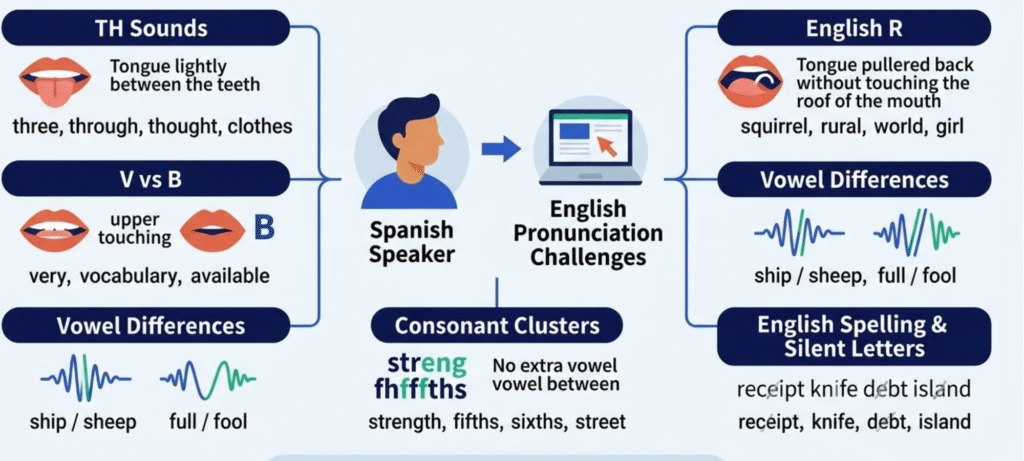
In practice, a handful of things cause most of the trouble. Many English TH sounds are unfamiliar to Spanish-speaking learners, and the English R is made differently from the tap or trill used in many varieties of Spanish. English also has vowel pairs, like the ones in “ship” and “sheep,” that a Spanish ear may hear as one sound. Consonants pile up at the ends of words. The spelling is a mess. And any syllable without stress collapses into a faint “uh.”
None of this means Spanish speakers are doing something wrong. They’re carrying the habits of one language into another, which every learner does.
Hard Words With the TH Sound
English has two TH sounds. The voiceless one, /θ/, is in “think” and “three.” The voiced one, /ð/, is in “this” and “clothes.” Many Spanish speakers reach for T, D or S, since those sounds are already comfortable.
The tongue does the same job for both. Rest the tip lightly between your front teeth. For /θ/, blow air past it. For /ð/, add a buzz from your voice. It feels ridiculous at first. Nearly everyone says so.
“Through” is hard because the TH runs straight into an English R, and learners often end up with “tru” or “dru.” Go slowly: a long th, then slide into roo.
Slip on the TH in “three” and you’ve said “tree,” a different word. Say them back to back a few times and watch what your tongue does: three, tree, three, tree.
With “thought,” the TH meets the vowel from “ball.” Lose the TH and you’re saying “tot.”
“Clothes” ends in /ðz/, which even native speakers go easy on. In fast speech it usually sounds like “close,” so don’t lose sleep over it.
Natives simplify “months” too. It ends in /nθs/. Get a clean “month” first, then add a light S.
“Strength” is where two problems collide. The S-T-R opening and the TH near the end both have to happen in one breath. Sometimes a word isn’t hard because of one sound. Two awkward ones are just sitting side by side.
Hard Words With the English R
Forget the spelling for a second and think about the mouth. A Spanish R taps or rolls, and the tongue hits the ridge behind your upper teeth. The English R in most American accents? Nothing touches. The tongue draws back and bunches up, lips rounding a bit. That’s it.
Then there’s “squirrel.” Everyone’s favorite example, and no wonder. You start with skw, crash straight into an English R, and then the word just fades out on a weak little syllable. Chop it: skwir, ul. Now stick them together. Two mistakes to dodge. Rolling the R is one. Adding a vowel before the S is the other.
“Rural” is awkward in its own way, with an R on both sides of a single vowel. Native speakers trip over it too. Honestly, you’re in good company.
“World” and “girl” share a trick. The R is baked into the vowel, written /ɝː/, and Spanish has no vowel quite like it. Say “were,” then add ld, and there’s your “world.” For “girl,” go with gur and close on a soft L. What usually goes wrong is a stray extra vowel, so “world” ends up as “wor-eld.”
“Bird” does the same thing. It’s short, so it makes a handy daily drill.
Try this. Say wer, then world. Then gir, then girl. Start small and grow it.
One last point about accents. Rhotic American speakers pronounce the R everywhere it’s written. Many British speakers drop it at the end of a word, unless a vowel follows. Which R should you copy? Whichever accent you’re aiming for.
Why Are V and B Difficult for Spanish Speakers?
In most varieties of Spanish, B and V aren’t separate sounds the way they are in English, so “baca” and “vaca” are pronounced alike. English keeps them apart, and mixing them up changes the word you said.
For V, rest your upper teeth on your lower lip and push voiced air through the gap. For B, close both lips and pop them open. If you can feel lip against teeth, you’ve got the V.
“Very” is the textbook case, and most learners say “berry.” “Vocabulary” has a V near the front and a B in the middle, so it’s a decent workout. In “available” the V comes early and the B late, and in quick speech they blur. “Village” often turns into “billage.”
Practice these pairs: berry and very, boat and vote, ban and van.
Don’t try to memorize which letter gets which sound. Feel where your lips and teeth sit instead. The body remembers that better than the eye remembers spelling.
English J Words Spanish Speakers May Find Difficult
Spanish J and English /dʒ/ are two different animals. Take “judge” and “jump.” The English sound has nothing to do with the J you’d read in “jamón,” which in most Spanish is a rough, scratchy rasp from the back of the throat. Some regions drift closer in a few words, and speakers vary, so there’s no single rule. What does happen a lot: learners reach for a y sound instead. “Joke” becomes “yoke.”
So how do you make /dʒ/? Start with your tongue in the D position. Don’t stop there. Let it slide straight into a buzzing zh. One movement, not two. Pause between the parts and it sounds stiff, almost robotic.
Now “jewelry.” People hear three syllables in the spelling. There are two: “JOOL-ree.” Many learners add the third without realizing, which is why it’s worth repeating a few times.
“Judge” is the easy one to spot, because the sound opens and closes the word. “General” and “January” are sneakier. Nothing on the page warns you. With “January,” don’t try to pronounce each letter as written. Split it into its natural syllables and copy a speaker of the accent you’re learning.
English Vowel Sounds That Can Make Simple Words Difficult
Spanish has five vowel sounds. English? Way more, and they don’t differ in just one way. Sometimes it’s the quality of the sound, sometimes where your tongue sits, and sometimes nothing but how long you hold it. We spend so much time on TH and R that vowels slide under the radar, even though they cause just as many mix-ups.
Take “ship” and “sheep.” Short and loose in one, long and tight in the other. Say “the ship is leaving,” then “the sheep is leaving,” and you’ll see why a tiny slip isn’t so tiny. “Live” and “leave” are the same story, though “live” has a trap: in “a live concert” it rhymes with “five,” which catches out plenty of people who only know the verb.
Here’s one I find interesting. “Woman” and “women” differ at the end when you read them, but the sound that actually changes is the first vowel: /ˈwʊmən/ versus /ˈwɪmɪn/. Easy to miss if you’re watching the wrong end of the word.
Then “full” and “fool,” another pair worth drilling, and “focus,” where the vowel glides from “oh” toward “oo.” A flat Spanish “o” sounds a bit off to English ears.
Bottom line, learners aren’t only adding new vowels. They’re training their ears to catch differences Spanish never needed. So listening comes first. Speaking comes after.
English Words With Difficult Consonant Clusters
Ask a Spanish speaker to say “strength” and watch their face. Three consonants right at the start, then a TH hanging off the back end. Brutal. Now try “fifths.” Or “sixths.” Or “twelfths,” which is basically a pile-up of consonants with a vowel somewhere in the middle, hiding. “Scratch,” “street,” “squirrel”: same story, three consonants before you even reach a vowel.
Spanish just doesn’t work that way. It likes its syllables light and open, so English clusters hit like a traffic jam.
You’ve probably caught yourself doing this. “School” turns into “eschool.” “Spain” becomes “Espain.” Tiny vowel, sneaks in at the front, and you don’t even notice it. Think about escuela and España, though. No native Spanish word starts with S plus another consonant, so your mouth patches the gap on its own. Not everybody does it. Plenty do.
What actually works? Slow down. Don’t attack the whole word in one go, because you’ll just crash into it. Build it up, one sound at a time:
street: s, st, str, street.
strength: s, st, str, streng, strength.
Hold that opening S like a long hiss. Then roll straight into the next sound, no vowel squeezed in between. Weird, right? Good. The weirdness means your mouth is learning something new.
And “fifths”? Don’t lose sleep over that ending. Even native speakers kind of drop it, and what comes out sounds a lot like “fifs.”
English Words Where Spelling Makes Pronunciation Harder
Spanish spelling is so regular that silent letters feel like a trap. English is full of them.
| Word | What makes it tricky |
|---|---|
| receipt | silent P, roughly ri-SEET |
| knife | silent K |
| debt | silent B |
| subtle | silent B, roughly SUT-ul |
| island | silent S, roughly EYE-lund |
| salmon | silent L, roughly SAM-un |
| Wednesday | sounds like WENZ-day |
Then there’s the “ough” family: through, though, thought, tough, cough. Same four letters, five different sounds. No trick fixes that. Learn each word on its own.
Words That Are Hard Because English Reduces Syllables
Open any Spanish word and the spelling pretty much hands you the stress. English? Not so lucky. Nothing on the page tells you where to push. And what happens to the syllables you don’t push is the real story: they fade into a weak vowel called the schwa, /ə/. You already say it all day. It’s the “uh” in “about.”
Spanish speakers often go the other way and say every written vowel in full. Makes sense, the letters are right there. But the word gets long, and a listener expecting English rhythm can’t catch it. Now compare what native speakers do. “Comfortable” is KUMF-ter-bul. Three syllables, not four. “Temperature” is TEM-pruh-chur, “chocolate” is usually CHOK-lit, “interesting” is often IN-tris-ting, and “literature” is LIT-ruh-chur. “Photography” breaks the pattern because the stress jumps to the second syllable: fuh-TOG-ruh-fee.
Slowing down won’t fix any of this. Find the stressed syllable, then let the rest shrink.
English Words That Look Easier Than They Sound
Sometimes the spelling points one way and the sound goes another. Take “schedule.” In American English it’s usually /ˈskedʒuːl/. In British English you’ll often hear /ˈʃedjuːl/. Both are fine. Just pick the accent you’re learning and stay with it. Not sure how they sound? The Cambridge Dictionary plays the British and American versions side by side, which is really handy.
“Queue” is one sound, the same as the letter Q. All those extra letters, and they do nothing. “Enough” ends with an f sound. “Though,” “tough” and “cough” all finish differently, even though they look like cousins. Why? English spelling held on to old habits from centuries ago while the pronunciation kept moving. The two never caught up.
Is There Really a Single Hardest English Word for Spanish Speakers?
No.
It depends on you. Which Spanish you grew up with, which English accent you’re learning, your age, how much English you’ve heard, your own speech habits, all of it counts. “Squirrel” gets named a lot because several difficult features land in one word. Still, that doesn’t make it the hardest word by any scientific measure.
What you can safely say is this: the hardest words for Spanish speakers to say in English tend to share a pattern. An unfamiliar sound, a crowded cluster, a subtle vowel, or spelling that misleads.
How Spanish Speakers Can Practice Difficult English Words
Pronunciation is physical, a bit like learning to throw a ball. Reading about it helps, but only doing it makes it stick.
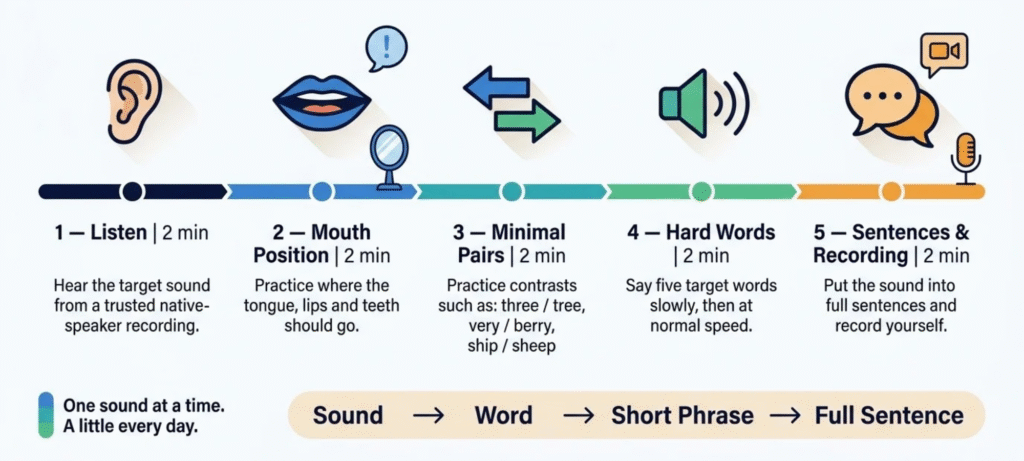
Begin with the sound, not the full word. If TH is the problem, practice th alone, then “three,” then “three trees.” Work with minimal pairs, which are two words that differ by one sound, like three/tree, very/berry, ship/sheep and full/fool. Grab a mirror for TH, V and R, since you can see those. Record yourself and compare it with a native speaker.
Then climb in steps. One word, then a short phrase, then a full sentence: three, three trees, There are three trees. The last step matters because sounds shift when words run together.
A Simple 10-Minute English Pronunciation Routine
- 2 minutes: listen to your target sound.
- 2 minutes: practice the mouth position.
- 2 minutes: run through minimal pairs.
- 2 minutes: say five hard words.
- 2 minutes: read two sentences and record them.
Stay on one sound for several days before you switch. A little practice every day beats one long session on the weekend.
You Don’t Need to Lose Your Spanish Accent
Having an accent isn’t a flaw. Every English speaker has one, and a Spanish accent can sit comfortably inside perfectly clear English.
The goal is to be understood. Spend your effort on the sounds that change meaning, like “three” turning into “tree” or “very” turning into “berry,” and let the rest go. You don’t have to copy every feature of a native accent. Better pronunciation means fewer misunderstandings. It doesn’t mean wiping out where you come from.
Frequently Asked Questions
What are the hardest words for Spanish speakers to say in English?
Squirrel, rural, through, world, fifths, comfortable, receipt, strength and jewelry come up most. They combine unfamiliar sounds, crowded consonants or tricky spelling.
What is the hardest English word for a Spanish speaker to pronounce?
There’s no single answer. Squirrel, rural and world are mentioned most, but it really depends on the person.
Why is “squirrel” hard for Spanish speakers?
It fits an skw cluster, an English R and a weak final syllable into one short word. Three tricky things, very little room.
Why do Spanish speakers struggle with TH?
Spanish doesn’t use the English TH sounds in the same way, so learners often swap in T, D or S.
Why do Spanish speakers confuse B and V?
In most varieties of Spanish, they aren’t separate sounds. English splits them in two, so the difference has to be learned.
What English sounds are hardest for Spanish speakers?
The TH sounds, V, the English R, the J sound, short and long vowel pairs, and consonant clusters.
Why do some Spanish speakers add an “e” before words like “school” or “street”?
Standard Spanish generally avoids words that begin with S plus another consonant, so the habit follows learners into English. It’s common, though not universal.
How can Spanish speakers improve English pronunciation?
Work on one sound at a time, use minimal pairs, record yourself, and practice in full sentences.
How do you pronounce English words correctly as a Spanish speaker?
Listen to a trusted recording first. Isolate the tricky sound, copy it slowly, then test it with a minimal pair. Move up to a short phrase, then a full sentence, and record yourself to compare with the model.
Is “schedule” pronounced differently in American and British English?
Yes. American English usually says /ˈskedʒuːl/ and British English often says /ˈʃedjuːl/. Both are correct.
Does having a Spanish accent mean your English is bad?
Not at all. An accent is normal. What matters is being clearly understood, so focus on the sounds that cause mix-ups instead of chasing a “perfect” native accent.
If you’d like to see how the Spanish sound system is laid out, the Wikipedia page on Spanish phonology is a clear place to start.
Final Thoughts
The hardest words for Spanish speakers to say in English aren’t random. Each one exposes a small gap between the two languages, whether that’s a sound, a cluster, a vowel, a spelling quirk or a shrunken syllable.
So skip the idea of memorizing 35 words. Look for what they have in common. Work on TH when the problem is TH. Use minimal pairs for V and B. Build clusters up slowly. Listen to the stress and copy it. Learn the odd spellings one by one. It also helps to learn a word’s sound at the same time as its meaning, and our tips on how to memorize vocabulary fit that well.