
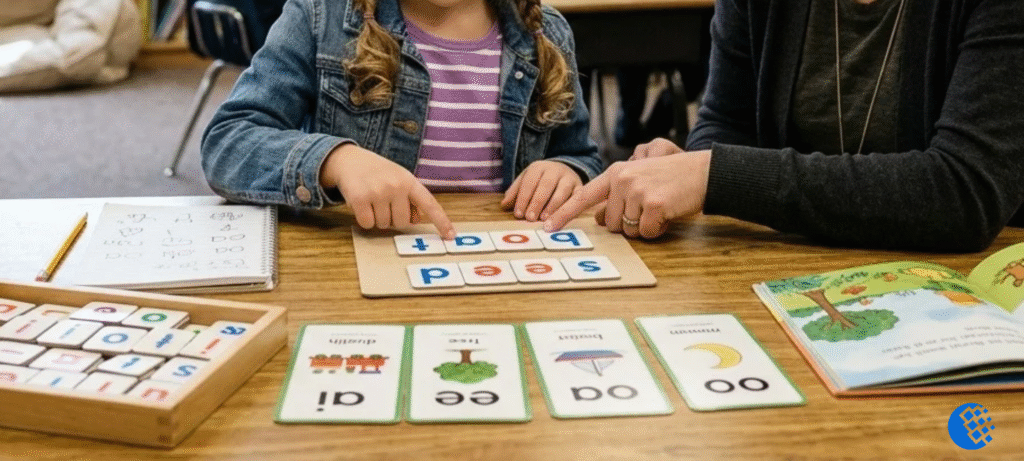
So, what are vowel digraphs? They’re two-letter spelling patterns that work together to spell one vowel sound. Look at the word rain. Your ear doesn’t catch a short /a/ followed by a short /i/. It catches a single long A, and the letters ai are simply how that sound gets written. Feet works the same way with ee, and boat does it with oa. When a kid starts spotting these pairs, plenty of “hard” words suddenly look a lot friendlier.
In this guide we’ll cover the definition, the common patterns, long and short vowel digraphs, and how they compare with diphthongs and consonant digraphs. We’ll also look at a few exceptions that catch almost everyone out, and there’s a practice set with answers waiting at the end.
What Are Vowel Digraphs?
Vowel digraph, simple words mein, is a spelling pattern. Do letters, ek sound. Bas. People get tangled up because they look at the letters and forget to listen. Letters are only the paper part. The sound is the real thing.
Try “boat”. On the page you get b, o, a, t, which is four letters. Out loud it’s /b/, /ō/, /t/, and that’s only three sounds. So where did the fourth letter go? It didn’t vanish. The o and the a team up and make one /ō/ between them. Most kids assume every letter has to make its own noise, so this part takes a minute to sink in.
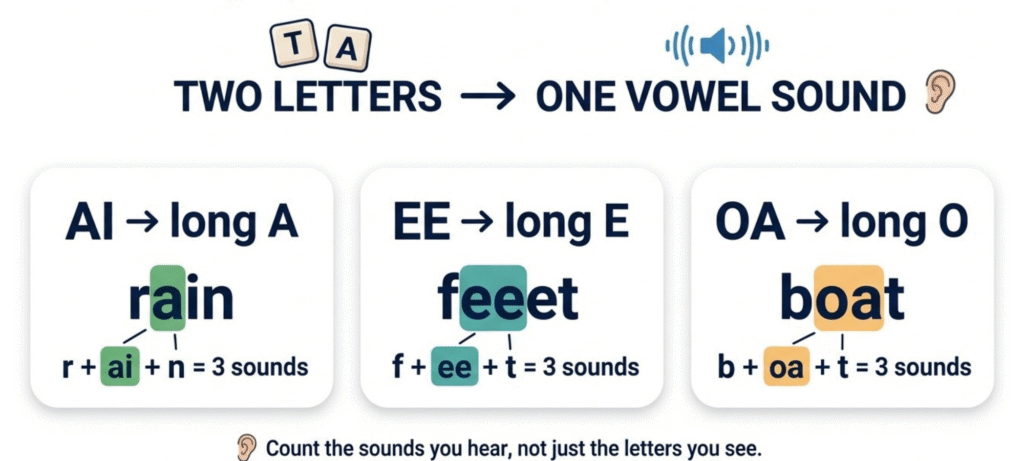
Two vowels side by side? That doesn’t automatically make a digraph, and a lot of guides skip over this. Then there’s the naming mess. Some teachers use “vowel digraph” for strictly two vowel letters, think ai or ee. Others say “vowel team” and toss in ay, ow and oy too. Who’s right? Honestly, nobody’s wrong. Your curriculum is what counts here, so pick the term it uses and stick with it. Kids get confused fast when the label keeps changing on them.
Tutoring or teaching a class? Our notes on spelling and word study show how these patterns can fit into your weekly spelling practice.
What Is a Vowel Team?
A vowel team is the wider group. It covers any two letters, and occasionally three, that join up to spell a vowel sound. Most vowel digraphs belong in it, but the reverse isn’t true. Look at ay in day. It has a y in it, so it isn’t strictly two vowels, and it still spells one vowel sound. That’s why many programs teach it as a vowel team anyway.
Take ay in day. The y isn’t a vowel letter in the usual sense, yet it’s doing a vowel’s job there. Same with w in snow. Many phonics programs file these under vowel teams. Others just call them vowel digraphs and move on.
So when two worksheets disagree about whether ow “counts,” don’t panic. It’s usually the labels, not the pronunciation.
What Are the Common Vowel Digraphs?
Here’s a core set that shows up in almost every early reading program.
| Pattern | Common sound | Example words |
|---|---|---|
| ai | long A | rain, train, mail |
| ay | long A | day, play, stay |
| ee | long E | feet, green, sleep |
| ea | often long E | beach, clean, teach |
| oa | long O | boat, road, coat |
| oo | two sounds | moon, book |
| ie | varies | pie, piece |
| ue | long U or /oo/ | blue, true, clue |
Then there’s a second group you’ll run into: ow, oi, oy, ou, ew, aw, au, ey and ei. Where these land depends on who’s doing the teaching. One textbook files them as vowel digraphs, another as vowel teams, and a third under diphthongs. Learn the pattern itself first; the label can wait until later.
How Many Vowel Digraphs Are There?
Nobody agrees on a number. Check three phonics programs and the counts rarely match.
Eight or nine is where some programs stop. Others reach twelve or more, because pairs like ow, oy and ew get counted too. What changes is the rule being used: two vowel letters side by side, or two letters that produce a single vowel sound. So for anyone searching “all the vowel digraphs,” the practical answer is the core set listed earlier, with a few extra vowel teams on top that shift from source to source.
Vowel Digraph Examples by Pattern
Let’s go through them one at a time, with words kids actually meet early on.
AI and AY
Both say long A. The usual habit is that ai sits in the middle of a word and ay sits at the end.
- ai: rain, mail, train, paint, brain
- ay: day, play, stay, gray, tray
The train came in the rain. We play outside every day.
That middle-versus-end habit is handy for spelling, but it’s a tendency, not a law. English loves breaking its own patterns.
EE and EA
EE is dependable. EA is the troublemaker.
- ee: see, tree, feet, sleep, green
- ea (long E): beach, clean, dream, speak, teach
- ea (other sounds): bread, head, steak
When a child reads bread as “breed,” that’s not a failure. That’s the pattern doing exactly what it often does. Teach it as “try long E first, then check if the word makes sense.”
OA and OW
OA is steady. It almost always says long O and tends to sit in the middle of a word.
- oa: boat, coat, road, float, toast
- ow (long O): snow, grow, slow, yellow
But ow has a second sound, the one in cow and now, and that’s where it drifts into diphthong territory. Start with the long O version.
OO
OO makes two sounds, which surprises people the first time.
- Long /oo/: moon, food, room, spoon
- Short /oo/: book, good, foot, wood
A quick trick is to try both pronunciations on a new word and see which one sounds like a real word.
IE and UE
These two show up less in early books, but they’re worth knowing.
- ie: pie, tie (long I); piece, field (long E)
- ue: blue, true, clue, glue
Vowel Digraphs by Long Vowel Sound
Sometimes it’s easier to sort by sound instead of spelling, especially when a child hears a sound and has to decide how to write it.
- Long A: ai (rain), ay (day)
- Long E: ee (feet), ea (beach)
- Long I: ie (pie)
- Long O: oa (boat), sometimes ow (snow)
- Long U: ue (blue)
What Are Long Vowel Digraphs?
A long vowel is simply a vowel that says its own name. Long A is the a in ape, long E is the e in eat, and the rest follow the same idea. Long vowel digraphs are the letter pairs that most often produce those sounds.
Notice the “most often” part, though. Plenty of vowel digraphs don’t give a long vowel at all. Kids cope much better when they hear this at the start, rather than bumping into the exceptions months later and feeling tricked.
Can Vowel Digraphs Make Short Vowel Sounds?
They can, and it surprises a lot of people. Having a vowel digraph in a word doesn’t guarantee a long vowel.
Take bread and head: the ea there sounds like a short E. Or book and foot, where oo gives a short, soft sound. The two letters still act as one team, but the sound that comes out isn’t the long vowel you’d guess.
This is why I tell learners that a vowel digraph only signals that two letters are teaming up. It won’t tell you which sound to say. For that, you have to look at the whole word.
What Are Vowel Digraphs and Diphthongs?
People swap these two terms constantly, and many textbooks don’t make it any clearer.
A vowel digraph describes spelling: two letters stand for one vowel sound, and that sound stays pretty much the same from start to finish. Rain is a good clean example.
A diphthong describes sound: a vowel that slides from one mouth position toward another within a single syllable. Say coin slowly and you can feel your mouth move. If you want the technical side, the Britannica entry on diphthongs covers it in more depth.
Here’s a mouth test that works well with kids. Say boat and notice your mouth stays put. Then say coin and feel it glide. Accents can change the result, so it won’t be perfect, but it’s a handy first check.
There’s one catch: ow can be either type. In snow the sound is steady, while in cow it glides. So spelling and sound are really two different things.
Vowel Digraph vs Vowel Team vs Diphthong
If those three terms are blurring together, this table might help.
| Term | What it describes | Example |
|---|---|---|
| Vowel digraph | Two letters, one vowel sound | ai in rain |
| Vowel team | Broader spelling-pattern label | ay in day |
| Diphthong | A gliding vowel sound | oi in coin |
Notice they’re not exactly competing. A digraph and a vowel team are about spelling. A diphthong is about sound. That’s why the same letters can show up in more than one column.
What Is the Difference Between Consonant and Vowel Digraphs?
If you’ve ever wondered about consonant and vowel digraphs, the short version is that both are two letters making one sound. The difference is which kind of sound.
| Type | What it is | Examples |
|---|---|---|
| Vowel digraph | Two letters, one vowel sound | ai in rain, ee in feet, oa in boat |
| Consonant digraph | Two consonants, one consonant sound | sh in ship, ch in chair, th in thin |
Consonant digraphs like sh, ch, th, ph and wh usually get taught first, because the sounds are easy to hear and show up in very common words. Vowel digraphs tend to come after kids can read short vowel words smoothly. If you’re planning a sequence, the folks at Reading Rockets share plain-language guidance on how phonics skills build on each other.
Are There Rules for Vowel Digraphs?
There are patterns, but I’d be careful with the word “rules.”
You’ve probably heard “when two vowels go walking, the first one does the talking.” It works for rain, boat and feet. Then it falls apart on bread, book, piece and said. A rule that breaks that often is really more of a hint.
A few patterns that hold up pretty well:
- ai often appears inside words (rain, train).
- ay often shows up at the end (day, play).
- oa commonly sits in the middle (boat, road).
- ee almost always says long E (feet, green).
- ea is flexible, so check the word (beach, bread).
The honest way to teach it is “here’s the usual pattern, and here’s what to do when it doesn’t fit.” Kids handle that way better than being handed a rule and then watching it fail.
Are Two Vowels Together Always a Vowel Digraph?
Nope. This is probably the most common mix-up.
Look at quiet. The i and e sit side by side, but they belong to different syllables (qui-et), so they aren’t acting as one unit. Same story in create (cre-ate) and idea (i-de-a). The vowels are neighbors, but each one gets its own beat.
So the check isn’t “are two vowels touching?” It’s “do these letters make one single vowel sound?” If yes, you’ve likely got a digraph. If the word splits between them, you don’t.
Are Vowel Digraphs Always Made of Two Vowels?
Not necessarily, depending on the program. Some resources reserve the term for two vowel letters. Others bring in ay, ow and oy under the same umbrella, even though they include a y or w.
How Do You Identify a Vowel Digraph?
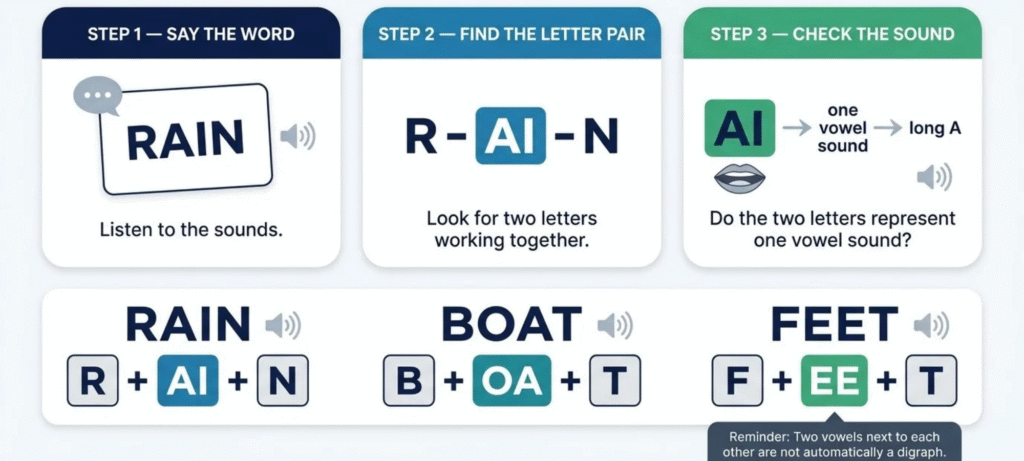
You don’t need anything fancy. Three steps do it.
- Say the word out loud and listen to the sounds.
- Look for two letters that seem to work together.
- Check whether they make one vowel sound.
Try it. Rain breaks into r, ai, n. Boat is b, oa, t. Feet is f, ee, t. And beach is b, ea, ch, which has a consonant digraph tucked in as well, so that one word holds both kinds.
And if you hit a tricky one like quiet, slow down and clap the syllables. That usually settles it.
Vowel Digraphs in Reading and Spelling
Here’s something worth knowing. Reading and spelling use vowel digraphs differently, and kids often find one easier than the other.
When a child reads, they see the letters and recognize the sound. They see ai and think “long A.” That’s the easier direction.
When a child spells, they hear a long A and have to pick the spelling. Is it ai, ay, or something else? That’s a real decision. A child might read rain perfectly and still write it as “rane.”
This is where the position habit earns its keep. In the middle of a word, try ai. At the end, try ay. So train and play start to make sense as a pair instead of two random words.
Vowel Digraph Word List
Here’s a short list to keep nearby for reading practice.
| Digraph | Sound | Example words |
|---|---|---|
| ai | long A | rain, mail, paint, brain |
| ay | long A | day, play, stay, tray |
| ee | long E | see, tree, sleep, green |
| ea | often long E | clean, dream, teach, speak |
| oa | long O | boat, coat, float, toast |
| oo | two sounds | moon, food, book, good |
| ie | varies | pie, tie, piece, field |
| ue | long U or /oo/ | blue, true, glue, clue |
A short list like this is easier to review than a giant wall of words, and kids can actually remember it.
Why Are Vowel Digraphs Important for Reading?
They save kids from sounding out every single letter. Once a child recognizes ai as one chunk, a word like brain goes from five separate letters to three quick sounds. That makes reading faster and a lot less frustrating.
They also help with spelling, since the same patterns come up again and again. And they connect basic letter-sound knowledge to smooth reading. Without them, kids tend to get stuck at the point where words stop being simple.
I won’t claim any magic numbers here. It’s just that most longer words are built from these chunks, so knowing them makes everything downstream easier.
When Do Children Learn Vowel Digraphs?
Usually in late kindergarten through first or second grade, but age isn’t really the deciding factor. Readiness is.
A child is typically ready once they know their letter sounds, can read short vowel words like cat and sit, and have met some consonant blends and digraphs. After that, vowel digraphs are the natural next step. The exact timing shifts by curriculum and by child, and that’s fine. For parents planning ahead, our piece on a preschool reading program covers the earlier groundwork.
How to Practice Vowel Digraphs
Short and frequent beats long and rare. Fifteen focused minutes is usually better than an hour of drilling.
Word sorting. Write words on cards and sort them by pattern. Put ai and ay words in separate piles, or split the two oo sounds.
Read it in a sentence. A word in context sticks better than one on a flashcard. The goat stood on the road does more work than “goat, road.”
Dictation. Say a word, have the learner write it, then check the spelling together.
Highlight and hunt. Give a short paragraph and have them mark every vowel digraph they can find.
Switch directions. Read a word, then spell it. Spell it, then read it. Each one reinforces the other.
Vowel Digraph Practice
Three small levels. Try them out loud first.
Beginner: Find the vowel digraph in each word.
- rain
- feet
- boat
- moon
Intermediate: Sort these words by digraph: rain, play, green, beach, snow, book.
Challenge: Which of these words contain more than one digraph-like pattern? sheep, beach, teach, chain.
Answers
Beginner: 1. ai, 2. ee, 3. oa, 4. oo.
Intermediate: ai (rain), ay (play), ee (green), ea (beach), ow (snow), oo (book).
Challenge: sheep has sh and ee. Beach has ea and ch. Teach has ea and ch. Chain has ch and ai. So all four contain both a consonant digraph and a vowel digraph.
Frequently Asked Questions
What are vowel digraphs?
Two-letter spelling patterns that stand for one vowel sound, like ai in rain or oa in boat.
What are the most common vowel digraphs?
The core set is ai, ay, ee, ea, oa, oo, ie and ue. Many programs also teach ow, oi, oy, ou and ew as related vowel teams.
What are all the vowel digraphs?
There’s no one universal list. Phonics programs sort patterns differently, so the number depends on the source.
How many vowel digraphs are there?
It depends on how a program defines the term. Roughly eight to a dozen are taught in early reading, and more if vowel teams are included.
What are vowel digraphs and diphthongs?
Vowel digraphs are spelling patterns that make a steady vowel sound. Diphthongs are gliding vowel sounds, like oi in coin.
What are long vowel digraphs?
Letter pairs that usually make a long vowel sound, such as ai, ay, ee, ea and oa. There are exceptions.
What is a vowel team?
A broader label for letter patterns that spell a vowel sound, including ay, ow and oy.
Are vowel digraphs always two vowels?
Not always. Some programs include patterns with y or w under the same label.
Are two vowels together always a digraph?
No. In words like quiet and create, the vowels sit in different syllables, so they don’t form one digraph.
What is the difference between consonant and vowel digraphs?
Consonant digraphs are two consonants making one sound (sh, ch, th). Vowel digraphs are two letters making one vowel sound.
Can a vowel digraph make more than one sound?
Yes. Ea can say long E in beach or short E in bread, and oo can say two different sounds too.
When do children learn vowel digraphs?
Usually late kindergarten through second grade, once they read short vowel words smoothly. Readiness matters more than age.
Final Thoughts
So, what are vowel digraphs? Two-letter patterns that stand for one vowel sound, hiding inside everyday words like rain, feet and boat. Learn the common pairs, remember that long vowels are a tendency and not a promise, and keep digraphs, diphthongs and consonant digraphs in separate boxes. Practice a little at a time, read real sentences, and let the exceptions be part of the lesson instead of a surprise.