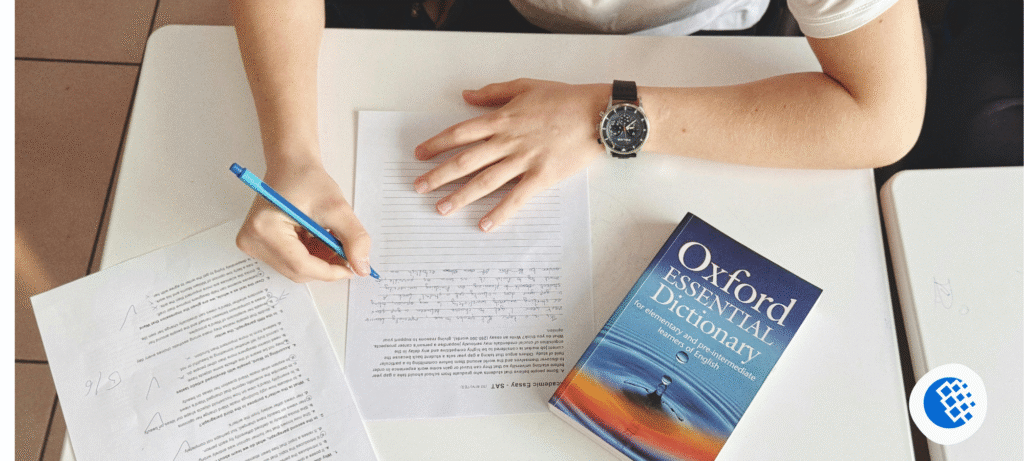

If you pull five random people into a room and ask if learning English is a nightmare, you’re going to get five totally conflicting answers. A native Spanish speaker will probably tell you it’s a walk in the park, while someone from Tokyo might tell you it’s an absolute wall of frustration.
So, let’s get down to it: is english one of the hardest languages to learn?
The short answer here is no. If you look at global linguistics, English doesn’t take the crown for the absolute most brutal language on the planet. But let’s be completely honest—it is easily one of the most maddening, contradictory, and flat-out confusing tongues to actually master.
Sure, it skips some of the heavy lifting found in other languages—you won’t have to stress over masculine or feminine nouns—but it makes up for that simplicity with downright bizarre spelling habits, pronunciation rules that change on a whim, and an endless library of figures of speech.
The Short Answer: How Difficult Is English Really?
When you zoom out and look at language difficulty on a global scale, English lands squarely right in the middle of the pack. At its core, it’s a Germanic language. However, its history is a messy, chaotic blend of Old Norse, French, Latin, and Greek. Because it has aggressively stolen bits and pieces from entirely different linguistic roots, it effectively operates with a split personality.
Whether english is one of the hardest languages to learn for you personally comes down to what language you spoke first.
If your mother tongue shares an ancestral branch with English (think Dutch, German, or Swedish), the whole process is going to feel fairly natural. On the flip side, if your native language relies on a totally distinct writing script, an entirely different grammar setup, or a sound system that doesn’t match (like Arabic, Mandarin, or Korean), getting fluent is going to demand a serious investment of time, sweat, and patience.
Why Is English One of the Hardest Languages to Learn?
There’s an old joke running around language forums that says, “English isn’t a real language; it’s just three distinct languages wearing a trench coat to sneak into a theater.” Honestly, it’s hard to argue with that. If you’ve ever wondered why is english one of the hardest languages to learn, here is the exact breakdown of what makes it such a massive headache for millions of global students.
1. English Spelling Is Wildly Unpredictable
In languages like Spanish or Turkish, what you see is what you get. They are phonetic—words sound exactly the way they look on paper. English completely trashes that playbook. Just look at this classic group of words:
- Though (rhymes with “go”)
- Through (rhymes with “too”)
- Tough (sounds like “tuff”)
- Thought (sounds like “thawt”)
Even though these words look practically identical to your eyes, they sound like entirely different universes when spoken aloud. For a foreign learner trying to read or write, this lack of predictability is incredibly frustrating.
2. Pronunciation Changes Based on Context
To make matters worse, English loves heteronyms—words that are spelled identically but completely shift their sounds and meanings depending on how they sit in a sentence.
- You can read a book right now (sounds like reed).
- But you read a book yesterday afternoon (sounds like red).
- A cold wind is howling outside (sounds like wihnd).
- You need to wind up that old grandfather clock (sounds like waind).
Without clear context clues to guide them, a student has zero way of knowing how to utter these words just by staring at the page.
3. A Massive Overload of Idioms
Native English speakers rarely just say what they mean. Instead, our daily conversations are packed to the brim with colorful idioms that make zero literal sense.
If a teacher tells an exhausted student to “hit the books,” they aren’t suggesting property damage to a textbook—they mean it’s time to study. Telling someone a project is a “piece of cake” just means it’s a breeze. Try translating those exact phrases word-for-word into any other language, and you end up with complete gibberish.
4. The Nightmare of Phrasal Verbs
A phrasal verb is what happens when you grab a standard verb, slap a tiny preposition onto the end of it, and completely rewrite the definition. The verb “take” shows just how ridiculous this gets:
- Take off: Slipping out of your jacket, or a massive Boeing leaving the runway.
- Take in: Processing complex data, or letting a stranded friend crash on your couch.
- Take up: Snagging a brand-new hobby or filling up empty space in a room.
There are literally thousands of these random combinations sprinkled through everyday speech, and students simply have to brute-force memorize them one by one.
5. Endless Grammar Rules (and Exceptions)
The moment you finally memorize a grammar rule in English, you’re immediately slapped with five distinct ways that rule fails. We drill schoolchildren on the classic spelling trick “I before E, except after C,” and then immediately have to explain outliers like neighbor, weigh, ancient, science, and weird. After a while, those exceptions start feeling way more common than the actual rules.
What Makes English Easier Than Many Languages?

Look, it’s not all terrible news. While is english one of the hardest language to learn is a debate that keeps language nerds up at night, the language actually offers some massive shortcuts that make it a whole lot friendlier than tongues like French, German, or Russian.
- No Grammatical Gender: In languages like Spanish or Arabic, every single object has an inherent gender. A wooden table might be feminine, while a paper book is masculine, forcing you to warp your adjectives to match. In English? A table is just a table. Objects don’t carry gender baggage.
- Simple Verb Conjugations: English verbs are surprisingly lazy. Take the verb talk, for instance: I talk, you talk, we talk, they talk. You only have to toss a lone “s” onto the end for he/she talks. Compare that to Romance languages, where verbs morph into dozens of complex endings depending on exactly who is opening their mouth.
- No Complex Case Systems: Languages like German and Russian rely heavily on “cases”—meaning the endings of nouns structurally warp depending on their specific role in the sentence. English completely dumped its case system generations ago, keeping basic sentence architecture vastly simpler.
- Resources Are Literally Everywhere: Because English serves as the default global language for corporate business, Hollywood movies, and social media culture, learners have an endless supply of immersion tools. You can sharpen your ear just by throwing on Netflix, loading up a podcast, or falling down a YouTube rabbit hole.
Is English Hard to Learn for Foreigners?
At the end of the day, how much you struggle with English depends entirely on the linguistic toolkit you are working with from birth.
For Spanish and Romance Language Speakers
If you grew up speaking Spanish, French, or Italian, English grammar is usually highly approachable. Because English historicially pillaged thousands of words directly from Latin and French, these students will instantly spot a massive chunk of shared vocabulary (words like important, family, and future). The real mountain to climb for this group is usually wrapping their tongue around unpredictable English vowels and dealing with silent letters.
For German and Northern European Speakers
People who speak Germanic languages tend to breeze right through foundational English. The core logic, sentence pacing, and basic vocabulary are incredibly close cousins. For example, the German word Haus seamlessly becomes House, and Hand doesn’t change a single letter.
For Chinese and East Asian Speakers
This is the specific demographic where English truly earns its reputation as one of the hardest languages to learn in the world. Mandarin Chinese relies on a character-based writing system and functions on vocal tones (where shifting your vocal pitch changes the word entirely). Jumping from that framework to a phonetic alphabet crammed with complex consonant clusters—like the brutal “th” sound in three or though—requires a massive cognitive pivot.
For Arabic Speakers
Arabic reads from right to left, utilizes a completely unique script, and constructs its vocabulary out of a strict three-letter root system. Because English grammar operates on completely mismatched structural rules, native Arabic speakers often find our tenses and phrasal verbs an incredibly steep hill to climb.
Where Does English Rank Among the Hardest Languages?

To get an objective look at where English actually sits, we can tap into real-world data from the Foreign Service Institute (FSI), the official branch that trains American diplomats for overseas deployment. They organize world languages into distinct tiers based on exactly how many weeks it takes a native English speaker to grasp them.
If we flip that exact logic on its head, we get a highly accurate look at how tough English is for outside native speakers:
| Difficulty Level | Languages | Average Time to Fluency |
| Category I (Easiest) | Spanish, French, Italian, Dutch | 24–30 weeks |
| Category II (Medium) | German | 36 weeks |
| Category III (Hard) | English, Russian, Hindi, Greek, Finnish | 44 weeks |
| Category IV (Super Hard) | Mandarin Chinese, Japanese, Arabic, Korean | 88 weeks |
Just like the breakdown shows, English lands comfortably in the “Medium-Hard” bucket. It demands a bit more brainpower than a highly phonetic tongue like Spanish, but it’s nowhere near as structurally intimidating as Mandarin or Arabic.
Real-World Applications: Classroom Communication
Grasping the nuances of language difficulty isn’t just some abstract academic theory—it has a massive, direct impact on how educators run their classrooms every single day. When you’re managing English Language Learners (ELLs), you have to be incredibly deliberate about how you close those communication gaps.
Adapting Your Classroom Environment
For students who are currently drowning in the messy, inconsistent rules of English, a highly stable, structured classroom environment is a total lifesaver. Instructors frequently lean on a clearly defined Classroom Management Philosophy to map out predictable daily routines. When your formatting and expectations are visually clear and consistent, these students don’t have to burn precious mental energy trying to guess what you want—letting them focus 100% of their bandwidth on picking up the vocabulary.
Teaching the Complexities of Writing
One of the most intimidating hurdles for an English learner is transitioning from basic casual speech over to formal academic prose. Written, structural English has a ton of formal quirks that never show up in standard conversations. For instance, guiding a student through the mechanics of How to Use Dialogue in an Essay means handing them an entirely fresh set of punctuation rules, formatting styles, and exact quote marks that can easily stress out a brain that is still trying to decode basic spelling.
Frequently Asked Questions
Is English one of the hardest languages to learn?
Not really. It’s widely viewed as a medium-difficulty language. Yes, the spelling patterns and pronunciation exceptions are highly annoying, but its lack of noun genders and relatively simple verb setups make it a whole lot faster to pick up than highly complex tonal systems like Mandarin, Arabic, or Japanese.
Why is English so difficult for foreigners to learn?
The primary friction points for outside learners boil down to the complete lack of strict phonetic rules (we do not pronounce things the way we spell them), our heavy reliance on bizarre local idioms, and phrasal verbs that change meanings based on tiny attached prepositions.
Is English easier or harder than Spanish?
For the vast majority of people, Spanish is significantly easier to pick up than English. Spanish is beautifully phonetic and boasts incredibly consistent spelling rules. Once you learn the Spanish alphabet sounds, you can accurately read almost any word in the entire language, which is completely impossible to do in English.
What is the hardest language in the world to learn?
Most professional linguists rank Mandarin Chinese, Japanese, Arabic, and Korean as the most challenging languages to master—especially if you grew up with a Western language—mainly because of their intricate written scripts, distinct cultural contexts, and complex grammar architectures.
Is English considered a Germanic language?
Yes, it is structurally a Germanic language down at its roots. However, because of waves of historical invasions, global trade, and shifting empires, it has integrated a staggering amount of vocabulary and stylistic influence from French, Latin, and Greek over the centuries.
Final Thoughts: The Verdict on English
When it’s all said and done, English is a bit of a riddle wrapped up in an enigma. It will absolutely mess with your head using words like cough and dough, throw you off balance with casual slang, and throw a massive wall of vocabulary at you. But because it skips out on brutal structural roadblocks like gendered nouns and complex case alterations, it stays incredibly accessible at a foundational level. Plus, with the massive wave of music, movies, and internet platforms readily available everywhere, anyone can build true fluency if they just commit to regular, everyday practice.