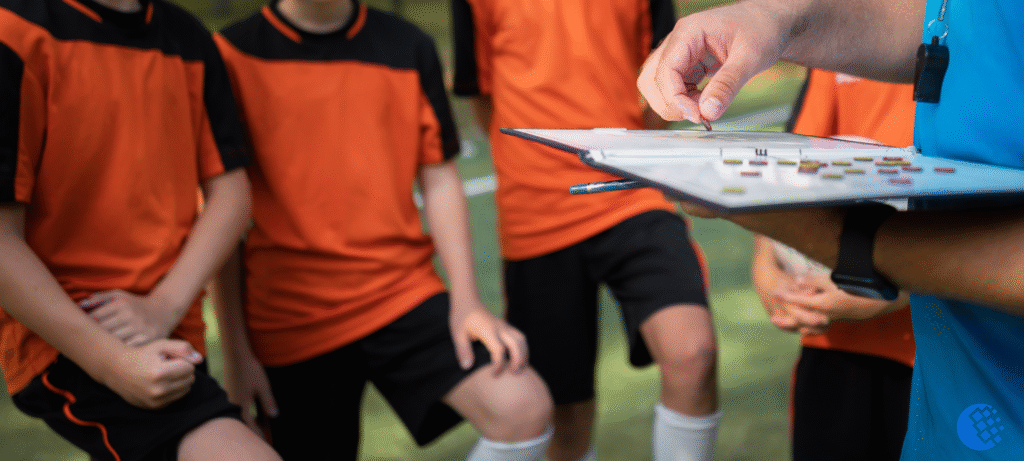
The classic image of physical education often features an instructor with a clipboard, checking off who brought their sneakers or grading a high-stakes, mandatory mile run. This traditional approach treats grading purely as a matter of compliance or performance on a single, stressful test. However, evaluating progress this way misses the entire purpose of movement literacy. To foster genuine, lifelong fitness habits, instructors must shift toward treating formative assessment in physical education as an indispensable, day-to-day tool for student development.
Think of it as a low-stakes, everyday practice to see how kids are doing in real-time. It helps you spot mistakes early and give helpful feedback right on the spot. Instead of acting like a final judge, it works like a GPS—helping you adjust your teaching while guiding kids as they work on their motor skills, figure out game strategies, and learn to play nice with others.
Table of Contents
- What Is Formative Assessment in Physical Education?
- Who Benefits from Ongoing PE Assessments?
- Why Ongoing Assessment Matters in the Gym
- The Three Domains of Holistic PE Assessment
- Examples of Formative Assessment in Physical Education
- Formative and Summative Assessment in Physical Education
- Step-by-Step: Implementing Formative Assessment
- Overcoming Common PE Assessment Challenges
- Best Practices for Daily PE Lessons
- Common Assessment Mistakes PE Teachers Make
- Frequently Asked Questions
What Is Formative Assessment in Physical Education?
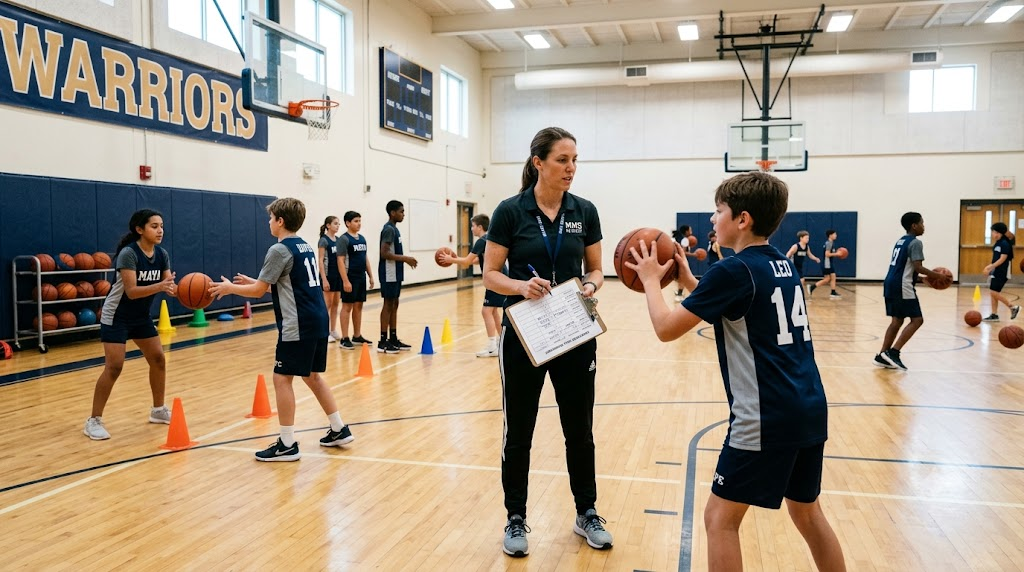
Formative assessment in physical education is an ongoing, low-stakes evaluation process that allows teachers to monitor students’ movement skills, tactical knowledge, and social behavior during live lessons. It focuses on providing immediate performance feedback to improve student learning and guide instructional decisions before final evaluations.
People often call this “assessment for learning.” The whole idea is to stop worrying so much about a final letter grade and focus on the actual learning process. In a loud, busy gym, this physical education assessment strategy doesn’t mean stopping everything to take a written test. Instead, it happens naturally during play. It might be a quick tip you give a student during a basketball drill, a simple checklist partners use during gymnastics, or just asking for a quick thumbs-up to see if everyone feels comfortable before a game starts.
Formative assessment supports student-centered learning and aligns with UNESCO’s Quality Physical Education framework, which promotes inclusive and lifelong physical activity.
Who Benefits from Ongoing PE Assessments?
When you change how you look at physical education assessment, the benefits ripple out to everyone involved in the school community:
- Teachers: It takes the guesswork out of lesson planning. You get immediate data showing if kids grasp a skill or if you need to re-teach it.
- Students: They get a clear roadmap of what skill development looks like. They aren’t wondering how they are being graded; they see their own progress.
- Schools & Administration: It provides concrete proof of student performance and learning outcomes based on clear performance criteria.
- Parents: It shifts report card conversations from “your child doesn’t pay attention” to objective updates on their actual movement competency.
Why Ongoing Assessment Matters in the Gym
When you build these quick checks into your daily routine, you turn a chaotic game space into a real learning environment. It completely changes the vibe from “what game are we playing today?” to “what skill are we mastering today?”
Research in physical education consistently shows that timely feedback improves skill acquisition because students correct movement patterns before they become bad habits. In my own classes, I’ve noticed that students who receive immediate verbal feedback often correct their technique within the exact same lesson instead of repeating the same mistake throughout the entire unit.
- It makes mistakes okay: Since these checks don’t hurt their grades, students feel comfortable trying new moves without stressing over messing up.
- It helps you change things up fast: A quick look around the gym tells you exactly who needs a tougher challenge and who needs an easier setup or lighter equipment.
- It gets kids motivated: When a student hears specific performance feedback like, “Keep your elbow tucked just like that, and look how much straighter your shot goes,” they see a clear link between good technique and better results.
The Three Domains of Holistic PE Assessment
If you want to know how a student is really doing, you can’t just look at their athletic skill. True physical literacy means keeping an eye on three specific learning objectives: moving, thinking, and connecting.
                  ┌─────────────────────────────┐
                  │  HOLISTIC PE ASSESSMENT     │
                  └──────────────┬──────────────┘
                                 │
         ┌───────────────────────┼───────────────────────┐
         ▼                       ▼                       ▼
┌─────────────────┐     ┌─────────────────┐     ┌─────────────────┐
│      MOVE       │     │      SOLVE      │     │     CONNECT     │
│  (Psychomotor)  │     │   (Cognitive)   │     │   (Affective)   │
│ Motor skills,   │     │ Rules, strategy,│     │ Teamwork, grit, │
│ form, mechanics │     │ spatial awareness│    │ sportsmanship   │
└─────────────────┘     └─────────────────┘     └─────────────────┘
1. Move (The Psychomotor Domain)
This is what most people picture when they think of gym class. It’s all about watching basic movement patterns and physical skills. Through structured teacher observation, you look at the mechanics: Is the student stepping with the correct foot when they throw? Are they bending their knees to cushion their landing?
2. Solve (The Cognitive Domain)
Gym class takes real brainpower. This area checks if a student actually knows the rules of a game, can make smart tactical plays, and understands where to position themselves. For example, do they know how to open up space to catch a pass, or can they explain how zone defense works compared to man-to-man?
If you are looking for ways to structure cognitive goals in other areas, check out our guide on 3rd Grade Math Lesson Plans or review our resources on AP Spanish Language Vocabulary to see how cross-curricular planning works.
3. Connect (The Affective Domain)
This part focuses on personal behavior and social skills. You’re watching how well students work together, how they handle arguments on the court, whether they show good sportsmanship, and how they deal with frustration when things go wrong.
Examples of Formative Assessment in Physical Education
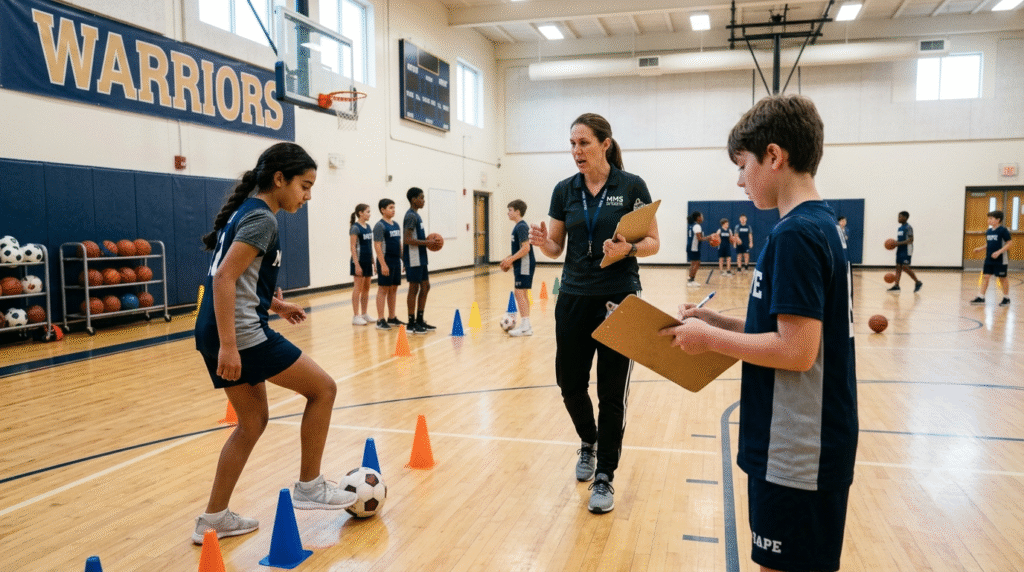
You don’t need to halt the action for fifteen minutes of paperwork to see where your students stand. The smartest examples of formative assessment in physical education fit right into your normal activities.
1. Peer Observations & Checklists
Pairing kids up to check each other’s form keeps everyone busy, even if you run low on equipment. Give them a super short, two-item checklist that targets specific movements.
Real-World Scenario: While practicing soccer passing, Partner A kicks against a wall and Partner B watches their technique. Partner B’s sheet has two simple questions: 1. Did they set their non-kicking foot right next to the ball? 2. Did they pass using the inside of their foot? Partner B shares what they saw, and then they swap places.
2. Interactive Exit Tickets
Right before the class heads to the locker rooms, have them answer a quick question. This can be done on index cards, small whiteboards, or a shared tablet.
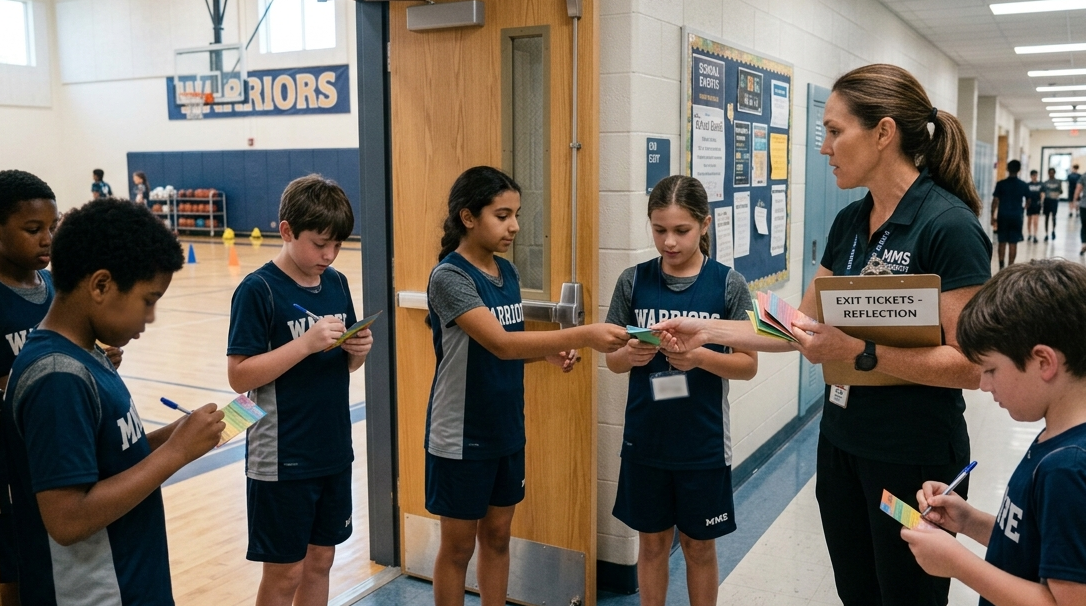
- Cognitive prompt: “Draw a fast sketch showing how a frisbee flies when you tilt it inside-out.”
- Affective prompt: “Write down one helpful thing a teammate did or said during our game today.”
3. High-Tech and Low-Tech Fitness Tracking
Modern physical education thrives on technology integration. If your school has the budget, heart rate monitors and fitness trackers allow kids to check their screens midway through a workout to see if they are in their target zone. If you don’t have wearables, you can use quick QR codes posted on the gym wall. Students can scan them with a tablet to submit quick self-reflections or answer a rapid-fire quiz on platform apps like Plickers or Kahoot.
4. Thumb Signals (Traffic Light System)
This is a quick, quiet way to read the room without disrupting the flow of class. Just ask everyone to hold a thumb against their chest:
- Thumbs Up: “I totally get the rules and I’m ready to play.”
- Thumbs Sideways: “I’m a bit confused about the boundaries, but I can give it a shot.”
- Thumbs Down: “I’m totally lost and need you to explain it one more time.”
Formative and Summative Assessment in Physical Education
To design a solid curriculum, you have to know how formative and summative assessment in physical education balance each other out. They aren’t opposites; they are just different parts of the same learning journey.
| Assessment Aspect | Formative Assessment | Summative Assessment |
| Primary Purpose | To back up ongoing assessment and guide daily changes | To test final skill mastery and give out grades |
| Timing | Happens during the actual learning process | Happens at the very end of a unit or grading period |
| Stakes/Impact | Low stakes; usually doesn’t affect the final grade | Higher stakes; counts for a big chunk of the report card |
| Teacher Action | Fix instructions, offer quick cues, swap groups | Log final stats, see how well the whole unit worked |
| PE Example | Watching a student’s forearm form during a volleyball drill | Counting completed passes during a real, formal game |
Step-by-Step: Implementing Formative Assessment
Ditching compliance-only grading takes a clear plan. Use this simple roadmap to weave quick checks into your next movement unit.
- Establish Clear Lesson Objectives (Pre-Class Planning): Decide exactly what success looks like before class starts. Skip vague goals like “today we play badminton.” Instead, focus on something clear: “Students will hit an underhand serve that clears the net and lands in the back court.”
- Deliver Explicit Criteria (First 5 Minutes): Show the kids exactly what steps lead to a perfect movement. Demonstrate it yourself or use a poster with basic pointers (like, “Drop the ball instead of tossing it, and step with your opposite foot”).
- Conduct Active Scanning and Cues (During the Activity): Move around the gym constantly. Instead of just shouting generic praises like “good job,” use precise cues that match your goals, like “Keep that wrist steady when you make contact, Marcus.”
- Deploy a Mid-Lesson Check-In (Halfway Point): Bring everyone in for a quick 60-second huddle. Ask a strategic question to see if they understand the strategy, then send them right back out to try it.
- Collect Final Reflection Data (Last 5 Minutes): Grab some quick feedback using an exit ticket or a fast thumb vote before the bell rings. Look this over before next class so you know whether to move on or review.
Sample Assessment Rubric: Overhand Throwing Mechanics
To make your performance assessment criteria clear, you can use a simple, actionable layout like this:
| Skill Element | Beginning | Developing | Proficient | Advanced |
| Stance & Step | Faces target directly; steps with same-side foot. | Turns slightly; steps forward but lacks balance. | Side to target; steps with opposite foot toward target. | Perfect side alignment; explosive transfer of weight. |
| Arm Action | Pushes ball forward from chest level. | Drops arm straight down without wind-up. | Brings ball back and up past ear level; follows through. | High elbow extension; fluid whip motion and deep follow-through. |
Overcoming Common PE Assessment Challenges
Let’s be completely honest: assessing movement patterns in a massive gym is tough. Here are the biggest hurdles teachers face and how to clear them:
- Challenge: Massive classes (40+ students). It feels impossible to look at every kid.
- Solution: Use peer-to-step networks. Let students use basic check sheets for each other so you can focus your attention on the kids who need the most help.
- Challenge: Limited equipment and short class periods. You can’t waste ten minutes passing out sheets.
- Solution: Go visual and digital. Use visual charts on your gym walls or quick video analysis on tablets where students film a three-second clip of their partner’s form for instant reflective learning.
- Challenge: Massive gaps in student ability.
- Solution: Build tiered assessment criteria into your tasks. Let students choose their distance from a target, but assess them on their form rather than whether they hit the bullseye.
Best Practices for Daily PE Lessons
- Keep objectives transparent: Never keep the daily goal a secret. Write it on a whiteboard where kids see it the moment they walk into the gym.
- Keep it brief: An assessment strategy shouldn’t take away from active movement time. If a check takes longer than two minutes, simplify it.
- Encourage self-reflection: True motor learning happens when a student can analyze their own movement. Ask open-ended questions that force them to feel their own body mechanics.
- Use data to pivot: If your exit tickets show that 70% of the class is confused about a rule, don’t move on to a tournament. Use that data to change your instructional choices the next morning.
Common Assessment Mistakes PE Teachers Make
Even the best teachers can trip up when trying to track movement skills. Keep an eye out for these classic mistakes:
- Grading hustle instead of actual learning: It’s tempting to hand out top marks to the kid who always smiles and tries hard. But if they still can’t throw properly or explain basic rules, your grade isn’t showing true progress.
- Making data tracking way too complicated: If your rubrics require you to log ten different metrics for forty kids every single day, you’ll burn out fast. Keep things simple with easy Yes/No checklists focused on one main skill per class.
- Collecting data but never using it: If you gather exit tickets just to throw them in a drawer without changing your next lesson, it’s just busywork. Let the kids’ actual performance dictate how fast you move through the curriculum.
Frequently Asked Questions
What is a formative assessment in physical education?
It’s just an easy, informal strategy a teacher uses during class to see if students understand a concept or can do a physical skill. The main goal is to get quick insights so you can update your instruction and give immediate feedback to help students improve.
How do I manage formative assessment with large classes of 40+ students?
When classes get huge, rely on partner networks and fast visual checks. Use peer sheets where kids check each other’s form, or use group thumb signals to get a read on the entire room in less than ten seconds.
Can formative assessments be used for grading?
You shouldn’t put these directly into the grade book as penalties. Think of them as practice markers instead. If you mark a kid down early in a unit while they’re still figuring out a new skill, you’ll just crush their confidence. Use these moments for coaching, and save the actual grading for the final summative test.
Final Thoughts
Bringing a regular strategy for formative assessment in physical education into your program completely changes the environment of the gym. It stops being a place where only the natural athletes stand out and becomes an inclusive space where every single kid learns how to get better step-by-step. By breaking your checks into moving, thinking, and connecting, you give your students the tools they need to build true physical literacy and stay healthy for life.