
Ask ten people what the best book for learning Russian is and you’ll get ten different answers, and honestly, they’re all a little right. Someone who’s never seen the Cyrillic alphabet needs a completely different starting point than someone who can already order coffee in Russian but keeps butchering the grammar. So instead of another generic “top 10” list, this guide sorts books by what they’re actually built for, so you can skip the trial and error.
Quick answer, if you just want one: Complete Russian (Teach Yourself) covers reading, writing, listening, and speaking in a single course, which saves most self-learners from buying three separate books. It’s not the right pick for everyone though, and we’ll get into exactly who should look elsewhere.
What Is the Best Book for Learning Russian?
There’s no single “winner” here, no matter what a clickbait headline promises. The best book for learning Russian really comes down to two things: where you’re starting from and what you’re actually trying to do. Want conversation skills? Reading fluency? Bulletproof grammar? Or just enough phrases to survive a trip? Complete Russian handles the broadest range for beginners. Grammar nerds tend to prefer New Penguin Russian Course. And if reading is the real goal, skip the textbook altogether and start with graded stories instead.
How to Choose the Right Russian Learning Book
A handful of honest questions will save you from reading twenty Amazon reviews.
Where are you starting from, exactly? A total beginner and someone who already knows the alphabet and a few phrases are not in the same boat, even if both call themselves “beginners.”
What’s actually pulling you toward Russian? Travel, speaking, grammar, literature, each one points you toward a different book, and chasing one that does everything usually ends in a half-finished shelf sitter.
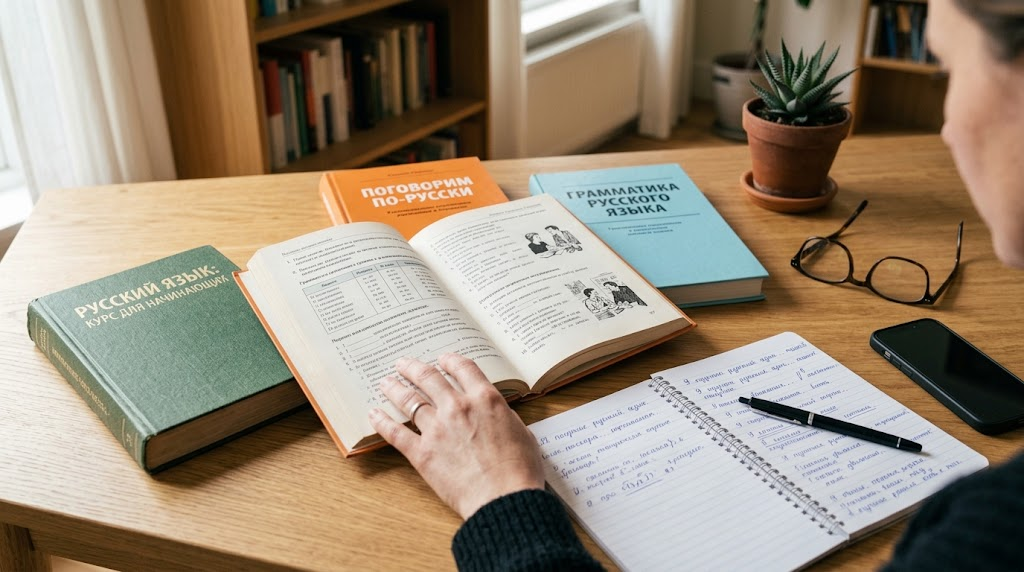
How do you personally learn? Some people want rules explained before they see examples. Others need a story to hang the vocabulary on. Neither approach is wrong, but going against your own grain is a fast track to quitting.
Does it come with audio? This one’s not optional, honestly. Russian word stress can shift the entire meaning of a word, and trying to guess pronunciation from print alone builds bad habits fast.
Can you check your own answers? If you’re studying solo, no answer key means mistakes just sit there uncorrected for weeks. It sounds minor. It’s not.
Best Russian Books at a Glance
| Book | Best For | Level | Learning Style | Audio | Main Strength |
|---|---|---|---|---|---|
| Complete Russian (Teach Yourself) | All-round skill building | A1 to B1/B2 | Structured textbook | Yes | Covers all four skills in one course |
| New Penguin Russian Course | Grammar-first learners | A1 to A2/B1 | Traditional textbook | Limited | Deep grammar explanations |
| Beginner’s Russian | First steps | Absolute beginner | Interactive workbook | Yes | Everyday situational vocabulary |
| Russian Tutor | Grammar practice | Intermediate | Exercise-based | No | Applied grammar tasks |
| Russian Short Stories for Beginners | Reading practice | Lower beginner | Graded reader | Some editions | Vocabulary through narrative |
| Easy Russian Phrase Book | Travel and quick phrases | All levels | Phrasebook | Yes | Phonetics guide for pronunciation |
| Learn the Russian Alphabet | Cyrillic basics | All levels | Workbook | No | Tracing exercises for print and cursive |
Best Overall Book for Learning Russian: Complete Russian
Why does Complete Russian sit at the top? Mostly because it does the job of three books at once, reading, writing, listening, and speaking, without making you piece together separate resources yourself. Lessons build around real situations you’ll actually hit: ordering food, asking directions, small talk with a neighbor. Grammar gets folded in gradually instead of dumped on you all at once in chapter one, which matters a lot more when you’re studying alone than in a classroom, where a teacher can just explain a confusing bit on the spot.
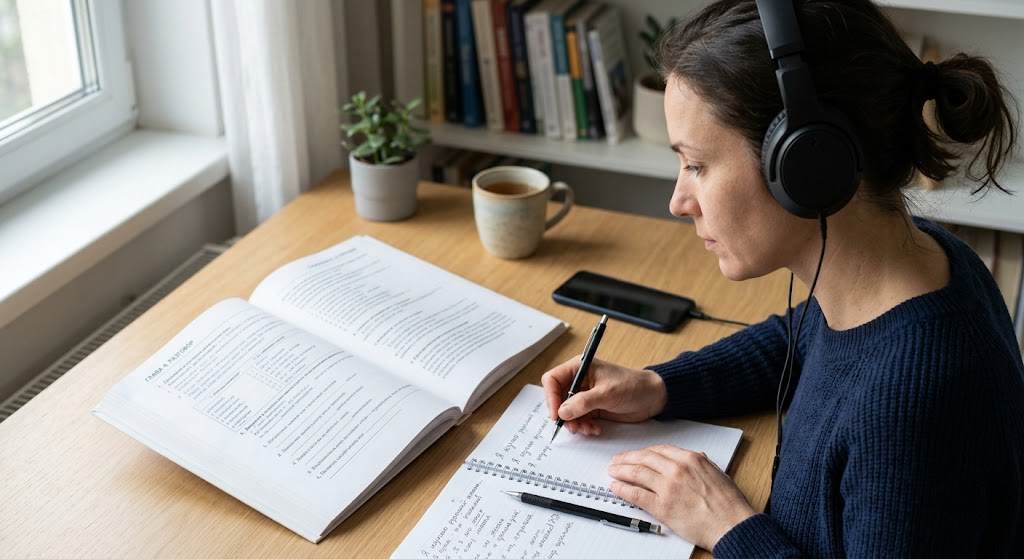
The audio deserves its own mention. Russian stress patterns shift depending on the word form, and if you only ever see the text, you’ll end up guessing, and guessing wrong more often than you’d think. Hearing it said correctly first saves you from unlearning bad habits later. There’s also a fair bit of built-in repetition, so a word from chapter three actually shows back up in chapter eight instead of vanishing.
Who should skip it? Anyone who already has some Russian under their belt and wants a fast, dense grammar deep-dive is going to find the pace slow, maybe even a little frustrating. This book is built for someone starting near zero. For that person specifically, it’s tough to beat.
Best Books to Learn Russian for Beginners
Three names come up again and again here, and each solves the “beginner” problem a little differently.
Beginner’s Russian goes the interactive workbook route. It walks through real, everyday scenarios and builds vocabulary a piece at a time, which works well if you’ve never studied a language before and don’t want it to feel like sitting through a lecture.
New Penguin Russian Course, written by Nicholas J. Brown, does almost the opposite. Rather than easing grammar in through short dialogues the way Complete Russian does, it puts the grammar right on the table early, case endings, gender agreement, verb patterns, and explains the logic before you’re expected to actually use any of it. That can feel heavy in the first few chapters. But once Russian’s case system starts showing up everywhere (and it will), that early groundwork pays off. If you’re someone who genuinely wants to understand why a sentence works before speaking it, this beats a lighter beginner course. One thing worth flagging: some of the vocabulary examples feel a bit dated, this book predates smartphones by a good margin.
My First Russian Book, built around illustrated vocabulary, isn’t really meant to stand alone. Think of it more as a warm-up for visual learners, or a companion sitting alongside one of the two books above.
Short version if you’re stuck choosing: go with Beginner’s Russian if you want something low-pressure and practical, go with New Penguin if you’d rather have the grammar explained properly right from day one.
Best Russian Book to Learn From Scratch
Starting from actual zero, not knowing the alphabet at all, is a different situation than being an “absolute beginner” who’s at least seen Cyrillic before. If that’s where you are, diving straight into a full textbook can feel like drowning.
A better order looks like this: Learn the Russian Alphabet first, until reading and writing Cyrillic feels normal instead of exhausting. Then move into Complete Russian. Then bring in a graded reader once basic sentences stop feeling like a puzzle. This sequence matters more than most people expect going in, trying to learn grammar and the alphabet at the same time just slows both down.
If you already know you’re the grammar-first type, New Penguin Russian Course also works from a true beginner starting point, it just asks for a bit more patience before the payoff shows up.
Best Russian Textbook for Self-Study
Self-study changes the math on what actually matters in a book. Structured lessons, answer keys, and audio go from “nice to have” to genuinely essential, they’re the difference between catching your own mistakes early and repeating them for months without noticing.
Complete Russian holds up well here, structure, audio, and checkable answers all in one place. Golosa, which shows up a lot in university courses, is another solid self-study option, especially if you want something closer to an academic pace, though it does lean more formal than conversational. Beginner’s Russian also works for self-study, particularly if shorter, less intimidating lesson chunks sound more sustainable to you. New Penguin can work solo too, but it takes more discipline, since the grammar-heavy structure leaves fewer built-in nudges to keep you moving.
Studying completely alone, no tutor, no classroom? Pick whichever book actually has answer keys you’ll realistically use, not just the one with the best reputation online.
Best Book for Learning Russian Grammar
Grammar is usually where things stall out, and Russian doesn’t make it easy on anyone. Six grammatical cases (nominative, accusative, genitive, dative, instrumental, prepositional), noun and adjective endings that shift with gender and case, verbs that come in perfective and imperfective pairs that trip up almost every single learner at some point. Toss in motion verbs and flexible word order once you’re past the basics, and yeah, it’s a lot.
Russian Tutor earns its spot specifically once you’ve hit that wall, not before. It’s built around applied exercises instead of abstract drills, so you’re using case endings and verb conjugation inside actual sentences rather than just memorizing a chart and hoping it sticks.
A Comprehensive Russian Grammar works better as a reference you keep within reach than something you sit down and read cover to cover. Pull it out mid-lesson when a case ending or verb aspect rule suddenly stops making sense.
501 Russian Verbs is narrower still, pure drilling for conjugation and aspect pairs, useful once the concept already clicks and repetition is genuinely what’s missing.
Best Books for Russian Reading Practice
Reading works better as a ladder than a single purchase. At A1 to A2, graded stories like Russian Short Stories for Beginners (Olly Richards) teach vocabulary through actual narrative instead of isolated flashcards, twenty stories, comprehension questions built right in. Moving up to A2 to B1, Short Stories in Russian for Beginners covers similar ground aimed a bit higher.
Once that feels comfortable, B1 to B2 learners can shift toward dual-language books like the Penguin Parallel Texts series, Russian and English side by side, which softens the jump into material that isn’t adapted for learners at all. B2 and beyond is really where authentic Russian literature, short stories, novels in their original form, starts to feel realistic instead of punishing.
Want a broader, expert-curated take on Russian reading picks? Five Books put together a well-regarded roundup that’s worth a look, especially if literature is the actual end goal rather than day-to-day conversation. Good second opinion beyond any single list, including this one.
Best Book for Russian Speaking and Listening
Speaking and listening get the least attention in most book reviews, which is odd, because this is arguably where a book alone falls shortest. Complete Russian is a strong pick here thanks to its audio dialogues built around everyday conversations. Shadowing them, listen first, repeat out loud, then check the transcript, does more for pronunciation and word stress than silent reading ever will.
Still, let’s be honest about the limits. No book replaces actual speaking practice. Understanding a dialogue on the page is a completely different skill from producing one out loud under pressure, in real time, with someone waiting on your answer. A book gets you the vocabulary and the listening reps. The actual talking, even just narrating your day to yourself out loud, has to happen alongside it.
Best Russian Books for Travel
Trip coming up soon and no time for a full course? The Easy Russian Phrase Book is the fastest practical option. It’s organized by topic with a big set of common phrases plus a phonetics guide, so you’re not just guessing at pronunciation. Conversational Russian Dialogues takes a similar practical route but frames everything as scripted real-life exchanges, which is a lot easier to rehearse out loud than to just read silently on a plane.
Best Resources for the Russian Alphabet and Vocabulary
Cyrillic looks way scarier from the outside than it turns out to be once you actually sit down with it. Learn the Russian Alphabet leans on tracing exercises to build muscle memory for both print and cursive, and with a bit of regular practice, most people find they’re reading basic Cyrillic faster than expected. For vocabulary, the Russian-English Bilingual Visual Dictionary, roughly 10,000 illustrated words plus a companion audio app, is a solid fit for anyone who remembers pictures better than plain word lists.
Vocabulary retention itself is less about the book you pick and more about the method behind it. We covered practical techniques for that separately in our guide on how to memorize vocabulary more effectively, and it applies whether you’re working through a textbook or a graded reader.
Best Russian Books by Level: A1 to B2
Mapping books to the CEFR scale makes this whole decision a lot more concrete. A1 is about Cyrillic, pronunciation, and basic phrases, so Learn the Russian Alphabet paired with the early chapters of Complete Russian fits there. A2 shifts toward everyday conversation and foundational grammar, still well covered by Complete Russian or the first half of New Penguin. B1 brings more complex grammar plus actual reading practice, which is where graded readers and Russian Tutor start earning their keep. By B2, you’re aiming at authentic texts and more advanced grammar, and that’s where dual-language books and A Comprehensive Russian Grammar as a standing reference stop being optional extras.
Best Book for Learning Russian on Reddit
Ask r/russian which book to buy and a handful of names come up over and over: New Penguin, Golosa, Living Language. Worth treating this as community opinion, not gospel, since answers shift a lot depending on whether the person replying learned in a classroom or entirely on their own.
There’s a real, ongoing back-and-forth in those threads between people who swear by grammar-heavy resources like New Penguin and people pushing communication-first options that get you speaking sooner, gaps in accuracy and all. Neither side is exactly wrong, it just depends what you’re optimizing for. The one thing nearly everyone actually agrees on: swapping books every few weeks slows you down way more than any single book choice ever could.
Best Book for Learning Russian PDF: Free and Legal Options
There’s a real gap between a legitimately free Russian learning PDF and a pirated scan from some random download site, and it’s worth knowing the difference before you go searching. Some publishers put out official ebook versions of their textbooks, and university language departments occasionally host open-access grammar guides, alphabet charts, and phrasebooks that are genuinely free and clean of any copyright issues.
Unofficial download sites are a different story altogether. Beyond the obvious licensing problem, those scans are often outdated editions, missing pages, or stripped of the audio links that made the book worth using in the first place. Before trusting any free digital Russian textbook, check that it’s a current edition, that it includes or at least references audio, and that it’s coming from a source that actually has the rights to give it away.
Book vs App: Which Is Better for Learning Russian?
This isn’t really an either-or question, honestly. Books are stronger for structured grammar explanations, case tables, and the kind of long-form reading comprehension that’s hard to pull off on a phone screen. Apps win at daily repetition, pronunciation feedback, and squeezing in ten minutes of practice while you’re waiting on coffee. Most people who actually stick with Russian long-term end up using both, a textbook for the backbone, an app for daily reinforcement. We’ve broken down which apps actually pair well with a book in a separate guide to Russian language learning apps, if you want to build that combo properly.
How to Learn Russian Effectively With a Book
A book on its own rarely gets anyone to real fluency, but a few habits speed things up noticeably. Learn Cyrillic first, fighting the alphabet and grammar at the same time just doubles the pain. Work through lessons in order instead of skipping to whatever chapter looks “interesting.” Listen before you read the transcript, let your ear do some of the work instead of leaning entirely on your eyes. Read sentences out loud, even alone in your room, feeling silly is fine. Try writing your own simple sentences instead of only filling in blanks. Go back and review the cases regularly, one chapter on them is never enough. Use spaced repetition for vocabulary rather than cramming a list the night before. Start graded reading earlier than feels comfortable. Prioritize actual speaking over passive review whenever you can. And probably the biggest one: stop switching textbooks the moment progress feels slow, that resets your momentum way more than it fixes anything.
How Long Does It Take to Learn Russian With a Book?
There’s no honest number that works for everyone here, and any guide promising “fluent in 3 months” is selling you something. Progress depends on daily study time, whether you’ve picked up another language before, how consistent you actually are week to week, and how much speaking or listening you’re getting outside the book itself.
A realistic routine matters more than a fixed timeline: 30 to 60 minutes with the book most days, some audio if the book includes it, a few minutes of speaking practice, even just talking to yourself about your day. Learners who keep that up consistently tend to notice real conversational progress somewhere between six months and a year. That’s a rough pattern though, not a promise, and it moves around a lot based on everything above.
Which Russian Book Should You Start With?
Still not sure? Here’s the fast version.
- Absolute beginner wanting one complete course: Complete Russian
- Starting from true zero, no Cyrillic yet: Learn the Russian Alphabet, then Complete Russian
- Prefer grammar explained before conversation: New Penguin Russian Course
- Learning mainly through stories and reading: Russian Short Stories for Beginners
- Trip coming up soon: Easy Russian Phrase Book
- Already speaking, need a grammar reference: A Comprehensive Russian Grammar
- Studying entirely alone with no classroom support: Complete Russian or Golosa, prioritizing answer keys and audio
Frequently Asked Questions
What is the single best book for learning Russian?
Complete Russian (Teach Yourself) is the strongest overall pick for most self-learners, since it covers reading, writing, listening, and speaking in one structured course.
Can I learn Russian with only books?
Yes, though it’ll be slower without regular speaking practice. Pair a book with audio and occasional conversation practice and things move noticeably faster.
What’s the best book for absolute beginners?
Beginner’s Russian or New Penguin Russian Course, both work, it really depends on whether you want a practical workbook feel or grammar explained up front.
Which book is best for Russian grammar specifically?
Russian Tutor, once you already have the basics down and want to lock in grammar through applied exercises instead of pure theory.
Is there a best book for total beginners with zero Cyrillic knowledge?
Start with Learn the Russian Alphabet, then move into Complete Russian once reading Cyrillic stops feeling exhausting.
Are legal free PDF versions available?
Some grammar guides and phrasebooks are legitimately free through official ebooks and university open-access resources. Skip the unofficial download sites, those editions are usually outdated or missing chunks.
How long does it realistically take to learn Russian from a book?
No fixed number, but consistent daily study plus speaking practice tends to show real conversational progress somewhere between six months and a year for most people.
Final Recommendation
There’s no single, universally correct answer to which is the best book for learning Russian. It depends on your level, your goal, and honestly, how you like to study. For general, well-rounded progress, Complete Russian is still the strongest place to start. Reading-focused learners should start with graded stories and work up to dual-language texts over time. For grammar depth, New Penguin or Russian Tutor cover that better than any all-in-one course can. Whichever one you land on, the thing that actually matters isn’t the book itself, it’s finishing what you start instead of restarting with something shinier every few weeks.
If you want a broader academic reference beyond this list, Indiana University’s language library maintains a detailed guide to Russian textbooks and teaching resources, worth bookmarking alongside these recommendations.