

In England, GCSE grades are numbers running from 9, the highest, down to 1, the lowest. There’s also a U, which stands for ungraded and means the overall qualification result didn’t reach the standard needed for a numbered grade. Grade 4 counts as a standard pass and grade 5 as a strong pass, and on results day those two numbers end up mattering more than people expect. If you grew up with A*, B and C, the new system can look strange at first. So this guide goes through how the old and new grades compare, what a pass really is, why nobody can give you a fixed percentage for a grade, and what your options are if a result comes in lower than you wanted.
GCSE Grades Explained: How the 9–1 Scale Works
England moved from letters to numbers in stages. English Language, English Literature and Maths were the first, graded with numbers in 2017. A lot of other subjects followed in 2018 and 2019, and by 2020 the rest had caught up. The reason for the change came down to the top end. Under the old system plenty of strong students ended up with the same A or A*, which made life hard for sixth forms and universities trying to tell them apart. Having three grades at the top, 7, 8 and 9, gives them more room to do that.
Once you’ve seen it written out, the scale is pretty easy to follow. A higher number means a better result, 9 is as high as it goes, and 1 is the lowest grade you can be awarded.
Here’s a quick reference to keep next to your results slip:
| Grade | What it signals |
|---|---|
| 9 | The very top; awarded to a small slice of the highest scorers |
| 8 | Excellent, just below the top grade |
| 7 | A strong result; the bottom of grade 7 is comparable to the bottom of the old grade A |
| 6 | Solid and comfortably above a pass |
| 5 | Strong pass |
| 4 | Standard pass |
| 3 | Below the standard pass |
| 2 | Well below the standard pass |
| 1 | Lowest graded result |
| U | Ungraded (unclassified) |
People often ask about U, so it’s worth a quick note. It isn’t a “grade 0” and it doesn’t sit below grade 1 on a scale. It simply tells you the work didn’t earn enough marks overall to be given a numbered grade.
One more thing that catches families out is tiers. In some subjects, such as Maths, students sit either a foundation or a higher tier paper. Foundation tier covers grades 5 to 1, and higher tier covers 9 to 4, with a limited safety net grade 3 for students who just miss a 4. That’s why two friends with the same subject can have different top grades available to them.
Old Letter Grades Against the New Numbers
Parents tend to ask this one first. What’s a 6 in old money, and is a 4 really the same as a C?
Not exactly. The two systems weren’t built to match grade for grade. They were lined up at three set points and everything between those points is only a rough comparison.
- The bottom of grade 7 is comparable to the bottom of the old grade A.
- The bottom of grade 4 is comparable to the bottom of the old grade C.
- The bottom of grade 1 is comparable to the bottom of the old grade G.
With those anchors in place, this is roughly how the rest falls:
| New grade | Rough old equivalent |
|---|---|
| 9 | Above the old A* |
| 8 | Around the old A*/A boundary |
| 7 | A |
| 6 | Upper B |
| 5 | Lower B / upper C |
| 4 | C |
| 3 | D / lower E |
| 2 | E / F |
| 1 | F / G |
Don’t read the middle rows as exact conversions. Grade 5 shows why. It lands in a spot the old system never had, a bit above a C and a bit below a B, so schools describe it as a strong pass instead of trying to fit it into a letter.
Grade 9 is a special case too, because there’s no matching old grade for it. It was brought in to split the very best candidates away from the rest of the A* group, and only a small share of students who get a 7 or above are awarded one. It really does mark out a top performance.
If you need to turn “gcse grades numbers to letters” for an old certificate or a form that still asks for letters, give both together. Something like “grade 6, broadly a high B” is fair, and nobody reading it will be misled.
What Is a Pass at GCSE? Grade 4 and Grade 5
England has two pass levels, and they get mixed up all the time.
Grade 4 is the standard pass. It’s the main benchmark, and it’s what the government expects students to reach in English and Maths. It’s also the line that decides whether you have to keep studying those two subjects after the age of 16.
Grade 5 is the strong pass. Schools and colleges treat it as a sign you know the material well. A lot of sixth forms ask for a 5 in any subject you want to take at A-level, and some ask for a 6 or 7 where the step up is big, Maths and the sciences being the usual examples.
Beyond those two benchmarks there isn’t a national rule. Each school or college sets its own entry requirements, and they can shift from one year to the next. A typical sixth form might want five GCSEs at grade 4 or higher, English and Maths included, along with better grades in the subjects you plan to study. A highly competitive one might ask for a handful of 7s. The most reliable place to check is the prospectus or admissions page of the place you’re applying to.
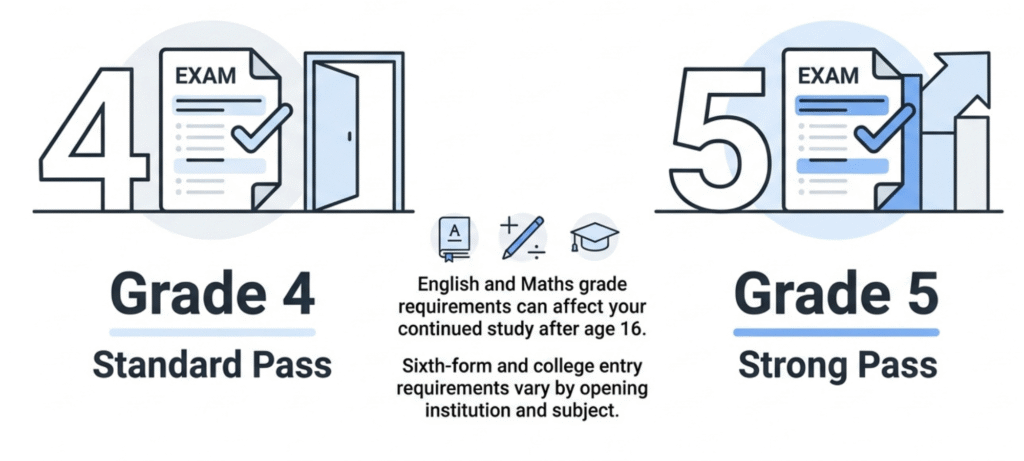
If you’re trying to decide how much a 4 versus a 5 really matters, think of it like this. A 4 leaves most doors open. A 5 opens a few more without anyone needing to talk it through first. Neither closes a route for good.
GCSE Grades Percentages and Grade Boundaries
“What percentage do I need for a 7?” is one of the most common GCSE searches, and it has a disappointing answer. There isn’t a fixed one.
A GCSE paper is marked out of a set number of marks, and the marks you earn are your raw mark. Once the marking is done, the exam board decides how many raw marks are needed for each grade. Those cut-off points are the grade boundaries.
They change because papers change. Exam boards look at evidence about how demanding a paper was and how students performed on it, and senior examiners review scripts around the proposed boundaries to check that the standard of work holds steady from year to year. So the boundaries aren’t a flat percentage, and they aren’t a straight ranking of students either. They’re a judgement about standards, backed by evidence.
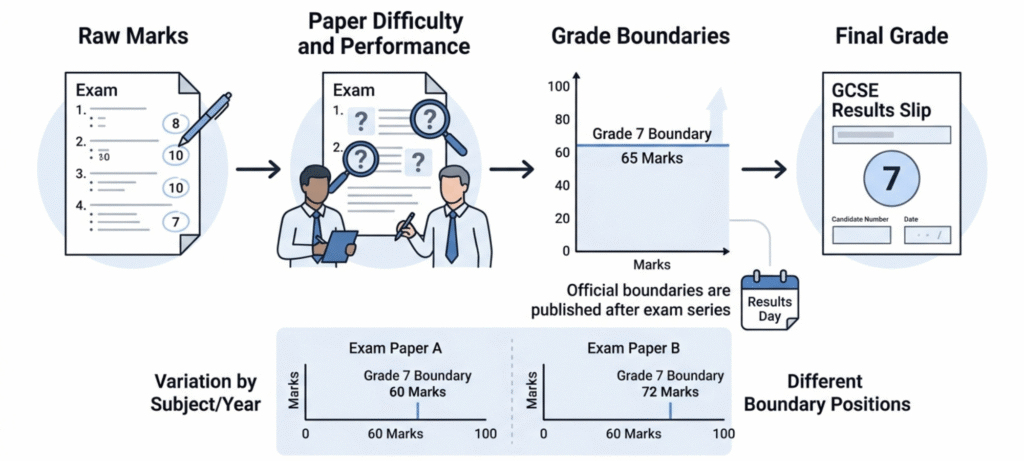
You can see the effect in practice. On some Maths papers the marks needed for a grade 4 have been well under half of the total. On an essay subject like English Literature, a grade 7 can fall somewhere completely different on the percentage scale. That’s why any chart saying “70% is always a grade 7” can’t be trusted, however many times you’ve seen one.
If you want a rough idea of where a grade sits, look at past boundaries for your exact exam board, subject and tier. AQA, Pearson Edexcel, OCR and the other boards publish them every summer, and AQA’s are on its grade boundaries. Use those figures to understand how a past paper behaved, not to predict the next one.
For a wider look at how percentage scores turn into grades in general, our piece on how percentage scores affect student grades covers the basics. GCSE works a little differently, though, because the boundaries are set after the exam instead of before it.
How GCSE Grades Are Set
It helps to know who’s behind all this. Exam boards write the papers, mark them and propose the boundaries. Ofqual, the regulator for qualifications in England, checks that the boards stay consistent with each other and with earlier years. Its own explanation of the system is on GOV.UK in the GCSE 9 to 1 grade scale guide.
The approach is often called comparable outcomes. Put simply, if this year’s students look similar in ability to last year’s, then the overall results should look similar too, even when the paper itself turned out harder or easier. It isn’t a quota, because each student is still graded on the work they handed in. It just stops results from lurching up or down because of one unusual paper.
There’s one more detail that explains the three anchor points. When the new scale started, the system was set up so that around the same proportion of students would get a 7 or above as used to get an A or above, a 4 or above as used to get a C or above, and a 1 or above as used to get a G or above.
GCSE Grades in Combined Science
Combined Science throws almost everyone the first time they see it on a results slip. Instead of one number you get two, like 6–6, 7–6 or 4–3.
The reason is that it’s a double award. It covers Biology, Chemistry and Physics in a slimmer form than studying the three separately, and it counts as two GCSEs. The two grades don’t stand for particular sciences, so the first isn’t Biology and the second isn’t Chemistry. Together they reflect how you did across the whole qualification.
The pair is always made up of two equal or adjacent grades, so you’ll see 9–9, 9–8, 8–8, 8–7, 7–7 and so on, right down to 1–1. A combination like 7–5 isn’t a standard result. If you take Triple Science, which means separate Biology, Chemistry and Physics, you get three single grades instead.
When you’re applying anywhere, give the Combined Science result as it appears on your slip. A 5–5 is a grade 5 in both parts of the double award, and it counts as two GCSEs, though individual colleges and courses may set their own science requirements. Check how the one you want treats it.
GCSE Grades Across England, Wales, Northern Ireland and Scotland
The 9–1 scale belongs to England, which surprises a lot of people who assume it covers the whole UK. Elsewhere the picture looks different.
Wales still uses letter grades for GCSEs, running from A* to G. The qualifications carry similar weight, but the grading isn’t the same, so a Welsh A can’t just be swapped for a number 7.
Northern Ireland works with letters as well, and adds a C* that sits between B and C. Depending on the awarding organisation, students there may get either numerical 9–1 grades or CCEA’s letter-based grades, which include C*.
Scotland doesn’t use GCSEs at all. Students usually take National 5 qualifications at about the same age, graded A to D, with “No Award” for anyone who doesn’t reach the standard. It’s a separate framework, so it shouldn’t be treated as another flavour of the GCSE scale.
If you’re applying from outside England, or you’re a college or employer comparing certificates, check which country and which awarding body issued the result before you convert anything.
What GCSE Grades Mean for Sixth Form, College and Beyond
Grades matter because they point you toward what comes next, but the effect is usually looser than students fear.
For sixth form and college, a common pattern is at least five passes at grade 4 or above, with English and Maths among them, plus specific grades in the subjects you want to take at A-level or on a vocational course. Some centres add up your best eight grades as points. Others only look at the subjects linked to your course. Read the exact wording for each place you apply to.
When it comes to apprenticeships and jobs, plenty of employers just ask for English and Maths at grade 4. For competitive university courses such as Medicine, Law or anything at Oxbridge, GCSEs are one part of a bigger picture. Admissions teams often like to see a solid run of 7s, 8s and 9s because it points to steady performance, but they also read your personal statement, your A-level predictions and the context you studied in.
It helps to remember that GCSEs are a starting line, not a final verdict. Lots of students find their feet at A-level or on a vocational route and finish well beyond where their GCSEs would have suggested.
What Happens If You Miss a Grade 4 in English or Maths?
Missing a grade 4 in GCSE English Language or Maths doesn’t mean your education has hit a dead end. In England, students on eligible 16 to 19 study programmes who haven’t reached grade 4 generally have to carry on studying the subject.
Which route you take depends partly on your grade. Full-time students with a grade 3 must study towards a GCSE in that subject. Those with a grade 2 or below can work towards a GCSE or an approved Functional Skills Level 2 qualification, depending on their circumstances and what the provider thinks is right.
A resit isn’t automatic, and it isn’t always the very next exam series either. Schools and colleges look at how a student is getting on and whether they’re ready before deciding when to enter them. For plenty of students, that extra time and a fresh look at where marks went missing leads to a better result the second time round.
If this applies to you, ask your college or school which route fits and when your next assessment will be. The Department for Education explains the current rules in its maths and English condition of funding guidance. And if you’re curious how grading looks in other countries, our guide to the US high school grading scale makes a handy comparison.
Frequently Asked Questions
What are the GCSE grades from highest to lowest?
In England, GCSE grades run from 9 (highest) to 1 (lowest). U means ungraded.
What does a grade 4 equal in the old system?
Grade 4 is comparable to the bottom of the old grade C, and it’s the standard pass.
Is a grade 5 a good GCSE grade?
Yes. It’s the strong pass, one step above the standard benchmark. Whether it’s enough for a particular sixth form or course depends on that provider’s own entry requirements.
What percentage do you need to pass a GCSE?
There’s no single figure. The marks needed for each grade depend on the subject, exam board, paper and year, so check the published boundaries for your exact paper.
What is the highest GCSE grade?
Grade 9 is the highest on the 9–1 scale used in England.
What does U mean on a GCSE result?
It means ungraded: the overall qualification result didn’t reach the standard for a numbered grade. It isn’t a number below 1.
Why do I have two grades for Combined Science?
Combined Science is a double award and counts as two GCSEs, so the result comes as a pair of equal or adjacent grades, for example 6–5.
Do all UK nations use the same GCSE grades?
No. England uses 9–1, Wales uses letters, Northern Ireland uses either 9–1 or CCEA letter grades depending on the awarding organisation, and Scotland uses a different system called National 5.
Final Thoughts
If you remember one thing about GCSE grades, make it this: 9 is the top, 4 is the standard pass, 5 is the strong pass, and the old letters only line up at a few fixed points. Be careful with any percentage chart, look at the official boundaries for your own paper, and confirm entry requirements with the school or college you’re aiming for. And if a result isn’t what you hoped for, there’s nearly always another way forward, whether that’s a resit, a different course or a stronger run at A-level.
Sources used for fact-checking: Ofqual’s GCSE 9 to 1 grade scale guidance on GOV.UK, the Department for Education’s maths and English condition of funding guidance, and AQA’s published grade boundaries.