

Honestly, most advice on the rules for writing English reads like terms and conditions. Nobody finishes it, and the funny part is that you don’t need most of it. Write whole sentences. Make sure the verb fits its subject. Don’t scatter commas just because you paused for breath. Get those three right and people will take your writing seriously.
I’ve watched students spend an hour debating “who” versus “whom” while their sentences had no verb at all. A grammar book won’t warn you about that, because it gives every rule the same weight. Start with the rules for writing English that prevent the biggest mistakes, and leave semicolons for later.
One sentence like “she go to the office yesterday” can make a capable person look careless. Annoying, right? But the fix is quick. Mistakes repeat, so once you catch your usual ones, your writing gets better fast.
This guide walks through English writing rules at every level: words, sentences, paragraphs, essays, emails, letters, summaries, and a bit of poetry. Every section has examples you can borrow.
What Are the Basic Rules for Writing English?
The basic rules for writing English are simple. Write complete sentences. Match your subjects and verbs. Pick the right tense. Use capitals and punctuation properly. Choose precise words. Keep each paragraph focused, and proofread before you publish.
Behind that list are just three questions. Is the sentence complete? Is it correct? Is it clear? Everything else in this article is a closer look at one of those.
A quick honest note before we go on. English isn’t one fixed system. British and American spelling differ, and style guides argue about commas. So when I call something a “rule,” I’ll tell you whether it’s a firm grammar rule or just a good habit most editors follow.
25 Essential Rules for Writing English
Think of these as a toolkit, not a test. Each one comes with a reason and a quick example.
Rules 1 to 5: Sentence Foundations
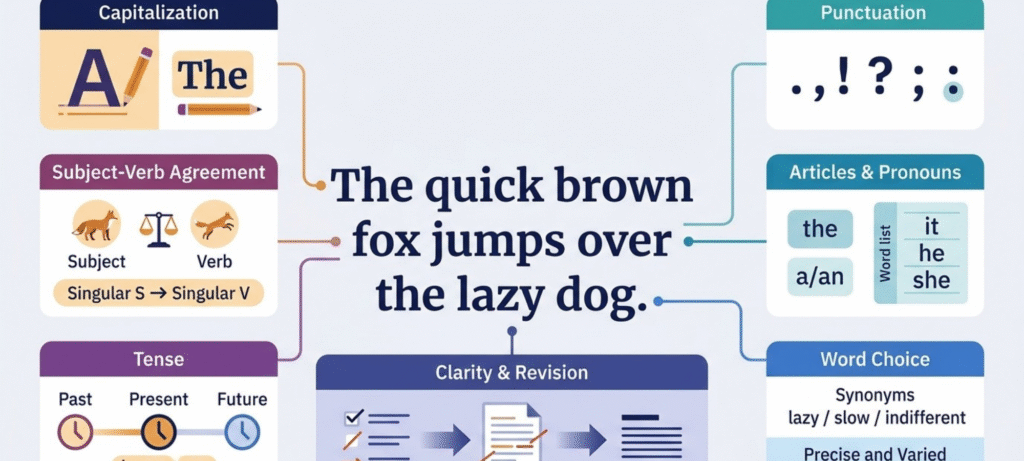
1. Start with a capital letter. It tells the reader a new thought is beginning. the meeting starts at noon should be The meeting starts at noon.
2. Write complete sentences. You need a subject, a verb, and a finished thought. Because the train was late. Late, and then what? Try: Because the train was late, we missed the first session.
3. Match the subject and verb. Here’s a classic trap: The list of items are on the desk. The real subject is “list,” so it’s The list of items is on the desk.
4. Pick a tense and stay with it. He go to Karachi last week should be He went to Karachi last week. Don’t jump between past and present in the same paragraph without a reason.
5. Keep the usual word order. English likes Subject, Verb, Object. The teacher graded the papers. Swap them around and you get nonsense.
Rules 6 to 10: Punctuation and Capitalization
6. Capitalize names and the word “I.” i study english in london becomes I study English in London.
7. End sentences properly. Periods for statements, question marks for questions. Go easy on exclamation marks. One per page is plenty.
8. Use commas to separate ideas. After lunch, we started the report. Or: I wanted to leave, but the rain kept falling. A comma is a small pause, not a place to dump every breath.
9. Apostrophes are for ownership and shortened words. The student’s notebook. It’s means “it is.” And please, never three dog’s.
10. The Oxford comma is your call. The Chicago Manual of Style likes it. The Associated Press Stylebook usually skips it. Neither is wrong. Just stay consistent. We bought pens, paper, and glue.
Rules 11 to 15: Words and Word Forms
11. Choose the right article. It’s a university but an hour, because the sound matters, not the letter. Use “the” when you mean something specific.
12. Make pronouns obvious. Sara told Meena she was late. Who was late? Fix it: Sara told Meena, “You’re late.”
13. Put describing words close to what they describe. A small blue bag sounds right. She quickly finished the exam keeps the adverb near the verb.
14. Watch the lookalikes. Their, there, they’re. Your, you’re. Its, it’s. When in doubt, expand the contraction and see if the sentence still works.
15. Who or whom? Use who for the doer (Who wrote this?) and whom for the receiver (To whom should I send it?). In casual writing, most people just use “who.”
Rules 16 to 20: Precision and Clarity
16. Fewer for things you can count, less for things you can’t. Fewer mistakes, less noise.
17. Skip double negatives. I don’t know nothing becomes I don’t know anything.
18. Be specific. “About 300 people came” tells me more than “a lot of people came.”
19. Keep modifiers next to their targets. She served sandwiches to the guests on paper plates makes it sound like the guests were on the plates. Try: She served the guests sandwiches on paper plates.
20. Stay consistent. If you spell it color, don’t switch to colour halfway down the page.
Rules 21 to 25: Voice, Flow and Revision
21. Prefer active voice when the doer matters. The committee approved the plan is cleaner than The plan was approved by the committee. But passive is fine when nobody knows who did it: The window was broken overnight.
22. Trim the filler. “In order to” is just “to.” “Due to the fact that” is “because.”
23. Mix your sentence lengths. Short ones punch. Longer ones can carry a bit more detail. Using only one kind gets dull quickly.
24. Choose connectors that fit. “However” shows contrast, “because” shows cause, “for example” introduces an illustration. Don’t pick one just because it sounds smart.
25. Read it out loud. Your ear catches things your eyes skip right over.
Rules for Writing English With Examples
Want the quick version? This table gathers common English writing rules with examples in one spot.
| Rule | Incorrect | Correct |
|---|---|---|
| Subject verb agreement | She go home. | She goes home. |
| Capitalization | i study English. | I study English. |
| Tense | He go yesterday. | He went yesterday. |
| Article | She is teacher. | She is a teacher. |
| Pronoun | Me and John went. | John and I went. |
| Apostrophe | The students book | The student’s book |
| Comma | After lunch we left. | After lunch, we left. |
| Fragment | Because I was tired. | Because I was tired, I slept. |
Bookmark it. These eight cover a surprising share of everyday errors.
How to Write English Correctly
Knowing the rules is one thing. Using them while you’re actually typing is another. Here’s a routine that works.
Start with one complete sentence. Check the subject and the verb. Confirm the tense. Look at your articles and pronouns. Then check spelling and punctuation. Cut any extra words. Finally, read it out loud, and proofread before you submit.
Let’s see it in action. Before: Yesterday me and my friend go to library because we has a exam. After: Yesterday, my friend and I went to the library because we had an exam. That’s five fixes in one sentence: pronoun order, tense, a missing comma, agreement, and the article.
Rules for Writing Sentences in English
A correct English sentence has a subject, a verb, and a complete thought. The basic pattern is Subject, Verb, Object. The student completed the assignment. Simple.
There are four sentence types. Declarative sentences state something (It is raining). Interrogative ones ask (Is it raining?). Imperative ones give orders (Close the window). Exclamatory ones show strong feeling (What a storm!).
Then there are four structures:
- Simple: I studied.
- Compound: I studied, and I passed.
- Complex: I passed because I studied.
- Compound complex: I studied because the exam was difficult, and I passed.
Good writers mix all four. Otherwise the text starts to sound like a robot reading a manual.
Now the usual mistakes. A fragment is missing a subject or verb (Running late for class). A run on glues two sentences together (I finished the report I sent it). A comma splice joins two full sentences with only a comma (The test was hard, I passed anyway). You can fix any of them with a period, a conjunction, or a semicolon.
Here’s a trick I like. Find the verb first. Then ask who’s doing it. If you can’t answer, the sentence is probably broken.
Rules for Writing Clear and Natural English
Grammar gets your sentence accepted. Clarity gets it understood. And plenty of perfectly correct writing is still exhausting to read, because it hides the point behind abstract words and long, winding phrases.
The US government’s plain language guidelines say it well: write for the reader, use everyday words, and keep sentences short. You can read the whole approach at PlainLanguage.gov. It works for students and professionals alike.
A few habits help:
- Be specific. Swap “many students struggled” for “14 of 30 students failed the quiz.”
- Pick the simpler word. “Use” beats “utilize” nearly every time.
- Lead with the point. Main idea first, details after.
- Read it like a stranger. Could someone with no background follow it?
Tone matters too. An email to your professor and a message to a friend can both be correct, but they shouldn’t sound the same. Formal writing usually avoids slang. Informal writing can loosen up. Decide who’s reading, then match your tone to them.
Rules for Paragraph Writing in English
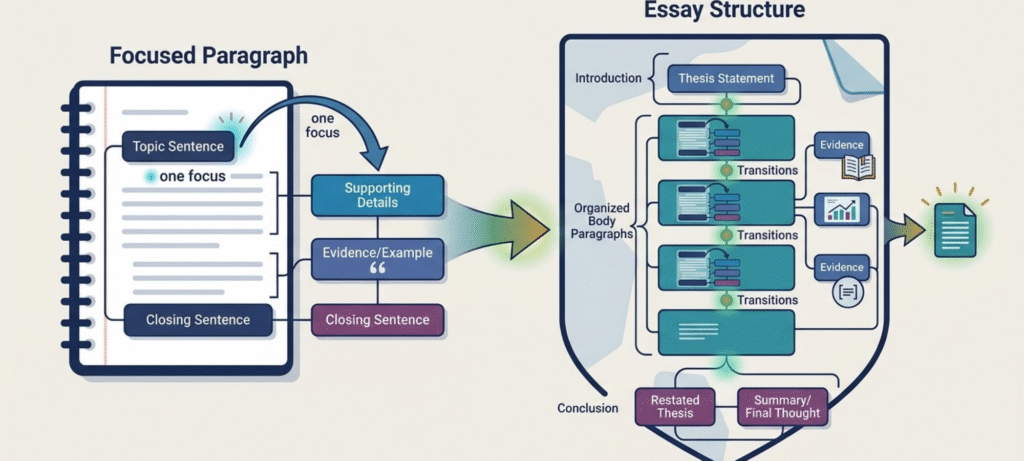
Here’s the basic formula: topic sentence, explanation, example or evidence, closing sentence. One paragraph, one idea.
Look at a weak one first. Reading is good. Many people like books. Some books are long. Writing is also important. It jumps around and says nothing.
Now a better version. Regular reading improves writing. When you read widely, you absorb sentence patterns without even trying. A student who reads one article a day meets hundreds of new phrases each month. Over time, those patterns show up in the student’s own work.
See the difference? The second one has unity, because every sentence backs one idea. It has coherence, because the ideas follow in order. And it has cohesion, because small phrases like “when” and “over time” tie everything together.
Aim for three to six sentences. Go shorter for online reading. And only keep a supporting detail if it truly supports the point.
Rules for Writing an Essay in English
The rules for writing an essay in English follow a simple path. Understand the question, plan, write an introduction with a thesis, build focused body paragraphs, back them up with evidence, and finish with a conclusion.
Introduction. Open with a hook or some context, add a little background, then state your thesis in a sentence or two.
Body paragraphs. Start with a topic sentence, add evidence, explain it, and link to the next point. Evidence on its own isn’t enough. Tell the reader why it matters.
Conclusion. Restate your thesis in fresh words, pull the main points together, and leave the reader with one last thought.
If you’re trying to persuade, you’ll also need to deal with opposing views. This guide on how to write an argumentative essay covers claims, counterarguments, and rebuttals step by step.
Essay Writing Rules for Students
Here are the writing rules for students that actually earn marks:
- Answer the exact question and stay on topic.
- Plan before you write.
- Use evidence, and cite sources when needed.
- Avoid repeating yourself and avoid showing off with hard words.
- Keep a formal tone and a steady tense.
- Don’t bring up brand new arguments in the conclusion.
- Double check citations and names.
Students often slip in five places: sentences that run too long, the same point repeated, informal language in academic work, weak paragraph structure, and skipped proofreading. Teachers almost always reward clarity over complexity.
Rules for Writing an Email in English
Start with a clear subject line. “Question about Friday’s assignment” beats “Hello” every time. Then pick a greeting that fits: “Dear Dr. Khan,” for formal, “Hi Sara,” for friendly.
Say why you’re writing early. Keep the details short. Make your request obvious, so the reader knows what you want them to do. Then close politely and add your signature.
Here’s a formal example. Subject: Meeting request for Tuesday. Dear Ms. Ali, I’m writing to ask whether we can meet on Tuesday to review the project timeline. I’m free after 2 p.m. Please let me know what works for you. Kind regards, Hamza. Short, polite, and clear.
Rules for Letter Writing in English
Letters follow a more fixed layout: sender address, date, recipient, greeting, body, closing, and signature. A formal or business letter uses a respectful tone and no slang. A letter to a friend can be relaxed.
Complaint, request, and application letters all work the same way. State your purpose in the first paragraph, give the relevant details, and end with a clear next step. For example: Dear Sir or Madam, I am writing to apply for the position of library assistant advertised on 5 March. That one line already tells the reader why you’re writing.
Basic Rules for Summary Writing in English
A summary is a short version of something longer, in your own words. Here’s how to do it:
- Read the source twice.
- Find the main argument.
- Highlight the essential points.
- Remove examples and repetition.
- Rewrite it in your own words.
- Keep the original meaning.
- Leave your opinions out.
- Check the final length.
Source: A survey of 500 commuters found that those who read on the train reported feeling calmer on arrival, while those who scrolled their phones reported no difference from those who simply stared out the window.
Summary: Reading on the train was the only commute habit linked to feeling calmer.
English Grammar Rules Every Writer Should Know
Here’s a sentence I see all the time: “Yesterday we goes to the market.” Nothing fancy is wrong with it. The verb just doesn’t match the time or the subject, and that one slip is enough to make a reader wince. Most grammar problems look like this. They’re small, they repeat, and they come from the same few places.
So skip the memorizing. Learn to find the subject, the thing the sentence is about, and then find its verb. Check that they agree. Check that the tense makes sense for when it happened. If both pass, adjectives, adverbs, and little words like “in” or “because” mostly take care of themselves.
Stuck on something odd? The Purdue Online Writing Lab explains most doubts in plain language, and Merriam-Webster is quicker than guessing at a spelling.
10 Rules of Writing for Beginners
- Know your reader.
- Have one clear purpose.
- Use complete sentences.
- Prefer clear words.
- Keep paragraphs focused.
- Use active voice when it fits.
- Remove unnecessary words.
- Support key points with examples.
- Keep grammar and style consistent.
- Revise before publishing.
Basic Rules for Writing English Poetry
Poetry bends the usual conventions on purpose. Even so, good poems still rely on craft: vivid imagery, rhythm, sound, careful line breaks, strong word choice, metaphor, a steady voice, and punctuation that’s there for a reason.
A poem can use a fragment as a whole line, but it should be a choice, not a slip. And don’t use “it’s poetic” as an excuse for careless errors in an essay. Different forms, different rules.
George Orwell’s Rules for Writing Clear English
George Orwell’s well known advice isn’t a grammar manual. It’s more like a set of habits. He told writers to avoid stale metaphors, choose short words, cut any word that can be cut, favor active voice, skip jargon when plain English will do, and break any of his own advice before writing something awkward.
So think of it as style philosophy, not grammar law. It fits nicely with the plain language approach we looked at earlier. The main message? Clarity beats decoration.
Common English Writing Mistakes to Avoid
The usual suspects are verb and subject mismatches, tense slips, missing capitals, misused apostrophes, fragments, double negatives, and mixing up words like your and you’re.
Why do we miss them? Because our brains autocorrect what we expect to see. Reading aloud helps. So does changing the font before your final pass. Both force you to look again.
English Writing Rules Checklist
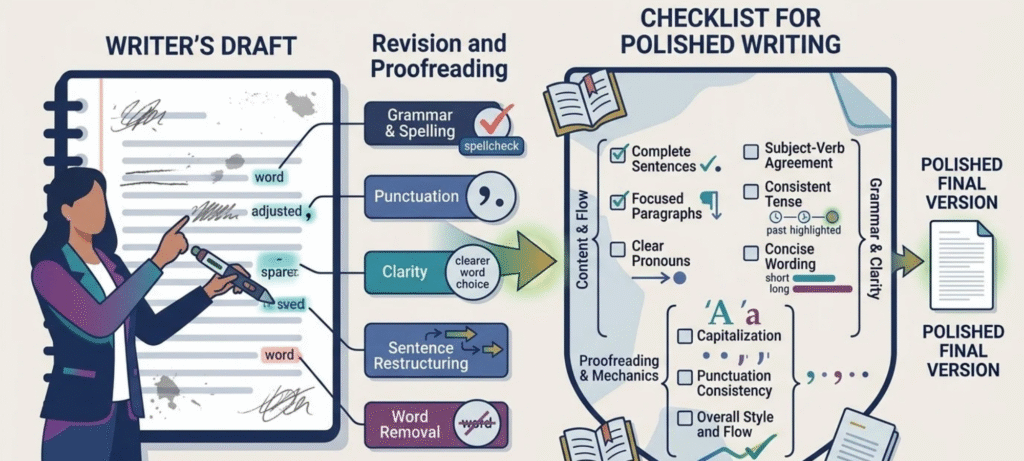
- Is every sentence complete?
- Does each subject agree with its verb?
- Is the tense consistent?
- Are capitals and punctuation correct?
- Are pronouns clear?
- Is each paragraph about one idea?
- Are transitions natural?
- Is the wording concise?
- Did I proofread out loud?
Frequently Asked Questions
What are the basic rules for writing English?
Use complete sentences, match verbs to subjects, keep your tense steady, punctuate correctly, choose precise words, organize your ideas, and proofread.
What are the 10 rules of writing?
There’s no single official list. A practical one is the beginner list above: know your reader, have one purpose, write complete sentences, use clear words, keep paragraphs focused, prefer active voice, cut filler, add examples, stay consistent, and revise.
How can I write English correctly?
Begin with short, simple sentences. Check agreement and tense, read your work aloud, and revise at least once.
What are the rules for writing sentences in English?
Use a subject, a verb, and a complete thought, with normal word order and correct punctuation. Avoid fragments and run ons.
What are the rules for paragraph writing in English?
Open with a topic sentence, add details and an example, use transitions, and close with a concluding sentence.
What are the rules for writing an essay in English?
Understand the prompt, plan, write an introduction with a thesis, develop body paragraphs with evidence, and conclude without adding new arguments.
What are the rules for summary writing in English?
Find the main idea, drop minor details, use your own words, keep the meaning, and leave out opinions.
How can students improve their English writing?
Read daily, write often, ask for feedback, and revise. Learning from corrected mistakes works better than memorizing long lists.
Final Thoughts
The rules for writing English aren’t about memorizing hundreds of grammar points. They’re about building clear sentences, organizing your ideas, picking the right words, punctuating with care, and revising before you hit publish. Start with the 25 rules, use the checklist, and practice on real writing.
Also remember that some “rules” are really conventions that change with context and audience. If you want to see how that works in more depth, this explainer on what a writing convention is is a good next read.
Write a little every day. Your ear will improve faster than you expect.