

How long is an essay? Ask five teachers and you could get five different answers. A middle school paper might be 400 words. A college research essay can pass 5,000. The number comes from the assignment, the grade level, the kind of essay, and how much evidence the topic needs.
Maybe your teacher just wrote “essay due Friday” on the board and moved on. No word count, no page limit. This guide gives you numbers to plan around, so you don’t turn in half a page or accidentally write a small book. They’re planning ranges, though. If your prompt names a limit, that limit wins every time.
How Long Is an Essay?
Most school essays land between 300 and 1,000 words. In college the range moves up to about 1,000 to 5,000, and graduate work can go past that. It’s a decent default when you’ve got nothing else to go on.
Yes, the ranges are wide. Both a 300-word and a 1,000-word essay can be perfectly fine in high school. The gap comes from what the instructor asked for, not from a hidden rulebook.
| Level or type | Common planning range |
|---|---|
| Very short response | 100 to 300 words |
| Middle school essay | 300 to 750 words |
| High school essay | 300 to 1,000 words |
| College application essay | Set by each application, often 250 to 650 words |
| Undergraduate essay | 1,000 to 2,500 words, longer for term papers |
| Graduate academic essay | 2,500 to 6,000 words |
Then there’s the awkward situation where a teacher says “write an essay” and leaves it at that, with nothing else to go on. Start with the rubric and the syllabus, because the number is sometimes hiding in one of them and people just never scroll far enough to find it. If it isn’t there, send a quick email or catch the teacher after class, since most of them don’t mind being asked at all. Can’t ask? Then aim for the middle of your level’s range, which works out to roughly 400 to 500 words in middle school, 500 to 800 in high school, and 1,000 to 1,500 in a first-year college class. And if you’re completely stuck, 500 to 1,000 words is a safe place to land for most school work.
What Determines Essay Length?
The prompt does most of the work. “Explain how photosynthesis works” is a smaller job than “Compare two novels and support your view with outside sources.” Pay attention to the verb. Describe, explain, argue, analyze and compare each ask for a different amount of effort, and that’s why two prompts on the same topic can need very different lengths.
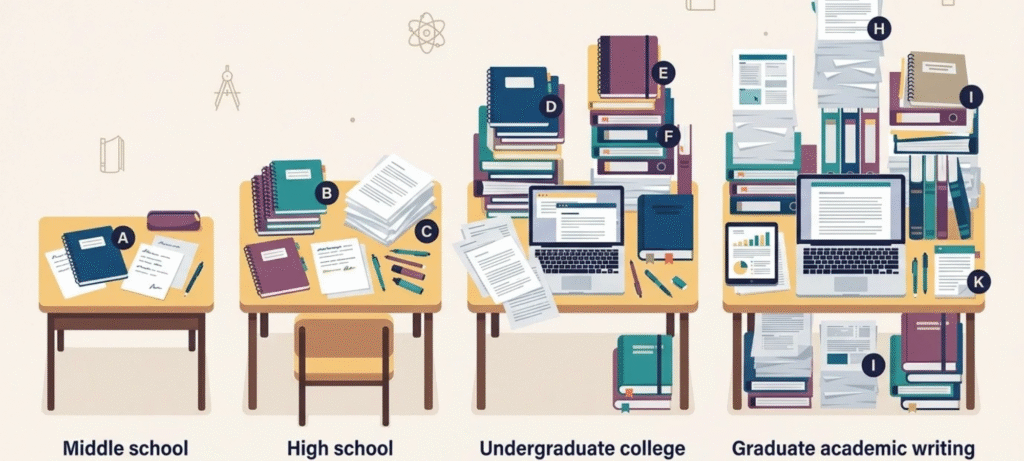
Grade level changes things too, because teachers expect deeper thinking as you move up, and deeper thinking eats words. So does the type of essay. A story can be short. A persuasive piece has to make a claim, back it up and answer the other side.
Sources add length. Three required citations means more space than an essay written from your own knowledge. And then there’s the teacher. One might call 600 words “short,” another might call 300 words short, even in the same building. So read the assignment sheet, rubric and syllabus before anything else.
Essay Length by Word Count
Word count is how most assignments get graded, so it’s worth knowing what each number can actually carry. Around 250 words, you’ve got room for one focused idea and an example or two, and pushing to 300 is just enough to fit a tiny three-paragraph essay. The classic school essay sits near 500, which is where an introduction, two or three body paragraphs and a conclusion all fit without feeling rushed. Get up to 750 and there’s finally space for a proper argument, with several pieces of evidence and a bit of analysis after each one.
At 1,000 words you can write a full five-paragraph essay with meaty paragraphs, or a short research piece that leans on a few sources, and either one fits without much trouble. Around 1,500 you’ll want an outline before you start, since that much material gets messy fast if you’re making it up as you go. Past 2,000 words you’re in research paper territory, which means sections, and a thesis statement that has to hold up across many pages.
Word count works like a box, not a target. A sharp 500-word essay can say more than a bloated 800-word one.
How Long Is an Essay in Sentences and Paragraphs?
Sentence count swings with your writing style. If your sentences average 15 to 20 words, 300 words gives you about 15 to 20 sentences, 500 words gives 25 to 35, and 1,000 words gives 50 to 70. Write shorter sentences and the count climbs. Write longer ones and it drops. Treat the numbers as a quick sanity check on a draft. Nobody’s grading you on sentence totals.
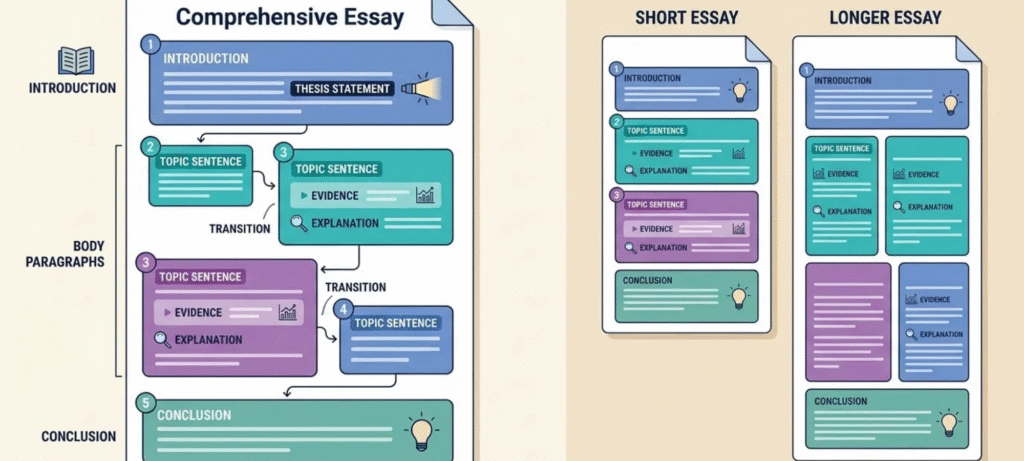
Paragraphs are easier to pin down. Most short essays have three to five. The five-paragraph version is an introduction, three body paragraphs and a conclusion. Go down to three and all your evidence has to fit into one body paragraph. A 2,000-word essay might run eight to twelve paragraphs, and a 5,000-word paper can hit twenty or more, usually grouped under headings.
People often assume five paragraphs means a certain length. It doesn’t. Five paragraphs is a shape. One student can write five paragraphs in 350 words and another can write five in 1,200, and the difference is how much each paragraph does. If you want to see how those pieces connect, our informative essay outline breaks it down.
So how long is an essay paragraph? Long enough to finish its idea, then it stops. In school writing that’s about four to eight sentences, or 80 to 150 words. A typical body paragraph opens with a topic sentence, adds evidence, explains it and ties back to the thesis. If yours fills half a page, two ideas are probably fighting for space, so split it. If it’s two sentences, something’s missing, usually the explanation.
How Long Is an Essay in Middle School?
Middle school essays usually run around 300 to 750 words, and plenty of teachers build assignments around the five-paragraph format. No national rule fixes a word count for each grade, so read the table as a planning guide. Schools differ a lot.
| Grade | Typical planning range | What teachers often look for |
|---|---|---|
| 6th grade | 250 to 500 words | Clear structure, one idea per paragraph, basic evidence |
| 7th grade | 400 to 650 words | Developed paragraphs and explained evidence |
| 8th grade | 500 to 800 words | More analysis and stronger details |
| 9th grade | 500 to 800 words | Steady organization and a clear thesis |
| 10th grade | 600 to 1,000 words | Deeper analysis, sometimes outside sources |
Look at how little the length shifts from row to row. What grows is the amount of thinking packed into each paragraph. A sixth grader may earn full credit for a clean beginning, middle and end. By eighth grade, the same word count has to hold actual analysis.
For anyone wondering how long is an essay in 7th grade in paragraphs, the usual answer is five: one introduction, three body paragraphs, one conclusion. Some teachers open the year with three-paragraph essays and work up, so check the rubric. One habit pays off at this level. Give each body paragraph one main point and at least one example, then add a sentence about why the example matters.
How Long Is a High School Essay?
Expect 300 to 1,000 words. In-class writing runs shorter, often 300 to 500 words, since you only get one period. A take-home analysis is more like 800 to 1,000. Research papers can go well beyond both.
Advanced and AP-style classes are less predictable. One prompt might want a tight argument in under 500 words, while the next wants a longer paper with citations. Argument writing in particular needs space for a claim, evidence and a reply to the opposing view, and our guide on how to write an argumentative essay shows how to fit it all in.
How Long Is a College Essay?
“College essay” means two different things, and the length depends on which one you’re talking about.
The application essay first. You don’t choose the length, because the application does. The Common App personal essay caps out at 650 words, and the Common App essay prompts page lists the current prompts and limits, so it’s worth a look before you draft. Supplemental essays are a mixed bag. Each school sets its own limit, and plenty land between 150 and 400 words. The portal won’t accept anything over, so those numbers beat any general range you read elsewhere.
Class essays in undergrad are longer and judged differently. A weekly response might be 500 to 1,000 words, a standard paper 1,000 to 2,500, and a term paper 2,500 to 5,000. Upper-level seminars can ask for more. Graduate personal statements tend to sit around 500 to 1,000 words, while graduate research essays often run 2,500 to 6,000 or beyond.
How Long Is a Short Essay?
Nobody agrees on this one. It could mean a single page, 300 words, or 750 words, depending on who’s asking. That’s why the assignment should give you a number. When it doesn’t, 300 to 500 words is a fair middle, and if you’re unsure I’d lean toward the lower end.
There’s no room to warm up in a short essay. Put the thesis near the top, choose your strongest piece of evidence instead of cramming in all of them, and stop once the point has landed. Trying to fit too much is the classic way these go wrong.
How Long Should the Introduction, Body, and Conclusion Be?
Here’s the usual split. Roughly 10 to 15 percent of your words go to the introduction, somewhere around 70 to 80 percent to the body, and whatever is left, 5 to 10 percent, to the conclusion. Take a 1,000-word essay: you’d spend about 100 to 150 words getting started, 700 to 800 on the body, and 50 to 100 wrapping things up. If you’re writing 500 words, it works the same way, you just halve every number.
Still, it’s a habit and not a rule. Plenty of personal essays tell their story for quite a while before they reach the point, and a research paper might need extra room at the start to explain the background. So don’t let the math boss you around. Use the percentages as a quick check, because if one section has grown way bigger than the rest, that’s your sign to trim it.
How Many Pages Is an Essay?
The same word count fills different amounts of paper depending on spacing, font, margins and headings. These figures assume 12-point font and one-inch margins.
| Word count | Double-spaced | Single-spaced |
|---|---|---|
| 250 words | About 1 page | About ½ page |
| 500 words | About 2 pages | About 1 page |
| 750 words | About 3 pages | About 1½ pages |
| 1,000 words | About 4 pages | About 2 pages |
| 1,500 words | About 6 pages | About 3 pages |
| 2,000 words | About 8 pages | About 4 pages |
Page-based assignments trip people up. “One page” could be 250 words double-spaced or nearly 500 single-spaced, so find out which spacing your teacher expects before you start counting. Formatting style matters as well. The MLA Style Center explains standard rules on spacing and margins, and APA has its own, so confirm which one your class uses.
How Long Should Different Types of Essays Be?
The type of essay changes how much proof you need to show, and proof takes up space. Take a persuasive essay arguing that school should start later. You’d need a clear claim and a few solid reasons, and you’d have to answer the people who disagree with you, which is hard to do in a couple of paragraphs. Most teachers end up drawing the line somewhere between 600 and 1,500 words for that kind of assignment. A narrative about your first day at a new school works on other terms. The length comes down to how much actually happened that day, and plenty of students wrap it up between 500 and 1,000 words.
Write about one place or person and you’ll likely run out of things to say somewhere around 300 to 800 words. Expository essays, where you explain something with facts and examples, tend to sit at 500 to 1,000 if you ask most teachers. Analytical essays on a poem or a chapter come out about the same. Personal statements just follow whatever limit the application gives you. Research essays are the longest, since you have to fit in both your sources and your analysis, which is why they commonly start at 1,500 words and climb from there.
You can tell a good story in 400 words and leave people satisfied, but try proving a point with real evidence in that space and it falls apart fast. That’s pretty much why essay type changes length.
How Long Does It Take to Write an Essay?
It depends on the length, the research, and how fast you write. Plan on about one to two hours for a 300 to 500 word response, planning and a quick edit included. At around 1,000 words you’re looking at a few hours, and most people split that over more than one sitting. A 2,000-word research essay can take several days, because reading and citations always run longer than expected.
Drafting is often the smallest part of the job. Outlining, finding sources, revising and proofreading together tend to take as long as the first draft, sometimes longer, and plenty of people don’t see that coming. It helps to count backward from the due date and leave a gap between writing and revising so you can reread the draft with fresh eyes, and if you always go over the word count, spending more time on the outline makes it much easier to notice when you’ve already made a point.
What If Your Essay Is Too Short?
Falling short usually means an idea isn’t fully developed. You don’t need more sentences, you need more thinking. Find your weakest body paragraph and ask what a reader would still want to know after reading it. A concrete example, a sentence on why your evidence matters, or a reply to an objection can add real substance.
Reread the prompt while you’re at it. It’s surprisingly easy to answer only half of it. Smoother transitions can help, and so can spelling out the reasoning behind each claim. Padding won’t. Filler adds words and no meaning, and most teachers spot it fast.
What If Your Essay Is Too Long?
Going over is just as common, and the fix is mostly editing. Cut points that repeat earlier ones. Keep one strong example where you’ve put three. Trim background that delays your thesis. Wordy phrases shrink easily, so “due to the fact that” becomes “because,” and long quotes can be shortened or paraphrased.
Try this test. Read a paragraph, then imagine it deleted. Would your thesis suffer? If not, cut it or fold it into another paragraph. It hurts to lose good writing, but a focused essay beats a wandering one nearly every time.
Frequently Asked Questions
How long is an essay?
Many school essays run 300 to 1,000 words, and undergraduate essays often run 1,000 to 5,000. Your instructions set the real length.
How many paragraphs are in an essay?
Short essays usually have three to five, and the five-paragraph format is the best known. Longer papers can have many more.
How many sentences are in an essay?
It depends on your sentence length. A 500-word essay typically has 25 to 35.
How long is a 500-word essay?
About one page single-spaced or two pages double-spaced, often in three to five paragraphs.
How long should a 7th-grade essay be?
Often five paragraphs and around 400 to 650 words, though each teacher sets the rules.
Is a 300-word essay long enough?
For a short response or a three-paragraph essay, yes. For a standard high school or college assignment, it’s usually too short.
Is a five-paragraph essay always required?
No. It’s a popular teaching format, but plenty of assignments use fewer or more paragraphs.
Does essay length matter more than quality?
You need to meet the requirement, but a clear thesis and well-developed evidence count for more. A focused essay that hits the target beats one that just fills space.
Final Thoughts
So, how long is an essay? As long as your assignment requires, and long enough to make your point with evidence that convinces a reader. The ranges here are useful for planning, but they never replace the instructions on your prompt, rubric or application.
Read those instructions first and use the ranges as backup. Let the ideas you need to prove shape your outline. If you end up short or long, fix the ideas and the editing instead of adding filler. And if something’s unclear, ask your teacher early. It’s much quicker than rewriting.