
If you’re planning to enter the Scholastic Art and Writing Awards this year, good, you should. Just don’t rush to the portal yet. Three things need sorting first: are you eligible, which category does your piece go in, and what’s your region’s deadline? Get one of them wrong and you might burn weeks, or miss the window completely.
The 2027 season opened on October 1, 2026, so it’s live right now. Deadlines vary, though. Each region sets its own, which means a friend in another state could have a totally different date from yours. In this guide I’ll explain how the contest runs, what winning really gets you, and what to double-check before you submit.
Quick answer: Entries opened October 1, 2026. The first regional deadline is December 1, 2026, and some regions keep going until January 4, 2027. An individual entry is $15. A senior portfolio is $40.
What Are the Scholastic Art and Writing Awards?
Among teen artists and writers in the U.S. and Canada, this is one of the most recognized programs around. The Alliance for Young Artists & Writers, a non-profit, runs it, and it has been going since 1923. Past winners include Sylvia Plath, Andy Warhol, Stephen King and Amanda Gorman, so it clearly has a knack for spotting talent early.
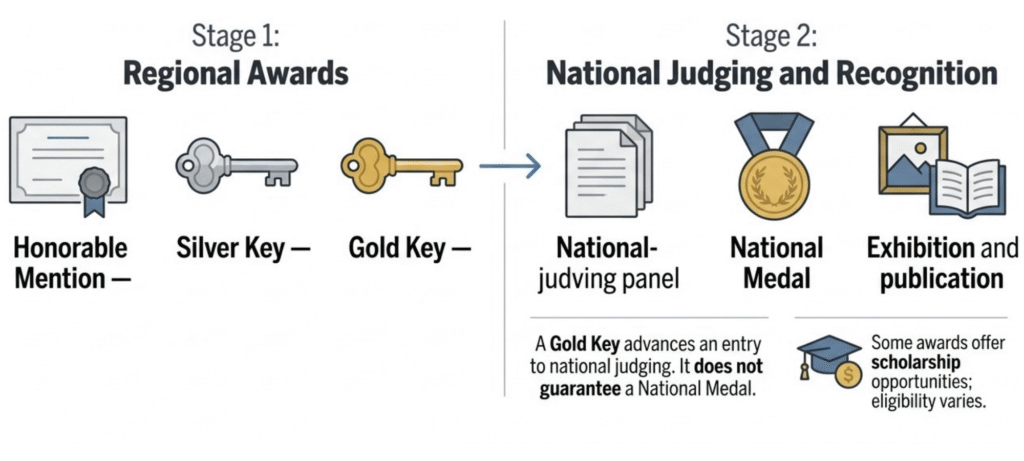
Judging begins at the regional level. Your piece can earn an Honorable Mention, a Silver Key or a Gold Key there. A Gold Key sends it on to the national round, where the best work can win a National Medal, get shown in an exhibition, get published, or sometimes come with scholarship money.
Over 100,000 teens enter every year. Yes, that means a crowded field. It also means lots of other students are asking themselves the same thing you are: is my work good enough? Usually you won’t know until you enter.
Who Can Enter the Competition?
Let’s go through the basic rules one at a time.
Grade and age. You have to be in grades 7 through 12. You also need to be at least 13 on the day you enter, so a very young seventh grader may need to wait.
Where you live and study. You need to live in, and attend school in, the United States, its territories or military bases, or Canada. Quebec doesn’t count. So no, students from every country can’t enter. If you’re homeschooled, you’re fine. Private school and public school students can enter too. Got an unusual situation, like moving between countries mid-year? Read the official terms before you pay anything.
Original work. Whatever you submit has to be yours. I’ll get to the AI question in a moment, because it’s the one students ask about most these days.
2027 Dates and Deadlines
| Milestone | Date |
|---|---|
| Entries open | October 1, 2026 |
| First regional deadline | December 1, 2026 |
| Latest regional deadlines | January 4, 2027 (some regions) |
| Regional results | January 27, 2027 |
| National results | March 31, 2027 |
| National Awards Week | June 8–11, 2027 |
You’ll see “December to January” written everywhere, and it isn’t much help. Your actual date could land anywhere in that stretch, and art and writing deadlines can even differ within one region. So open the My Region page on the official Scholastic Awards website and look up your own dates. Write them down somewhere you’ll see them. Dates can also change, so go with the live calendar over any article, this one included.
Can you enter after the deadline? No. Late entries aren’t accepted. Deadline day is also when the portal gets busy, since lots of students upload at once and things can slow down. Don’t leave it for the last evening. Finishing a few days early costs you nothing and saves a lot of stress.
Categories: Choosing the Right One
The program has more than 20 categories across art and writing. The count shifts from year to year, so check the official site for the current list.
Art: painting, drawing, photography, sculpture, comic art, fashion, film and animation, mixed media, jewelry and digital art.
Writing: poetry, short story, personal essay and memoir, journalism, critical essay, novel writing, screenplays and scripts, and speculative fiction.
Portfolios: graduating seniors can send in either an art portfolio or a writing portfolio. Each has its own rules, so read those on their own.
Choosing a category seems simple until your actual piece is sitting in front of you. Say you wrote a story that features a ghost. Is it a short story, or does it belong in speculative fiction, which carries its own genre expectations? Or you did an ink drawing and then glued collage pieces over it. Is that drawing or mixed media? These are fair questions, and each category’s description is where you’ll find the answer. Read it before you commit.
You can sometimes change categories before your regional deadline. Not every switch is allowed, and some require you to start a fresh entry, so it’s best to get it right from the start.
How to Submit, Step by Step
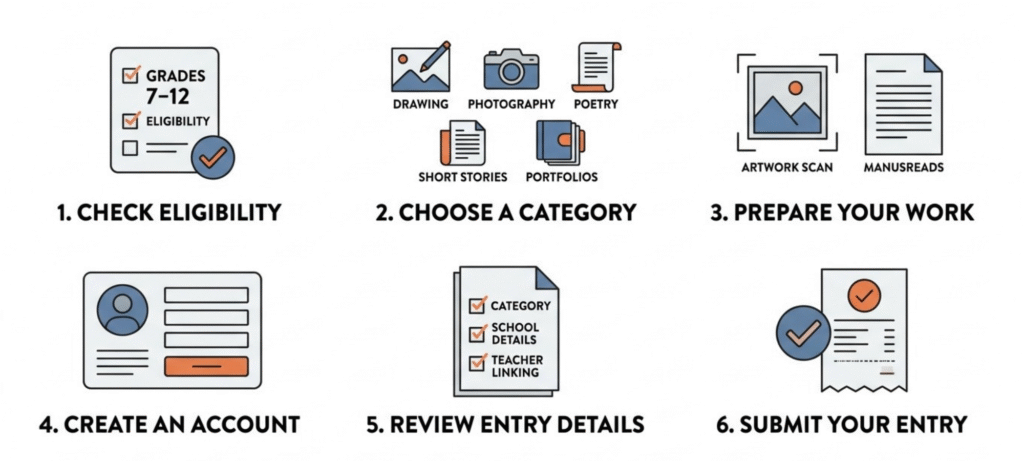
- Confirm you’re eligible and look up your regional deadline. Do this first, before anything else.
- Read the complete rules for your category. Word limits and upload requirements differ from one category to the next.
- Prepare your work. For art, photograph or scan it in even lighting, and watch for glare and shadows. The official FAQ asks for 300 dpi and a file of roughly 3 to 5 MB. For writing, paste your final text into the portal’s text box, since PDFs aren’t accepted. After pasting, read it again for broken lines and odd spacing.
- Set up your account and enter your details with care. A typo in your name or school can cause problems down the line.
- Connect your work to a teacher or school when the portal prompts you.
- Pay the fee or request a waiver. This season, entries are $15 each and portfolios are $40. If the cost is a barrier, waivers exist, and there’s nothing awkward about asking for one.
- Review everything, then submit. Save a copy of your work along with your confirmation
A small tip. Do steps 1 to 3 on a weekend, when you aren’t rushed. Then do the account and upload on another day with fresh eyes. It’s much easier to catch mistakes that way.
Can You Use AI?
A little, yes. But there are clear limits.
Scholastic lets you use AI tools for some parts of the creative process, like brainstorming ideas or sketching out an outline. What it won’t accept is a final piece that AI produced. You also have to state whether you used AI and in what way.
One habit pays off here: hold on to your sketches, notes and early drafts. They trace your path from an empty page to the finished work, and they come in handy if someone asks how you made it. Rules can change, so look at the current policy on the official site before you submit. And if you’d like a student’s take on using AI tools without crossing the line, this guide on using AI humanizers responsibly is worth a few minutes.
Gold Key, Silver Key and Honorable Mention
These are the regional awards. A Gold Key is the top one, and it sends your work on to national judging. A Silver Key and an Honorable Mention both recognize strong work at the regional level.
One thing is easy to mix up. A Gold Key doesn’t mean you’ve won a National Medal. It means your piece gets to compete at the national level. That’s the whole deal. It’s a big step, but it isn’t the finish line.
Many regions also hold exhibits or ceremonies for their winners. If there’s one near you, go. Seeing your work on a wall, or hearing your name called, feels good even if your piece doesn’t move on.
Winners and Results
Regional results are set for January 27, 2027, and national results come on March 31, 2027. You’ll find them in your awards portal account and on the official results pages linked from the main site.
When you search for winner lists, look at two things: the year and the award level. A 2026 list belongs to a different season. Regional winners also aren’t the same group as national medalists. And since 2027 results don’t exist yet, be careful with any page that claims to have them.
Scholarships
This season, scholarship opportunities range from $500 to $12,500. They include the Portfolio Awards for graduating seniors, the Herblock Award for editorial cartoons, the New York Life Award, American Voices & Visions, and Best-in-Grade. If cartooning is your thing, the Herb Block Foundation has details on its own award.
Some awards ask for an extra statement or follow a theme. Entering doesn’t make you eligible for all of them. Before you count on any money, check each award’s amount and rules on the official scholarship announcement.
How Competitive Is It, and Does It Help With College?
It’s competitive. With more than 100,000 teens entering, it couldn’t be anything else. But you won’t find an official win rate to quote. Regional awards, Gold Keys and National Medals are three different results, so a single percentage would be misleading. If a website gives you an exact number, be skeptical.
Judging is anonymous. The judges don’t see your name, age or school. They look at three things:
- Originality: your own point of view, not a copy of a popular style.
- Technical skill: how well you handle your medium, structure or language.
- Personal voice or vision: a clear sense of why you made the piece.
What does that look like in practice? Picture a photo that’s sharp and well lit but feels like a hundred others. Now picture a rougher shot with a clear idea behind it. The second one can hit harder. In writing, a personal essay usually works because of small, honest details, not big words. A plain sentence that tells the truth beats a fancy one that doesn’t.
What about college? A Gold Key or National Medal can strengthen your honors or activities list, and it gives you something real to write about. But it doesn’t guarantee admission, and your grades still matter. If you’re curious how colleges treat them, here’s which grades colleges look at.
FAQ
What are the Scholastic Art and Writing Awards?
They’re a recognition program for teen artists and writers in grades 7 to 12. The Alliance for Young Artists & Writers runs them.
When do the 2027 awards open?
They opened on October 1, 2026.
When is the deadline?
It depends on your region. The first is December 1, 2026, and some run until January 4, 2027.
How much does it cost?
It’s $15 per entry and $40 per portfolio. Fee waivers are available.
Is it international?
No. It covers the U.S., its territories and military bases, and Canada, except Quebec.
What is a Gold Key? It’s the top regional award, and it sends your work to national judging.
Can I enter more than one category?
Yes. You can send in more than one piece, and each one counts as its own entry.
Can I use AI?
Only to help with parts of the process. The final work has to be your own, and you’re asked to say if you used AI.
Final Thoughts
The Scholastic Art and Writing Awards give eligible young artists and writers a real shot at recognition and scholarships. So start with your regional deadline. Then read the rules for your category and get an original piece ready well before the cutoff. Fees, dates and award rules can change from year to year, so check the official website one last time before you enter.