

180 days of spelling and word study can describe a full school year approach where students learn spelling through patterns, sounds, word parts and meaning, instead of memorizing a new list every Monday. Many school calendars have roughly 180 instructional days, and if you spend them helping kids notice how words work, spelling stops feeling like guesswork.
You probably know the weekly list routine. Ten words show up on Monday. Kids copy them. Friday brings a test. By the next Wednesday, half the words are gone. And the student who got 10 out of 10? They spell one of those same words wrong in a science report. That gap is one reason spelling and word study have become such a common pairing in literacy conversations.
This guide covers what word study is, how it differs from traditional spelling, how to map out a full year, which activities work, how to assess progress and where to find good resources. It’s written for classroom teachers, tutors and parents who want a plan that makes sense without the jargon.
What Is Spelling and Word Study?
Spelling and word study together describe how students learn to write words correctly and why those words look the way they do. Spelling is encoding, which just means turning the sounds you hear into letters on a page. Word study is the bigger investigation of how sounds, letter patterns, word parts and meanings fit together.
Take the word “cake.” A child who memorized it knows one word. A child who studied it knows the silent e signals a long vowel, that the same pattern shows up in “make” and “lake,” and that it can help with a new word like “flake.” One idea opens up dozens of words.
Reading and spelling lean on the same skills: hearing sounds, matching them to letters, spotting common chunks and understanding how words are built. When instruction connects these skills, students get more chances to use the same word knowledge in both reading and writing. That approach shows up in established literacy resources, including Reading Rockets, which describes word study as a way of connecting spelling with phonics, word recognition and vocabulary.
What Is the Difference Between Word Study and Traditional Spelling?
Spelling is about writing words accurately. Word study is wider. It looks at how words sound, look, are built and carry meaning. Traditional spelling is one piece of that picture, not the enemy of it.
| Traditional Spelling | Word Study |
|---|---|
| Memorize a list of words | Investigate patterns across groups of words |
| Same list for the whole class | Groups based on what students already know |
| Practice by copying | Practice by sorting, building and hunting |
| Success means a good test score | Success means applying a pattern to new words |
| Words are learned one at a time | Words are learned in families and structures |
Memorization still has a place. Some words really are irregular, and kids have to learn them. Words like “said” and “was” break the usual rules and need direct teaching. The real question is how much of your year depends on memorization alone.
Here’s one way to see it. A spelling list tells you whether a child remembered ten words. Word study tells you whether the child understands why those words are spelled that way. Research-based literacy guidance has also questioned approaches that lean mostly on memorizing disconnected lists, and puts patterns, word structure and meaningful relationships between words in the spotlight instead.
The Three Layers of Word Study
Think of English spelling as three layers stacked on each other. Students don’t leave one behind. They keep using all three as words get harder.
The Alphabetic Layer
This is where kids connect single sounds to letters. A phoneme is the smallest unit of sound, and a grapheme is the letter or letters that stand for it. Look at “ship.” Four letters, but only three sounds: sh, i, p. Younger students trip up here because they assume one letter always means one sound.
Activities at this level are simple. Say the word slowly, count the sounds, then decide which letters to write. Segmenting and blending live here too. If a child can’t hear the three sounds in “ship,” copying it ten times won’t fix much.
The Pattern Layer
Once students handle single sounds, they start seeing how letters group together. Short vowel words like “cat,” “bat” and “flat” follow one pattern. “Make,” “cake” and “same” follow another. After that come vowel teams like “rain” and “boat,” blends, digraphs and word families.
The point isn’t to memorize three words. It’s to spot a pattern that travels. When a student meets “plane” for the first time and thinks, “that looks like the a_e pattern,” the pattern did its job.
The Meaning and Morphology Layer
This layer focuses on word parts that carry meaning: base words, roots, prefixes and suffixes. Think “help,” “helpful” and “helpless.” The base stays put and the ending changes the meaning. Same with “play,” “played” and “playing,” or “happy” and “unhappy.”
Later grades add Greek and Latin roots, which unlock a lot of vocabulary. A student who recognizes that “bio” relates to life has a useful clue when meeting words like “biology” and “biography.” It won’t give the full meaning on its own, but it’s a solid start. This is where word study for phonics, spelling and vocabulary instruction really comes together, because one lesson on a root can support decoding, spelling and word meaning at the same time.
How to Teach Spelling Through Word Study
Find out what students already know, pick one pattern, let them sort and investigate words, then push the pattern into real reading and writing. The order matters, so here’s a simple sequence.
Step 1: Assess first. A spelling inventory shows which features students have down and which are shaky. You don’t need anything fancy. A short dictated list of words that get harder will tell you a lot.
Step 2: Pick one pattern. Resist covering three things at once. Short a is plenty for a week: cat, map, hand, flag.
Step 3: Sort the words. Hand out word cards and ask kids to group them by what they notice. Sorting is where the thinking happens, so let them struggle a bit.
Step 4: Ask students to explain the pattern. Don’t give them the rule. If a student says, “these all have a in the middle and it makes its short sound,” they own that idea in a way they never would if you’d announced it.
Step 5: Hunt for the pattern. Students search books, posters and their own writing for more examples.
Step 6: Transfer. This is the step teachers skip most. Give students words they’ve never practiced and see if they can use the pattern. If they only spell the words from the list, the lesson isn’t finished. A good transfer check changes the example slightly instead of repeating the practice list, so students have to apply the pattern rather than recall the answer.
Notice how little of this involves copying a word five times. The work is noticing, comparing and applying. Researcher Timothy Shanahan makes a similar point in his piece on essential fundamentals of spelling instruction, where he argues that spelling works best when it’s tied to word study, phonics and vocabulary.
Spelling and Word Study Activities
Good activities are hands on, short and built around one pattern at a time. Here are seven that work across lots of grade levels.

Word Sorts
Students group word cards by a shared feature. A simple short vowel sort might have two columns, short a and short i. “Cat,” “map” and “flag” go in one, “sit,” “big” and “ship” in the other. Add an “oddball” column for words that don’t fit. Exceptions spark great conversations.
Word Hunts
Give students a target pattern and send them looking. A picture book, a science text, their own journal. Hunts tie the pattern to real reading, which is the whole point.
Sound Mapping
Say the word, stretch it out, count the sounds, draw a box for each one, then write letters in the boxes. “Ship” gets three boxes, with “sh” sharing one. It’s especially useful for kids who still mix up letters and sounds.
Word Building
Letter tiles let students change a word one piece at a time. Start with “cap,” add an e to get “cape,” swap the c to make “tape,” then drop the e for “tap.” They see how a tiny change shifts both sound and meaning.
Word Chains
A chain changes one sound at each step: cat, cot, hot, hop, hope. It’s a five minute warm up that blends phonics and spelling.
Word Study Notebook
Students keep a running record of patterns, example words, exceptions and new vocabulary. It becomes a personal reference they can check while writing. By June, it’s proof of how much they’ve learned.
Word Walls
Build a word wall around the patterns your class is studying, not just a long list of high frequency words. Students add examples, compare related words and look at the wall while they read and write. Over time it turns into a visual record of every spelling pattern the class has investigated.
How to Organize 180 Days of Spelling and Word Study
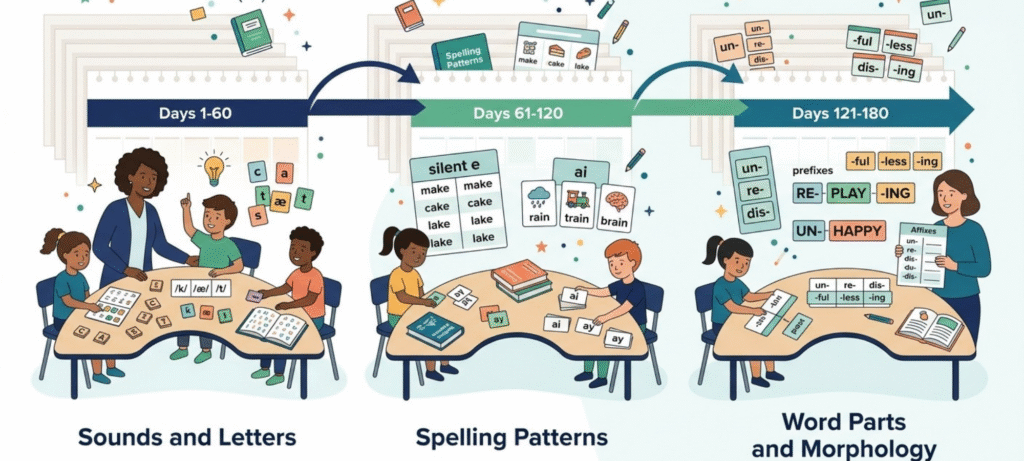
One practical way to organize 180 days of spelling and word study is to split the year into phases that move from sounds to patterns to word parts, with review built in. The table below is a sample framework, not an official curriculum. Change it to fit your grade level, your standards and your students.
| Days | Main Focus |
|---|---|
| 1 to 20 | Sounds, letters and the alphabetic principle |
| 21 to 45 | Short vowels and simple CVC patterns |
| 46 to 70 | Digraphs and consonant blends |
| 71 to 95 | Long vowels and CVCe patterns |
| 96 to 120 | Vowel teams and other common patterns |
| 121 to 145 | Suffixes and inflectional endings |
| 146 to 165 | Prefixes and roots |
| 166 to 180 | Review, application and assessment |
Treat it as a map, not a script. The sequence is intentionally broad. A kindergarten, first grade, third grade or intervention group wouldn’t spend the same number of days on each feature. A second grade class might fly through the first phase in a week, while older struggling readers could need far longer on short vowels. That’s fine. Your starting point should come from assessment, not the calendar alone.
A rigid pacing guide can also backfire. If half your class hasn’t got the long vowel pattern by Day 95, moving on doesn’t do them any favors. Build in review days and let your assessment results decide when to speed up or slow down.
How to Differentiate Spelling and Word Study
A yearlong plan doesn’t mean every student studies the same pattern at the same time. Use spelling inventories, writing samples and quick word tasks to see what each group is ready for. One group might work on short vowels while another tackles vowel teams or endings. The routine can stay the same (sorting, hunting, building, applying) while the word sets change.
Differentiation also doesn’t mean planning five separate lessons. You can run one word sort routine with different patterns or difficulty levels. The goal is giving each student a feature they can investigate and use, without it being frustrating or way too easy.
Spelling and Word Study Resources Teachers Can Use
Useful resources fall into four groups: classroom materials, digital tools, print references and professional sites. You don’t need all of them. More isn’t automatically better.
Classroom materials. Word cards, letter tiles, word walls, sorting mats, decodable texts and student notebooks cover most needs. Plenty of these can be made by hand in an afternoon. Spelling inventories are worth having too, since they guide grouping.
Digital tools. If you use games or apps, look for ones that teach patterns instead of just drilling lists. Instant feedback, adjustable difficulty and links to vocabulary are good signs. Be careful with tools that only reward speed.
Print and reference resources. Dictionaries, morphology charts and pattern reference sheets help students check their own work.
Professional sites. Teacher focused sites explain the research and share sample lessons. The Reading Rockets spelling and word study section is a solid starting point.
Whatever you pick, ask one simple question: does this help students notice patterns, or does it just ask them to memorize? The answer usually tells you if it’s worth your time.
How to Teach Spelling Rules and Word Study
Teach the pattern first, then look at where it works and where it breaks. Calling something a “rule” can mislead kids, because English has plenty of exceptions shaped by its history. Words came in from Old English, French, Latin and Greek, and each brought its own habits.
A few common patterns show how it plays out:
- Silent e: tap becomes tape
- Doubling: run becomes running
- Dropping the e: make becomes making
- Changing y to i: happy becomes happiness
After each one, invite students to find words that don’t fit. When a kid notices that “give” doesn’t follow the silent e pattern, that’s a win, not a problem. They’re thinking about how words behave.
Keep your language honest. Instead of “a vowel always does this,” try “a vowel usually does this, and here’s what happens when it doesn’t.” Being upfront about exceptions helps students see that spelling patterns describe tendencies, not perfectly universal rules.
What About Irregular and High Frequency Words?
Not every high frequency word has to be treated like a total stranger. Look for the parts students already know, then point to the one spot that’s unusual. A word like “said” has familiar sounds and one unexpected letter combination. That keeps irregular words connected to the bigger goal of understanding how words work, instead of turning them into a pile of things to memorize.
How Word Study Supports Phonics, Spelling and Vocabulary
These areas work because students aren’t learning them as separate skills. They’re learning one system from a few different angles.
Phonics gives kids the sound and letter connections they need to decode. Spelling involves encoding, while reading involves decoding, and both draw on related knowledge about sounds, letters and word structure. Vocabulary grows when students understand word parts, since “unhappy” and “unfair” share a meaningful chunk. Reading gets easier because familiar patterns make new words less scary. Writing gives students a place to use spelling patterns and word knowledge in real contexts.
When teachers schedule these as separate blocks, kids often don’t connect them. A child sounds out words fine in phonics, then misspells the same words in a story. Word study bridges that gap by keeping the same patterns in front of students across reading, spelling and writing.
There’s a vocabulary payoff too. If you want new words to stick, teaching their parts helps far more than a definition alone. Our guide on how to memorize vocabulary shows how word parts and active practice make new terms stay put.
Assessing Students During Word Study
Check whether students can apply a pattern to words they haven’t practiced, not just whether they remembered this week’s list. That one shift changes how you measure everything.
Useful tools include:
- Spelling inventories at the start of the year and again at intervals
- Dictated sentences that include target patterns
- Writing samples, where you look for patterns in errors instead of counting mistakes
- Sorting tasks, which show whether students understand the categories
- Transfer words, meaning unfamiliar words that follow a taught pattern
- Reading unfamiliar words, since decoding and spelling support each other
Repeat assessment now and then instead of treating it as a one time placement. Students’ word knowledge changes as they get instruction, and your groups should change with it. If you want more ideas for catching gaps early, this post on how teachers can spot learning gaps is a good companion read.
Errors tell you a lot. If a student writes “bote” for “boat,” they know the long o sound and they’re experimenting with the spelling. That’s more advanced than writing “bot,” and your next lesson should reflect it. Looking at errors this way makes grouping much easier and instruction more targeted.
How to Build a Weekly Spelling and Word Study Routine
A weekly routine gives students structure without turning word study into another memorize and test cycle. Here’s one possible rhythm.
- Monday: Introduce the pattern and sort words together.
- Tuesday: Hunt for the pattern in texts and talk about what students find.
- Wednesday: Build words with tiles and practice sound mapping.
- Thursday: Use the pattern in writing and connect it to vocabulary.
- Friday: Check understanding with a short assessment that includes transfer words, then review.
A short daily block can be enough for focused word study, though the exact time depends on grade level, lesson goals and the needs of the group. Some teachers combine Tuesday and Wednesday when a pattern is easy. What matters is that Friday checks thinking, not only memory.
Common Mistakes to Avoid When Teaching Spelling
A few habits quietly undermine good spelling instruction, even when teachers mean well.
- Giving random word lists. Words without a shared pattern are harder to learn and harder to connect.
- Making students copy words again and again. Repetition is more useful when students also notice, explain and apply the pattern.
- Teaching rules with no examples. A rule floating alone is easy to forget.
- Ignoring exceptions. Students find them anyway, and they deserve a conversation.
- Teaching every child at the same level. Spelling development varies a lot inside one classroom.
- Separating spelling from reading. The two feed each other.
- Never linking spelling to vocabulary. Word parts carry meaning, so use them.
- Testing memory instead of transfer. A perfect Friday score doesn’t guarantee lasting learning.
If you spot one or two of these in your own routine, you’re in good company. Small changes, like adding a transfer question to your test, can make a real difference.
One quick note: spelling patterns have exceptions, and instructional sequences vary by grade, curriculum and student development. Adapt activities to what your students already know instead of treating any single sequence as universal.
Frequently Asked Questions
What is spelling and word study?
Spelling and word study is an approach that teaches students to spell by investigating sounds, letter patterns, word parts and meanings instead of memorizing unconnected lists.
What is the difference between word study and spelling?
Spelling is about writing words accurately. Word study is broader and asks students to explore patterns, structure and meaning. Spelling is one important part of it.
How do you teach spelling rules and word study?
Introduce one pattern at a time, let students sort and discuss examples, then test the pattern on new words. Talk openly about exceptions so students understand that rules describe tendencies.
What are examples of word study activities?
Common ones include word sorts, word hunts, sound mapping, word building with tiles, word chains, word walls and keeping a word study notebook.
How does word study support phonics?
It shows students how sounds and letters combine into patterns, then asks them to use those patterns in reading and writing.
What are useful spelling and word study resources?
Letter tiles, word cards, sorting mats, decodable texts, spelling inventories, reference sheets and trusted teacher sites like Reading Rockets all support good instruction.
How many days should students spend on one spelling pattern?
There’s no single number that works for every class. A simple pattern may need only a few lessons, while a trickier feature may need repeated practice and review. Assessment should tell you whether students are ready to move on or need more time. That’s also why a plan built around 180 days of spelling and word study works best as a flexible map, not a fixed schedule.
Conclusion
Planning 180 days of spelling and word study means trading the weekly list for a year long trip through sounds, patterns and meanings. It takes some upfront planning, but it gives you a structure for helping students understand words instead of just remembering a list. Start small. Pick one pattern, run one sort, add one transfer question to your next assessment and see what changes. Over a full school year, those small shifts add up to readers and writers who know why words look the way they do.