

So what does an Early Modern English translator actually do? Two things, really. It’ll take something you’ve typed today and dress it up so it reads like the 1500s or 1600s, or it flips the other way and pulls older wording back into plain modern words. Why would someone bother with this? Shakespeare homework’s a common one. Some people are writing a play. Others just want a fancier party invitation, or they’re simply curious how “you are” would’ve come out of someone’s mouth in 1600. What you’ll find below covers the mechanics of how these tools actually work, the ones people tend to use in practice, what the grammar looks like under the hood, the spots where results tend to fall apart, and a way to double-check them yourself. Less a history lecture, more of a manual you can actually use.
And look, if English already feels like a maze most days, that’s a pretty common experience. It’s a big part of why people keep asking whether English is one of the hardest languages to learn.
What Is an Early Modern English Translator?
Short version first: Early Modern English spans roughly the late 1400s to the late 1600s, the language Shakespeare, Tyndale, Milton, and the King James Bible were all written in. There are basically two directions an Early Modern English translator can run.
Push it modern to Early Modern, and you land on things like “thou art” and “he speaketh.” Flip it around, Early Modern to modern, and “what dost thou seek?” becomes “what are you looking for?”
What separates a good translator from a bad one comes down to pronouns, verb endings, vocabulary, and sentence flow, all handled properly rather than guessed at. A weak tool just grabs words off a list and hopes it lands right. You can call it an Early Modern English translator online, a historical English translator, or even a “thee and thou” converter, none of that really matters. What matters is whether it actually gets your sentence right.
How Does an Early Modern English Translator Work?
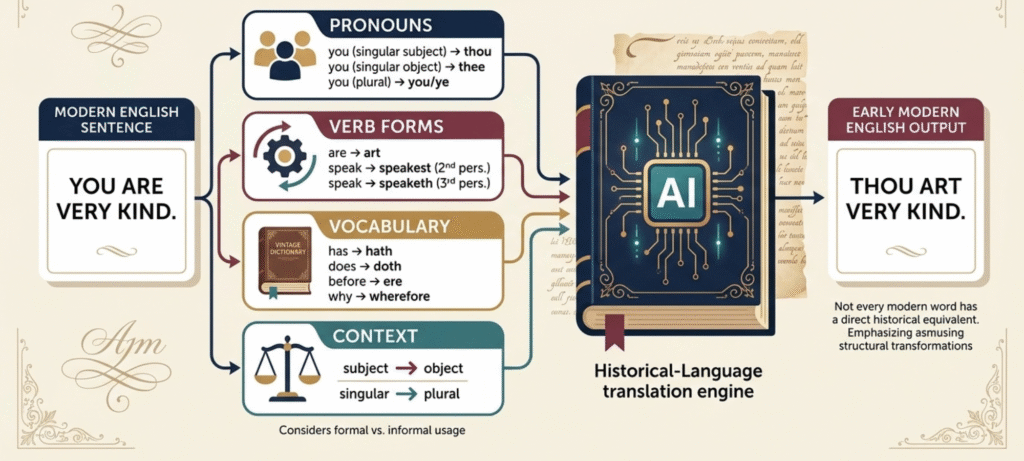
Most follow the same rough recipe.
Pronouns. Modern “you” may become thou, thee, thy, or thine, depending on its role. Not every “you” should change, though, and that’s where quality shows.
Verbs. Regular verbs pick up endings: speakest with thou, speaketh with he. Irregular verbs have their own forms, like hast, hath, dost, and doth.
Vocabulary. Some modern words have period alternatives. Many don’t. Good tools leave those alone.
Context. Is the speaker addressing one person or several? Familiar or formal? Subject or object? A lazy tool ignores all of this.
Picture a student typing “you’re my best friend” and getting back something like “thou’rt mine best friend.” Charming, sure. Also a rough guess. Treat every output as a draft, not a ruling.
Modern English to Early Modern English Translator
This is what most people actually want when they come looking. Type in an English to Early Modern English translator, and the goal is simple: take a modern sentence and give it that period-flavored feel.
But here’s the honest part. What you get back is a stylistic rendering, nothing close to a historically authenticated reconstruction. There was never one single, fixed version of Early Modern English to reconstruct in the first place. A schoolteacher scribbling something in 1580 didn’t write the way a Jacobean poet did in 1620, and truthfully, neither one wrote quite the way any tool assumes they did.
That’s why Modern English to Early Modern English translation does fine with short, straightforward sentences, but starts wobbling once slang, idioms, or anything more abstract gets involved. You’ll find full examples of that further down the page.
Early Modern English to Modern English Translator
Now the other way around. An Early Modern English to modern English translator decodes older text so you can read it quickly. Students use it for plays, sermons, Bible passages, letters, and literature assignments.
Simple case: “Thou art mistaken” becomes “You are mistaken.”
Harder case: a passage with words that changed meaning. A tool that only knows today’s definitions can mislead you politely and confidently. So read the surrounding lines, not just the swapped words.
Shakespearean English to Modern English Translator
If you’re working with plays, you’ll often want a Shakespearean English to modern English translator. Take the famous line “Wherefore art thou Romeo?” Many people read “wherefore” as “where.” It actually means “why.” Juliet isn’t asking where Romeo is, she’s asking why he has to be Romeo, a Montague.
Other quick ones: “I know not” is “I don’t know,” and “Prithee, stay” is “Please, stay.” Small details like these are exactly why a bare word swap isn’t enough.
Can an Early Modern English Translator Convert Individual Words?
Sometimes, but word by word is risky. Historical meaning depends on context. A few classic traps:
prevent once could mean “go before” or “anticipate.”
nice could mean “foolish” or “precise.”
meat often meant food in general.
conversation could mean behavior or way of life.
presently could mean “immediately.”
That’s why an Early Modern English word translator is helpful for a quick look but shouldn’t be your final authority.
Early Modern English Translation Examples
Here’s a set of examples across different situations. Treat the modern to Early Modern rows as style-oriented, not guaranteed historical reconstructions.
| Type | Modern English | Early Modern English style |
|---|---|---|
| Everyday | You are very kind. | Thou art very kind. |
| Question | What do you want? | What dost thou want? |
| Possession | This book is yours. | This book is thine. |
| Formal speech | Please tell me your name. | Prithee, tell me thy name. |
| Friendship | You are my best friend. | Thou art my truest friend. |
| Negative | I don’t know. | I know not. |
| Historical text | Thou art mistaken. | You are mistaken. |
| Shakespeare-style | Wherefore art thou Romeo? | Why are you Romeo? |
Notice that “I know not” isn’t fancy invention. It reflects how negatives worked back then, without the helper “do.”
Thou, Thee, Thy, Thine and You Explained
These forms cause more confusion than anything else.
| Form | Function | Example |
|---|---|---|
| thou | subject | Thou art wise. |
| thee | object | I see thee. |
| thy | possessive before a consonant | Thy book is here. |
| thine | possessive before a vowel sound, or on its own | The choice is thine. |
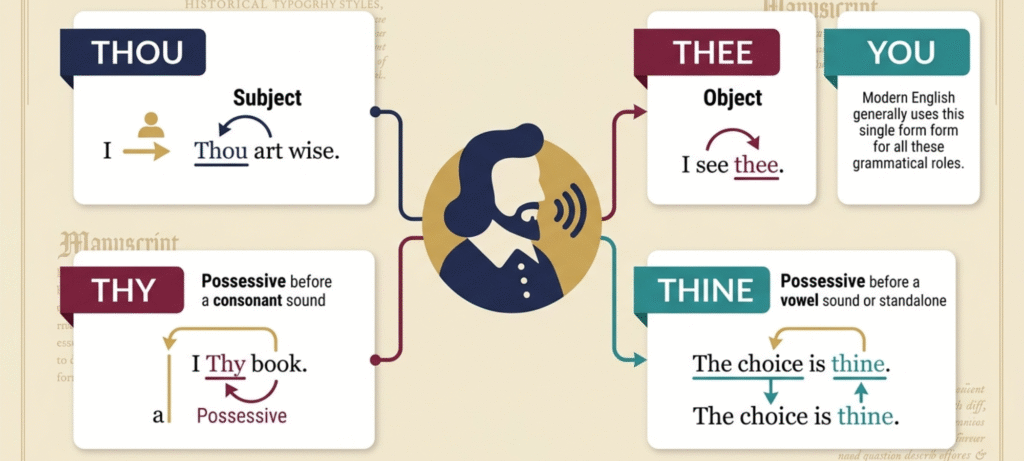
Thou and its relatives were singular and familiar, used with friends, family, children, and in prayer. Ye and you covered the plural and the formal singular. So a character might say thou to a close friend and switch to you the moment a lord walks in.
Which means thou is not just “old-fashioned you.” It carries closeness, sometimes affection, sometimes insult. Modern English lost that distinction, which is partly why we invented “y’all” and “you guys.”
Key Features of Early Modern English
This section turns the article into a small reference. Skim what you need.
Pronouns. Thou, thee, thy, thine, ye, you, as covered above. Subject, object, possessive, singular, plural, familiar, formal.
Verb endings. Second-person singular takes -est (thou speakest, knowest, hast, dost). Third-person singular takes -eth (he speaketh, knoweth, saith, hath, doth, goeth). Common forms like art, wilt, and shalt appear constantly. By Shakespeare’s day the modern -s was already competing, so both patterns appear, even in the same play.
Vocabulary. Thousands of words came in from Latin, Greek, and other languages, and meanings shifted over time (see the word traps above).
Spelling. Far less standardized than today. Printers spelled the same word several ways, and letters like u and v were often interchangeable.
Word order. Some constructions feel unfamiliar: “Comest thou hither?” instead of “Are you coming here?”
Negation. Older patterns like “I know not” and “fear not.”
Contractions. Forms like ’tis and ’twas were common, though not every contraction fits every text or period.
Punctuation and capitalization. Historical texts often follow different conventions from modern ones, including irregular capitals.
Early Modern English Timeline
The dates are approximate, and scholars draw the lines a little differently.
| Period | Rough date | Why it matters |
|---|---|---|
| Late Middle English | 1400s | Chaucer’s language fading |
| Printing press in England | c. 1476 | Spelling starts to settle |
| Tudor period | 1485 to 1603 | Core of early Early Modern English |
| Tyndale’s New Testament | 1526 | Landmark English translation |
| Elizabethan period | 1558 to 1603 | Shakespeare’s early career |
| Jacobean period | 1603 to 1625 | King James Bible, 1611 |
| Milton’s Paradise Lost | 1667 | Late Early Modern English |
| Restoration | 1660 onward | Shift toward Modern English |
For a broader look at how English moved through these stages, the Britannica overview of the English language is a good place to start.
How the Great Vowel Shift Changed English
English vowels didn’t stay put forever. Somewhere around the end of the Middle English period, they started moving, slowly, over hundreds of years, in what people now call the Great Vowel Shift. Speech changed a lot in that time. Spelling didn’t. That gap is basically why English words look one way and sound another today. Pick up almost any word and you’ll find it looked the same on paper in 1600 as it does now, even though it came out of someone’s mouth completely differently back then.
Early Modern English vs Shakespearean English
People treat these as the same thing, but they aren’t. Sure, Shakespeare belongs to the Early Modern English period. But so does Tyndale’s Bible. So does Marlowe. Spenser, Bacon, Milton too, along with countless sermons, letters, legal papers, and scientific texts nobody remembers by name. One playwright, however famous, doesn’t define an entire era of the language.
English to Shakespearean Translator: Is It the Same Thing?
Not quite. Tools built around an English to Shakespearean translator are chasing one narrow slice of the period, the theatrical, Elizabethan flavor specifically. Plenty overdo it, throwing thee and thou into every sentence, even though Shakespeare himself wrote differently depending on which character was talking. For a play, a party, some creative writing, sure, that stagey tone is the whole appeal. For anything historical, you want the wider Early Modern English net instead.
Is an Early Modern English Translator the Same as a Fancy English Translator?
No. “Fancy English” just means dressed-up, formal wording, nothing more specific than that. Early Modern English is a real historical period the language went through. Something styled like Shakespeare might sound fancy to modern ears, but sounding fancy and being historically accurate are two completely different claims.
Early Modern English Translator vs Archaic English Translator
An archaic English translator is a broader idea. Someone using that phrase might want Shakespearean wording, Biblical English, medieval flavor, older vocabulary, or just a formal historical tone. Early Modern English points to one specific period. All Early Modern English is archaic by today’s standards, but not all archaic English is Early Modern.
Early Modern English vs Old English vs Middle English
| Stage | Approx. period | Famous association |
|---|---|---|
| Old English | c. 450 to 1100 | Beowulf |
| Middle English | c. 1100 to 1500 | Chaucer |
| Early Modern English | c. 1500 to 1700 | Shakespeare |
| Modern English | c. 1700 to present | Contemporary English |
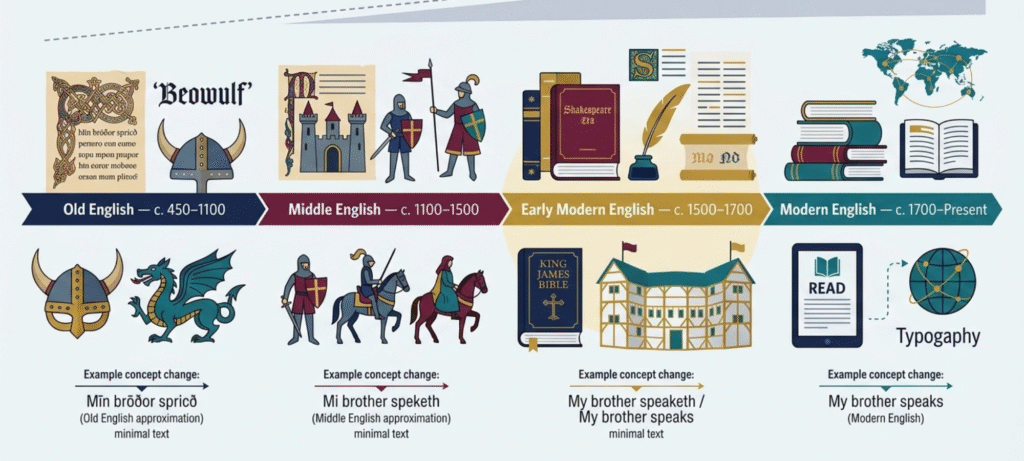
So an English to Old English translator and a Middle English translator aim at very different targets. Old English looks nearly foreign to modern readers. Early Modern English is mostly readable, which is exactly why it’s so easy to play with.
Early Modern English Bible Translations
Bible history sits at the center of this period.
| Translation | Date | Key figure or team | Why it matters |
|---|---|---|---|
| Tyndale New Testament | 1526 | William Tyndale | Strongly shaped later English Bible wording |
| Great Bible | 1539 | Various contributors | Early officially authorized English Bible |
| Geneva Bible | 1560 | English Protestant translators | Widely read before the King James Version |
| King James Version | 1611 | Team of translators | Formal, influential English |
Who Translated the Bible Into Early Modern English?
No single person. Several translations appeared during the period, including Tyndale’s pioneering work from Greek and Hebrew and the King James Bible, produced by a team of scholars. Tyndale was executed in 1536, and much of his phrasing lived on in later versions.
Why Does the King James Bible Sound So Old-Fashioned?
Honestly, the short answer is pretty simple. It’s just the English people wrote in 1611, done up in a formal, dignified tone on purpose. The translators actually said this themselves, that they wanted something elevated rather than something that sounded popular or casual, so they reached for older forms of the language. By that point, thou, thee, hath, and saith were already fading out of how people actually talked day to day. They stuck around in the Bible anyway, which is exactly why later readers ended up hearing them as something sacred and ancient. I wouldn’t go so far as to say the translators “deliberately used old English,” though. That’s not quite right. They were writing in the English of their own time, just choosing a conservative tone to write it in.
A surprising number of everyday idioms actually come from this translation. “The salt of the earth” and “a wolf in sheep’s clothing” are two well-known ones. Worth a look if that kind of thing interests you: idioms for writers.
How Accurate Are AI Early Modern English Translators?
Useful? Yes. Authoritative? Not really.
They handle some things fine on their own: common pronouns, verb patterns people recognize easily, simple sentences, and keeping things readable overall. Where they start to struggle, and where you should slow down and check things yourself, is exact period vocabulary, regional differences, a particular author’s style, Biblical phrasing, words that meant something different back then, and idioms.
Limitations of AI Early Modern English Translators
The usual problems: invented archaic words that never existed, fake grammar that sounds plausible, thou sprinkled on every “you,” wrong verb endings, modern concepts given made-up historical vocabulary, Shakespeare and King James and generic “olde” English blended together, and no way to tell which author, date, or register you actually need.
How to Check an Early Modern English Translation for Accuracy
Run through this checklist:
- Is the target period clear, or is it a vague mix?
- Is the pronoun right for the speaker and listener?
- Does the verb ending match the subject?
- Does the vocabulary belong to the period?
- Was modern slang handled sensibly?
- Does the sentence keep the original meaning?
- Is it Shakespearean when you wanted broad Early Modern English?
- Are old words used with their old meanings?
- Can key words be supported by a dictionary? The Oxford English Dictionary tracks when words and senses appeared.
- Does the tool claim more certainty than it can prove?
A tool that promises “100% accuracy” is a red flag, not a feature.
Best Early Modern English Translators and Free Tools
Here’s how several tools that show up in search results describe themselves. I haven’t independently tested them, so treat the details as their own claims and check the current versions yourself.
| Tool | Best for | Direction | Features (per its own page) | Watch out for |
|---|---|---|---|---|
| OpenL | AI-based translation | Both | Text, image, audio, documents; free tier | Free plan has daily and character limits |
| LingoJam | Simple browser use | Both | Elizabethan and modern conversion; usage tips | Its author says it isn’t perfect |
| Shakespeare Talk | Stage-style wording | Modern to Early Modern | Free; good for captions, plays, jokes | Narrow Shakespearean focus |
| Translator Max | Quick conversion | Modern to Early Modern | Archaic pronouns and period wording | More style than history |
| WordCountTool | Creative rewrites | Modern to Shakespearean style | Theater scripts, themed events | Not a full historical reconstruction |
| TranslatorMind | Free AI conversion | Both | Shakespeare-era cadence, or back to modern | Accuracy still needs checking |
| Anything Translate | English to Early Modern Standard | Modern to Early Modern | Free, AI-based | Verify output for study |
Sites like Polytranslator and Old English Translators focus on Old English, which is a different language stage.
So what’s the best Early Modern English translator? It depends. For creative fun, a stage-style tool is enough. For study, pick one that handles both directions and always double check the results.
Are There Free Early Modern English Translators?
Yes, plenty. Free browser tools are common, and many need no signup. Just watch for character limits, daily caps, and whether image, audio, or document support is paywalled. A free early modern English translator is fine for a caption or a classroom activity. It isn’t automatically accurate, and it shouldn’t be your only source for a research paper.
Can You Use an Early Modern English Translator Online?
Absolutely. An early modern English translator online works in your browser with a simple copy and paste workflow, no install needed. It’s handy for converting a sentence quickly on desktop or phone.
Is There an Early Modern English Translator App?
Some tools offer apps, but for most people a mobile browser does the job. If you do choose an app, look at what input it supports (text, voice, image), whether it works offline, how it treats your privacy, and what the free tier limits. An app isn’t necessary just to translate a few lines.
Can Google Translate Translate Early Modern English?
Not really. Google Translate is built mainly for modern languages, and Early Modern English is a historical stage of English, not a standard target language you pick from a menu. It may misread historical text. Dedicated tools are more useful for stylistic conversion, and for academic work you should always verify against the original text and scholarly sources.
How to Get Better Translation Results
Give the tool some context. Tell it the period you want, the audience, the tone, the direction, and whether you want Shakespearean style or broader historical English. Say whether accuracy or creativity matters more.
Here’s a sample prompt: “Convert this sentence into Early Modern English around 1600. Preserve the meaning, avoid modern slang, and don’t make it specifically Shakespearean.”
That single line tends to beat pasting text in with no instructions.
Common Early Modern English Translation Mistakes
Here’s what goes wrong most often:
Changing every “you” to “thou.” Adding -eth to everything. Using “thine” before every noun. Assuming all Early Modern English is Shakespeare. Confusing it with Old English. Translating words without context. Inventing archaic vocabulary. Assuming the King James Bible represents the whole period.
Avoid those and you’re ahead of most tools.
How to Use an Early Modern English Translator
- Write or paste your text, ideally in short, clean sentences.
- Choose the direction.
- Read the output for pronouns, verb endings, vocabulary, and meaning.
- Verify anything important against a dictionary or a scholarly source.
Who Uses These Translators?
Students reading Shakespeare, actors warming up lines, writers experimenting with historical voice, teachers building activities, and hobbyists making toasts and captions. Each has a different accuracy bar, so decide yours before you start.
Frequently Asked Questions
What is an Early Modern English translator?
A tool that converts text between modern English and the English of roughly the 16th and 17th centuries, in either direction.
What is the best Early Modern English translator?
It depends on your goal. Pick one that supports the direction you need, is clear about its limits, and lets you check the output.
Is there an Early Modern English translator online?
Yes, many browser-based tools exist.
Is there a free Early Modern English translator?
Yes, though free tools usually have limits and varying accuracy.
Is there an Early Modern English translator app?
Some exist, but a mobile browser often works just as well.
Can Google Translate translate Early Modern English?
Not reliably. It’s built for modern languages, so use dedicated tools and verify the output.
What is an archaic English translator?
A broader term for tools that produce or decode older-sounding English, not limited to Early Modern English.
What is the difference between an Early Modern English translator and a Shakespeare translator?
The first covers a whole historical period, while the second targets Shakespearean, Elizabethan-style wording.
Can I translate Shakespeare into modern English?
Yes, but watch words like “wherefore” that changed meaning.
Can an AI translator produce historically accurate Early Modern English?
It can produce convincing style, but accuracy needs checking against reliable sources.
What does thou mean?
Thou is the singular, familiar “you” used as a subject.
What is the difference between thou and thee?
Thou is the subject form, thee is the object form.
What is the difference between thy and thine?
Thy goes before a consonant sound, thine before a vowel sound or on its own.
What years are Early Modern English?
Roughly the late 15th century to the late 17th century, with scholars dating it slightly differently.
Final Thoughts
An Early Modern English translator can be a fun and useful tool, but it works best when you know what it’s imitating. Remember that Shakespeare is only part of the period, that “you” never disappeared, and that any output is a stylistic approximation until checked. Use it for reading, writing, and play, and verify the details whenever accuracy counts.