

A patient walks into a hospital for outpatient surgery. A surgeon performs the procedure, an anesthesiologist manages sedation, and a radiologist reads the imaging afterward. By the time that patient goes home, the hospital has actually generated two separate claims for the same visit — one for the facility itself, and one for the doctors who did the work. That second claim is where profee coding lives. So what is profee coding, exactly, and why does it exist as its own specialty instead of just being folded into regular hospital billing? Short version: it’s the part of medical coding that captures a provider’s clinical judgment, not the building they worked in.
Quick Answer
ProFee coding, short for professional fee coding, is the process of translating a physician’s or licensed practitioner’s clinical work — visits, procedures, decision-making — into CPT, ICD-10-CM, and HCPCS Level II codes so insurers reimburse that provider correctly. It’s distinct from facility coding, which bills separately for the hospital’s room, equipment, and nursing staff during that same encounter.
Key Takeaways
- ProFee coding bills for a provider’s expertise and cognitive work, not the physical space where care happened.
- CPT and ICD-10-CM are the two workhorse code sets, with HCPCS Level II covering supplies and drugs.
- ProFee claims go out on a CMS-1500 form; facility claims use a UB-04 — different forms, different rules entirely.
- Reimbursement ties back to the CMS Physician Fee Schedule and Relative Value Units, or RVUs.
- Emergency medicine and multi-specialty groups each have their own quirks worth understanding before you specialize.
Why Is It Called “ProFee” Coding?
The name is really just shorthand. “Pro” for professional, “fee” for the fee a provider charges for their service — professional fee, ProFee. It’s not an official CMS term you’ll find printed on a claim form, but it’s stuck in the industry because it draws a clean line between what a physician bills for and what the hospital bills for. Ask five coders where the term originated and you’ll get five slightly different stories, but the meaning is consistent everywhere: it’s provider-side coding, full stop.
What Is ProFee Coding?

Strip away the acronyms and profee coding is really just this: someone has to translate what a doctor actually did — the exam, the judgment calls, the procedure performed — into a language insurers understand. That language is made of codes. A coder reads through the physician’s documentation, works out which CPT code matches the service, pairs it with the correct ICD-10-CM diagnosis code, and files a claim that essentially says: this provider did X for a patient with condition Y, and deserves payment for it.
Here’s the part that trips people up when they’re first learning what is profee coding: hospital billing and physician billing aren’t the same thing, even though they’re happening in the same building at the same time, sometimes for the same fifteen-minute encounter. The hospital’s claim covers the room, the equipment, the nurses. The provider’s claim — the profee claim — covers their time, training, and clinical decision-making. Two claims, two purposes, one patient encounter.
Who Uses ProFee Coding?
Pretty much anyone who bills for direct patient care rather than facility resources. Physicians across every specialty, nurse practitioners, physician assistants, group practices, outpatient clinics, emergency physicians, radiologists reading scans remotely, surgeons — if a licensed provider is billing for their own professional judgment and skill, ProFee coding is how that gets translated into a claim. Hospital-employed physicians still generate profee claims separate from the hospital’s own facility claim, which is exactly why the same encounter so often produces two bills that patients find confusing.
How Does ProFee Coding Work?

The workflow is fairly linear once you’ve watched it happen a few times. A patient comes in for a visit or procedure. The provider documents what happened in the medical record — symptoms, exam findings, treatment given. A coder then reviews that documentation and pulls out the billable pieces: the diagnosis (ICD-10-CM), the procedure or visit level (CPT), and any supplies or drugs needing HCPCS Level II codes. Modifiers get attached where needed — say, a procedure was more complex than usual, or performed on a specific side of the body. The claim goes out on a CMS-1500 form, the insurer reviews it, and payment follows. Or a denial does, if something’s off.
Written out like that, it sounds simple. In practice, it rarely is. Physician notes are sometimes vague. Templates get overused, copied forward from visit to visit until they barely reflect what actually happened that day. And a coder has to know enough medicine to catch when documentation doesn’t actually support the code being billed. That gap between what the doctor meant and what the chart actually says is where a lot of coding careers get genuinely interesting.
Why Accurate ProFee Coding Matters
Get a code wrong and the consequences aren’t abstract. Under-code a service and the practice loses revenue it earned. Over-code it and you’ve invited an audit, or worse, a fraud investigation nobody wants to be part of. Claim denials pile up when documentation doesn’t line up with what was billed, which slows down cash flow for the whole practice. There’s also a compliance angle that new coders underestimate at first — Medicare and commercial payers both run edits (NCCI edits, for instance) specifically designed to catch mismatched or duplicate billing, and a coder who understands why accuracy matters tends to catch problems before a payer does.
What Does a ProFee Coder Do, Day to Day?
Most of the job is chart review. A coder reads through physician notes, pulls the relevant diagnosis and procedure information, assigns codes, and checks everything against payer rules before the claim goes out. Ask almost any experienced ProFee coder what slows them down most, and you’ll usually hear the same answer: documentation. Even a skilled coder can’t bill for something a physician never wrote down. That’s why a lot of the job is really about reviewing notes for completeness, not just assigning codes off a chart that’s already perfect. In many practices, coders also query the physician directly when documentation doesn’t quite support the level of service being billed — a short back-and-forth that can make the difference between a clean claim and a denied one.
ProFee Coding vs Facility Coding
| Feature | ProFee Coding | Facility Coding |
|---|---|---|
| What’s billed | Provider’s clinical work and expertise | Hospital overhead, room, equipment, nursing |
| Claim form | CMS-1500 | UB-04 |
| Primary code sets | CPT, ICD-10-CM | CPT/HCPCS, ICD-10-CM, plus Revenue Codes and DRGs |
| Who gets paid | The physician or practice | The hospital or facility |
| Complexity driver | Documentation of clinical decision-making | Length of stay, resources used |
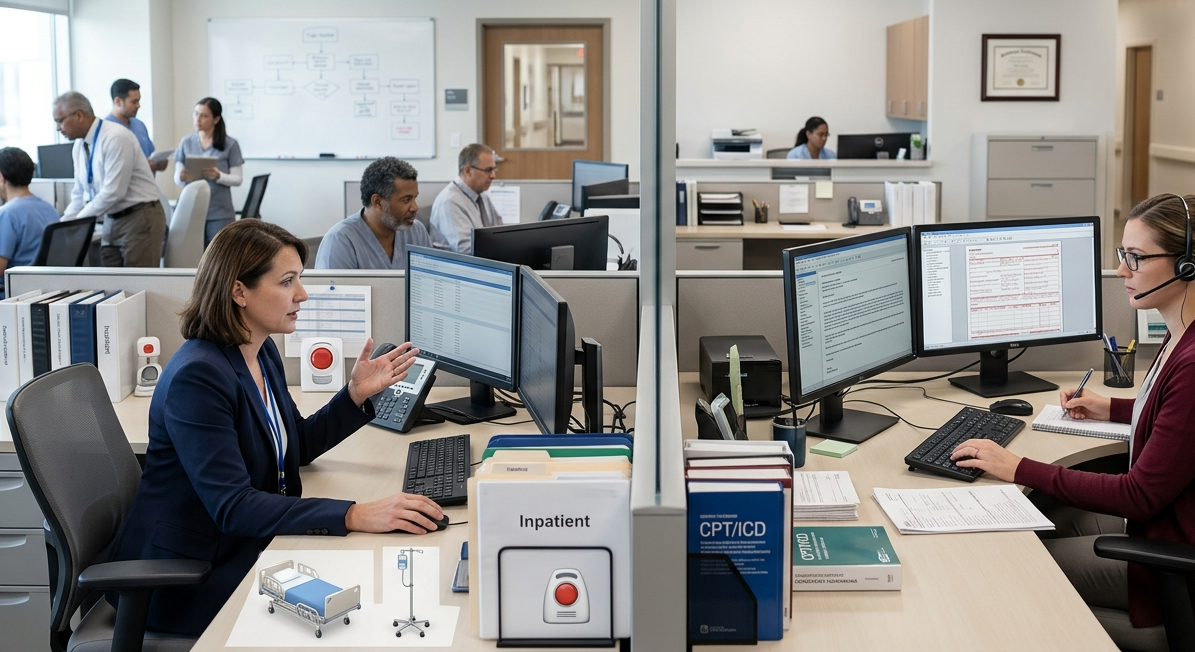
Emergency department visits are a good example of why this split matters in practice, and honestly one of the clearest ways to explain what is profee coding to someone new to the field. When a patient shows up in the ED, the emergency physician’s work gets billed separately from the hospital’s ED facility fee — same visit, two claims, two coders potentially working from the exact same chart without ever speaking to each other.
What Is ED ProFee Coding?
Emergency department profee coding is its own animal, honestly. ED physicians see patients with wildly different acuity levels in the same shift — a sprained ankle one hour, a cardiac event the next — and the coder has to reflect that range accurately using Evaluation and Management (E/M) codes. Trauma cases, critical care time, and rapid decision-making all need precise capture, because under-coding a critical care encounter costs a practice real revenue, while over-coding invites scrutiny nobody wants. Anyone coming from a clinical background — paramedics or EMTs who’ve completed an Emergency Medical Responder course, for instance — often find the clinical vocabulary in ED charts a little more familiar than coders arriving from a purely administrative track.
What Is a Multi-Specialty ProFee Coding Position?
A multi-specialty coder isn’t coding for one type of physician. They’re coding for a group practice or hospital-based team that might include cardiology, orthopedics, and general surgery under one roof. That means juggling multiple documentation styles and multiple sets of specialty-specific CPT nuances, sometimes switching between them within the same shift. It’s more demanding than single-specialty coding, no question. But it also tends to pay a bit more and opens up broader career mobility, since you’re building expertise across several fields at once instead of just one.
Code Sets Used in ProFee Coding
- CPT (Current Procedural Terminology) — maintained by the American Medical Association, covers procedures and services.
- ICD-10-CM — diagnosis codes explaining why the service was needed in the first place.
- HCPCS Level II — supplies, drugs, and equipment not covered under CPT.
- Modifiers — two-digit additions clarifying circumstances, like a bilateral procedure or a service performed by more than one provider.
- RVUs (Relative Value Units) — assigned by the CMS Physician Fee Schedule to each service, and the actual determinant of reimbursement amounts.
Common Mistakes in ProFee Coding
New coders tend to trip over the same handful of errors. Picking the wrong E/M level is probably the most common — either under-selling a genuinely complex visit or over-stating a simple one. Missing modifiers cause a surprising number of denials, especially on bilateral or staged procedures. Diagnosis-to-procedure linkage errors — billing a service without a diagnosis code that actually justifies medical necessity — are another frequent flag. And using an outdated CPT or ICD-10-CM code after the annual updates roll out is a mistake that happens more often than anyone likes to admit, even among coders who’ve been doing this for years.
Software Used in ProFee Coding

Most coders work inside an electronic health record system like Epic or Cerner, often paired with dedicated coding software such as 3M, Optum Encoder, or AAPC’s Codify tool. These platforms help flag missing documentation, suggest applicable codes, and catch some compliance issues automatically — though none of them replace a coder’s judgment when the chart is ambiguous, which, honestly, is most of the time.
Skills and Certification
Solid profee coders know medical terminology and basic anatomy cold, since you can’t code what you don’t understand. Beyond that, attention to detail and comfort with ambiguity matter more than people expect going in — documentation is rarely perfect, and a coder has to make judgment calls that stay within compliance boundaries. Most coders pursue certification through AAPC (the CPC credential is the most common entry point) or AHIMA (CCS), and most employers now treat certification as a baseline requirement rather than a nice-to-have.
Is ProFee Coding a Good Career?
For a lot of people, yes. Entry-level profee coders in the US typically start somewhere in the low-to-mid $40,000s, with experienced coders — especially those certified across multiple specialties — pushing well past $60,000. Remote positions have become far more common since the pandemic reshaped how a lot of revenue cycle work gets done, which is a real draw for people who want flexibility. Career paths often move from general coding into auditing, compliance, or coding education down the line. A background in a related health field doesn’t hurt, either — some coders come in after studying medicine abroad, including students who’ve experienced Medical College Campus Life in Guyana before eventually shifting toward the administrative side of healthcare.
Common Challenges
Documentation gaps are probably the single biggest headache in this line of work — a coder can only bill what’s actually written down, and physicians don’t always write with a coder’s needs in mind. Claim denials follow close behind, often from missing modifiers or mismatched diagnosis-procedure pairs. Payer policies shift constantly, and annual CPT and ICD-10-CM updates mean coders are never quite finished learning. None of this makes the job impossible. It just means the learning curve doesn’t flatten out the way people expect after year one.
Frequently Asked Questions
What is profee coding?
It’s the process of coding a physician or licensed practitioner’s clinical services — visits, procedures, decision-making — for insurance reimbursement, kept separate from the hospital’s facility claim.
What is profee medical coding?
Same thing as profee coding — “medical” gets added informally sometimes, but it refers to the same professional fee coding process built on CPT, ICD-10-CM, and HCPCS Level II.
What does a ProFee coder do?
Reviews physician documentation, assigns the correct diagnosis and procedure codes, applies modifiers where needed, and submits claims on a CMS-1500 form.
Is ProFee coding hard?
There’s a real learning curve, mostly because documentation quality varies so much from provider to provider, but it’s very learnable with the right training and certification.
How is ProFee different from facility coding?
ProFee bills for the provider’s expertise; facility coding bills for the hospital’s overhead, using different code sets and an entirely different claim form.
What certification do I need?
AAPC’s CPC credential is the most common starting point, though AHIMA’s CCS is also widely recognized across the industry.
How much do ProFee coders earn?
Entry-level pay tends to start in the low-to-mid $40,000s, with experienced and multi-specialty coders earning noticeably more over time.
What software do ProFee coders use?
Common tools include Epic, Cerner, 3M, Optum Encoder, and AAPC Codify — though the software supports the coder’s judgment, it doesn’t replace it.
Can beginners learn ProFee coding?
Yes. Most people start with a certification course, then build speed and accuracy through supervised on-the-job experience during their first year or two.
Is ProFee coding remote-friendly?
Very much so now. Remote coding positions expanded significantly after 2020 and remain common across hospital systems, physician groups, and revenue cycle companies.
Is AI replacing ProFee coders?
Automation is handling more of the routine coding work, but human coders remain essential for complex charts, audits, and compliance decisions that genuinely require judgment.
Conclusion
At its core, profee coding is the bridge between what a physician actually does and what an insurance company is willing to pay for. It’s detailed work, occasionally frustrating, and genuinely essential to how healthcare gets paid for in the US. If you’re weighing whether to specialize in it, it’s worth spending time with resources from CMS and AAPC, both of which publish detailed, current guidance on coding rules and certification paths — alongside AHIMA and the AMA’s own CPT guidance, which most working coders end up referencing sooner or later. Once you understand what is profee coding at this level, the rest of the specialty — ED coding, multi-specialty coding, certification, career growth — starts to make a lot more sense.