
It’s midnight. Your essay is done, the deadline is first thing tomorrow, and you’re staring at the screen with one nagging worry. What if an AI detector flags it, even though you wrote every word yourself?
I hear this a lot from students, and it’s the main reason people are searching for Proofademic AI right now. So here’s a plain look at what it does, what it costs, how accurate it says it is, and where you should be careful.
One thing up front. I haven’t run my own lab tests on it. This review comes from Proofademic’s public pages, the research the company has published, and one outside review by a competitor. I’ll tell you which is which as we go.
Quick verdict: Proofademic AI can give you a handy early signal on your own writing, and the free scan covers a short essay. Just remember that an AI score is a clue. It isn’t proof of who wrote something. It doesn’t replace your drafts, your notes, or a chat with your instructor.
What Is Proofademic AI and How Does the Detector Work?
Proofademic AI is an AI detection tool that also has a plagiarism checker. It’s made for students, teachers, publishers and editors. You paste in some text or upload a file. It gives you an overall score for how AI-like the writing looks, plus highlights on individual sentences.
Those highlights are what set it apart from simpler checkers. Many tools just say “40% AI” and leave you guessing. Proofademic shows you which lines caused the concern. If you’re a student, that’s the useful part, because you can see exactly where a reviewer might look twice.
So what’s happening under the hood? According to the company’s own published method, the detector reads each sentence alongside the sentences around it. It doesn’t treat every line as if it stood alone. That’s one reason a single document can show different results from one paragraph to the next. Keep in mind that this is the company describing its own system, and I can’t confirm it independently.
Proofademic also says it can spot text from big models like ChatGPT, Claude and Gemini, and that it supports several languages, with adjustments for non-native English writers. Those are claims. Treat them that way until you’ve seen some evidence, which we’ll get to.
Does it work on ChatGPT, Claude and Gemini text? The company says yes. But no detector catches every output from every model, so don’t read that as a promise.
Is Proofademic AI Free?
Partly. Proofademic offers a free starting option with 1,000 words and says you don’t need a credit card to try it. It looks like a limited, trial-style allowance, not 1,000 fresh words every month. That’s enough for one short essay or a few paragraphs. It won’t cover a whole semester.
Here’s how the plans looked on the official pricing page when I checked:
| Plan | Price | Monthly words |
|---|---|---|
| Free | $0 | 1,000 words |
| Essential | $15/month | 200,000 words |
| Premium | $25/month | 400,000 words |
| Professional | $45/month | 600,000 words |
Two quick things before you sign up.
The first is the free allowance. Read the exact wording when you register, because trial terms change. The second is easy to miss: a monthly word allowance isn’t the same as a per-scan limit. A plan might give you 200,000 words a month and still cap how much you can paste in at once. If you want to scan a long dissertation chapter by chapter, check that limit first.
Prices move around, so confirm everything on the official site before you pay.
My honest take? Start with the free scan. A paid plan only makes sense if you check long documents often, or you’re a tutor or teaching assistant with a pile of submissions.
How to Use Proofademic AI to Check an Essay
It’s pretty simple. Here’s the workflow the company describes for students.
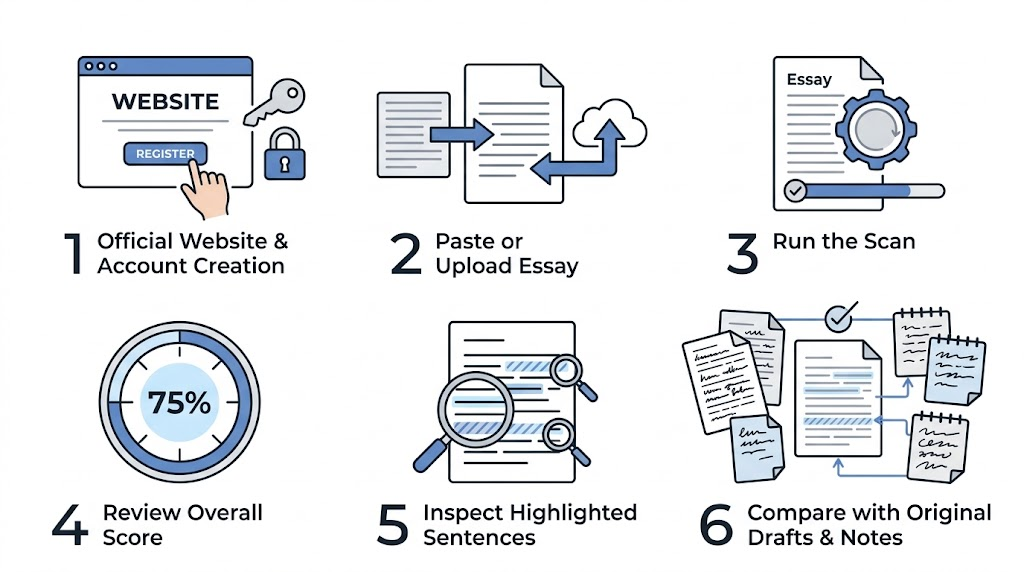
- Go to the official site and make a free account. Watch out for lookalike sites that promise “free unlimited” scans.
- Paste your essay or upload the file. For your first try, use about 500 to 800 words so you don’t burn the whole free allowance.
- Run the scan and look at the overall result first.
- Open the sentence-level view and see which parts are highlighted.
- Compare those parts with your drafts. Be honest with yourself about where each one came from. Was it your own thinking, a paraphrased source, or an AI tool that helped you?
- If you care about matching text, check source overlap as a separate step.
A word of warning here. Don’t rewrite every highlighted sentence just to push the score down. You’ll end up with a flatter, worse essay. If a sentence is really yours, leave it alone. If it sounds vague or generic, fix it because it’ll make the essay better, not because a detector complained.
Proofademic AI Detector: What the Scores Actually Mean
The detector looks at things like word choice, sentence rhythm and how predictable the phrasing is. Then it estimates how closely your text matches machine-written patterns. You get two views.
The document-level score is one overall estimate. It helps you decide whether a closer look is worth your time.
The sentence-level view is the heat-map style one. It marks which lines look more AI-like. This matters most for mixed writing, like when you wrote the essay yourself but used an AI tool to tidy one paragraph.
Here’s the catch. A highlighted sentence doesn’t prove an AI wrote it. The detector can only say the passage looks like patterns it links to AI. Plain, formal or heavily edited human writing can look exactly the same.
Is Proofademic AI Accurate?
This is the question everyone really wants answered, so let’s take it slowly.
Proofademic publishes its own test results. It reports a false-positive rate of 0.2% at the document level, measured on a set of human-written academic texts. It also reports a sentence-level F1 score of 92.9% on a mixed-authorship test. Those look great, and they may be perfectly true for the data the company used.
But there’s a lot packed into those two numbers.
They come from the company. They show how the tool did on Proofademic’s own datasets, under its own conditions. That’s not an independent audit, and it doesn’t promise the same result on your essay.
They measure different things. A false-positive rate tells you how often real human writing gets wrongly flagged. An F1 score combines precision and recall into one measure. Precision looks at how many sentences flagged as AI-generated were actually AI-generated, while recall looks at how many AI-generated sentences the detector successfully identified. It does not mean 92.9% of every essay will be judged correctly.
Context changes everything. Style, subject, length, language and how much a text was edited all affect the result. A 300-word reflection behaves very differently from a 5,000-word literature review.
There’s also an outside test worth knowing about. Ryter Pro, a company that sells a writing tool, published a review with five tests: a raw ChatGPT essay, a human-written article, a humanized AI essay, an ESL student essay and a German AI essay. According to them, Proofademic caught the raw and German AI text, treated the human and ESL samples as human, and still showed AI signals on the humanized one. That’s encouraging. But the reviewer sells a competing product, and the full scores and samples aren’t published, so nobody can repeat the tests. I’d call it one data point, not proof.
So here’s my advice. Treat Proofademic’s numbers as a fair starting point, and keep your own evidence of how you wrote the essay.
Can Proofademic AI Flag Human-Written Student Essays?
Any AI detector can. And honestly, this is the fear behind most of these searches.
Research backs the worry up. A well-known Stanford study on GPT detector bias found that several popular detectors flagged a big share of TOEFL essays, written by non-native speakers, as AI-generated. That study didn’t test Proofademic, so it doesn’t show Proofademic has the same problem. It does explain why ESL calibration matters, and why you shouldn’t assume any detector is fair by default.
Some kinds of human writing get flagged more often. Very formal academic prose with a predictable structure is one. Short passages are another, since there’s too little text to judge. Writing that’s been smoothed by grammar tools can trigger it too. So can the safe, standard phrasing that students still learning English often use, and stock transitions like “in conclusion” that show up everywhere.
Proofademic says it adjusts for non-native writers to cut down on false positives. That’s a good sign. I just wouldn’t go as far as saying it treats every ESL student fairly, because nobody outside the company has fully checked that claim.
What if your original essay gets flagged? Don’t panic. A score starts a conversation. It doesn’t hand down a verdict. Here’s what to do:
- Save your original drafts and notes right away.
- Look at the highlighted sentences in context, not on their own.
- Open your document’s version history and check the timeline.
- Keep your sources and research notes handy.
- Ask your instructor how they’d like you to submit evidence.
That paper trail is your best protection, and Google Docs version history is one of the most convincing records you can show.
Proofademic AI Plagiarism Checker vs AI Detector
Lots of students think these two are the same thing. They’re not.
An AI detector guesses whether the style of your writing looks machine-made. It doesn’t compare your essay to a library of sources.
A plagiarism checker looks for matching text in web pages and other documents. It shows you where your wording is close to something already published.
That’s why you can get odd combinations. A fully original essay can still look AI-like. An AI-written essay can sail through a plagiarism check, because the model wrote new wording. And a properly cited essay with long quotes can show source overlap even though it’s completely honest work.
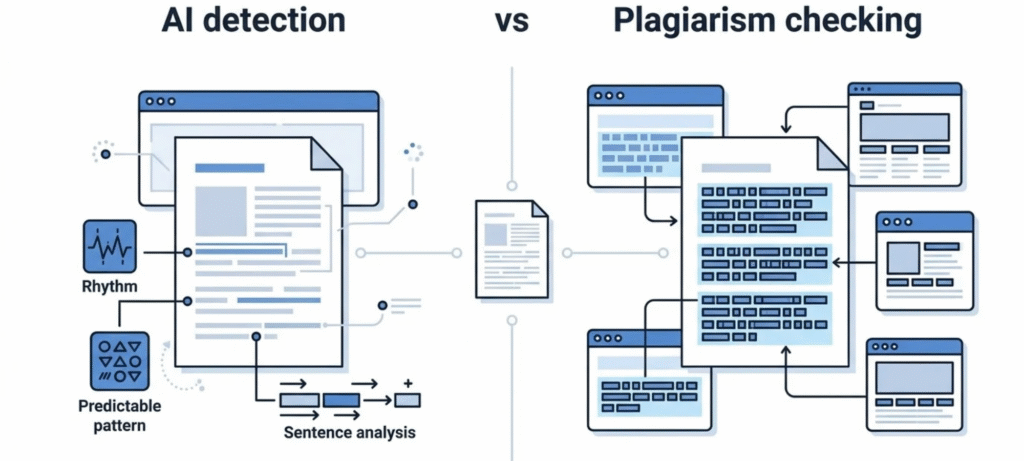
Proofademic lists these as separate checks, which is the right way to do it. One note: don’t assume both checks run together in every plan or every scan. Check the current product pages. When you read your results, ask two different questions. “Does this read like AI?” and “Does this match other sources?” One answer never replaces the other.
Is Proofademic AI Good for Students?
For the right student, yes, as long as your expectations are realistic.
It’s a good fit if you want a quick self-check on a short essay before you hand it in. It also helps if you write in a second language and want to see how your text looks to a detector. And if you used AI lightly for brainstorming, it’s a decent way to confirm your final draft still sounds like you. The sentence-level feedback is a bonus over a single unexplained number.
It’s less useful if you expect a score to “prove” your work is human. It won’t. It’s also a poor fit if you’re tempted to chase a 0% result by rewriting everything, or if you need to scan very long documents all the time on a tight budget.
Something students often forget: checking yourself over and over can just make you anxious without improving anything. If you did the work honestly, a paper trail protects you better than any score. Keep your outlines, notes, early drafts and sources.
And always follow your school’s AI policy. Some courses allow AI for brainstorming. Others ban it completely. A detector can’t tell you what’s allowed.
If you want more background, EasyGrader’s guide to AI detection tools and academic integrity explains how schools use these tools and why scores shouldn’t be the final word. Wondering about rewriting tools too? Read how to use AI humanizers responsibly first. A detector and a humanizer do very different jobs, and using one to dodge the other creates its own integrity problems.
Privacy and Limitations
Before you upload a graded assignment anywhere, read the privacy policy and terms. Look for how long documents are stored, whether your text is used to train models, how you delete your data, and what happens to your account once the trial ends. I couldn’t pull up Proofademic’s policy to confirm those details while writing this, so I won’t promise anything about deletion or confidentiality. Open the policy yourself and read it before you upload.
A few limits apply to every detector, this one included:
- No detector is perfect. False positives and false negatives both happen.
- Very short passages can produce less dependable results because the detector has less text and context to analyse.
- Edited or humanized text is harder to judge. The more a draft has been rewritten, the less certain the result.
- Context is missing. A detector can’t see your drafts, your notes or how you worked.
- Policies differ. The same score can mean different things at different schools.
Proofademic AI Pros and Cons
Pros
- Sentence-level highlights give you something to inspect, not just a number
- The free 1,000-word option lets you try it without paying
- Plagiarism checking is offered as its own feature
- It claims multi-language support and non-native English calibration
Cons
- The accuracy figures come from the company, not an independent audit
- The free allowance is small and looks trial-style
- Privacy and retention terms need a careful read
- Like every detector, it can mislabel real human writing
Frequently Asked Questions
Is Proofademic AI free?
It has a free option with a 1,000-word allowance, and you don’t need a credit card to start. Paid plans begin at $15 a month. Check the current terms on the official site.
Is Proofademic AI accurate?
The company reports a 0.2% document-level false-positive rate and a 92.9% sentence-level F1 on its own test sets. Those numbers apply to specific datasets, so don’t treat them as a guarantee for your essay.
Can Proofademic AI check plagiarism?
Yes. It lists plagiarism checking separately from AI detection, and the two results measure different things.
Can it detect humanized AI text?
One public competitor review says it still showed AI signals on humanized text. That test wasn’t independently verified, and detection generally gets harder the more a text has been edited.
Is it good for students?
It works well as a self-check, especially on short essays. Just treat the result as a clue and keep your drafts as proof.
Should a school rely on one detector score?
No. A score should start a review, not end it. Drafts, version history and a conversation with the student matter much more.
Final Verdict
Proofademic AI is a sensible tool for students who want an early read on their own writing. The sentence-level view is its best feature. The free scan lets you try it at no cost, and the separate plagiarism check helps you see two different kinds of risk.
Its weak spot is the one every detector shares: the score looks more certain than it really is. The company’s accuracy numbers are encouraging but self-reported, and the best-known outside test is useful but far from independent.
So use Proofademic AI as a checkpoint, not a judge. Write your own work, keep your drafts, follow your school’s rules, and if a score ever worries you, bring your evidence to the conversation. Don’t rewrite your essay just to please an algorithm.