There’s a strange myth floating around flight schools and student pilot forums: that you basically need to be a math genius to fly a plane. It’s not true, and honestly, it puts off a lot of people who would otherwise make great pilots.
So let’s clear this up properly. Why do pilots need to be good at math? The short answer is that pilots need to be good at math because flying involves constant calculation — fuel burn, weight limits, wind angles, descent timing, and arrival speeds all have to be worked out correctly, often in your head, often under time pressure. None of it is advanced calculus. Most of it is the kind of arithmetic, basic algebra, and geometry you already learned in school, just applied to a cockpit instead of a textbook.
Do Pilots Need to Be Good at Math?
The Quick Answer: Pilots need solid practical math skills rather than advanced academic theory. Aviators use basic arithmetic, introductory algebra, and fundamental geometry to calculate real-time fuel burn, flight times, aircraft weight distribution, descent profiles, and crosswind corrections. These calculations rely heavily on mental math shortcuts and hand-held flight computers.
That’s really the heart of it. Pilots aren’t sitting there solving differential equations mid-flight. What they’re doing is closer to the kind of math a contractor uses to measure a room, or a nurse uses to calculate a dosage — practical, repetitive, and tied directly to getting something done safely.
Why Math Is Important in Aviation
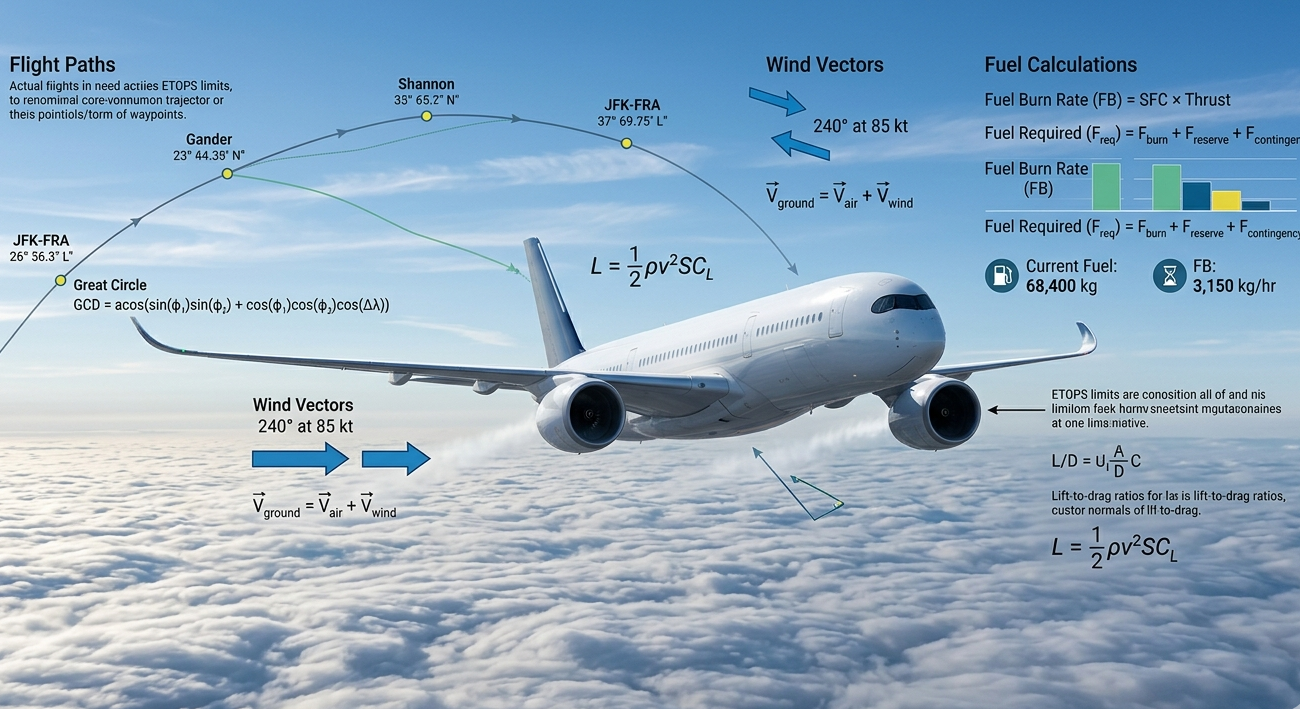
It’s easy to assume that since modern aircraft have computers, GPS, and autopilot, pilots don’t really need to crunch numbers anymore. That assumption is wrong, and here’s why it matters.
- Safety Comes First: Every fuel calculation, every weight check, every descent plan exists because getting the number wrong has real consequences. An aircraft that’s overloaded or has its weight distributed incorrectly can become genuinely difficult or impossible to control. A fuel miscalculation can mean running short before reaching an alternate airport. Math in aviation isn’t an academic exercise — it’s risk management with numbers attached.
- Tactical Decision Making: Adjustments in the cockpit often come down to quick math. Air traffic control might ask a pilot to adjust speed to hit a runway slot at a specific time, or to climb to a new altitude by a certain point. The pilot has seconds, not minutes, to work out whether that’s achievable and respond.
- Operational Efficiency: Airlines plan routes, fuel loads, and passenger weight down to fairly tight margins because carrying excess fuel costs money, and carrying too little is dangerous. Pilots and dispatchers work together using math to find that balance on every single flight.
What Types of Math Do Pilots Use?
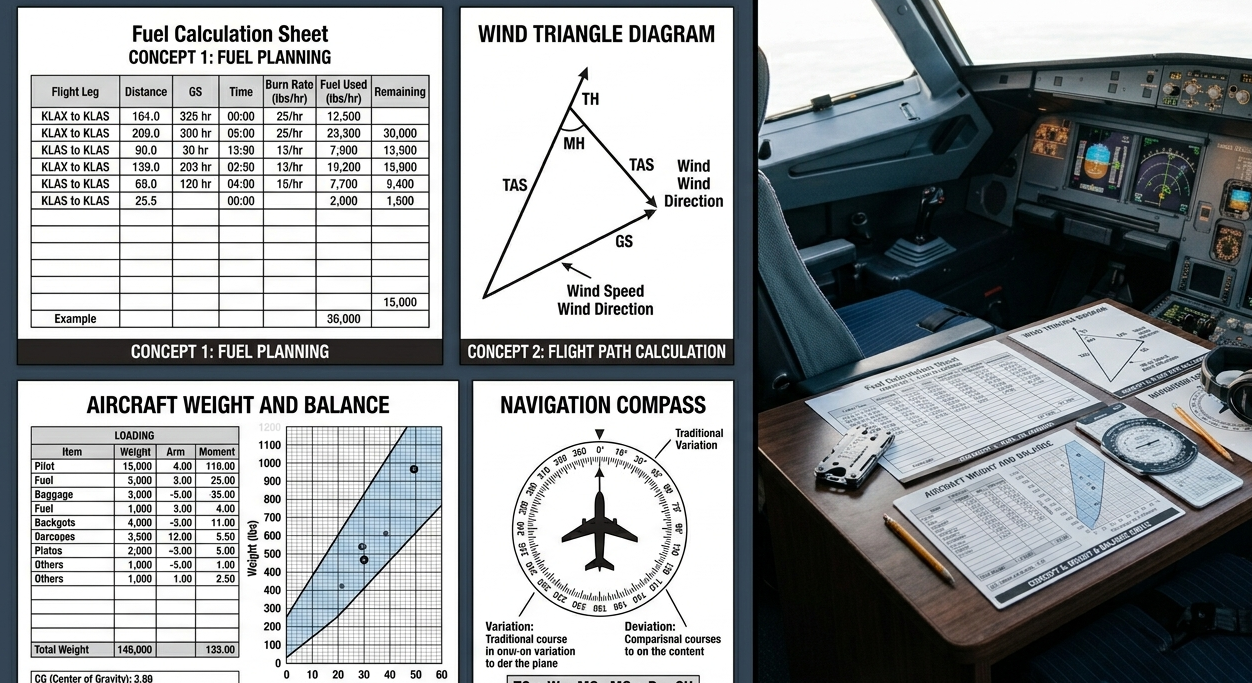
The math pilots rely on falls into a few distinct categories, and almost all of it sits at a level most people covered well before college.
Basic Arithmetic
Arithmetic covers the bulk of everyday flying — adding fuel quantities, subtracting burn rates, converting units between gallons and pounds, and working out time zone differences on long-haul routes.
Algebra
Algebra comes into play when pilots need to solve for an unknown variable. This includes figuring out what groundspeed is required to make a certain arrival time, or working out how much fuel is needed for a specific leg given a known hourly consumption rate.
Geometry and Trigonometry
Geometry matters most in navigation. Routes, headings, and the angles between a planned course and the wind direction are geometric problems at their core. Trigonometry shows up specifically in wind correction. Calculating how much a crosswind will push an aircraft off its intended path, and how many degrees to adjust the heading to compensate, relies on trigonometric vectors. In practice, pilots use a flight computer or app rather than working the formulas by hand.
How Pilots Apply Math During Every Flight
This is where the theory turns into something you can easily picture happening in a real cockpit environment.
- Flight Planning: This starts well before takeoff. Pilots calculate total distance, estimate time en route based on expected groundspeed, and work out fuel requirements including a safety reserve.
- Navigation: Tracking position during flight means comparing actual progress against the initial plan and adjusting headings as needed.
- Fuel Budgeting: Calculations continue throughout the trip, since burn rates change with altitude, power settings, and wind changes. Pilots are essentially running a constant fuel budget in their heads.
- Weight and Balance: This must be confirmed before the aircraft leaves the ground. It means adding up the weight of passengers, baggage, and fuel, then checking that the center of gravity falls inside the safe limits allowed by the manufacturer. If you get this wrong, the aircraft can become unstable or even uncontrollable during takeoff and landing.
If you’re working through these calculations yourself for the first time and want a refresher on how foundational arithmetic and word-problem skills are taught and practiced, reviewing the guide on Making Sense of Primary 1 Mathematics Questions is a useful look at how these core number skills get built from the ground up — the same basic operations pilots later apply to fuel and weight calculations.
- Wind Correction: Headings are constantly recalculated as weather conditions change. A crosswind that shifts just five degrees can mean adjusting the heading to stay on the intended ground track.
- Descent Planning: This is one of the more satisfying mental math problems pilots solve, working backward from altitude, distance to the airport, and descent rate to figure out exactly when to start coming down from cruise altitude.
Do Airline Pilots Use Mental Math?
Yes, constantly, and this is probably the part that surprises people most. Even with autopilot, flight management systems, and GPS doing the heavy lifting, pilots are trained to verify those numbers independently using mental math. If a computer is feeding bad data, or air traffic control suddenly asks for an unplanned speed or altitude change, there’s no time to dig out a calculator. The pilot needs an answer in seconds.
A classic real-world example: ATC tells a pilot to reduce speed to cross a fix at a specific time, three minutes from now, while currently fifteen miles out. The pilot needs to quickly work out the groundspeed that achieves that, compare it to current speed, and adjust accordingly — all while flying the aircraft and talking on the radio. That’s mental math under pressure, and it happens on a huge number of flights.
Emergency situations push this even further. If an engine fails or weather forces a diversion, pilots need to recalculate fuel range, time to a new airport, and descent profiles almost instantly, often without the luxury of double-checking on an electronic device.
Can You Become a Pilot If You’re Bad at Math?
This is probably the single biggest worry students bring up before starting flight training, and the honest answer is reassuring: yes, in most cases, you can. Struggling with advanced math in school does not automatically disqualify anyone from flying. What actually matters is whether you can handle basic arithmetic accurately and consistently, and whether you’re willing to practice the specific calculations aviation requires.
A few things make this easier than people expect:
- Practical Context: Basic math is genuinely enough for the vast majority of flying tasks — nobody is asking a student pilot to prove an abstract theorem.
- Pattern Repetition: Practice improves speed and confidence quickly, since these calculations follow predictable operational patterns that become second nature with repetition.
- Modern Tools: Aviation software, electronic flight bags, and mechanical flight computers handle a lot of the heavier lifting, leaving pilots to focus on understanding and verifying the result rather than deriving it from scratch.
If you struggled with math in school but are willing to put in focused practice on the specific calculations pilots use — fuel burn, time-speed-distance, weight and balance — there’s no reason that earlier struggle should keep you out of the cockpit.
What Math Is Required in Flight School?
Flight schools don’t typically require a math entrance exam, but ground school does cover specific applied math topics tied directly to certification standards. According to the regulatory guidelines, private pilot candidates are tested on knowledge areas that include performance and limitations, weight and balance computations, and navigation, all of which rely on the arithmetic, algebra, and basic geometry covered earlier. Commercial pilot training raises the bar slightly, expecting faster and more confident calculations, but it’s still built on the same foundational math rather than introducing something dramatically harder.
Anyone wondering what level of math actually gets tested can look directly at the official FAA Pilot’s Handbook of Aeronautical Knowledge, which walks through the exact weight and balance, performance, and navigation calculations every student pilot needs to master before a checkride. It’s a genuinely useful reference if you want to see real operational examples.
How Technology Helps Pilots With Calculations
Modern cockpits are full of tools designed to take some of the calculation burden off pilots, though none of them remove the need to understand the underlying math.
- Flight Management System (FMS): Continuously calculates fuel, time, and route data based on real-time flight conditions.
- GPS Systems: Provides constant position updates that feed into navigation calculations automatically.
- Electronic Flight Bag (EFB): Now standard in most airline and general aviation cockpits, this tool replaces paper charts and manual tables with digital systems that update instantly.
- E6B Flight Computer: Whether the old-school physical wheel or its electronic app equivalent, this remains a staple for working out wind correction, fuel, and time-distance problems quickly.
These tools are genuinely useful, but pilots are trained not to blindly trust any single output. Cross-checking a computer’s number with a rough mental estimate is standard practice, because a typo or a sensor glitch can produce a confidently wrong answer.
Common Pilot Math Summary
| Task | Primary Math Used | Practical Application |
| Fuel Planning | Arithmetic | Balancing hourly fuel burn against trip legs and regulatory safety reserves. |
| Navigation | Geometry | Plotting headings, checking tracking radials, and calculating true courses. |
| Crosswinds | Trigonometry | Solving wind vectors to determine the exact runway crosswind component. |
| Weight & Balance | Algebra | Calculating structural moments to keep the center of gravity within margins. |
| Descent Planning | Mental Math | Using 3-to-1 ratios to determine exactly when to idle power and begin a descent. |
For learners building toward this from an earlier stage, or supporting a student who needs a more structured approach to foundational numbers, reviewing a comprehensive Math Curriculum for Special Education is a helpful resource for building number confidence step by step, well before fuel calculations and wind correction angles ever enter the picture.
Frequently Asked Questions
Do pilots need calculus?
No. Calculus is not part of standard pilot training, licensing, or testing. The math used in flying is arithmetic, basic algebra, geometry, and some practical trigonometry.
Is pilot math difficult?
Most students find it highly manageable once they’ve practiced the formulas a few times. The mathematical concepts are simple; the main challenge is executing them quickly and accurately under time pressure.
What is the hardest math pilots use?
Wind correction calculations, which rely on trigonometric relationships, tend to feel the most abstract to new students. In practice, almost all pilots solve these using an app or a flight computer rather than doing the long-form trigonometry by hand.
Do military pilots use more math?
Military and fighter pilots work with faster aircraft and tighter tactical timing margins, so their mental math needs to happen much quicker, but the underlying mathematical concepts are not fundamentally more advanced than commercial aviation.
How often do pilots calculate fuel?
Constantly. Fuel status is checked before departure, recalculated at every major waypoint during the flight as wind conditions change, and verified again before any descent or diversion decision is made.
Conclusion
So, why do pilots need to be good at math? Because every flight is a string of small calculations stacked on top of each other — fuel here, weight there, a wind correction, a descent point, a speed adjustment for air traffic control. None of it demands an advanced academic math background, but all of it demands accuracy, speed, and a willingness to practice until the numbers feel completely automatic.
If you’re someone who’s hesitated about pursuing flight training because math wasn’t your strongest subject in school, it’s worth separating that memory from what aviation actually asks of you. The math pilots use is learnable, practical, and highly satisfying once it clicks.