
2 step directions for speech therapy are simple instructions that ask a child to do two things in order, like “Pick up the ball and put it in the box.” That’s the whole idea. But the skill underneath it is bigger than it looks. The child has to listen, hold the words in memory, sort out which action comes first, and then actually move.
This guide is for parents, teachers, and SLPs who want more than a list of commands. You’ll get real examples, age-based tips, activities, visual supports, goal ideas, and a plan for the moment a child nails step one and forgets step two. Which happens a lot. Almost every kid does it at some point.
What Are 2 Step Directions for Speech Therapy?
A two-step direction has two separate actions inside one sentence. “Get your shoes and bring them to me” works. So does “Touch your nose and clap your hands.” Step one, step two, done.
Here’s a small scene. A therapist says, “Take the cup and put it on the table.” The child grabs the cup, then stands there holding it, looking around. Nothing is wrong with the child necessarily. The second half of the sentence just didn’t stick. That gap between hearing and holding is exactly what this practice targets.
Not all two-step directions are equal, though. There are three main types worth knowing:
- Related steps: the two actions belong together. “Pick up the block and put it in the box.”
- Unrelated steps: the actions have nothing to do with each other. “Touch your head and clap your hands.” These are harder because the child can’t guess step two from step one.
- Sequential or time-based steps: these use words like first, then, before, and after. “Before you sit down, get your book.”
Many 3 and 4 year olds handle related directions fine but stumble on unrelated ones. If you want to see how comprehension differs from speaking, our breakdown of the difference between speech and language is a useful side read. Following directions sits on the language side, the understanding side, and that’s why SLPs care about it so much.
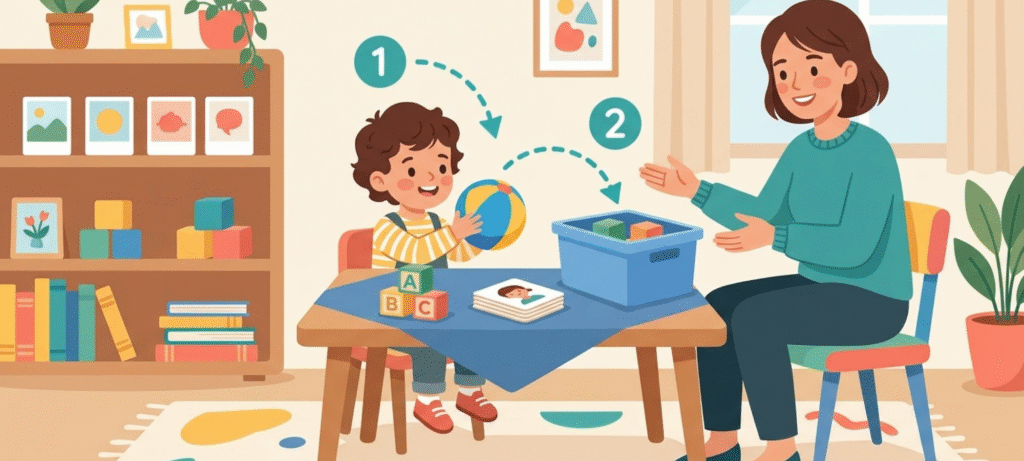
Why Following Two-Step Directions Matters
Directions are everywhere. “Wash your hands and come eat.” “Put your backpack away and line up.” A child who can’t manage two steps at a time will feel lost a dozen times a day, and adults may read that as not listening.
Practicing this skill builds several things at once:
- Receptive language, which is understanding what people say
- Auditory memory, holding spoken words long enough to act
- Sequencing, knowing what goes first
- Attention and processing time
- Vocabulary for actions, objects, and locations
One honest note. Struggling with directions doesn’t automatically mean a language disorder. It can come from vocabulary gaps, attention, memory, hearing, processing speed, or plain distraction. A child who’s tired or hungry will fail a direction they’d nail in the morning. So think of 2 step directions for speech therapy as a way to observe and practice, not a diagnosis tool. If trouble keeps showing up across settings, a licensed speech-language pathologist can look deeper.
2 Step Directions for 2 Year Olds
This is a big search on its own, so let’s give it space. Parents of toddlers usually want to know what to try at home and whether their child is “on track.”
Children develop at different speeds, so skip rigid promises. What works is choosing directions that match where the child is. For many 2 year olds that means familiar objects, everyday routines, and two related actions in short sentences.
Try these:
- “Get your shoes and bring them to me.”
- “Pick up the block and put it in the box.”
- “Get your cup and put it on the table.”
- “Take the book and give it to Dad.”
- “Wash your hands and dry them.”
- “Open the box and take out the car.”
Keep your tone playful. Toddlers can smell a quiz from across the room. Say it once, clearly, and wait. Pointing or showing the object is fine at first. Kids learning to follow two-step instructions usually do better inside routines like snack time, bath time, and cleanup, because the situation itself gives hints.
And if your toddler only does the first step? That’s normal practice, not failure. Celebrate step one, then help with step two.
2 Step Directions Speech Therapy Examples You Can Use Today
Here are more than 30 examples, grouped so you can pick what fits. Read them naturally. Don’t turn them into a robotic drill.
Everyday routine directions
- Get your coat and come to the door.
- Pick up the toy and put it away.
- Open the door and come inside.
- Get a napkin and give it to Mom.
- Close the fridge and sit in your chair.
- Get your spoon and put it on the napkin.
Body movement directions
- Touch your nose and clap your hands.
- Stomp your feet and sit down.
- Raise your arms and turn around.
- Jump two times and touch your knees.
- Put your hands on your shoulders and count to eight.
- Shake your head and say hello.
Object and concept directions
- Pick up the red block and put it beside the blue block.
- Get the pencil and put it under the book.
- Take the car and put it in the box.
- Find the big bear and give it a hug.
- Put the spoon in the cup and the cup on the tray.
Classroom directions
- Get your pencil and open your notebook.
- Circle the star and color the square.
- Pick up the paper and put it on the desk.
- Take out your folder and write your name.
- Push in your chair and line up.
Sequential directions
- Get your coat and then stand by the door.
- Pick up the toy before you sit down.
- Wash your hands and then get your snack.
- First clap, then touch your toes.
- Before you open the box, find the blue crayon.
That’s 31, with room to mix and match. Swap the objects for whatever your child is obsessed with this week. Dinosaurs beat plain blocks every time.
2 Step Directions Speech Therapy Activities
Worksheets are fine, but movement and play usually win. Here are eight activities that turn practice into something that feels like a game.
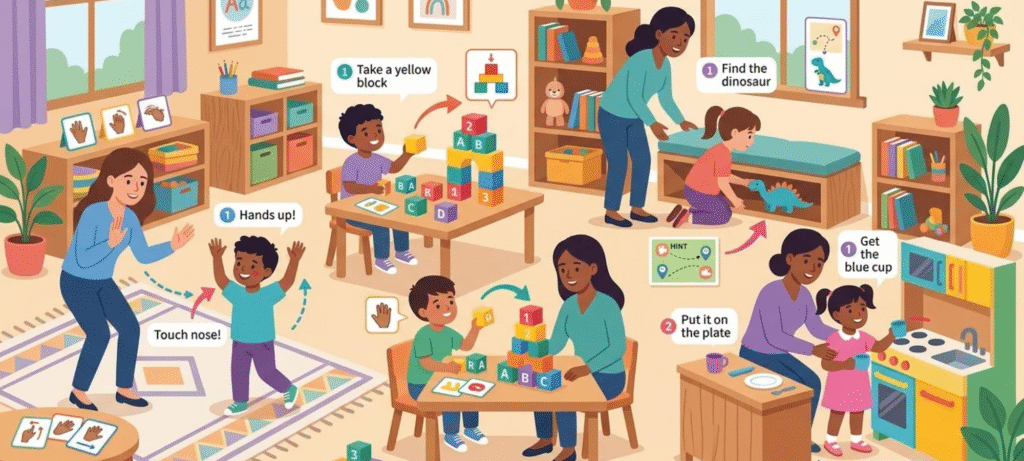
Simon Says, two-step edition. “Simon says touch your head and clap.” Kids love it, and you can slip in a silly one like “hop and wave to the wall.”
Toy cleanup race. “Pick up the car and put it in the bin.” Real jobs feel meaningful, and cleanup happens to be something you need anyway.
Pretend play. Kitchen, doctor, grocery store. “Get the apple and put it in the basket.” Pretend play hides the practice inside a story.
Movement circuit. Jump and clap. Turn and sit. Stomp and wave. Fast, silly, effective.
Coloring directions. “Color the circle red and draw a line under it.” This adds color and position words.
Block building. “Pick up the blue block and put it on the red block.” Great for spatial language too.
Snack routine. “Get your cup and sit at the table.” Hungry kids pay attention very well.
Scavenger hunt. “Find the ball and bring it to me.” Hide things around the room and make the hunt two steps long.
If you’re looking for more ideas beyond this list, browse our speech therapy activities for toddlers guide for at-home options.
One real-life tip from therapy rooms. Keep sessions short and stack wins early. Start with a direction you’re almost sure the child can do. Confidence carries into the harder ones.
How to Teach a Child to Follow 2 Step Directions
Teaching this skill works best in small, ordered steps. Jumping straight to “Put the red crayon under the chair and then sit down” is like asking someone to run before they’ve walked.
Step 1: Check the vocabulary. If a child doesn’t know “under” or “crayon,” the direction fails for reasons that have nothing to do with two steps. Teach the words first.
Step 2: Start with related actions. “Get the ball and give it to me.” The second action naturally follows the first.
Step 3: Add “and” or “then.” “Get the ball and put it in the box.” Then later, “Get the ball, then sit down.”
Step 4: Move to unrelated actions. “Touch your head and clap.” Now the child can’t predict step two.
Step 5: Layer in concepts. Colors, sizes, locations, and before or after.
Step 6: Fade the support. Start with gestures, pictures, or demonstrations. Slowly pull them back as the child succeeds. The goal is understanding spoken language, not depending on cues forever.
If you want reliable background on language development and what SLPs assess, the American Speech-Language-Hearing Association explains receptive and expressive language in plain terms and is a good place to send worried parents.
Visual Supports for 2 Step Directions
Visuals are one of the most useful tools for early learners. A first-then board is the classic example. Two pictures side by side: FIRST, pick up toy. THEN, put in box.
Other options include picture cards, simple hand-drawn stick figures, real objects, pointing, and short gestures. A parent can even draw two tiny boxes on a sticky note.
Think of a visual as a bridge. Words disappear the moment they’re spoken, but a picture stays put. For a child whose auditory memory is still growing, that stability helps. Then, as they succeed, you begin fading. Point less. Show one picture instead of two. Eventually, just the words.
Don’t let the support become permanent if the goal is following directions by listening alone. But also don’t yank it away too fast. Fade slowly and watch how the child responds.
How to Make 2 Step Directions Easier or Harder
The number of steps isn’t the only thing that changes difficulty. Many factors do.
Easier:
- Familiar words and objects
- Related actions
- Short sentences
- A quiet room
- A picture or gesture cue
- A routine the child already knows
Harder:
- Unrelated actions
- New vocabulary
- Location words like beside, between, and behind
- Time words like before and after
- Background noise
- A pause before the child can start
A simple path looks like this: one-step commands, then two related steps, then two unrelated steps, then directions with spatial or time concepts, and finally three steps. Developmental checklists are helpful for general expectations, and the CDC’s developmental milestones list what many children can do at different ages. Use them as a guide, not a scoreboard.
What to Do When a Child Struggles With the Second Step
This is the moment most people quietly search for. The child does step one perfectly, then freezes.
Resist the urge to repeat the entire sentence three times in a louder voice. It rarely helps. Try this instead:
- Split it up. Say “Get the ball.” Then, “Put the ball in the box.” Then put them back together.
- Show a picture or model. Let them see both actions.
- Give processing time. Count silently to five or ten before you say anything.
- Ask them to repeat. “What do you do first? What’s next?”
- Cut the noise. Turn off the TV, move closer, get on their eye level.
- Simplify the words. Swap “place” for “put” if needed.
A parent once told me her son always remembered the second step and dropped the first. Turns out he was listening to the end of every sentence, since that’s what he heard last. Small pattern, big clue. Notice what your child does, not just whether they pass.
2 Step Directions Speech Therapy Worksheets and PDF Practice
Lots of people search for a printable PDF, so let’s talk about what a good one includes. Look for clear pictures, simple language, one or two targets at a time, and age-appropriate vocabulary. The best ones mix coloring, circling, and matching with concepts like first-then, colors, sizes, and positions.
Worksheets are helpful. They give structure, they’re easy to send home, and they make progress easy to track. But they work best as reinforcement, not the only kind of practice. A child who can circle the star and color the square on paper still needs to follow directions when someone says “grab your jacket and get in the car.”
So print a worksheet if it helps, then take the same directions into real life.
2 Step Directions Speech Therapy Goals
SLPs write goals based on assessment, so treat these as templates, not universal targets. Every child’s goal should be individualized.
A sample structure: “Given a verbal two-step direction with familiar actions, the child will complete both steps in the correct order with 80% accuracy across three consecutive sessions.”
You can adapt that for:
- Related directions: two connected actions
- Unrelated directions: two unconnected actions
- Spatial concepts: directions with in, on, under, beside
- Temporal concepts: directions with first, then, before, after
- Classroom directions: school-based, multi-part instructions
For IEP purposes, the goal should name the type of direction, the level of support, the accuracy target, and how many sessions or opportunities will be measured. Data collection matters. A simple tally sheet showing correct, prompted, and incorrect responses tells you more than a general feeling of “he’s getting better.”
1 Step vs. 2 Step vs. 3 Step Directions
| Type | Example | What it asks of the child |
|---|---|---|
| 1 step | “Touch your nose.” | One action, one thing to remember |
| 2 step | “Touch your nose and clap.” | Two actions in order |
| 3 step | “Touch your nose, clap, and sit down.” | Three actions, higher memory demand |
More steps do raise difficulty. But so do new vocabulary, unrelated actions, and distractions. A short three-step direction with familiar words can be easier than a two-step one full of location words. Adjust one thing at a time.
2 Step Directions Speech Therapy for Autism
For autistic children, two-step direction practice can work well with the right supports. Visual supports, predictable routines, gestures, movement-based directions, and first-then boards are all common tools. Some autistic children find visual information easier to use, though not all do, so watch the individual child rather than assuming.
Keep prompting individualized. Follow the child’s communication style. And if a child uses AAC, make sure the direction vocabulary is available on their system so they can also talk about what they’re doing.
Keep it playful and low pressure. Motivation matters a lot. A direction built around a favorite toy or interest will get more attention than a random drill.
Can Adults Use 2 Step Directions in Speech Therapy?
Yes. This surprises people. Adults recovering from a stroke or brain injury, or working on cognitive-communication skills, may practice following multi-step directions too. The examples look different: “Pick up the folder and place it on the desk.” “Read the sentence and underline the key word.” “Take the card and put it beside the notebook.”
The purpose shifts toward attention, memory, and functional communication. Any plan should come from a licensed clinician and fit the person’s needs.
Frequently Asked Questions
What are some simple 2 step directions for speech therapy?
Try “Pick up the ball and put it in the box,” “Touch your nose and clap,” or “Get your coat and come to the door.” Start with related actions and familiar objects.
What is the IEP goal for two-step directions?
A typical goal states that the student will follow two-step verbal directions with a set accuracy across several sessions, with the level of support listed. It should be individualized by the SLP or IEP team.
What are some 2 step direction games?
Simon Says with two actions, treasure hunts, block building, pretend kitchen play, and cleanup races all work well.
Can a 3 year old follow two step directions?
Many can, especially with related, familiar directions. Unrelated or concept-heavy ones are often harder. Children vary, so talk to a pediatric professional if you’re worried.
What are examples of two-step instructions?
“Wash your hands and dry them.” “Get your shoes and put them by the door.” “Circle the pig and draw a line to the elephant.”
How do you teach a child to follow two-step directions?
Confirm vocabulary, start with related actions, add “and” or “then,” introduce unrelated directions, layer in concepts, and gradually fade visual support.
What are 2 step directions for speech therapy for a 2 year old?
Use short, familiar, related actions within routines, like “Get your cup and put it on the table.”
What if my child only remembers the first step?
Split the direction into two one-step commands, give extra wait time, use a picture, and then recombine them.
Final Thoughts
2 step directions for speech therapy are one of the most practical ways to build listening, memory, and understanding. Start small. Match the direction to your child’s level, use real routines and play, add visuals when needed, and fade them slowly. Track what works.
Progress can be uneven, and that’s fine. Some days a child will follow three steps and the next day struggle with two. Keep it light and keep going. And if you’d like to build these habits between sessions, our guide to at-home speech therapy for kids is a good next stop.