
Imagine a teenager who can easily solve complex math equations on a classroom whiteboard, but completely freezes up when a cashier hands them change at a local store. Or think about a young adult who can recite classic literature from memory but can’t read the warning label on a prescription pill bottle to stay safe.
If you look back at your own school days, you probably remember spending hours memorizing theoretical formulas, calculating geometry angles, or diagramming sentences. But for many individuals—especially those navigating unique developmental or learning needs—spending precious school hours on abstract theories doesn’t just feel disconnected. It can actively get in the way of building a self-sufficient life.
That’s exactly why learning what is functional academics is the most important starting point a teacher or parent can look into.
Stop focusing on cramming information into a student’s head just so they can pass some generic, standardized test. This hands-on approach completely changes the game. It moves away from dry, abstract theory and gets straight to the point: teaching the core skills that a person actually needs to handle their own life, keep a steady job, and get around their neighborhood with confidence and safety.
Whether you’re a special education teacher sitting down to write your next IEP, a parent trying to wrap your head around what your child’s school day really looks like, or an administrator rethinking how your curriculum is built, this guide is here to walk you through exactly how this kind of real-world learning can make a massive difference.
What Is Functional Academics?
Let’s skip the dry textbook jargon for a second. If you look up a formal definition, you’ll hear that functional academics refers to applying basic reading, writing, and math to real-world settings. But what does that actually look like on a random Tuesday afternoon?
Quick Summary: Functional academics is an educational approach that teaches reading, writing, math, and communication through real-life situations. The goal is simple: helping students become completely independent at home, school, work, and in their neighborhood.
It means transforming traditional classroom subjects into tools for personal survival and autonomy. Instead of learning for the sake of a report card, a student learns because they need to navigate the world without someone constantly holding their hand.
 Traditional Tracks  ──► Focus on grade-level theory, memorization, & abstract testing.
 Functional Tracks   ──► Focus on immediate, real-world utility & personal survival.
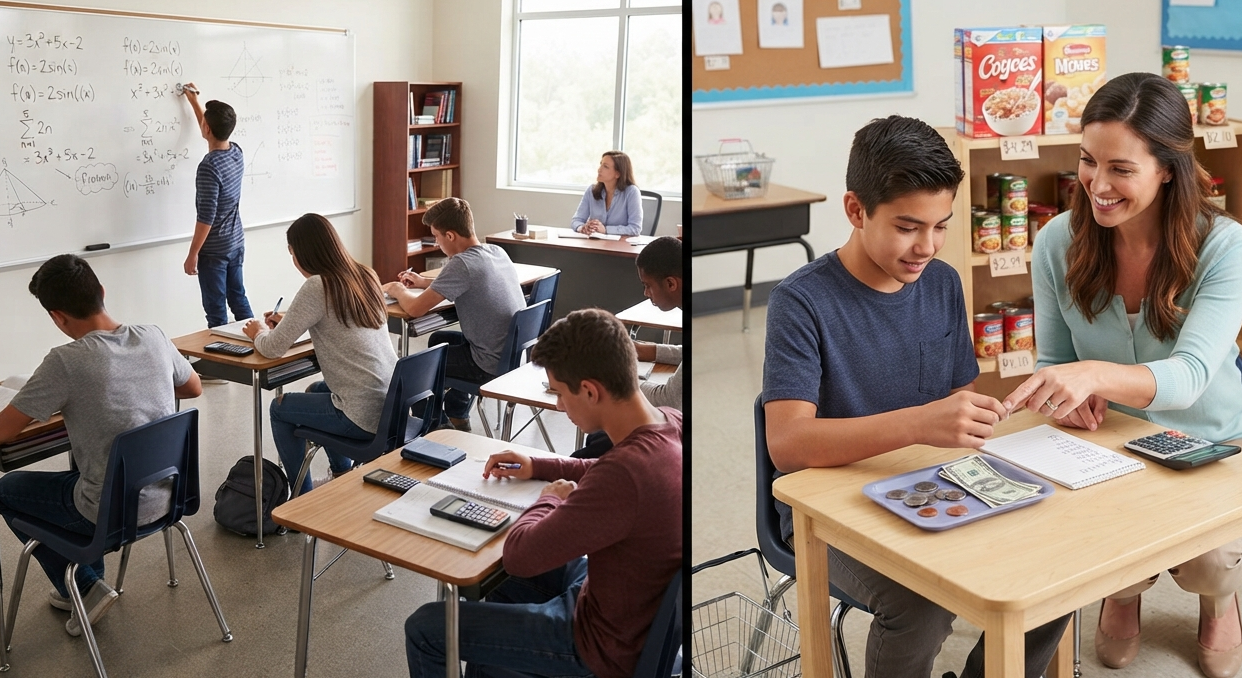
To see this difference in action, look at how the ultimate goal shifts between a traditional classroom path and a functional one:
- Traditional Reading: Analyzing the underlying themes, metaphors, or character arcs in a Shakespearean play.
- Functional Reading: Reading a menu at a local diner, scanning a public bus schedule, or recognizing a DANGER sign on an electrical fence.
- Traditional Math: Solving for x in a multi-step algebraic equation using an Interactive Learning Environment.
- Functional Math: It’s less about long equations and more about real-life math—like knowing if you’ve actually got enough cash in your wallet to cover your groceries before you hit the checkout line.
At the end of the day, these aren’t just “school lessons.” They are essential life skills disguised as classroom tasks, designed to help people move through the world with real confidence.
Functional Academics vs. Traditional Academics
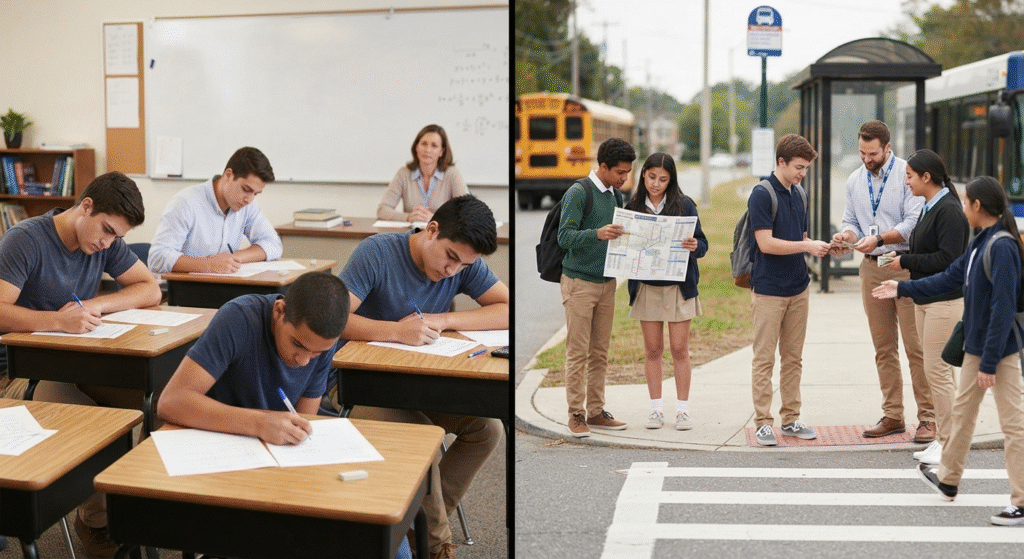
It’s a common mistake to think these two approaches are at war with each other. They aren’t. But their priorities, environments, and definitions of “success” are worlds apart.
In a traditional setup, the clock is always ticking toward the next state standard or college application. In a functional setup, the clock is ticking toward adulthood and true independence.
Here is how the two paths stack up side-by-side, along with concrete examples:
| Feature | Traditional Academics | Functional Academics | Real-World Example |
|---|---|---|---|
| The Big Goal | Mastering state standard curriculums and preparing for higher education. | Building long-term personal autonomy, vocational success, and self-advocacy. | Learning how to keep a clean apartment and hold a part-time job instead of prepping for the SAT. |
| What They Learn | Abstract theories, formulas, and broad generalized knowledge. | Concrete, immediate life skills that apply directly to daily routines. | Measuring a cup of laundry detergent versus calculating the volume of a cylinder via Geometry Learn V3. |
| Where They Learn | Inside a standard classroom, relying heavily on textbooks and lectures. | A mix of the classroom, home kitchen, local grocery store, and city buses. | Taking a city bus to a grocery store to practice buying ingredients instead of drawing them on paper. |
| The Pacing | Driven rigidly by school calendars, grading periods, and test dates. | Completely self-paced, based entirely on the student mastering the task. | Spending three weeks entirely on learning how to count change until it is completely mastered. |
| How It’s Measured | Letter grades, percentiles, timed quizzes, and formal essays. | Direct performance checklists, task analysis, and observation in real life. | A teacher using a checklist to see if a student can independently cross a street safely. |
| The Final Output | A high school diploma or traditional college readiness track. | An enhanced quality of life, supported living, or competitive employment. | Landing a job at a local business and managing a personal debit card safely. |
Why Is Functional Academics Important?

This approach is vital because it creates a direct link to real-world safety, self-confidence, and long-term employment. When you teach a student how to manage their daily routine, you aren’t just drilling academic subjects into them—you’re actively shielding them from vulnerability and helping them navigate the world on their own terms.
A Real-World Example: Meeting Sarah
To see the real impact of this shift, take the story of Sarah, a 16-year-old student with autism. For years, she hit a wall in traditional high school algebra and freshman English. The heavy, abstract nature of the work triggered so much anxiety that she felt like she was constantly drowning, falling further and further behind her peers.
When her IEP team shifted her focus toward functional academics, everything changed. Instead of graphing lines, Sarah practiced tracking a simple monthly budget and counting cash. Instead of analyzing poetry, she practiced reading bus schedules, local street maps, and grocery labels.
Within just a year, Sarah was traveling on her own from her house to the local bakery. Now, she’s even holding down a part-time job there, handling inventory tasks without a hitch. The best part? This functional approach didn’t mean “lowering the bar” for her at all—if anything, it gave her a straightforward, achievable path to taking charge of her own life and building the future she wanted.
What Is Functional Academics in Special Education?
While any student can benefit from a dose of practical learning, understanding what is functional academics in special education is essential. For neurodivergent individuals and those with cognitive or developmental differences, this framework isn’t just a helpful alternative—it’s a legal and developmental lifeline.
Under federal laws like the Individuals with Disabilities Education Act (IDEA), public schools are mandated to provide a Free Appropriate Public Education (FAPE). This education must be specifically tailored to prepare students with disabilities for employment, further training, and independent living. If a student has a severe cognitive delay or a learning disability that makes abstract high-school calculus impossible, forcing them through that curriculum fails the mandate.
              [ Federal Law: Prepare the Student for Real Life ]
                                      │
         ┌────────────────────────────┴────────────────────────────┐
         ▼                                                         ▼
Traditional Academic Path                                 Functional Academic Path
(Focuses on college admission)                   (Focuses on independent adult survival)
Because of this, special education programs often design a dedicated functional curriculum for students who struggle with abstract concepts but thrive with hands-on, concrete instruction. This typically includes individuals diagnosed with:
- Autism Spectrum Disorder (ASD)
- Intellectual Disabilities (ID)
- Significant developmental delays or Down Syndrome
- Traumatic Brain Injuries (TBI)
Transitioning to Adult Life (TBI and Beyond)
When you’re working on an Individualized Education Program (IEP), things get real during the transition planning phase, which legally starts by age 16. It forces us to ask a tough, honest question: What happens the day after the student turns 18 or 21 and the school bus stops coming?
If a student hasn’t learned to fill out a job application, cross a street safely, or manage basic personal details, their world can shrink pretty fast. A functional academic approach is designed to stop that from happening—it’s about giving them the tools to expand their world, not shrink it.
What Actually Counts as “Functional Academic Skills”?
Walk into a classroom focused on real-world skills, and you won’t find students buried in encyclopedias. Instead, you’ll see lessons broken down into practical, bite-sized goals they can actually use.
Functional Reading
Forget about dissecting poetry or reading classic novels. Functional reading is all about survival. It’s the ability to see a sign in the community, understand it in a split second, and make a decision that keeps you safe.
- Survival & Safety: This is non-negotiable. You have to be able to spot signs like STOP, EXIT, CAUTION, or POISON in a split second and know how to find a restroom when you’re out and about in the community.
- Getting Around: It’s all about finding your way in the real world. That means reading street signs, making sense of building directories, knowing how to use digital maps, and figuring out train or bus schedules on the fly.
- Smart Shopping: This is where the small details matter most. It’s about checking expiration dates in the grocery aisle, comparing prices to stick to a budget, and actually catching allergy warnings on labels before you toss something into your cart.
- Following Directions: Whether you’re trying to whip up a quick lunch using a recipe or following an emergency evacuation plan during a drill, it all comes down to being able to take written instructions and turn them into action.
A Quick Teacher’s Insight: It’s actually really common to see a student ace reading flashcards in a quiet, calm classroom, only to have them completely freeze up the moment they see those same words in a loud, chaotic shopping mall. True mastery doesn’t happen at a desk; it only happens when they can read and react in the middle of a real-world environment.
Functional Writing: The Key to Adult Independence
Functional writing isn’t about writing essays or perfect literary analysis. It’s strictly about the practical, real-world skills you need to manage your personal affairs, land a job, and communicate clearly.
Here are the four pillars of functional writing:
- Personal Identity: You should be able to write down your full name, home address, phone number, and emergency contact details from memory. Relying on a “cheat sheet” just doesn’t cut it when you’re on the spot.
- Official Paperwork: Being able to navigate the real world means handling paperwork—whether that’s filling out a digital job application, completing a medical intake form, or opening a bank account.
- Daily Reminders: True independence is usually found in the little things that keep your day on track. Whether it’s scribbling a quick grocery list so you don’t forget the essentials or leaving a simple note for your roommate—like “Gone to work, back at 5″—these small habits are what make living on your own actually run smoothly.
- Digital Communication: Let’s face it, you can’t get by today without being tech-savvy. You need to be able to fire off a clear, professional text to your boss when you’re under the weather, or know how to handle basic digital tasks—like logging into a secure account—without getting stuck or frustrated by the process.
Functional Math: The Skills You Actually Use
Functional math isn’t about memorizing complex formulas or solving for “x.” It is strictly about the practical math you need to get through a normal day, manage your home, and stay independent.
Here is what that looks like in practice:
- Handling Money: It’s more than just knowing currency values. It’s about feeling comfortable using the “next dollar up” method to pay for a snack and having the confidence to double-check that you got the right change back from the cashier.
- Time Management: It goes beyond just glancing at an analog or digital clock. Real-world time math is about planning—like knowing that if your shift starts at 3:00 PM and it’s a 20-minute walk, you absolutely have to be out the door by 2:40 PM.
- Home & Kitchen Math: Math is a daily habit. It’s using measuring cups to follow a recipe, weighing items on a digital scale, or keeping track of your budget so your phone bill doesn’t slip through the cracks.
A Common Pitfall in the Classroom Many schools spend months having students match paper pictures of coins on a worksheet. But here is the truth: that doesn’t translate to real life. You can get a perfect score on a paper assignment and still completely freeze up when you’re standing in a busy checkout line. If you want a student to actually learn, you have to put physical cash in their hands and let them make real purchases.
Functional Communication
You could be a whiz at reading and math, but it really won’t get you far if you can’t voice what you need or understand what’s being asked of you. Real independence comes down to how well you can actually communicate when you’re out there on your own.
- Self-Advocacy: It’s all about finding your voice. You need to know how to speak up when you’re stuck, explain exactly how you’re feeling to a doctor, or feel confident enough to say a firm “no” the moment a situation feels sketchy or just plain uncomfortable.
- Emergency Reactions: This is a non-negotiable life skill. It’s not just about knowing how to dial 911; it’s about keeping your head when things get tense, being able to clearly explain where you are, and talking effectively to first responders when every single second counts.
Digital Literacy
Let’s be honest—the days when you could get by with just a pen and paper are long gone. If you’re serious about living independently as an adult, getting comfortable with technology isn’t just a bonus anymore; it’s a requirement. Navigating the digital world safely has become just as essential as reading or writing. Whether it’s using apps to get around town or knowing how to keep your private data locked down, digital literacy is now a basic survival skill you can’t afford to skip.
- Mastering the Basics: Independence starts with the small stuff. This means knowing how to keep your phone charged, adjusting your volume settings when you’re in a quiet place, and knowing how to connect your devices to a secure, private Wi-Fi network rather than just clicking on any open signal you find.
Real-Life Examples and Activities
Where do these skills actually live? They live in the daily routines of a standard household and the local community. By turning normal chores into learning moments, we remove the “textbook feel” completely.
Simple, Real-World Ways to Practice
You don’t need a formal classroom to build these skills. You can turn everyday chores into “learning labs” that help students gain confidence in the real world. Here are three easy ways to start:
- The Kitchen Laboratory: Skip the theory and get into the kitchen. Have the student follow a visual, step-by-step recipe to make lunch. It’s a perfect way to combine functional reading (following instructions), math (using measuring cups and tracking cook time), and essential kitchen safety.
- The Grocery Run: Give the student a five-dollar bill and a clear mission: find a loaf of bread, check the expiration date, make sure it’s under budget, and pay the cashier on their own. That moment at the register—where they handle the transaction independently—is where the real growth happens.
- The Mock Interview: Role-playing is a game-changer for workplace prep. Act out a simple job scenario where they have to introduce themselves, fill out a basic emergency contact form, and ask a “manager” a question about their schedule. It takes the stress out of the actual experience later on.
What Is Academic Functioning?
When navigating educational paperwork, it is incredibly easy to confuse similar-sounding terms. A common mix-up happens around the phrase what is academic functioning. While it sounds identical to functional academics, they mean two completely different things.
Quick Summary: Academic functioning describes a student’s actual current performance level and processing abilities in traditional areas like reading comprehension, math speed, and writing compared to peers their age. It is a score or metric, not a style of teaching.
Think of it this way: when a school psychologist runs an evaluation, they are testing the student’s academic functioning to see how their brain handles information conceptually.
If that evaluation reveals that a 16-year-old’s academic functioning in math is stuck at a first-grade level despite years of intensive traditional schooling, it provides a massive clue to the team. It tells them that continuing to push traditional high school algebra isn’t working. Instead, they should shift gears toward a functional academics curriculum, spending that time mastering money math, clock reading, and practical budget tracking.
(Note: Don’t get this confused with broader institutional terms either; for example, if you are looking at how university resources are organized, you might search for what is academic library and its functions to study campus infrastructure. Our focus here is entirely on individual human learning capabilities.)
What Is a Functional Academic Assessment?
You can’t build a customized learning plan out of thin air. Before an educator can write specific real-world goals, they have to figure out exactly where the student’s independent skills break down. This diagnostic process is what is a functional academic assessment.
If you’ve ever seen a traditional academic assessment, it’s usually built around strict, quiet, standardized testing rooms where a child points to shapes or matches words to score against a national percentage. A functional assessment throws out the testing room. It is criterion-referenced and observational—meaning we watch the student interact with real tasks to see what they can actually achieve on their own.
The Toolkit of a Functional Assessment:
- Real-World Observation: Watching how a student handles a busy school cafeteria line, walks down a community sidewalk, or interacts with a store clerk.
- Task Analysis Breakdown: Splitting a large, complex task into tiny, bite-sized steps to spot the exact moment a student gets stuck. For example, breaking “ordering food” into: looking at the menu, picking an item within a budget, waiting in line patiently, speaking clearly to the cashier, handing over cash, and waiting for change.
- Adaptive Behavior Questionnaires: Using established diagnostic tools (like the Vineland adaptive behavior scales supported by experts at Understood.org) where parents and teachers rate a student’s everyday execution of communication, self-care, and community safety.
What Is Included in the Present Levels of Academic Achievement and Functional Performance (PLAAFP)?
The detailed notes from those functional assessments directly feed into the most important section of any IEP: the Present Levels of Academic Achievement and Functional Performance, or PLAAFP (sometimes called the PLOP).
Think of the PLAAFP as a high-resolution snapshot of exactly who the student is on any given day. You cannot write a legal or useful IEP goal without a clear baseline here. A well-written PLAAFP balances two sides of the same coin:
                  ┌──────────────────────────────┐
                  │      THE PLAAFP BALANCE      │
                  └──────────────┬───────────────┘
                                 ▼
         ┌───────────────────────┴───────────────────────┐
         ▼                                               ▼
Academic Achievement                          Functional Performance
What their brain handles conceptually         How they execute tasks in daily life
(e.g., Reading level metrics)                 (e.g., Using public tools independently)
- Academic Achievement Details: This section documents raw score abilities. “Sarah reads single-syllable words at a second-grade instructional level but struggles with multi-syllable decoding and complex sentences.”
- Functional Performance Details: This section documents real-world execution. “Sarah can locate survival words like STOP and EXIT in the neighborhood, but she cannot navigate a public transit map or find her way back home from the local library without adult supervision.”
When you have a clear, honest PLAAFP baseline, writing the next step becomes easy. If the baseline says a student can only identify whole hours on a clock, the next goal naturally focuses on teaching them to read half-hours.
Teaching Strategies That Genuinely Work
If you are an educator or a dedicated caregiver looking to put these concepts into motion, skip the abstract explanations and stick to these proven behavioral strategies:
- Community-Based Instruction (CBI): Make trips out into the neighborhood a non-negotiable part of the weekly routine. Don’t just talk about banking; walk into a local branch, pick up a slip, and practice waiting in line.
- Backward Chaining for Quick Wins: If a task has five steps (like doing laundry), handle the first four steps yourself and let the student complete the final step—pushing the start button on the washing machine. This lets them experience the immediate satisfaction of finishing a job. Once they master the end, back up and have them do steps 4 and 5.
- Heavy Visual Checklists: Swap out long streams of verbal instructions for clear, icon-based visual schedules. A photo strip showing the exact steps to clean a bedroom or follow a recipe builds true self-reliance because it eliminates the need for an adult to keep repeating directions.
Common Mistakes to Avoid
When schools and families try to move toward functional learning, it’s easy to fall into a few common traps:
- Relying entirely on classroom simulations: A student might count plastic coins perfectly at their desk, but completely freeze when dealing with a fast-moving line at a busy grocery store counter. Real environments matter.
- Forgetting about peer interaction: True community survival includes knowing how to speak respectfully to a coworker or ask a store associate for help. Don’t isolate the learning to just the student and the teacher.
- Failing to involve the family at home: If a teacher spends all week teaching a child how to tie their shoes or make a sandwich, but parents do it for them over the weekend to save time, the skill won’t stick. Consistency across environments is key.
Practical Tips for Parents and Teachers
To make this curriculum work without burning out, try these practical, everyday strategies:
Parent Tip: Keep It Integrated You don’t need to turn your kitchen table into a stressful classroom. Just include your child in what you are already doing. When making dinner, hand them the measuring cup. When walking the dog, ask them to point out the stop signs. These micro-moments add up to massive independence over time.
Teacher Tip: Use Environmental Print Clean out your collection of generic flashcards. Instead, bring real cereal boxes, authentic store menus, local bus maps, and empty prescription bottles into your classroom. Let your students interact with the exact visual layouts they will see the moment they step outside the school doors.
Common Myths About Functional Learning
- Myth: Functional academics means giving up or setting lower expectations.
- Reality: It actually means shifting toward smarter, more impactful goals. Forcing a student with severe cognitive challenges to spend three years failing geometry isn’t holding a high standard; it’s wasting valuable time. Shifting to functional math means setting an incredibly high standard for their actual, independent adulthood.
- Myth: Students either do 100% traditional work or 100% functional work.
- Reality: It is almost always a fluid spectrum. A student can perfectly well stay in a general education classroom for reading and history, but split off to work on functional, practical money skills and vocational training during math blocks.
- Myth: You can teach all of these life skills using simple classroom worksheets.
- Reality: Worksheets are just the starting line. A student can get a perfect score on a paper worksheet featuring pictures of quarters and dimes, yet completely panic when faced with a long line of impatient customers at a real checkout counter. Real environments are non-negotiable.
Frequently Asked Questions
Why is functional learning so crucial for long-term safety?
If a student can’t read a CAUTION sign, identify the expiration date on spoiled food, or state their basic personal details to a first responder, they are highly vulnerable. Functional learning prioritizes these survival skills above all else to protect the individual when protective systems aren’t around.
What does a transition plan actually do?
A transition plan is a formal roadmap built directly into an IEP before a student turns 16. It coordinates community services, sets specific independent lifestyle goals, and maps out the exact steps needed to move from school services into independent living, supported employment, or higher training.
Can a student switch back to a traditional track later?
Yes. An IEP is a living, breathing document reviewed every single year. If a student shows massive developmental leaps and their academic functioning scores improve significantly, the team can always re-adjust the goals to introduce more traditional, grade-level content.
A Final Thought for Educators and Caregivers
Choosing a functional path isn’t about placing limits on what a student can achieve. In fact, it is exactly the opposite. It is an intentional, deeply respectful decision to give an individual the exact tools they need to control their own life.
By grounding everyday education in real contexts, we stop teaching for the test and start teaching for life. That is how true independence is built—one real-world victory at a time.