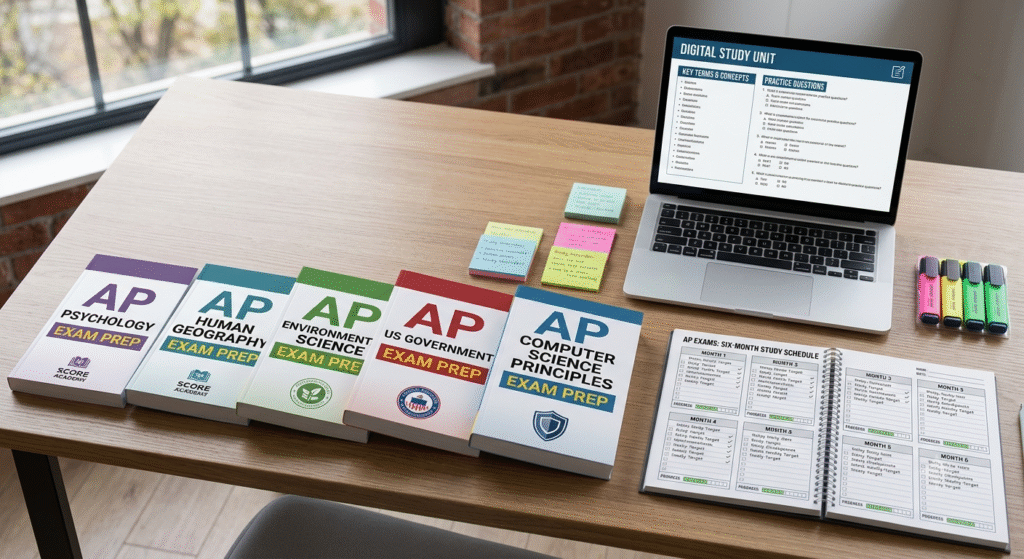
The easiest AP classes to self study are AP Psychology, AP Human Geography, AP Environmental Science, and AP Computer Science Principles. They lean on memorization and everyday logic instead of heavy math or lab work, and the free study material for them is genuinely good. AP US Government and Politics deserves a mention too — plenty of students knock it out in a few weeks if they already follow the news.
Table of Contents
- What Makes the Easiest AP Classes to Self Study Actually Easy
- Who Should Self Study an AP Exam
- Who Should NOT Self Study an AP Exam
- The Easiest AP Classes to Self Study, Ranked
- AP Classes That Look Easy But Aren’t
- Easiest AP Class Overall
- Easiest AP Science Classes
- Easiest AP Classes for STEM Students
- Easiest AP Classes for Humanities Students
- Best AP Class Based on Career Goal
- Best AP Class by Grade Level
- Which AP Exam Has the Highest Pass Rate
- What Reddit Actually Says
- Hardest AP Classes to Self Study
- Is Self Studying an AP Worth It
- Best Study Resources
- A Realistic 6-Month Study Plan
- Common Mistakes Self-Studiers Make
- FAQ
- Final Verdict
Introduction
Every May, a wave of students sit for AP exams they never took a class for. No teacher walking them through the curriculum, no built-in study group, just a review book, some YouTube videos, and a test date circled on the calendar. Figuring out the easiest AP classes to self study before you commit saves months of wasted effort. It works. It works surprisingly often, actually. But it works a lot better for some subjects than others.
I put this guide together after going through the official College Board Course and Exam Descriptions for over a dozen AP subjects, comparing recent score distributions, and reading through hundreds of comments across AP communities like r/APStudents to see which patterns actually held up. That’s the honest basis for the rankings below — not guesswork, and not just a repeat of whatever list ranks highest right now.
Before diving into the rankings, one recommendation worth pausing on: pair your AP prep with a solid study app instead of relying purely on a textbook. We’ve broken down some genuinely useful options in our guide to Best Learning Apps for Adults, and a few of them work just as well for high schoolers cramming AP content on their own schedule.
So which classes actually make sense to self study? That depends less on how “easy” a subject sounds and more on three boring but important factors: how much of the exam is memorization versus problem-solving, how good the free resources are, and whether you need lab equipment or a teacher’s feedback to actually learn the material.
What Makes the Easiest AP Classes to Self Study Actually Easy
An AP class earns a spot on this list when it rewards reading and memorization more than it rewards years of skill-building. AP Psychology and AP Human Geography fit that description. AP Calculus BC does not, no matter how motivated the student.
A few things separate a self-study-friendly AP course from a nightmare one:
- Content type. Concept-heavy, vocabulary-driven subjects translate well to solo study. Skill-based subjects, like foreign languages or calculus, need repeated practice and correction that’s hard to replicate alone.
- Lab or performance requirements. Biology, Chemistry, and Physics all involve lab-based FRQs on the exam. If you’ve never touched a Bunsen burner, that’s a gap no amount of flashcards fixes.
- Quality of free resources. Some AP courses have entire libraries of free prep — Khan Academy videos, official practice FRQs, Fiveable study guides, Albert.io question banks. Others barely have anything usable outside a paid review book.
- Exam format. Multiple-choice-heavy exams are more forgiving for self-taught students than exams weighted toward free-response writing, where feedback from a real teacher matters a lot.
- Prior exposure. A student who already follows politics closely will find AP Government easy. A student who’s never coded will find AP CSP harder than its reputation suggests.
None of this means the easier APs require zero effort. It means the effort required is the kind you can generate on your own, without a lab partner or a teacher grading your essays every week.
Who Should Self Study an AP Exam?
Self-studying makes the most sense for a specific set of students, not everyone with an AP score goal in mind.
- Homeschool students who don’t have access to a formal AP classroom but still want the credit and the transcript boost.
- Students whose schools don’t offer certain APs. Plenty of smaller high schools skip subjects like AP Psychology or AP CSP entirely.
- International students preparing for US college admissions who want to demonstrate rigor College Board recognizes worldwide.
- Students chasing college credit to skip intro courses once they’re on campus, especially in subjects where their school offers strong AP credit policies.
- Students strengthening a Common App profile with an extra AP that signals initiative beyond their school’s course catalog.
If you fall into one of these groups, self-study is less of a gamble and more of a practical workaround.
Who Should NOT Self Study an AP Exam?
This part gets skipped a lot, and it shouldn’t.
- Students already juggling five or six AP classes. Adding a self-study exam on top of that course load usually backfires.
- Students with a track record of poor time management. Nobody’s checking in on your progress here. If deadlines slip without external pressure, this format punishes that.
- Students who genuinely learn better through discussion. Some people need a classroom back-and-forth to actually retain material. Self-study removes that entirely.
- Students eyeing calculus- or lab-heavy subjects as a first attempt. Save AP Physics C or AP Chemistry for later, once you’ve built the habit on something more forgiving.
Being honest about which category you’re in matters more than any ranking on this page.
The Easiest AP Classes to Self Study, Ranked
Here’s a working ranking based on content type, resource availability, and how often self-studiers actually pass without formal instruction.
| Rank | AP Class | Self-Study Difficulty (1–10) | Math Required | Lab Component | Best For |
|---|---|---|---|---|---|
| 1 | AP Psychology | 3 | None | No | Everyone, especially first-timers |
| 2 | AP Human Geography | 3.5 | None | No | Humanities-leaning students |
| 3 | AP Environmental Science | 4 | Basic | Minimal | STEM students avoiding heavy math |
| 4 | AP US Government and Politics | 4 | None | No | Students who follow current events |
| 5 | AP Computer Science Principles | 4.5 | Basic | No | STEM students, no coding required |
| 6 | AP Comparative Government | 5 | None | No | Students interested in world politics |
| 7 | AP Statistics | 5.5 | Moderate | No | Math-comfortable students |
| 8 | AP Seminar | 6 | None | No | Strong writers and researchers |
| 9 | AP US History | 6 | None | No | Students who enjoy reading and narrative |
| 10 | AP Biology | 6.5 | Basic | Yes | STEM students willing to grind |
| 11 | AP World History | 7 | None | No | Students with patience for content volume |
| 12 | AP English Language | 7 | None | No | Strong readers and analytical writers |
Numbers here reflect general patterns from official course data and student-reported outcomes, not guarantees. Plenty of students have bombed “easy” APs by underestimating them, and plenty have crushed “hard” ones because the subject clicked with how they think.
AP Psychology — Difficulty: 3/10
This is the one almost every self-study list leads with, and for good reason. The content is mostly vocabulary and named studies. You’re not solving equations. You’re learning what confirmation bias is and being able to spot it in a scenario.
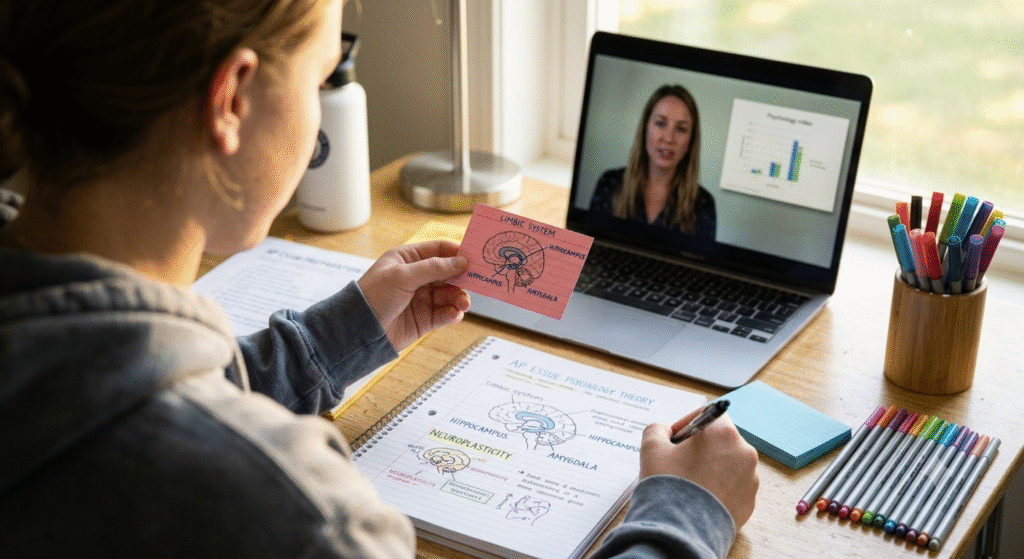
Where students struggle: the sheer number of terms and researchers to memorize before the exam. Average study time: 2 to 3 months at a steady pace. Best free resources: Khan Academy’s AP Psych course, Quizlet decks for terminology, and Barron’s review book. Should you self study it? Yes, especially as a first AP exam. It builds confidence fast.
AP Human Geography — Difficulty: 3.5/10
Students often describe this one as “common sense with labels.” You’re learning models — population growth, urbanization, agricultural patterns — and applying them to real-world examples. No prior geography obsession required.
What surprises most students: how much of the exam is applying models to unfamiliar scenarios rather than pure recall. Average study time: 2 to 3 months. Best free resources: Fiveable’s AP HuG guides and past official FRQs from AP Central. Should you self study it? Yes. It’s often recommended as a freshman-friendly AP for this exact reason.
AP Environmental Science — Difficulty: 4/10
Some call it “AP Earth Science” because it feels more intuitive than Bio or Chem. You’re learning about ecosystems, energy resources, pollution, and climate systems. There’s math, but it’s basic — no calculus involved.
Reality check: the free-response section expects you to apply formulas under real time pressure, so passive reading alone won’t cut it. Average study time: 3 months. Best free resources: Khan Academy and the official APES Course and Exam Description on AP Central. Should you self study it? Yes, particularly for STEM students who want a science credit without the calculus baggage.
AP US Government and Politics — Difficulty: 4/10
If you already read the news or care about how government functions, this exam feels less like studying and more like confirming what you already know. The content is US-specific and structured around required documents and Supreme Court cases.
Common mistake: treating the required cases and documents as optional background instead of memorizing them precisely, since the FRQs test exact recall. Average study time: 6 to 10 weeks for a student who follows politics; longer otherwise. Best free resources: Khan Academy’s Gov course and Fiveable live reviews. Should you self study it? Yes, especially for students already interested in civics.
AP Computer Science Principles — Difficulty: 4.5/10
Don’t confuse this with AP Computer Science A. CSP is conceptual — you’re learning about algorithms, data, and the internet at a high level, plus completing a self-paced Create Performance Task. No prior coding experience is strictly required.
Before choosing this one: know that the Create Performance Task has its own submission deadline, separate from exam day, and it needs planning ahead of time. Average study time: 3 months, spread out to account for the project component. Best free resources: Code.org’s free CSP curriculum and College Board’s official task requirements. Should you self study it? Yes, and it’s one of the better options for students avoiding math-heavy science APs.
AP Classes That Look Easy But Aren’t
A few AP exams have a reputation for being manageable that doesn’t hold up once you’re actually inside the curriculum.
- AP Statistics looks approachable because there’s “no calculus.” In practice, it demands careful reading of word problems and comfort interpreting data, which trips up students who assumed it would feel like basic math.
- AP Biology gets lumped in with “science APs are all similar,” but the sheer volume of content and lab-based FRQs make it noticeably harder than APES.
- AP Seminar sounds like an easy writing class from the title alone. It actually demands structured research, argument analysis, and a collaborative team project that’s genuinely awkward to replicate solo.
- AP English Language seems doable for anyone who reads a lot, but the rhetorical analysis FRQs reward a very specific skill set that takes real practice to build, not just casual reading habits.
Going in aware of this gap matters more than trusting a subject’s reputation at face value.
Easiest AP Class Overall
If someone forces you to pick just one, AP Psychology wins. It has the most accessible content, the deepest well of free resources, and a format that rewards steady memorization over specialized skill. Most self-studiers report finishing prep in under three months without burning out.
Easiest AP Science Classes
Among the sciences, AP Environmental Science is the clear front-runner for self-study. AP Biology comes next, mostly because its content, while dense, doesn’t require advanced math. AP Chemistry and AP Physics 1 and 2 sit much further down the list — both lean heavily on problem-solving skills that are genuinely hard to build without guided practice and lab exposure.
Easiest AP Classes for STEM Students
STEM students who want an AP credit without a brutal math load should look at AP Environmental Science, AP Computer Science Principles, and — with some caution — AP Statistics. Stats rewards logical thinking more than raw computation, but it does require comfort interpreting data and reading word problems carefully.
Easiest AP Classes for Humanities Students
For humanities-leaning students, AP Psychology, AP Human Geography, and AP US Government form a strong trio. All three are readable, discussion-friendly subjects. Students who enjoy writing can also consider AP Seminar if their school offers it, since the exam rewards clear argumentation over technical precision.
Best AP Class Based on Career Goal
| Career Interest | Best AP Class | Why |
|---|---|---|
| Psychology or Counseling | AP Psychology | Direct overlap with intro-level college coursework |
| Computer Science | AP Computer Science Principles | Builds foundational literacy without requiring prior coding |
| Business or Economics | AP Macroeconomics / Microeconomics | Concept-based intro to core business theory |
| Law or Political Science | AP US Government and Politics | Mirrors intro political science coursework |
| Environmental Science or Sustainability | AP Environmental Science | Covers foundational ecology and resource management |
| Education or Social Work | AP Psychology or AP Human Geography | Both build people-focused analytical skills |
Matching a self-studied AP to an intended major does more for a college application than picking whatever ranks “easiest” on a list.
Best AP Class by Grade Level
Freshman year: Start with AP Human Geography or AP Psychology. Both are forgiving for a first attempt and don’t assume prior AP experience.
Sophomore year: AP Environmental Science or AP US Government work well once a student has one AP under their belt.
Junior year: This is when AP Computer Science Principles or AP Statistics make sense, especially for students narrowing in on a STEM track before senior-year applications.
Senior year: Self-studying at this point usually targets a specific gap — a missing science credit, or a subject tied directly to an intended major — rather than an “easy” pick just to add a number to the transcript.
Which AP Exam Has the Highest Pass Rate?
Pass rates and 5-rates shift slightly from year to year, so treat any specific number as a snapshot rather than a permanent fact. Historically, subjects like AP Psychology, AP Comparative Government, and AP Environmental Science tend to post strong pass rates relative to other AP offerings, though official College Board score distribution reports, published annually on AP Central, are the accurate source to check before relying on any figure. A high pass rate doesn’t automatically mean “easy for you” — it reflects the average across a huge and varied pool of test-takers, many of whom did take a formal class.
What Reddit Actually Says
Search “easiest ap classes to self study reddit” and you’ll find the same names come up again and again across r/APStudents threads: Psychology, Human Geography, and Government. Some students argue AP Computer Science Principles deserves a spot too, calling it low-effort if approached early, though a few disagree and point out the Create task catches procrastinators off guard.
There’s genuine disagreement over AP Statistics. Some students self-study it in a month using nothing but Barron’s or Marco Learning’s review videos. Others, especially those shaky on basic algebra, describe it as far tougher than its reputation suggests. Worth remembering: online opinions reflect individual backgrounds, not universal difficulty.
Hardest AP Classes to Self Study
On the flip side, a few exams are notoriously rough to self study:
- AP Physics C — calculus-based, and hard to learn without guided problem-solving.
- AP Chemistry — heavy lab component and stoichiometry that benefits from feedback.
- AP Calculus BC — builds on skills that need consistent practice and correction.
- AP Latin — a niche language with limited free resources.
- AP Music Theory — an aural component that’s genuinely hard to self-assess.
None of these are impossible. They just demand a level of independent discipline, and usually outside tutoring, that goes beyond what most self-studiers sign up for.
Is Self Studying an AP Worth It?
For most students, yes, but the value depends on what you’re actually chasing. If the goal is college credit, check the specific college’s AP credit policy first. A score of 5 at one school might skip an entire intro course, while another school barely acknowledges AP credit at all.
For college admissions, an extra self-studied AP — particularly at a school with a competitive applicant pool, like an Ivy League reach — signals initiative beyond the standard course catalog. It won’t outweigh a weak transcript elsewhere, but paired with solid grades, it adds a genuine data point. Some students also chase it for scholarship applications that specifically reward AP coursework or self-directed academic projects.
It’s worth putting this in context alongside the rest of your admissions prep. A self-studied AP score sits next to your SAT or ACT score, your GPA, and your Common App activities list as one more data point, not a replacement for any of them. Admissions officers tend to read independent study as a sign of initiative, but only when the rest of the application backs it up.
Weighing the tradeoff also means thinking about your weighted GPA and how much bandwidth you actually have. Taking on an extra AP without a formal class period can shift how your semester workload feels, which indirectly affects your GPA planning. If you’re weighing that tradeoff, our breakdown on How Does AP Class Affect GPA? walks through how weighted grades and self-study exams factor into your overall GPA picture.
Best Study Resources
| Resource | Best For | Cost |
|---|---|---|
| College Board AP Central | Official course outlines, past FRQs, scoring guidelines | Free |
| AP Classroom | Official practice questions tied to your registered exam | Free (via school) |
| Khan Academy | Video lessons mapped to AP curricula | Free |
| Fiveable | Live reviews, study guides, community | Free/Paid tiers |
| Albert.io | Practice questions with instant feedback | Free/Paid tiers |
| Barron’s | Practice tests, dense content review | Paid |
| Princeton Review | Structured review books | Paid |
| Marco Learning | Video-based review for specific subjects | Free/Paid tiers |
| Heimler’s History | History-focused review videos | Free |
| Code.org | Full CSP curriculum, self-paced | Free |
| Quizlet | Vocabulary and terminology drilling | Free/Paid tiers |
Official College Board material should always be your foundation, especially for understanding exam weighting and scoring guidelines. Everything else fills gaps around it.
A Realistic 6-Month Study Plan
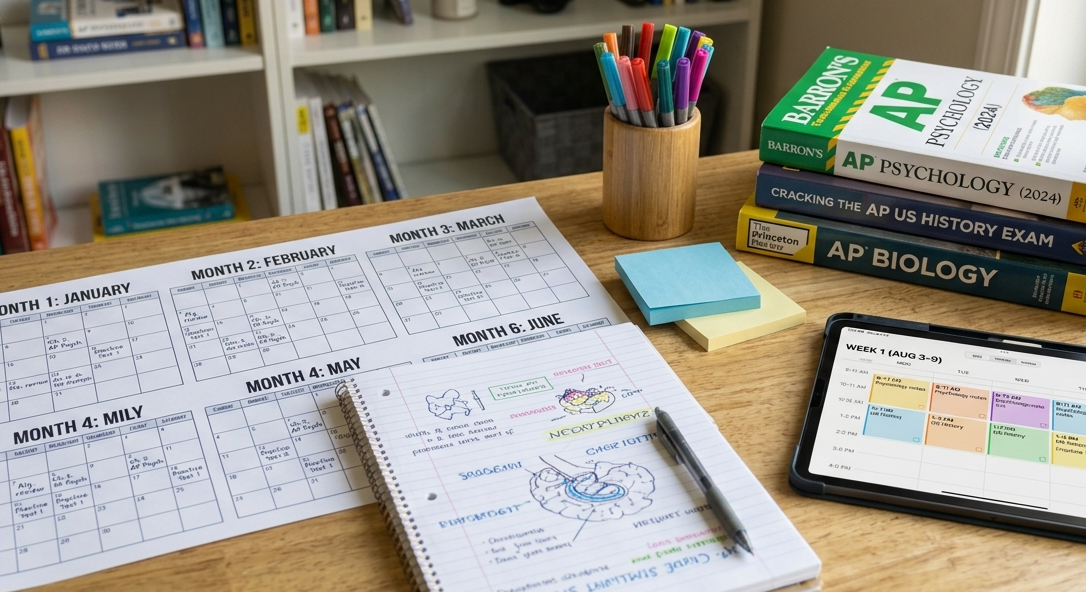
Months 1–2: Read through the full Course and Exam Description once. Don’t memorize yet, just get familiar with the shape of the exam and how it’s weighted.
Month 3: Start unit-by-unit review, pairing textbook chapters with Khan Academy or Marco Learning videos. Take unit quizzes as you go.
Month 4: Begin timed multiple-choice practice, ideally through AP Classroom or Albert.io. Track which units keep tripping you up.
Month 5: Shift focus to free-response practice. Compare your answers against official scoring guidelines from AP Central, not just the “correct” content.
Month 6: Full-length practice exams under real time constraints, including any available Bluebook digital practice for exams that use it. Review mistakes, not just scores.
This pace assumes 4 to 6 hours a week. Compress it if you’re starting later, but don’t skip the practice-exam phase — it’s the part self-studiers cut first and regret most.
Common Mistakes Self-Studiers Make
- Choosing AP Chemistry or Physics as a first self-study exam
- Reading content passively without ever practicing FRQs
- Ignoring the official Course and Exam Description
- Skipping full-length practice tests until the final week
- Assuming a strong pass rate means “no effort required”
- Forgetting exam registration deadlines, since self-studiers have to arrange a seat through a local school or approved testing center themselves
FAQ
What are the easiest AP classes to self study?
AP Psychology, AP Human Geography, AP Environmental Science, AP Computer Science Principles, and AP US Government and Politics are consistently ranked as the most manageable for self-study.
What is the easiest AP class to self study for a first-timer?
AP Psychology. Its vocabulary-based structure and abundance of free resources make it a common starting point, and most students finish prep in two to three months.
Can I self study AP exams?
Yes. College Board allows students to register for AP exams independently, without having taken the corresponding class, through their school or an approved testing center.
Which AP has the highest pass rate?
Pass rates shift slightly year to year, so check the latest official score distribution on AP Central before relying on any specific number.
Which AP is easiest to get a 5 on?
Generally the same subjects that are easiest to self study — AP Psychology and AP Human Geography tend to have strong 5-rates, though this varies annually.
Can freshmen self study AP exams?
Yes. Freshmen can self study an AP exam, and AP Psychology or AP Human Geography are the most realistic starting points since neither requires prior AP experience or advanced math. Success depends more on consistent weekly study time than on age or grade level, so freshmen should build a schedule before committing.
Do colleges care if I self studied?
Most colleges view a self-studied AP score the same as one earned through a class. What matters is the score, not how you got there.
Is AP Psychology really as easy as people say?
It’s manageable, not effortless. Students who skip regular review still struggle with the sheer volume of vocabulary and named studies.
Is AP Human Geography beginner friendly?
Yes, it’s frequently recommended for students taking their very first AP exam.
How many AP exams should I self study in one year?
Most advisors suggest starting with one, maybe two, especially if you’re also handling a full course load elsewhere.
Is AP Statistics good for self study?
It can be, if you’re comfortable with algebra and data interpretation. It’s tougher for students who struggle with word problems, despite the “no calculus” reputation.
Is AP Psychology easier than AP Biology?
Generally yes. AP Psychology relies mostly on vocabulary and concept recall, which suits independent study well. AP Biology covers a larger course workload and includes lab-based free-response questions that are harder to practice without hands-on lab access, making it a heavier lift for most self-studiers even though both are considered manageable exams.
What’s the hardest AP to self study?
AP Physics C and AP Calculus BC are widely considered the toughest to self study, since both rely on skill-building that’s hard to replicate alone.
Do I need a textbook to self study an AP exam?
Not strictly, but a review book like Barron’s or Princeton Review helps organize content far more efficiently than free resources alone.
What score do I need to get college credit?
This depends entirely on the specific college’s AP credit policy. Check with the admissions or registrar’s office directly.
Can self-studying hurt my GPA?
Not directly, since most self-studied exams don’t appear on your transcript as a course grade. It can affect your overall workload and study time, though.
Final Verdict
The easiest AP classes to self study aren’t the ones with the flashiest reputation. They’re the ones built around memorization, conceptual thinking, and strong free resources rather than years of skill practice. AP Psychology and AP Human Geography sit at the top of that list for good reason, with Environmental Science, Computer Science Principles, and US Government close behind.
Rather than picking a subject purely because it ranks “easiest,” match it to your grade level, your intended major, and how much bandwidth you actually have this semester. That decision matters more than any single ranking, including this one. For the official word on exam structure, scoring, and registration deadlines, the College Board’s AP Central is the source to check before finalizing your plan.
Pick one subject that actually interests you, follow a structured plan instead of cramming in April, and lean on free resources like Khan Academy to fill in gaps as you go. That combination beats any “easy AP” ranking on its own.