

Handwriting exercise books for schools are not simply notebooks with lines on the page. The right choice depends on a pupil’s age, handwriting stage, the ruling and guide lines used, the handwriting style the school teaches, and how the book will actually be used in the classroom day to day. This guide walks through how to choose handwriting exercise books by age, ruling, layout, and classroom purpose, so purchasing decisions are based on what pupils actually need rather than cover design or price alone.
Terminology varies by country, so this guide uses both UK terms such as Reception and Key Stage 1 and US terms such as kindergarten and elementary school where useful.
Most schools default to whatever a supplier lists first, then wonder halfway through the year why younger pupils are struggling to keep letters on the line, or why older pupils feel babied by ruling that no longer matches their writing stage. A handwriting exercise book earns its name because of the guidance built into the page, not because the word “handwriting” is printed on the cover.
What Are Handwriting Exercise Books for Schools?
A handwriting exercise book is a school workbook designed with specialised ruling and writing guides that help pupils practise letter formation, size, spacing, and alignment.
A standard ruled exercise book gives pupils a single line to write on and leaves formation entirely up to them. A handwriting exercise book adds structure on top of that line: a midline to show letter height, a dotted or shaded guide for tracing, or graded ruling that narrows as pupils progress. The goal is not simply neat penmanship; pupils also need consistent letter formation, spacing, alignment, and enough writing fluency to handle normal classroom tasks. Comparing options like ordinary lined paper against a purpose built handwriting book helps clarify why the extra guidance matters for pupils who are still building these skills.
What Should Schools Look For in a Handwriting Exercise Book?
Before comparing specific products, it helps to have a short list of criteria in mind, since suppliers rarely organise their catalogues around what a classroom actually needs.
- Age appropriate line spacing
- A clear baseline and midline
- Enough writing space per line
- Compatibility with the school’s print or cursive handwriting style
- Dotted or traceable letter models where relevant
- Progressive ruling that narrows as pupils advance
- Durable cover and binding for daily use
- Paper that resists bleed through from pen or marker
- Space for teacher feedback or marking
- Consistent format across year groups where possible
- Usability for left handed pupils
- Reasonable cost at bulk order quantities
A quick checklist before ordering is worth running through with staff: does the ruling match the pupils’ current writing stage, does the letter style match the school’s handwriting policy, can teachers mark comfortably in the space provided, does the paper work well with the pens or pencils pupils actually use, and is the binding durable enough to survive a full term of daily handling.
What Ruling Is Best for Handwriting Practice?
For many schools, ruling is one of the most important decisions in choosing handwriting exercise books for schools, and it is where most buying mistakes happen.

Wide lined books are generally better for early writers because they give more room to control letter height, spacing, and placement. As a general starting point, early writers may need substantially wider spacing than fluent writers, while older pupils can often transition to narrower ruling as letter size and control improve.
| Stage | Typical Ruling Approach | Purpose |
|---|---|---|
| Early years | Wide ruling, large guides | Pre writing strokes, letter formation |
| Kindergarten or Reception | Wide ruling with a midline or dotted guide | Letter height and positioning |
| Key Stage 1 or early elementary | Medium ruling | Words, short sentences, spacing |
| Upper primary | Narrower ruling | Joined writing, fluency, longer work |
| Secondary or intervention | Depends on the individual learner | Legibility, speed, targeted practice |
Exact line widths vary by manufacturer and school system, so treat any specific measurement as a typical example rather than a fixed rule. A few common layout types worth knowing:
Wide lined books suit beginners and pupils who need more physical space to form letters correctly.
Dotted midline books add a middle guide line between the baseline and topline, which helps pupils judge lowercase letter height consistently.
Shaded ruling uses colour or tint to mark the writing zone, giving beginners and intervention learners a stronger visual boundary than a thin printed line offers.
Three line ruling separates the lowercase body from ascenders and descenders, which is particularly useful once pupils are forming letters like b, d, g, and p correctly.
Plain lined books suit pupils who have already mastered letter formation and are writing independently without needing guide structure. The same principle applies when schools compare school handwriting books for different year groups: the internal layout matters more than the cover.
Print, Cursive, or Joined Handwriting?
There is no single handwriting style that is universally best for every pupil or every school. What matters more is consistency with whatever style the school already teaches.
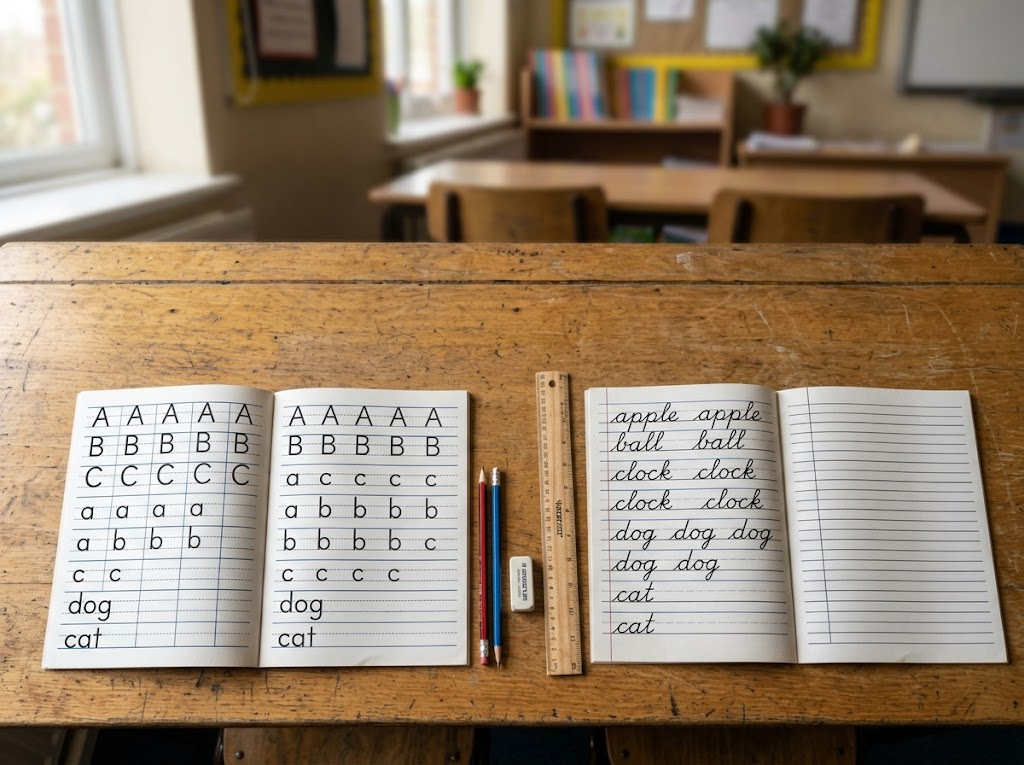
Print books tend to work best in the early stage of letter formation, since individual letters are easier to isolate and correct. Cursive or joined handwriting books support fluency once pupils are writing longer pieces regularly. A handwriting exercise book should reinforce the letterforms and joining patterns pupils are already being taught, rather than introduce a competing style that confuses early learners. Before ordering in bulk, it is worth checking sample letters against the school’s own handwriting policy document, since even small differences in how a letter joins can create confusion for pupils who are still building consistent habits. Our own comparison of print versus cursive handwriting goes into more detail on how schools typically decide between the two.
Some whole school schemes, such as Nelson Handwriting from Oxford University Press, are built around a staged progression from early formation through to joined cursive writing across primary years. That kind of staged approach is worth understanding as a general framework even if a school ultimately chooses a different provider, since it illustrates how ruling, letter style, and pupil age are meant to move together. For current details on this specific scheme, Oxford University Press’s Nelson Handwriting page is worth checking directly, since program structure and materials can change.
Choosing Handwriting Books by Age and School Stage
Early Years and Kindergarten
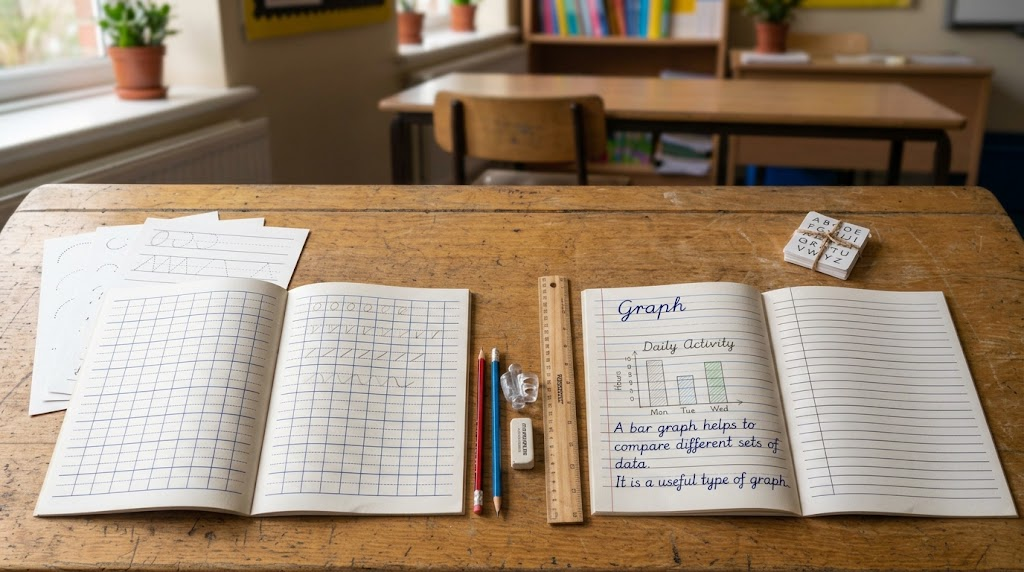
At this stage, books should offer large writing spaces, simple pre writing strokes, tracing activities, basic alphabet formation, and often some room for drawing alongside writing. Short practice pages work better than long ones, since attention spans and pencil control are both still developing. This is where terms like handwriting workbook for kindergarten and handwriting books for early years become most relevant, and where a split page layout combining drawing space with lined writing space tends to work particularly well.
Key Stage 1 or Early Elementary
Books at this stage generally cover uppercase and lowercase letters, basic number formation, word spacing, and short sentence copying, with guide support gradually reduced as pupils gain independence.
Upper Primary
Pupils here are typically working on joined handwriting, consistency of letter size and spacing, writing stamina across longer pieces, and copying full paragraphs rather than isolated words or sentences.
Secondary and Intervention
Older pupils and those receiving additional support generally need narrower ruling where appropriate, more personalised practice, a focus on legibility and reasonable writing speed, and extra space for pupils who need it. Any handwriting intervention material should be treated as one tool among several rather than a guaranteed fix. Handwriting interventions can be useful for targeted support, but schools should evaluate each pupil’s progress rather than assume that one workbook will work equally well for every learner, so pairing any workbook with regular teacher observation matters more than the specific product chosen.
Handwriting Exercise Book Formats for Schools
Format decisions affect cost, durability, and how well a book survives a full term of classroom use.
| Format | Best Use | Advantage | Limitation |
|---|---|---|---|
| A4 lined | Daily classroom writing | More writing space | Takes more storage room |
| A5 lined | Homework or short practice | Portable and economical | Less space per page |
| Stapled, shorter page count | Short term or light practice | Lower cost | Less durable over a full term |
| Exercise book bound, longer page count | Regular ongoing use | Fewer replacements needed | Higher upfront cost |
| Split page | Early years | Combines drawing and writing | Less suitable for older pupils |
Paper weight, resistance to ink bleed through, cover durability, and how easily books can be labelled and colour coded by year group are all worth checking with a sample before placing a large order.
What to Ask a School Handwriting Book Supplier
Before committing to a supplier, a short set of questions can save a lot of trouble later: what ruling options are available, can samples be requested before a bulk order, are books available in more than one size, what are minimum order quantities, are bulk discounts available, what is the expected delivery time, can covers be labelled or customised for year groups, and are paper sourcing or sustainability specifications available on request. Getting clear answers here tends to prevent the most common procurement headaches.
Handwriting Curriculum and Publisher Options
A handful of programs and publishers come up repeatedly when schools research handwriting exercise books, and it is worth understanding what each generally represents rather than treating any one as an automatic best choice.
| Resource or Program | What It Generally Offers | Where It Tends to Fit |
|---|---|---|
| Nelson Handwriting | A whole school progression from early formation through joined cursive | Reception through upper primary |
| Morrells Handwriting | Graded workbooks spanning primary through secondary stages | Schools wanting continuity across many year groups |
| Learning Without Tears / Handwriting Without Tears | A structured, multisensory approach | Early learners and some intervention settings |
| Generic ruled exercise books | Flexible, lower cost, fits a school’s own teaching sequence | Schools with an established in house handwriting approach |
| Specialist intervention workbooks | Extra visual guidance and targeted practice | Struggling writers and pupils receiving additional support |
Product details, pricing, and current availability change over time, so it is worth checking each publisher’s official page directly before making a purchasing decision, particularly for bulk school orders. Morrells Handwriting’s official site is a useful reference point for schools comparing graded workbook options across primary and secondary stages.
How Teachers Can Use Handwriting Exercise Books Effectively
The book itself is only part of the picture. A short, consistent routine tends to produce better results than long, infrequent sessions or simply having pupils fill an entire page without feedback.
A workable fifteen minute structure looks something like two minutes on posture and pencil grip, three minutes of teacher modelling, four minutes of guided letter formation, four minutes applying the letter or join in words or short sentences, and two minutes of review with one specific improvement target, such as keeping letters on the baseline or maintaining consistent spacing. Quality of practice generally matters more than quantity, and a single clear feedback point tends to stick better than a page covered in corrections.
Supporting Left Handed and Struggling Writers
Left handed pupils and those with handwriting difficulties benefit from a few consistent adjustments: enough writing space, room to angle the paper comfortably, visual letter models placed where they are easy to see without smudging fresh ink, shorter initial copying tasks, and high contrast guide lines. Persistent difficulties are worth discussing with the school’s SENCO or an occupational therapist rather than assuming a workbook alone will resolve them. A specialised workbook may provide useful visual structure and repeated practice, but it is not a diagnosis or a treatment, and pencil grip in particular varies naturally between individual writers, so it is worth treating grip as a concern only when it causes pain, fatigue, or genuinely restricts a pupil’s writing.
Handwriting Exercise Books vs Printable Worksheets
Printable worksheets are useful for a short intervention session, a sample lesson, or a quick assessment. Exercise books tend to work better for ongoing daily practice, building writing stamina over a term, and keeping a continuous record of progress in one place. If a school does use printable resources alongside exercise books, checking licensing terms matters, and it is worth using official publisher samples rather than assuming a freely circulated PDF represents a complete or accurate handwriting program.
School Buying Checklist
Before placing a bulk order, it helps to work through a short checklist with the staff who will actually use the books day to day.
- Confirm year groups and pupil numbers
- Decide whether the school needs print, cursive, or both
- Select ruling appropriate to each stage
- Request samples before committing to a full order
- Test samples with a small group of actual pupils
- Check paper quality against the pens or pencils used in class
- Confirm page count and binding durability
- Ask suppliers about bulk order pricing
- Review delivery timelines against the school calendar
- Confirm the books match the school’s existing handwriting policy
A school ordering several hundred books is generally better served testing two or three ruling options with one early years class and one upper primary class before committing to a full order, since what works on paper in a catalogue does not always hold up once pupils are actually using it.
Common Mistakes Schools Make
- Using the same ruling for every year group regardless of writing stage
- Choosing a book based on cover design rather than internal ruling and layout
- Giving beginners narrow lines meant for more advanced writers
- Switching letter styles between different books or year groups
- Assigning too many pages in a single sitting
- Overlooking left handed pupils when selecting ruling and layout
- Treating a workbook as a complete handwriting program on its own
- Ordering large quantities before testing a sample with real pupils
FAQs
What are the best handwriting exercise books for schools?
The best choice depends on pupil age, current handwriting stage, ruling, handwriting style, and how the book will be used in class. Wide guided ruling generally suits beginners, with schools moving toward narrower ruling as pupils gain control.
What ruling is best for kindergarten handwriting?
Kindergarten and early years pupils usually do best with wider ruling, often including a midline or dotted guide, though the exact spacing should match each child’s current letter formation ability rather than a fixed number.
What is the difference between a handwriting exercise book and a normal exercise book?
A normal exercise book has a single ruled line for general writing. A handwriting exercise book adds specialised guides such as a midline, dotted letters, or graded ruling specifically to support letter formation, size, and spacing.
Should schools use print or cursive handwriting books?
The right choice depends on the school’s own handwriting policy rather than one style being universally better. Print tends to suit early letter formation, while cursive or joined writing supports fluency once pupils are more established.
Are handwriting exercise books better than worksheets? For regular ongoing practice, exercise books offer continuity, writing stamina, and a running record of progress. Worksheets work well for short activities, targeted intervention, or quick assessments.
Can handwriting books help pupils with dysgraphia or other writing difficulties?
A specialised workbook may offer useful visual structure and repeated practice, but it is not a diagnosis or a treatment. Persistent difficulties are worth discussing with the school’s SENCO or a qualified occupational therapist.
What should schools check before buying handwriting exercise books in bulk?
Schools should check the ruling, handwriting style, paper quality, binding, page count, age suitability, and compatibility with their handwriting policy. Requesting samples and testing them with pupils before placing a large order can also help avoid buying books that are unsuitable for a particular year group.
How often should pupils practise handwriting?
Short, regular sessions tend to work better than occasional long ones. Frequency can be adjusted based on age, writing stamina, and whether a pupil needs additional support.
Conclusion
Choosing handwriting exercise books for schools comes down to matching ruling, layout, and handwriting style to where pupils actually are, not to what looks best on a supplier’s homepage. Testing samples with real pupils before a bulk order, keeping ruling consistent with each year group’s writing stage, and checking that any book matches the school’s existing handwriting policy will do more for classroom results than chasing a single “best” product.