
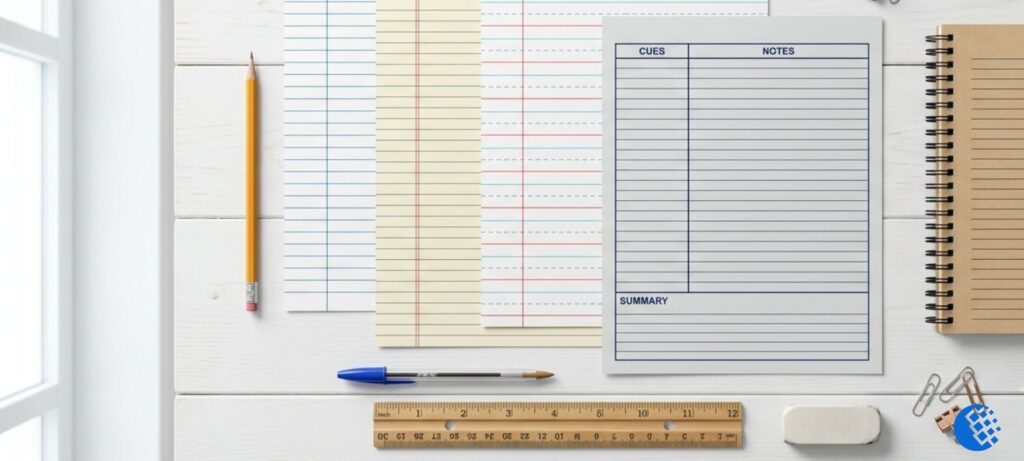
Lined paper is writing paper printed with evenly spaced horizontal guide lines that help keep handwriting straight and consistent. It’s the paper most people picture the moment someone says “notebook paper” and it’s still the default writing surface in classrooms, offices, and journals decades after most other paper habits went digital. Whether you’re printing a sheet for a first-grader learning to form letters or setting up a page for meeting notes, understanding the different rulings, sizes, and printing options makes a real difference in how usable the final page actually is.
Quick definition: Lined paper is any sheet printed with parallel horizontal lines used as a writing guide. It’s commonly available in wide ruled, college ruled, narrow ruled, and primary writing formats, and is used across schools, offices, and journaling.
This guide covers what lined paper is, the different types available (including loose leaf paper, composition notebook paper, and graph or dot grid paper for comparison), how to print it correctly at home, and how to build your own in Word or Google Docs — plus free printable templates in PDF and editable Word format for A4 and US Letter.
What Is Lined Paper?
What Does Lined Paper Mean?
Lined paper means any sheet with horizontal lines printed across it at a fixed, repeating distance apart. The lines act as a baseline for handwriting, keeping each row of text level instead of drifting up or down the page — something almost impossible to do consistently on a blank sheet.
Why Is It Called Ruled Paper?
“Ruled paper” and “lined paper” describe the exact same thing. The “ruled” term comes from the older manufacturing process, where lines were literally drawn with a ruler and pen before printing presses took over. You’ll still see “ruled” used more in office and stationery contexts, while “lined” tends to show up more in school and homeschool settings — but the two terms are interchangeable.
The History of Lined Paper
Ruled paper has been around since well before typewriters. Hand-ruled manuscript paper existed for centuries, but mass-produced lined paper only became common in the mid-1800s once paper mills could print consistent guide lines cheaply at scale. John Tetlow patented an early paper-ruling machine in 1770, and by the 1800s, ruled paper had become the standard for schools and offices across the US and UK — a shift that happened largely because handwriting instruction was becoming more standardized at the same time.
Why People Still Use Lined Paper Today
Despite how much writing has moved to screens, lined paper hasn’t gone anywhere. A few reasons it’s stuck around:
- Students rely on it for daily handwriting practice, class notes, and homework, since the lines correct for uneven letter height long before a child has full pen control.
- Teachers use it for worksheets, spelling tests, and writing assignments where consistent formatting matters for grading.
- Writers still draft by hand on ruled pads because the physical act of writing slows down thinking in a way that tends to produce better first drafts.
- Office professionals reach for a legal pad during meetings because typing notes on a laptop, ironically, is proven to encourage less retention than writing them by hand.
- Journalers use lined notebooks for daily entries, gratitude logs, and bullet journals where structure keeps the habit consistent.
- Homeschool families print lined paper constantly, since it’s one of the cheapest, most flexible resources for building a full curriculum at home.
Types of Lined Paper
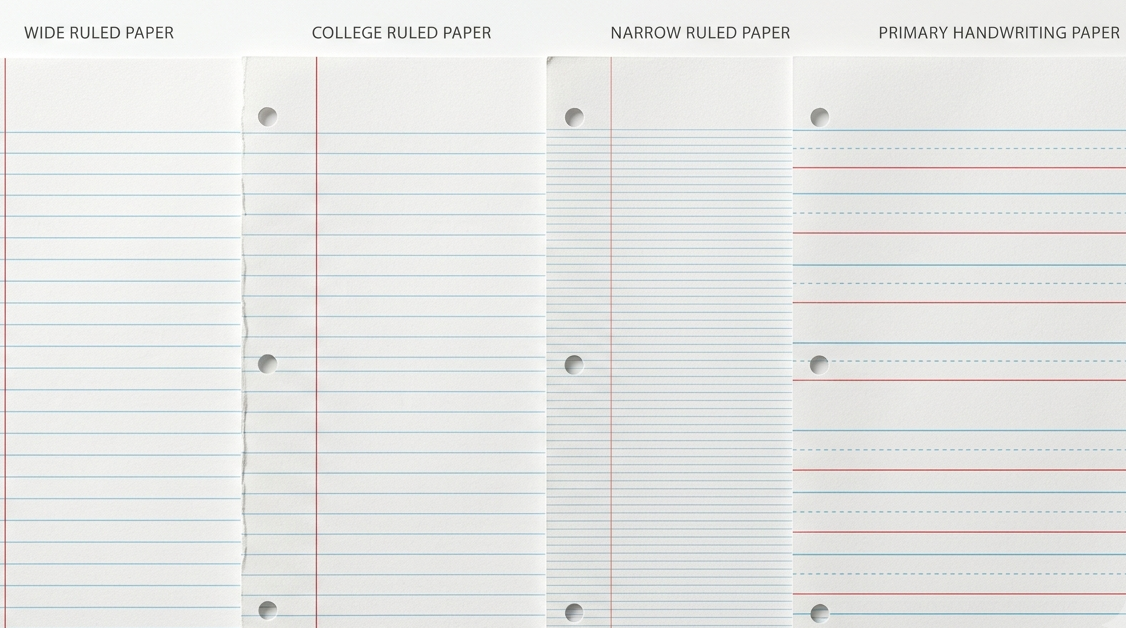
Not all lined paper is the same, and picking the wrong ruling for the task is a more common mistake than people realize.
Wide ruled paper has lines spaced about 8.7mm (11/32 inch) apart. It’s the standard for younger students, roughly kindergarten through fifth grade, because bigger letters are easier to control with a beginner’s grip.
College ruled paper narrows that spacing to about 7.1mm (9/32 inch), giving more lines per page. It’s the default for middle school through college and most office notepads, since it fits more writing into the same sheet without feeling cramped for an adult hand.
Narrow ruled paper goes even tighter, around 6mm, and mostly shows up in specialty stationery and some international notebooks rather than standard US classrooms.
Primary writing paper is built for the earliest writers — usually a wide dashed midline between two solid lines, so a child can see exactly where uppercase letters, lowercase letters, and letters with descenders like “g” or “y” should land.
Handwriting paper is a broader category that includes primary paper but also covers any ruling designed specifically to teach letter formation, sometimes with a dotted ascender line and descender line marked separately from the baseline.
Cornell notes paper adds a narrow left-hand column and a summary section at the bottom to a standard ruled page, built specifically for the Cornell note-taking method popular in high school and college.
Legal ruled paper uses a wider left margin (usually 1.25 inches) than standard notebook paper, historically for attorneys to add notes or annotations beside the main text — it’s still the standard yellow legal pad ruling today, and the same ruling shows up on most memo pads and writing pads sold for office use.
It’s also worth knowing where lined paper sits next to its closest relatives in the stationery aisle. Loose leaf paper is simply lined paper punched for a binder — usually with a three-hole punch pattern in the US or a two/four-hole pattern for A4 binders elsewhere. Composition notebook paper is lined paper bound permanently into a stitched notebook rather than sold as loose sheets. Spiral notebook paper is the same idea with a wire binding instead, which lets pages tear out cleanly. And if you’ve ever needed the opposite of lined paper, graph paper and dot grid paper swap the horizontal lines for a grid or dot matrix, which suits math, diagrams, and bullet journaling better than straight rules do.
A first-grade teacher printing handwriting worksheets for a full class of 25 students will almost always reach for wide ruled or primary paper, since the larger spacing helps young students keep letters aligned without constant correction. A university student prepping lecture notes tends to go the other way, choosing college ruled paper because it fits noticeably more information per page and cuts down on how many sheets a semester’s worth of notes takes up.
Wide Ruled vs. College Ruled Paper
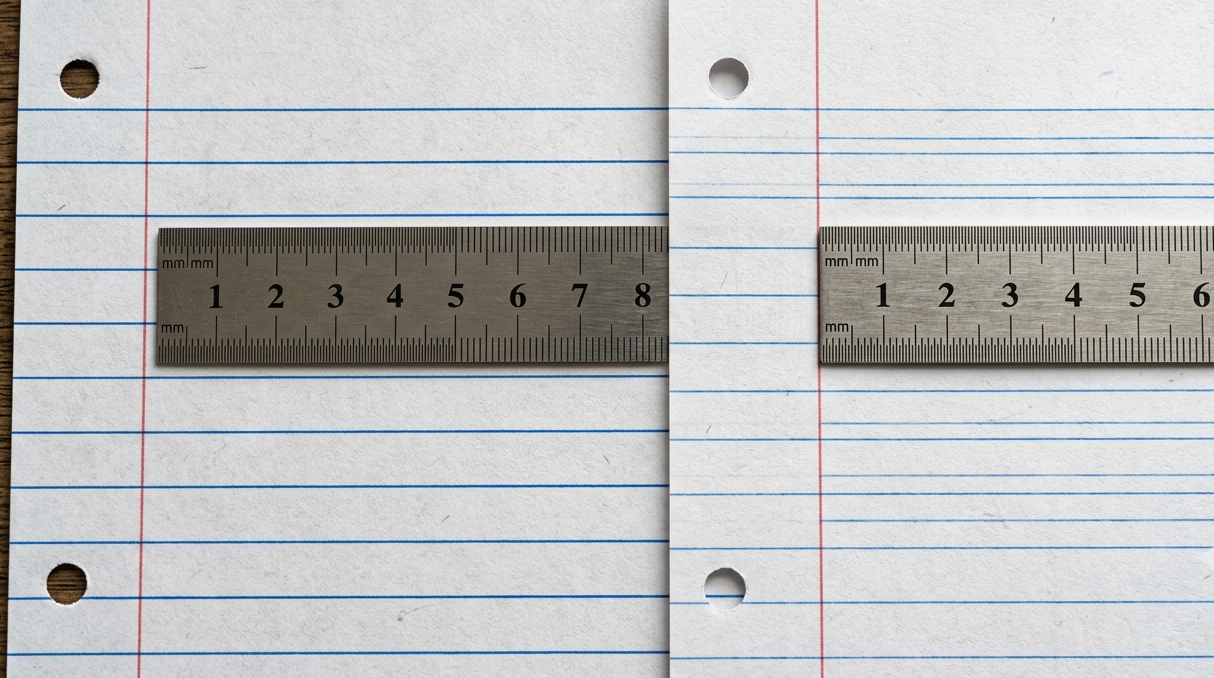
| Factor | Wide Ruled | College Ruled |
|---|---|---|
| Line spacing | ~8.7mm (11/32″) | ~7.1mm (9/32″) |
| Best age group | Elementary (K–5) | Middle school through adult |
| Writing space per page | Less text, larger letters | More text, smaller letters |
| Common use | Handwriting practice, early homework | Notes, essays, journaling |
| Advantage | Easier for beginner motor control | More content fits per page |
| Disadvantage | Wastes space for practiced writers | Too cramped for young handwriting |
If you’re not sure which to print, a simple rule of thumb: anyone still working on letter formation benefits from wide ruled, and anyone writing in cursive or taking dense notes benefits from college ruled.
Free Printable Lined Paper Templates
All of the templates below are free to download and print at home in PDF or Word format, available in both A4 and US Letter sizes.
Printable lined paper PDF — the most reliable format for consistent printing, since PDF locks in exact line spacing regardless of what device or printer you’re using.
Lined paper printable / lined sheets of paper printable — standard notebook-style rulings in wide, college, and narrow spacing.
Printable notebook paper — designed to match standard 3-hole punched loose leaf paper, so printed sheets fit straight into a binder.
Blank writing paper — primary and handwriting-paper versions with the dashed midline for early writers.
US Letter (8.5″ × 11″)
Lined Paper at a Glance
| Paper Type | Best For | Typical Age Group | Line Spacing |
|---|---|---|---|
| Primary/handwriting paper | Learning letter formation | Kindergarten–1st grade | Wide, with dashed midline |
| Wide ruled | Early homework, class notes | Elementary (K–5) | ~8.7mm |
| College ruled | Notes, essays, journaling | Middle school–adult | ~7.1mm |
| Narrow ruled | Compact note-taking | Specialty/international use | ~6mm |
| Cornell notes paper | Structured note-taking | High school–college | College ruled + margin column |
| Legal ruled paper | Office and meeting notes | Adult/professional | Wide left margin, college spacing |
Lined Paper Sizes Explained
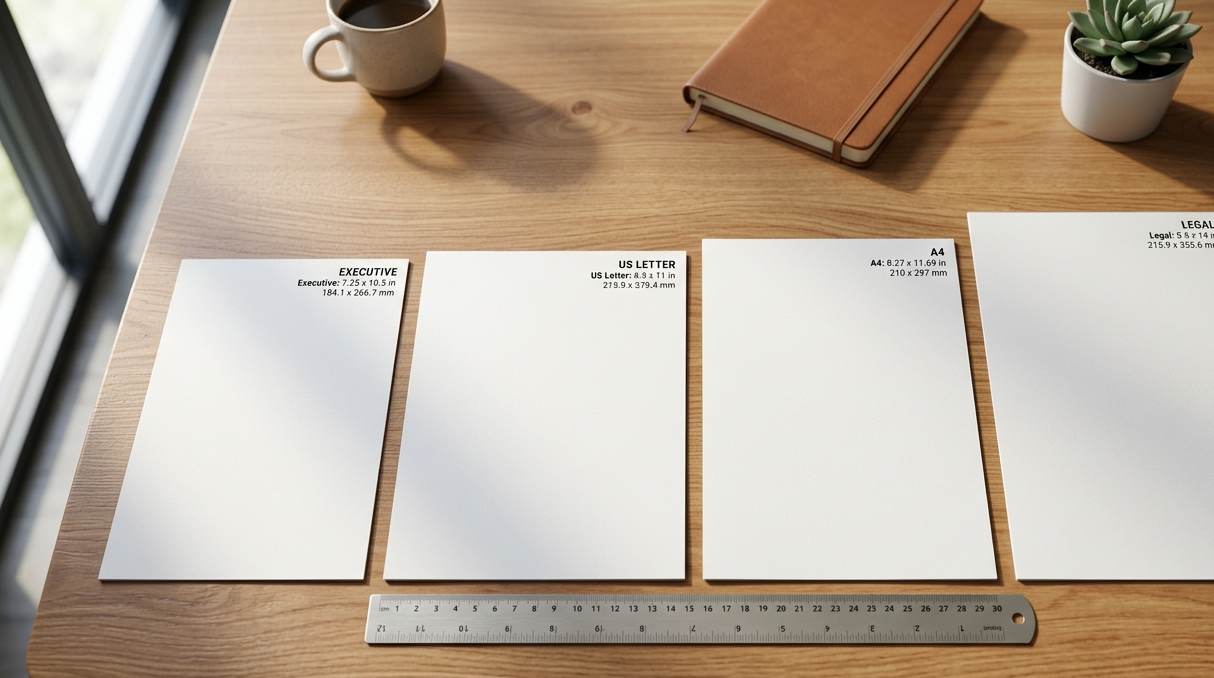
Paper size matters more than most people expect, especially if a printed sheet needs to fit into an existing binder or notebook cover.
| Size | Dimensions | Common Region |
|---|---|---|
| A4 | 210mm × 297mm (8.27″ × 11.7″) | UK, Europe, most of the world |
| US Letter | 8.5″ × 11″ (215.9mm × 279.4mm) | United States, Canada |
| Legal | 8.5″ × 14″ | US legal and business documents |
| Executive | 7.25″ × 10.5″ | Compact notebooks, planners |
A4 and Letter look nearly identical at a glance, but A4 is slightly narrower and noticeably taller. Printing an A4 template on a Letter-set printer (or the reverse) without adjusting the settings usually crops content or leaves an odd white margin — always confirm paper size in your printer settings before running a full batch, a point covered in more depth by ISO paper size standards.
How to Print Lined Paper at Home
- Download the PDF or Word template matching your ruling and size.
- Open your printer settings and confirm paper size matches the template (A4 or Letter — this step alone prevents most printing problems).
- Set orientation to Portrait unless you specifically downloaded a landscape template.
- Check your margin settings — 0.5″ to 1″ margins print cleanly on nearly every home printer.
- For double-sided notebook paper, enable duplex printing, or manually flip the stack if your printer doesn’t support it automatically.
- Print a single test page before running a full batch to catch scaling issues early — this also confirms the left margin line hasn’t shifted from whatever margin was set in Microsoft 365 or Google Workspace when the template was built.
Can You Use Lined Paper in a Printer?
Yes, you can generally print onto blank or pre-lined paper stock without issue, though standard lined notebook paper isn’t designed as printer stock and can jam thinner inkjet trays if it’s been through a binder before. For best results, use fresh, uncreased sheets designed for your printer type.
Inkjet printers handle standard 20lb paper well and are the better choice for anything with color or photo elements.
Laser printers run hotter and work better with slightly heavier stock (24lb or higher), and they tend to produce sharper, smudge-resistant lines — a real advantage if the sheet will get handled a lot, like a spelling test that goes home in a backpack.
Either way, stick to standard multipurpose paper (20–24lb) unless your printer’s manual specifies otherwise — cardstock and specialty paper can jam feed trays not designed for that thickness.
How to Make Lined Paper in Microsoft Word
- Open a new blank document and go to the Layout tab to set your margins (0.5″–1″ is standard).
- Go to Design → Page Borders, then open the Borders and Shading dialog.
- Under Setting, choose the line style, width, and color you want for the ruling.
- In Options, set “Measure from” to Edge of Page and adjust the spacing between lines to match your target ruling (roughly 8.7mm for wide ruled, 7.1mm for college ruled).
- Apply and preview — repeat the border across the page height, or use a single-row table with visible bottom borders and no side borders for more precise, repeatable spacing.
Microsoft’s own support documentation covers a few different methods for creating ruling lines in Word if you want more granular control over line style.
How to Make Lined Paper in Google Docs
- Open a blank Google Doc and go to File → Page Setup to confirm your paper size.
- Insert a table with 1 column and enough rows to fill the page (Insert → Table).
- Right-click the table, select Table properties, and remove the top, left, and right borders — leave only the bottom border visible.
- Set consistent row height under table properties to control line spacing.
- Repeat rows down the page, or copy-paste the table structure until it fills the sheet.
It’s a rougher process than Word since Google Docs doesn’t have a dedicated page-border ruling tool, but it works fine for a one-off printable.
Best Line Spacing for Different Uses
| Use Case | Recommended Ruling |
|---|---|
| Kindergarten | Primary/handwriting paper with midline |
| Elementary (1st–5th) | Wide ruled |
| Middle & high school | College ruled |
| College / adult note-taking | College ruled or Cornell |
| Journaling | Wide or college ruled, depending on handwriting size |
| Calligraphy | Wide ruled or custom-spaced guide sheets |
| Office notes | Legal ruled or college ruled |
Best Paper for Handwriting Practice
The pen or pencil matters as much as the ruling. A standard pencil or ballpoint pen works fine on most 20lb printer paper, but a fountain pen or gel pen can bleed or feather through thinner stock. If handwriting practice involves a fountain pen — common in calligraphy practice — look for at least 24lb paper, or a smoother, slightly coated stock designed to resist ink bleed. For basic cursive and print practice with pencil, standard wide or primary ruled paper is all that’s needed.
Lined Paper for Students
Lined paper shows up constantly across a student’s actual workload — homework sheets, in-class notes, formal assignments, and exams all typically expect a consistent ruling, usually specified by the teacher or the format of the assignment itself. Writing assignments in particular tend to have specific formatting expectations depending on grade level; a middle schooler drafting their first news-style piece benefits from seeing a real newspaper article example for students before putting pen to paper, since the structure of that kind of writing is very different from a personal narrative or essay.
Lined Paper for Teachers
For teachers building materials, lined paper is one of the most flexible classroom worksheet resources available — worksheets, spelling tests, penmanship practice, and assessment sheets all typically start from a blank ruled template. Matching the ruling to the grade level (wide for younger grades, college for older ones) keeps handwriting expectations realistic instead of penalizing students for a spacing problem that isn’t really about their underlying writing skills. Most school supplies budgets already account for notebook paper and office supplies like this as a recurring cost, which is exactly why printable versions save money over a full school year.
Lined Paper for Journaling
Journaling doesn’t require any particular ruling, but the choice still shapes the habit. A daily journal or diary usually works best with a ruling that matches natural handwriting size — wide ruled for larger, looser handwriting, college ruled if entries run long and space is tight. Gratitude journals, which are usually short and list-based, tend to work fine on either. Bullet journals are the one exception here, since dot grid paper (not lined) is the more common format for that particular system.
Common Printing Mistakes
- Wrong paper size selected — printing an A4 template on a Letter-set printer, or the reverse, without adjusting settings first.
- Incorrect scaling — “Fit to page” settings can subtly shrink line spacing, throwing off handwriting guides.
- Wrong margins — too-narrow margins can clip the outermost lines near the paper’s edge.
- Low-quality or thin paper — cheap stock bleeds through with pen and jams more easily in laser printers.
- Blurry printing — usually a low ink or toner warning being ignored past the point it should have been addressed.
- Cropped pages — happens when a PDF is printed at “actual size” is skipped in favor of default auto-scaling.
Tips for Choosing the Right Lined Paper
- For school, match ruling to grade level rather than defaulting to college ruled for everyone.
- For office use, legal ruled or college ruled both work well — pick based on whether extra margin space for annotations is useful.
- For calligraphy, use wider spacing and heavier paper that resists ink bleed.
- For handwriting practice, primary paper with a midline is worth the extra step for anyone still learning letter formation.
- For journaling, let your natural handwriting size decide the ruling rather than picking based on what looks neat empty.
- For meeting notes, legal ruled with a wide left margin makes it easier to add follow-up items after the fact.
How These Recommendations Were Put Together
The rulings, spacing measurements, and paper-size guidance in this guide are based on standard notebook manufacturing conventions (the same wide/college/narrow spacing used by most US school supply brands), common home printer settings, typical classroom writing practices by grade level, and the ISO 216 international sizing standard used outside North America. None of it is guesswork — it reflects how these products are actually specified and sold.
Frequently Asked Questions
What is lined paper?
Lined paper is paper printed with evenly spaced horizontal lines that guide handwriting into straight rows, commonly used for school, office, and journaling purposes.
What is ruled paper?
Ruled paper is another name for lined paper — the terms are used interchangeably.
What are the lines on paper called?
The lines themselves are usually called rules or ruling lines; the top guide is sometimes called the ascender line and the bottom the baseline.
What is the difference between wide ruled and college ruled paper?
Wide ruled spaces lines about 8.7mm apart and suits younger students, while college ruled narrows that to about 7.1mm for more compact adult handwriting.
Can you print lined paper?
Yes — download a PDF or Word template, confirm paper size and margins in your printer settings, and print as you would any document.
Can you use lined paper in a printer?
Standard printer paper prints fine; pre-used or creased notebook paper can occasionally jam thinner trays, so fresh sheets work best.
How do you make lined paper in Word?
Use the Design tab’s Page Borders tool, or build a single-column table with only bottom borders visible, to create repeatable ruling lines.
How do you create lined paper in Google Docs?
Insert a table, remove all borders except the bottom one on each row, and set consistent row heights to control spacing.
What size is notebook paper?
Standard US notebook paper is 8.5″ × 11″ (Letter size); most of the rest of the world uses A4 (210mm × 297mm).
Is lined paper available in A4?
Yes — most printable lined paper templates, including the ones in this guide, are available in both A4 and US Letter sizes.
Where can I download printable lined paper?
Free PDF and Word templates are linked throughout this guide, covering wide, college, and narrow ruling in both major paper sizes.
Which lined paper is best for handwriting?
Primary or wide ruled paper works best for early handwriting practice; college ruled suits more developed handwriting.
Which ruled paper is best for school?
Match the ruling to grade level — wide for elementary, college for middle school through college. Students working on longer-form writing assignments, like a high school research paper example, typically move to college ruled by that point simply because of how much text a research paper requires per page.
Can I print lined paper at home?
Yes, with any standard inkjet or laser printer, using the templates and settings covered in this guide.
What paper weight is best for printing?
Standard 20lb paper works for most printing; 24lb or higher holds up better for laser printers, fountain pen use, or documents that will be handled repeatedly.
Is lined paper recyclable?
Yes — standard uncoated lined paper is recyclable like most office and notebook paper. Spiral wire bindings and plastic notebook covers typically need to be removed first.
What GSM paper is best for lined paper?
80 GSM (roughly 20lb) is standard for everyday printing; 90–100 GSM holds up better for fountain pens or paper that will be handled or erased often.
Can lined paper be laminated?
Yes, though lamination is usually only worth it for reusable templates — a handwriting practice sheet meant to be written on with dry-erase marker, for example, not paper meant for pen or pencil.
How do you print double-sided lined paper?
Enable duplex printing in your printer settings if it’s supported, making sure “flip on short edge” or “long edge” matches how the paper will be bound. Without built-in duplex support, print all odd pages first, then reload the stack to print the even pages on the reverse side.
Is college ruled the same worldwide?
Not exactly. US college ruled spacing (~7.1mm) is a fairly fixed standard, but countries using A4 paper often use slightly different spacing conventions on their own ruled notebooks, so a template built for US college ruled won’t always match a European notebook exactly.
Which lined paper is best for fountain pens?
Look for heavier stock, 90 GSM or higher, with a smoother finish — thinner 20lb paper is more likely to feather or bleed through with wet fountain pen ink.
Can I edit lined paper templates?
Yes, if you download the Word version rather than the PDF — Word templates let you adjust margins, line spacing, and paper size directly, while PDF templates are fixed and best for printing as-is.
What’s the difference between lined and graph paper?
Lined paper has horizontal rules only, built for handwriting; graph paper adds a full grid of horizontal and vertical lines, better suited to math, technical drawing, and diagrams.
Final Thoughts
Lined paper looks like the simplest possible thing to print, right up until the wrong ruling or the wrong paper size turns a five-minute task into a wasted print run. Once you know the difference between wide and college ruled, understand how A4 and Letter sizing actually affects your printer settings, and have a couple of reliable templates saved, printing the right sheet takes less time than finding a notebook at the store. Whether it’s a first-grader’s handwriting practice, a legal pad for meeting notes, or a stack of A4 for a journal, matching the ruling to the actual task is what makes the page usable rather than just correctly sized.