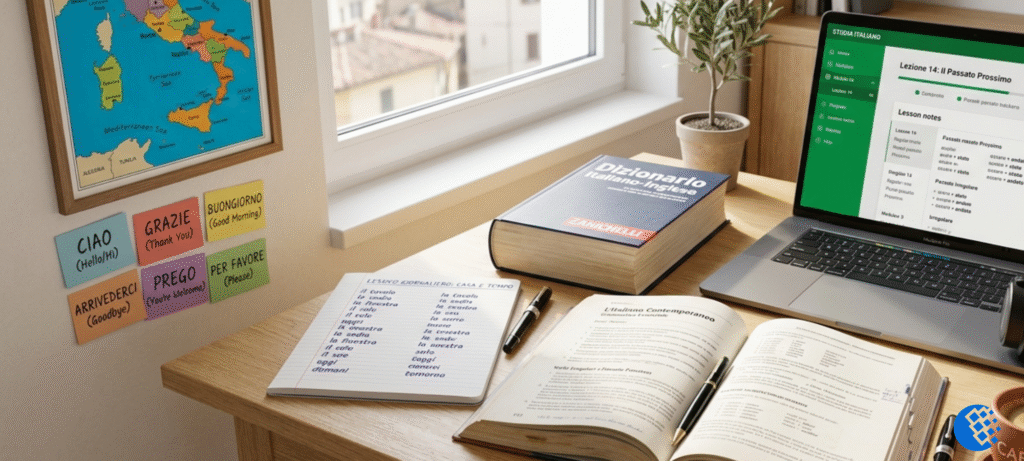
Someone asked me this at a dinner party once, half-joking, half-desperate: “How difficult is it to learn Italian, actually? Give me the real answer, not the Duolingo owl version.” Fair question. And the honest answer is – it depends less on the language itself and more on what you’re bringing to it.
Your native language shapes a lot of this. So does your listening habit, your patience with grammar tables, and whether you actually enjoy sitting with the language or just want a shortcut to fluency.
Here’s the quick version, since that’s probably what brought you here. Italian sits among the easiest foreign languages for English speakers to pick up. The Foreign Service Institute estimates around 600 to 750 classroom hours before you’re at professional working proficiency. Reading and pronunciation come fast. Verb conjugations, noun gender, and the speed of native conversation are where most people slow down.
Is Italian Difficult to Learn?
Short answer – easier than most, harder than people expect.
Stack it against Mandarin or Arabic and Italian barely counts as a challenge. Stack it against something built for simplicity, like Esperanto, and suddenly it has real weight to it. Where you personally land depends on a handful of things: do you already speak a Romance language, are you okay with memorizing patterns that don’t always make sense, and how many hours a week can you realistically give it.
Most people feel great for the first couple of months. Then the intermediate stage shows up, grammar gets denser, and that’s usually where the real test begins.
Italian ranks among the easier languages for English speakers overall, but that ease is front-loaded. The later stages ask more of you.
Italian Difficulty at a Glance
| Skill | Difficulty |
|---|---|
| Reading | Easy |
| Writing | Easy |
| Speaking | Medium |
| Listening | Medium-Hard |
| Grammar | Medium |
| Vocabulary | Easy |
| Pronunciation | Easy |
Vocabulary and reading move quickly because of shared Latin roots. Speaking and listening take longer – those skills come from repeated exposure, not memorization, so there’s no real shortcut around them.
Why Do Some People Find Italian Hard to Learn?
Nobody tells beginners this part, so I will. Italian doesn’t feel hard because the language is unusually complicated. It feels hard because of what happens once you’re a few months in.
A lot of learners start out with expectations that don’t match reality. They see “Category I, easiest group” somewhere online and assume that means fluency in a few weeks of app streaks. It doesn’t work that way. Category I still means hundreds of study hours – just fewer than, say, Japanese would demand.
Then comes the plateau. Vocabulary keeps piling up, but grammar starts throwing subjunctive forms and compound tenses at you faster than they feel manageable. Progress seems to freeze even though you’re still putting in the work, and this is exactly where a lot of people quit – not because they’re bad at languages, but because plateaus feel like failure when they’re really just part of the process.
Speaking anxiety matters more than people admit, too. Conjugating a verb correctly on paper is one thing. Doing it out loud, in real time, while someone waits for your answer, is a completely different skill. That gap between knowing a rule and producing it instantly is where a lot of confidence quietly disappears.
Fast native speech doesn’t do beginners any favors either. Textbook audio is slow and deliberate. A real Italian speaker telling a story at dinner runs words together in ways that make even solid vocabulary hard to catch in the moment.
Why do some people find Italian hard to learn even after months of study? Usually it comes down to exactly these things – unrealistic timelines, an unexpected plateau, and the mental leap from understanding grammar to actually using it under pressure.
Why Italian Is Easier Than Many Languages
Here’s the head start you’re not always told about. Around 60% of English vocabulary traces back to Latin, and Italian – being a direct descendant of Latin – shares an enormous slice of that vocabulary with English. Words like “importante,” “informazione,” and “possibile” barely need translating.
Pronunciation is the other gift. Italian is phonetic almost to a fault. Words are spelled exactly how they sound, which means no silent letters waiting to trip you up, and none of the guessing games English throws at learners with words like “though” and “through.”
Sentence order stays close to English too – subject, verb, object, most of the time – so you’re not fighting an unfamiliar structure on top of everything else you’re learning.
Shared vocabulary, phonetic spelling, and familiar word order add up to a real advantage, one you don’t get with a language from a completely unrelated family.
What Actually Makes Italian Difficult
This is the part most guides skim past, and honestly it’s the more useful half of the conversation.
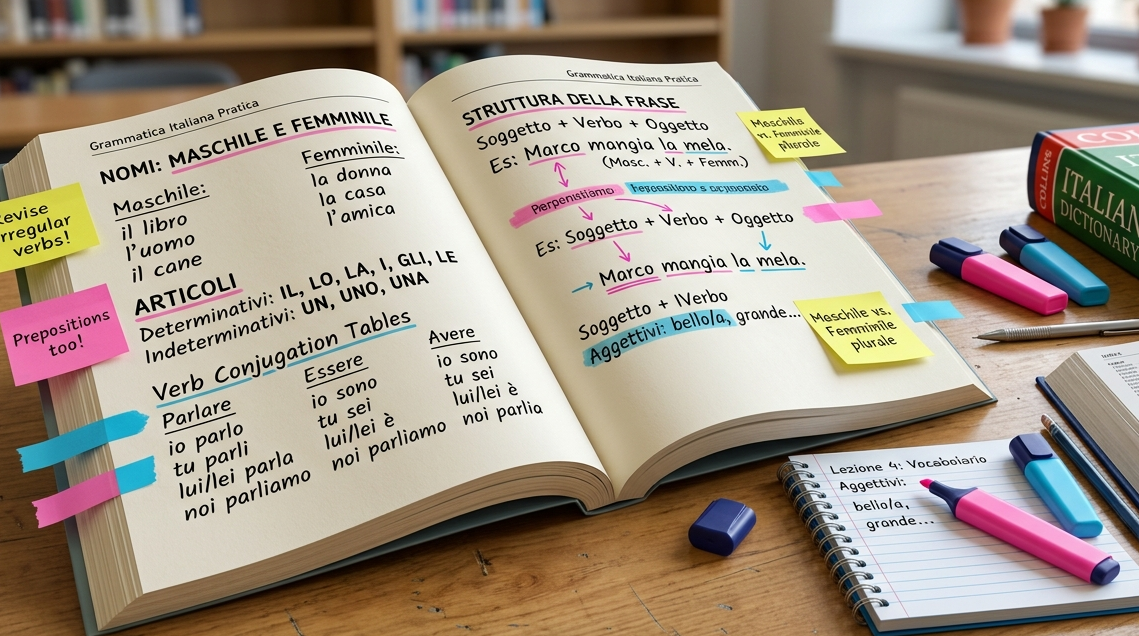
Gendered nouns are the first wall most beginners hit. Every noun is either masculine or feminine, and that gender affects the article and adjective attached to it. “Il libro” (the book) is masculine. “La casa” (the house) is feminine. Some of it follows patterns. A lot of it doesn’t, and you just have to learn the exceptions as you go.
Verb conjugations get intense fast. Verbs shift form based on tense, mood, and who’s doing the action, and then the subjunctive mood shows up – a form that barely exists in casual English but appears constantly in Italian for doubt, wishes, and hypotheticals. This tends to be the point where people start Googling “why is Italian grammar so hard” late at night.
Prepositions merging with articles catch people off guard too. “Di” plus “il” becomes “del.” “A” plus “la” becomes “alla.” Small detail, but it’s one more thing to memorize that beginners rarely see coming.
And then there’s real spoken Italian – the version you hear on a street in Naples, not the version from your textbook audio. Native speakers run words together, talk fast, and lean on regional accents that shift both vocabulary and pronunciation from one region to the next.
None of this sticks without a study routine you can actually keep up. If you’re trying to figure out how language learning fits into a broader daily schedule – especially with multiple subjects competing for time – Language Lessons for a Living Education covers how to build that kind of rhythm sustainably, and the same logic applies whether you’re teaching a classroom or just yourself.
Gendered nouns, verb conjugations, and fast native speech are the real obstacles here – not the alphabet, not basic pronunciation, and not word order.
How Long Does It Take to Learn Italian?
The Foreign Service Institute places Italian in its easiest category for English speakers – Category I, right alongside Spanish, French, and Portuguese. Their official language difficulty rankings put the estimate at 600 to 750 hours of study to reach general professional proficiency.
That number sounds intimidating until you break it into chunks.
| Level | Estimated Time | What You Can Do |
|---|---|---|
| Basic conversation | 3-6 months | Order food, ask directions, introduce yourself |
| Intermediate | 6-12 months | Hold everyday conversations, read simple articles |
| Advanced | 12-24 months | Discuss opinions, follow native-speed conversation |
| Professional fluency | ~600-750 hours total | Work or study comfortably in Italian |
Consistency wins over intensity almost every time. Thirty focused minutes a day tends to beat one exhausting three-hour weekend cram session, mostly because retention depends on repetition spread out over time, not crammed into one sitting.
Can you become fluent in Italian in one year? For plenty of committed learners, yes – assuming “fluent” means comfortable conversational ability rather than flawless native command. An hour a day for twelve straight months gets most people well past intermediate and into genuinely functional Italian.
Basic conversation is realistic within months. Full professional fluency, going by FSI’s own numbers, takes closer to a year or more of steady effort.
Is Italian Easier Than Other Languages?
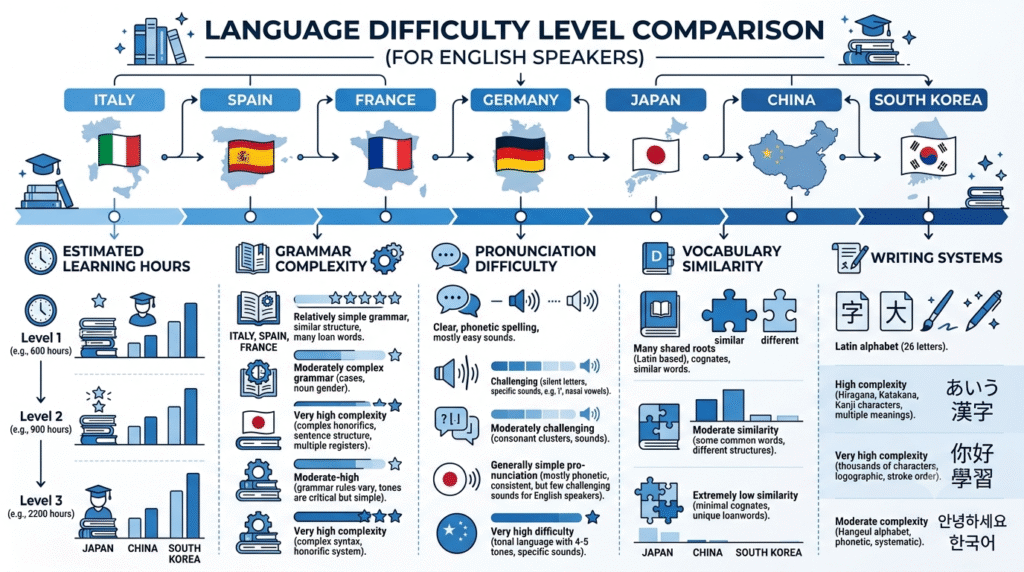
Difficulty only really means something in context, so here’s Italian next to a few other language families.
| Language | FSI Category | Approx. Hours | Shared Vocabulary with English |
|---|---|---|---|
| Spanish | I | 600-750 | High |
| Italian | I | 600-750 | High |
| French | I | 600-750 | High |
| Portuguese | I | 600-750 | High |
| German | II | 900 | Moderate |
| Korean | IV | 2,200 | Low |
| Japanese | IV | 2,200 | Low |
| Mandarin | IV | 2,200 | Low |
Italian sits comfortably in the easiest tier next to Spanish and French, for pretty much the same reasons – shared Latin roots, phonetic spelling, familiar sentence order. Curious how difficulty looks completely outside the European language family? What Is the Easiest Asian Language to Learn? covers a different set of hurdles entirely – tones, character-based writing – none of which Italian learners ever have to touch.
How Difficult Is It to Learn the Italian Language Compared With Spanish?
Genuinely close. Spanish edges ahead slightly for total beginners, mostly because there’s simply more learning material out there for it and its verb patterns lean a touch more predictable. Grammatically though, the two are close cousins – similar gendered nouns, similar conjugation logic, similar word order. Someone already comfortable in Spanish will pick up Italian noticeably faster than someone starting cold in either one.
Italian and Spanish land in the same FSI difficulty tier, and knowing one gives you a real head start on the other.
Who May Find Italian Easier?
Difficulty isn’t a fixed number – it shifts depending on what you already speak.
| Native Language | Difficulty Learning Italian |
|---|---|
| Spanish | Very Easy |
| Portuguese | Easy |
| French | Easy |
| Romanian | Easy |
| English | Moderate-Easy |
| German | Moderate |
Romance language speakers – Spanish, Portuguese, French, Romanian – get a serious head start, since Italian shares grammar logic and vocabulary roots directly with all of them. English speakers land in a decent spot too, just without the shared grammar structure to lean on. German speakers face a bit more friction, since Germanic and Romance grammar pull apart more sharply.
Is Italian Hard for English Speakers Specifically?
Not particularly, relatively speaking. Shared vocabulary already puts English speakers ahead before they’ve even cracked a textbook open. Add phonetic spelling into the mix and reading comprehension develops faster than it would for, say, French, where silent letters and odd spelling rules cause more early frustration.
Where English speakers actually struggle is grammar logic that simply doesn’t exist in English anymore – grammatical gender being the obvious one, since English dropped it centuries ago. The subjunctive mood is another blind spot, since English speakers barely register they’re even using a form of it in their own language.
Common Challenges Beginners Face
Rolling the R trips people up early – it’s as much a physical skill as a linguistic one, and some learners need weeks before it clicks. Noun genders rarely become fully automatic either; even advanced speakers second-guess themselves occasionally. Verb endings stack up fast once you’re juggling present, past, future, conditional, and subjunctive all at once. And listening speed is probably the single most common complaint – reading Italian and following rapid native speech are two entirely different skills.
Tips to Learn Italian Faster
Daily listening, even the passive kind playing in the background, trains your ear faster than most people expect. Shadowing – repeating a native speaker in real time, matching their rhythm – builds pronunciation and listening comprehension together. Reading aloud, even just headlines, reinforces phonetic patterns until they feel automatic.
Spaced repetition keeps vocabulary from leaking out of memory a week later. Conversation practice, shaky and imperfect as it usually starts, moves you forward faster than passive study ever will. And immersion – podcasts, graded readers, switching your phone’s language – adds exposure without carving out extra study time.
Best Resources for Learning Italian
Duolingo and Babbel are solid for building a daily vocabulary habit, though neither replaces actual conversation. Busuu and Memrise cover similar ground, with Busuu leaning toward structured lessons and Memrise leaning harder into spaced repetition. Pimsleur is mostly audio-based, which fits Italian’s phonetic nature well. Language Transfer takes more of a grammar-first, thinking-method approach that clicks for some learners better than app drilling does. Glossika is worth checking out for sentence-pattern repetition once you’re past the total-beginner stage.
LingQ and graded readers help bridge the gap between beginner textbooks and real native content. Italki connects you with tutors and conversation partners directly, which tends to be the fastest way past the intermediate plateau where a lot of self-taught learners get stuck.
Podcasts deserve their own mention. Shows built specifically for learners – slower, clearly enunciated, with vocabulary explained along the way – bridge that gap between textbook drills and native-speed content far better than jumping straight into Italian radio. Once basic listening feels solid, switching to native podcasts or subtitled shows builds real-world comprehension that classroom study alone rarely covers.
For anyone chasing something more formal, the Università per Stranieri di Siena runs recognized Italian courses and certification exams for non-native speakers. The Accademia della Crusca – Italy’s oldest linguistic academy – also publishes reliable material on grammar and usage for learners who want to go past app-based study.
Books help too, not just phrasebooks. Graded readers – novels simplified for specific proficiency levels – let you practice reading without reaching for a dictionary every other sentence. A1 and A2 readers feel almost too easy at first, but that repetition is exactly what cements vocabulary long-term.
Regional Accents and Real-World Italian
Here’s something most beginner guides skip over entirely: the Italian you learn in a classroom isn’t quite the Italian you’ll hear walking through Rome, Florence, or Milan. Standard Italian, based largely on the Tuscan dialect, is what gets taught almost everywhere, and it’s also what most Italians use in formal settings, news broadcasts, and when talking with foreigners.
Step outside that and regional variation shows up fast. A Neapolitan accent sounds noticeably different from someone speaking in Turin. Sicilian dialect can feel like an entirely separate language to an untrained ear. Venice has its own rhythm too, and even something as basic as a greeting shifts region to region.
None of this should scare you off. Standard Italian gets you understood everywhere in the country, and locals are generally patient with a learner making a genuine effort. But it’s worth knowing going in that “fluent in Italian” and “able to follow every regional accent without effort” are two different milestones – and most learners, even fairly advanced ones, keep running into new dialect surprises for years.
Is Learning Italian Worth It?
Depends what you’re chasing, honestly. For travel, it opens up Italy well past the tourist script – ordering off a menu without pointing, actually following a conversation in a small-town trattoria. For culture, it unlocks opera, film, and literature in their original form, which loses something in translation no matter how good the subtitles are. Career-wise, Italian carries less global reach than Spanish or Mandarin, but it holds real weight in fashion, design, culinary work, and certain EU-facing roles.
Is Italian worth learning in 2026 specifically? If anything, more so than a few years back – remote work and EU-based freelance opportunities have made regional language skills more valuable, not less. And for plenty of learners, the payoff is simply personal: connecting with heritage, or just the satisfaction of getting good at something that took real effort.
Frequently Asked Questions
How difficult is it to learn Italian for English speakers?
Easier than most languages, thanks to shared Latin vocabulary and phonetic spelling – though gendered nouns and the subjunctive mood still take real study.
How difficult is it to learn the Italian language compared to Spanish and French?
About the same overall. All three sit in the FSI’s easiest category for English speakers, at roughly 600-750 hours to reach working proficiency.
Is Italian easier than French?
Roughly comparable in difficulty, though Italian’s phonetic spelling makes reading and pronunciation feel more approachable to most beginners than French’s irregular spelling does.
Is Italian easier than Spanish?
Very close. Spanish has a slight edge for beginners mainly because of resource availability, but grammatically the two languages are structured similarly.
Is Italian harder than German?
Generally yes for English speakers – German’s case system and word order diverge from English more sharply than Italian’s grammar does.
Is Italian harder than Portuguese?
Not really. Both sit in the same FSI tier with similar grammar complexity, though Portuguese pronunciation (especially the European variant) trips up more beginners early on.
Can I learn Italian in three months?
Basic conversational ability, yes, with consistent daily practice. Full fluency realistically takes closer to a year or more.
Can you become fluent in Italian in one year?
For many dedicated learners, yes – an hour of steady daily practice for twelve months typically gets you to comfortable conversational fluency, even if native-level mastery takes longer.
Is Italian grammar difficult?
The core grammar is manageable, but gendered nouns, verb conjugations, and the subjunctive mood add real complexity once you’re past the beginner stage.
Is Italian pronunciation easy?
Yes, generally. Italian is highly phonetic – words are pronounced exactly as they’re spelled – which makes it far more predictable than English or French.
Can I learn Italian at home without a classroom?
Yes. Apps, podcasts, graded readers, and online tutors through platforms like italki make self-study a completely viable path to fluency.
What’s the fastest way to learn Italian?
Combining daily listening, active conversation with a tutor or partner, and steady vocabulary review tends to move learners forward faster than relying on any single method alone.
Is Italian worth learning in 2026?
Yes, particularly for travel, cultural interests, and EU-facing freelance or remote work, even though its global career reach is narrower than Spanish or Mandarin.
Conclusion
So, how difficult is it to learn Italian in the end? Easier than most languages you could pick, thanks to shared vocabulary and phonetic spelling, but not without real friction once gendered nouns, verb conjugations, and native listening speed enter the picture.
If you want a broader framework for tracking your own progress a few months in, the CEFR (Common European Framework of Reference for Languages) gives you a standardized way to measure where you stand, from A1 beginner through C2 fluency.
Build a habit you can actually keep up, get listening practice in early, and don’t let the subjunctive mood scare you off. Every Italian learner wrestles with it at some point – and every one of them gets through it eventually.