
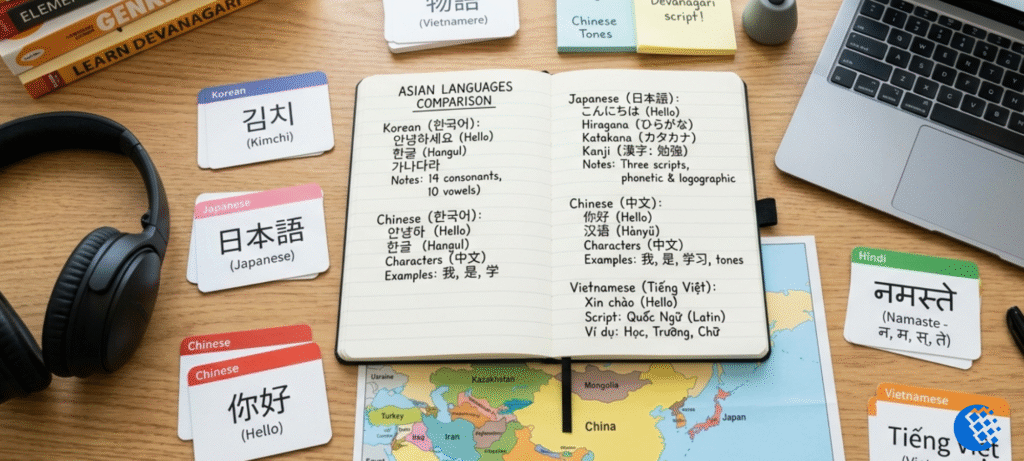
Anime gets a lot of people curious about Japanese. K-dramas do the same thing for Korean. Fair enough – passion is a decent starting point. But excitement alone doesn’t make a language’s grammar any simpler.
So what is the easiest Asian language to learn, really? It comes down to a few concrete things. The alphabet you’re reading. How the grammar behaves. Whether tones mess with your pronunciation. And, honestly, what language you already speak.
If English is your native tongue, Indonesian is the clear front-runner. You keep the Latin alphabet you already read every day. Words sound exactly how they’re spelled. And the grammar skips almost every hurdle that trips up beginners elsewhere — no verb conjugation, no gendered nouns, zero tones. Malay sits right beside it for nearly identical reasons.
Of course, “easy” is relative. If you already read Chinese characters, Japanese kanji won’t feel nearly as overwhelming. If you speak Spanish, Tagalog will feel oddly familiar thanks to hundreds of shared loanwords. Curious how language difficulty gets measured across different families in general? Is English One of the Hardest Languages to Learn is worth a look — it covers the same core factors from the other direction.
What Is the Easiest Asian Language to Learn?
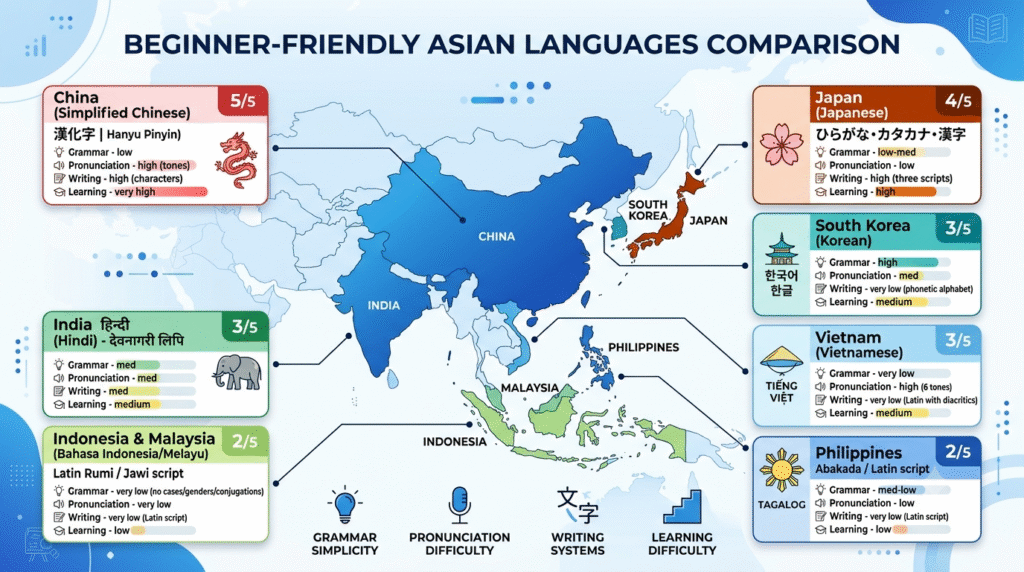
Quick answer first, for anyone in a hurry. Indonesian (Bahasa Indonesia) is widely considered the easiest Asian language for native English speakers. Latin alphabet. Phonetic spelling. No verb conjugation, no noun gender, no tones. Malay is a close second, sharing most of that same structure.
Here’s how the usual suspects actually compare once you get past the headline answer.
Indonesian feels built for beginners. Say a word the way it’s spelled, and you’re right. Past tense? You just add a word like “sudah” — no conjugation table required. Plurals are simple too; say the word twice, like “buku buku” for books. Most people reach basic conversation within a couple of months of steady effort.
Malay overlaps with Indonesian so heavily that a lot of courses teach them together. The vocabulary drifts apart the deeper you go, but learn one and you’re most of the way toward understanding the other.
Tagalog (Filipino) catches people off guard. Latin alphabet, no shifting verb tenses, and thousands of words borrowed straight from Spanish and English — “mesa” for table, “kompyuter” for computer. The verb-focus system takes a minute to wrap your head around, but vocabulary sticks fast.
Korean has a bit of a split personality. Hangul, the alphabet, was designed in the 1440s specifically to be learned quickly. Most people can read it within days. Speaking fluently is a longer road — Korean flips the sentence order compared to English, and honorifics add real complexity once conversations get past the basics.
Vietnamese also uses the Latin alphabet, which already puts it ahead of Mandarin for comfort level. The catch is six tonal pitches. Same syllable, six different meanings, depending on pitch. Grammar, though, stays refreshingly simple — no conjugation, no gender, no plural fuss.
Hindi runs on Devanagari script. It looks intimidating at first, but it’s phonetic and genuinely logical once you sit with it a couple of weeks. Sentence structure is more forgiving than most East Asian languages, though there’s still a brand-new script to learn before anything else clicks.
| Language | Writing System | Grammar | Pronunciation | Beginner-Friendly? |
|---|---|---|---|---|
| Indonesian | Latin alphabet | Very simple | Phonetic, no tones | Yes — top pick |
| Malay | Latin alphabet | Very simple | Phonetic, no tones | Yes |
| Tagalog | Latin alphabet | Moderate (verb focus) | Straightforward | Yes |
| Korean | Hangul (unique) | Moderate–complex | No tones, new sounds | Reading yes, fluency slower |
| Vietnamese | Latin alphabet | Simple | Six tones | Moderate |
| Hindi | Devanagari script | Moderate | Phonetic | Moderate |
What Actually Makes a Language Easy?
Worth naming this before going further. The Foreign Service Institute — the group that trains U.S. diplomats — has ranked language difficulty for decades based on how long English speakers typically need to reach working proficiency. Not gospel, but genuinely useful.
A few things keep showing up.
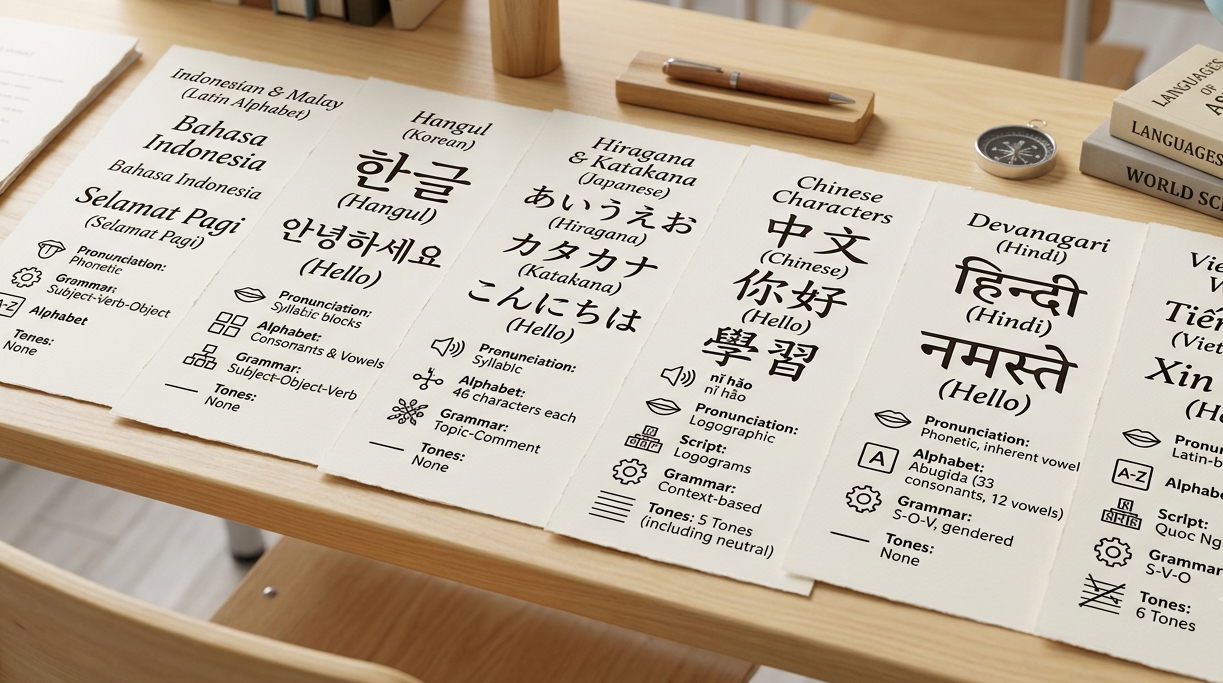
The writing system matters more than most people expect. Latin-alphabet languages — Indonesian, Malay, Tagalog, Vietnamese — give you a head start, since you’re not learning to read from scratch. Character-based systems, or unique alphabets like Hangul, add a whole extra layer before you can even sound words out.
Grammar is next. Skip verb conjugation, noun gender, and tense systems, and you free up energy for vocabulary instead. Indonesian is the clearest example of this.
Pronunciation and tones trip up more people than almost anything else. Tonal languages — Mandarin, Vietnamese, Thai — force you to retrain your ear in a way non-tonal languages simply don’t.
And your native language shapes everything. Speak Spanish? Tagalog gets easier. Read Chinese characters already? Japanese kanji feels less alien. There’s no single universal “easiest.” There’s an easiest for you — which is really the honest answer to what is the easiest Asian language to learn once you strip away the generic listicle rankings.
What Is the Easiest East Asian Language to Learn?
This one comes up a lot, since Chinese, Japanese, and Korean dominate most people’s mental picture of “Asian languages,” even though Southeast and South Asia have plenty of their own contenders. Among the three, Korean usually wins. Mostly because of Hangul.
Mandarin asks you to memorize thousands of individual characters. Japanese stacks three writing systems on top of each other — hiragana, katakana, kanji. Korean’s alphabet, by contrast, is logical enough that most learners read basic words within a week. The grammar still takes real work — sentence order, honorifics, verb endings that shift with formality — but you’re not fighting the writing system and the grammar at the same time. That difference matters more than people assume.
Mandarin’s grammar, oddly, is one of the easier parts. No conjugation, no tense markers, no plurals. What makes it hard is everything else — four tones that completely change meaning, plus a character system that takes years, not months, to read comfortably. Japanese sits somewhere in the middle: manageable grammar, layered writing system.
If your goal is building vocabulary that reinforces itself as you go, the same layering principle applies whether you’re tackling Korean particles or something like AP Spanish Language Vocabulary. Build blocks onto blocks. It works across language families more than people expect.
For a difficulty benchmark, the Foreign Service Institute’s language categories place Korean, Japanese, and Mandarin in the hardest tier for English speakers — around 88 weeks to reach proficiency, versus roughly 24 weeks for Indonesian or Malay. That gap alone explains why Southeast Asian languages dominate most “easiest” lists.
Which Asian Language Should You Actually Learn?
Difficulty rankings only get you so far. What you’re trying to do with the language matters more.
Planning travel through Southeast Asia? Indonesian or Malay covers huge ground for relatively little effort, since the two overlap so much. Chasing a business or career goal? Mandarin’s difficulty is offset by its economic reach — worth the longer road if that’s genuinely the plan. Drawn in by K-dramas or anime? Korean or Japanese will feel more rewarding day to day, even with a steeper curve, because your motivation stays fed by content you already enjoy. Chasing heritage or family connection? The easiest language is whichever one gets you closer to the people you’re trying to reach. Difficulty becomes secondary at that point — proof that the easiest Asian language to learn online or offline still depends more on your “why” than on any ranking.
How Long Does It Actually Take?
| Language | Basic Conversation | Intermediate Fluency | Working Proficiency (FSI) |
|---|---|---|---|
| Indonesian | 2–3 months | 6–9 months | ~24 weeks |
| Malay | 2–3 months | 6–9 months | ~24 weeks |
| Tagalog | 3–4 months | 8–10 months | ~36 weeks |
| Korean | 4–6 months | 12–18 months | ~88 weeks |
| Vietnamese | 4–6 months | 12–16 months | ~48 weeks |
| Mandarin | 6–9 months | 18–24 months | ~88 weeks |
| Japanese | 6–9 months | 18–24 months | ~88 weeks |
These numbers assume near-daily practice, not a few flashcards whenever you remember the app exists. Someone studying an hour a day moves noticeably faster than someone squeezing in ten distracted minutes. Obvious, maybe. Still trips up more learners than the language itself does.
Mistakes Beginners Make Picking a Language
Choosing a language purely because it’s trendy is probably the most common one. People start Korean because of a show they liked, then lose steam once honorifics get complicated and the initial spark fades.
Skipping pronunciation early is another. Tempting to rush into vocabulary lists, sure — but bad habits formed in week one are brutal to unlearn by month six.
Learning words in isolation instead of context backfires too. Vocabulary sticks better attached to a sentence you’d actually say, not floating alone on a flashcard.
And expecting fluency in a couple of months — especially with Mandarin or Japanese — just sets people up for discouragement that has nothing to do with their ability and everything to do with an unrealistic timeline.
Best Resources for Learning an Asian Language
Apps like Duolingo, Babbel, and Memrise are fine for early vocabulary and keeping a daily streak alive, though they rarely get you to real conversation on their own. Pimsleur’s audio courses help with pronunciation, especially for tonal languages where your ear needs training as much as your memory. LingQ leans on real content — articles, short stories — which builds vocabulary faster than isolated flashcards once you’re past the basics.
Don’t skip physical books and structured courses, either. A surprising number of people forget the resources sitting in plain sight. University language departments loan out textbooks and workbooks nobody thinks to check anymore. If it’s been a while since you walked into one, Importance of a Library makes a solid case for why that old-fashioned resource still beats a phone full of apps, especially for structured grammar study.
Frequently Asked Questions
What is the easiest Asian language to learn for English speakers?
Indonesian, generally, with Malay close behind. Both use the Latin alphabet, phonetic spelling, and skip tones, verb conjugation, and grammatical gender entirely.
Is Korean easier than Japanese?
Reading-wise, yes. Hangul is far faster to pick up than Japanese’s three writing systems. Grammar difficulty between the two is roughly comparable.
Is Mandarin harder than Japanese?
Both usually land in the same FSI difficulty tier. Mandarin’s grammar is simpler, but tones and character memorization make fluency a long haul either way.
Which Asian language is best for travel?
Indonesian or Malay, if Southeast Asia is the destination. The overlap between the two covers a lot of ground for relatively little study time.
Is Indonesian easier than Spanish?
For English speakers, Indonesian’s grammar is arguably simpler in places — no conjugation, for one — though Spanish benefits from more shared vocabulary with English.
Which Asian language has the simplest grammar?
Indonesian and Malay both rank near the top. No conjugation, no gender, straightforward sentence order.
Can adults learn an Asian language from scratch?
Yes. Children pick up native accents more easily, but adults are generally faster at understanding grammar structures logically. Consistent daily practice is what actually determines success.
What is the easiest East Asian language to learn?
Korean wins in East Asia because Hangul is quick and logical to learn, giving you a smooth starting point compared to Chinese or Japanese character systems.
Final Thoughts
Deciding what is the easiest asian language to learn ultimately comes down to your personal background, your daily habits, and why you want to learn in the first place. High motivation will always take you further than picking a language strictly because a difficulty list says it’s easy.
For most English speakers starting from zero, Indonesian and Malay offer the smoothest entry points, with Korean and Tagalog offering great alternatives depending on your exact goals. If you want a broader academic framework to track your own progress once you’ve picked a language, the CEFR (Common European Framework of Reference for Languages) is a solid standard to measure against.
Pick the option that aligns with what you want to achieve, build a simple daily routine, stay consistent, and the initial difficulty ranking won’t matter nearly as much six months down the line.