

How Many Scholarships for D1 Baseball?
Thirty-four. That’s the number most people are searching for when they type in how many scholarships for d1 baseball, and it’s the current cap under the new roster-based model. But that single number hides more than it explains.
The old system used to work differently. Coaches split 11.7 scholarships across a roster of 27 or more players, so full rides were basically a rumor for most families. The new rule removes that ceiling and lets a program fund every rostered player if it wants to. The catch, and there’s always a catch, is that “wants to” runs straight into “can afford to.” Families asking how many full scholarships for D1 baseball actually get funded usually get the same answer: it depends entirely on the school.
Here’s where it helps to see how this plays out in a related sport too. Families comparing options often end up reading Can You Get a Scholarship for Basketball?, since the aid-stacking approach carries over pretty closely from one sport to the next.
Division I baseball programs can now award scholarships to all 34 players on their roster, replacing the old 11.7 scholarship limit. Schools aren’t required to fully fund every scholarship, though, so real-world awards still swing widely depending on a program’s budget.
Quick Facts
- Maximum roster: 34 players
- Up to 34 scholarships available, if fully funded
- Full rides: possible, but still uncommon
- Partial scholarships: the most common outcome
- Academic aid: can usually be combined with athletic aid
- Scholarships: typically renewed on a year-to-year basis
D1 Baseball Scholarships at a Glance
| Rule | Current Status |
|---|---|
| Roster limit | 34 players |
| Scholarship limit | Up to 34 funded spots |
| Full rides | Possible, still limited |
| Partial scholarships | Still the norm |
| Academic aid stacking | Yes |
| Need-based aid stacking | Yes |
Key Takeaway: The NCAA now allows Division I baseball programs to fund up to 34 scholarships, but each school decides how much of that it actually pays for. Always ask a coach how the program funds its roster before comparing offers side by side.
How Many D1 Baseball Scholarships Per Team, Really?
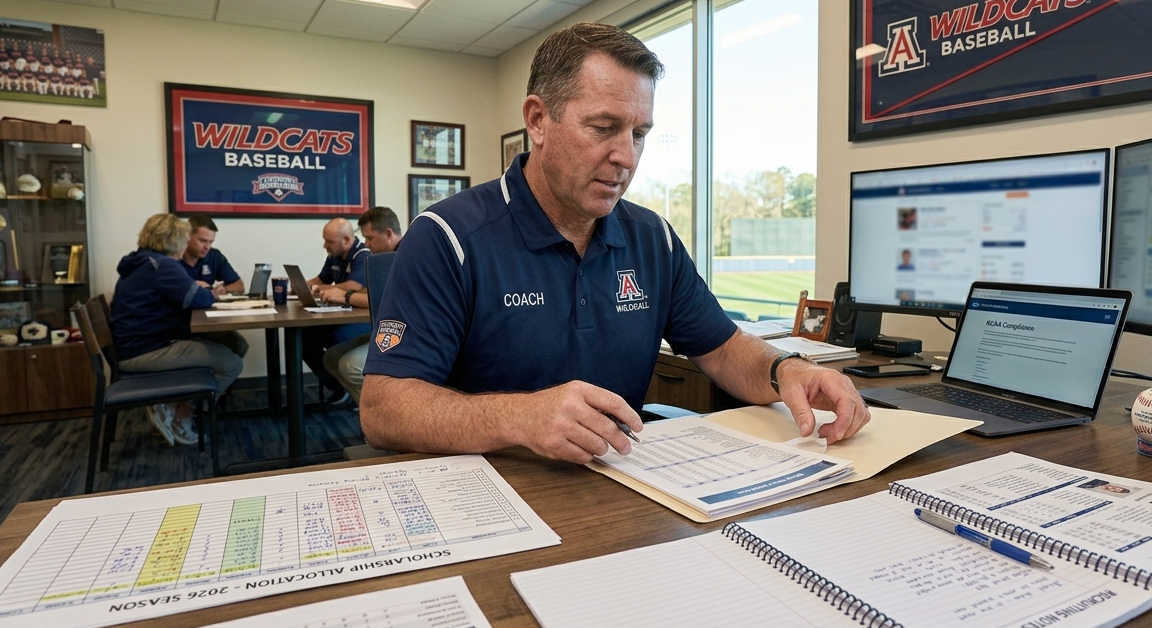
Every D1 program is capped at 34 roster spots now, and coaches can spread scholarship money across the entire group instead of a smaller slice of it. That part’s straightforward.
What isn’t straightforward is funding. A program with strong revenue-sharing resources might come close to fully funding all 34 spots. A program in the same conference, working with a tighter athletic budget, might still be stretching a modest pool of money thin. So when someone asks how many baseball scholarships in D1 a particular school hands out, the honest answer depends on that school’s checkbook, not the NCAA rulebook.
Many recruiting families assume that a partial scholarship means a player isn’t a priority. In practice, coaches often distribute available funding across the roster to balance depth at every position, so partial awards are common even for key contributors, not just bench players filling out numbers.
Which Schools Can Actually Offer 34 Scholarships?
Here’s where things get uneven. Schools that opted into the revenue-sharing framework from the House v. NCAA settlement gained access to the full 34-scholarship model. Programs that opted out stay under the older 11.7 cap, though they’re not bound by the new 34-player roster limit either.
Power conference programs, generally, have deeper pockets and lean toward funding a larger share of the roster. Smaller or mid-major programs may technically be allowed to offer more scholarships under the new rules and still not have the budget to actually do it. Worth asking directly, honestly: has this program opted into the new model, or not?
How D1 Baseball Scholarships Actually Work
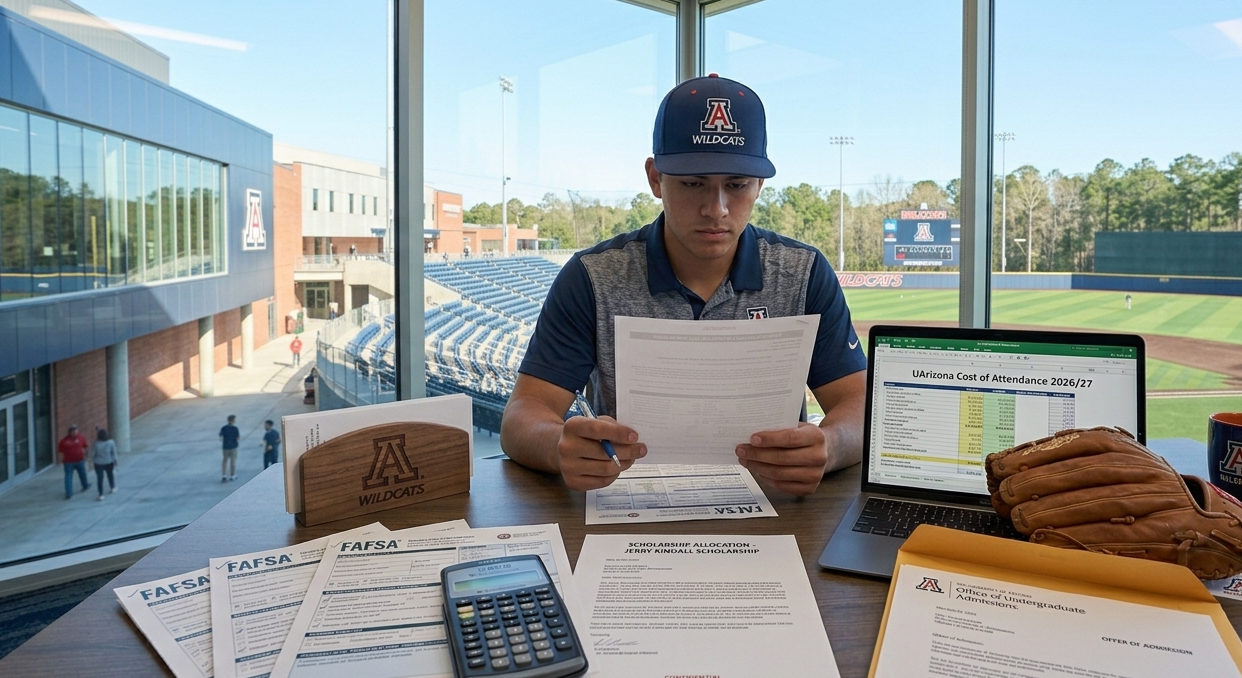
Most families are surprised the first time an offer arrives. It’s rarely one clean number. It’s usually a blend — some athletic money, maybe an academic award, sometimes a bit of need-based aid layered on top.
Think of athletic aid as the coach’s piece of the puzzle. Academic aid comes from a completely different office, and the two often work together without either side fully coordinating on their own. A player with strong grades can sometimes stack an academic scholarship on top of a partial athletic one, and that combination ends up covering more of the real cost of attendance than the athletic number by itself would suggest.
This pattern isn’t unique to baseball, either. Families researching How to Get a Volleyball Scholarship run into a nearly identical mix of athletic, academic, and need-based aid shaping the final offer.
Don’t assume the athletic department and the financial aid office are talking to each other automatically. Sometimes they are. Often, a family has to connect those dots themselves.
Are D1 Baseball Scholarships Guaranteed Every Year?
Short answer: not automatically. Athletic scholarships are typically renewed one year at a time, not locked in for four years straight.
Does that mean scholarships get pulled all the time? Not really. Coaching staffs review awards annually, and performance, roster needs, and coaching changes can all factor into whether an amount stays flat, goes up, or gets trimmed. NCAA policy requires written notice before a reduction or non-renewal, so it’s not something that happens quietly in the background.
Why Athletic and Academic Scholarships Aren’t the Same Thing
These two get lumped together constantly, and they really shouldn’t be. An athletic scholarship comes from the coaching staff, tied to roster needs and recruiting evaluation, and it counts against the team’s scholarship limit. An academic scholarship comes through admissions or the financial aid office, based on GPA and test scores, and it has nothing to do with a coach’s budget.
That distinction matters more than it sounds. A strong academic profile can add real value to a scholarship package no matter what’s happening on the field that season.
Can You Get a Full Ride for D1 Baseball?
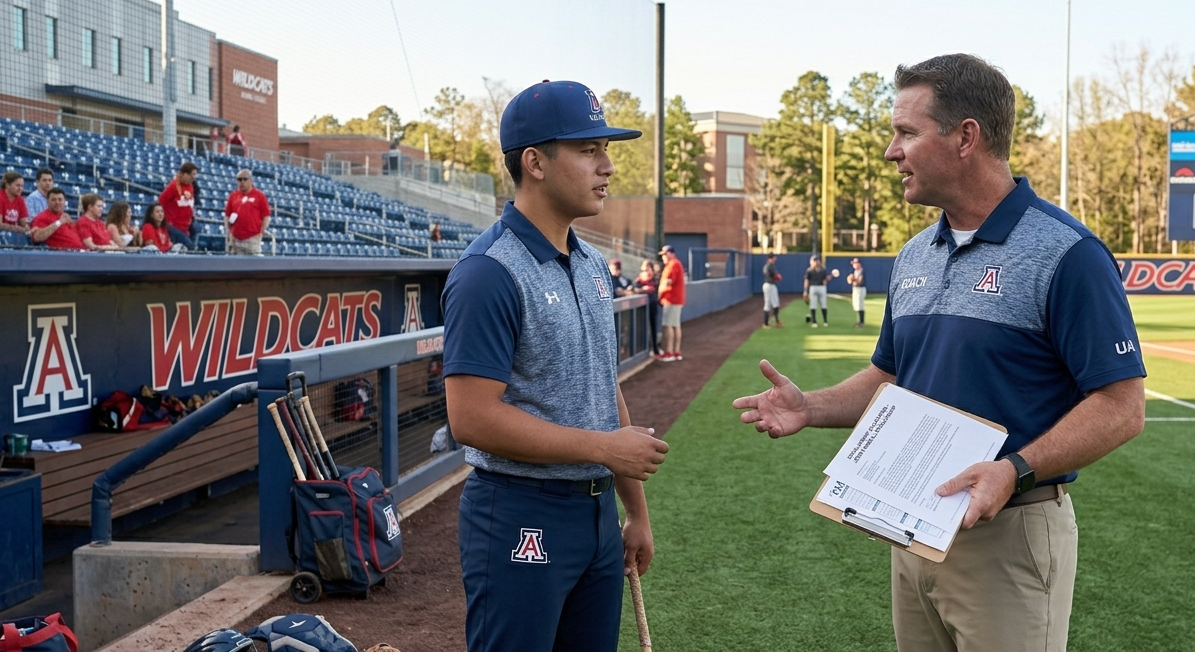
Yes. More of them exist now than two years ago. But full rides are still reserved for a small slice of recruits — the ones a program genuinely views as difference-makers, whether that’s a top-of-the-rotation arm, a middle-of-the-order bat, or a catcher a staff considers close to irreplaceable.
Imagine a coach has a budget that can fully fund only 18 players out of 34. Rather than spreading that thin across the whole roster, the staff might award full rides to two or three elite arms while combining partial athletic aid with academic scholarships for the rest of the class. That’s a much more realistic picture than assuming every spot gets treated the same.
Most rostered D1 players are still working with partial scholarships. Not because the program undervalues them. Baseball has always operated this way, since coaches have to stretch limited money across a large roster built to survive a long season and inevitable attrition.
Which Players Usually Receive the Largest Baseball Scholarships?
Not every position gets treated equally when scholarship money is handed out. Elite pitchers, especially those who can start, tend to sit near the top of a coaching staff’s priority list, since a program’s ceiling is often tied directly to its rotation depth. Catchers are another group that often draws bigger offers, largely because the position is hard to recruit and even harder to develop quickly.
Power hitters who can drive in runs consistently also tend to command stronger packages, along with multi-position athletes who give a coach flexibility to fill gaps across the roster. None of this is guaranteed, and plenty of everyday contributors at less “premium” positions still land solid partial scholarships. But if you’re wondering why one recruit’s offer looks bigger than another’s despite similar stats, position scarcity is usually part of the answer.
D1 vs D2 vs D3 Baseball Scholarships
| Division | Scholarship Rules |
|---|---|
| D1 | Up to 34 scholarships, subject to school funding |
| D2 | Lower scholarship limits under a different equivalency model |
| D3 | No athletic scholarships; aid comes through academic and need-based sources |
This is worth keeping in mind if you’re only evaluating D1 programs. Plenty of families end up with a stronger overall aid package at a D2 or D3 school once academic scholarships and need-based aid enter the picture, even without an athletic scholarship attached.
Just How Hard Is It to Earn a D1 Baseball Scholarship?
Harder than most families expect, honestly. Baseball recruits from a huge pool of high school players, and only a small percentage of them ultimately compete at the Division I level, which is part of why athletic scholarships stay this competitive year after year.
Coaches are looking at exit velocity, arm strength, pitch command — the obvious stuff. But makeup and coachability matter just as much, sometimes more. Every coach has a slightly different recruiting philosophy too. Some prioritize raw tools. Others lean toward projectable athletes or academic fit, especially at programs where roster spots are limited by budget rather than talent.
Timing plays a role as well. Coaches often build their recruiting boards a full year or two ahead of a signing period, which means the conversations that lead to an offer usually start well before senior year.
Questions to Ask Every Coach
- Does your program fund all 34 scholarships, or a smaller number?
- Is academic aid stackable with athletic aid here?
- How often are scholarships reviewed or renewed?
- How many players on the current roster receive full scholarships?
- What typically happens to scholarship commitments after a coaching change?
How to Improve Your Chances
Grades matter more than most recruits expect. A strong GPA opens the door to academic aid that effectively supplements a partial athletic scholarship, and it widens which schools are realistically in play.
Showcases help, but quality of competition counts more than how many events a kid attends. Direct, personalized emails to coaches tend to land better than mass-blasted recruiting profiles. And registering early with the NCAA Eligibility Center avoids last-minute eligibility headaches once an offer is actually on the table.
Common Myths, Cleared Up
Not everyone on a D1 roster gets a full scholarship. That one’s not close to true, even under the new rules. Scouts and coaches don’t only watch marquee showcases either — plenty of legitimate offers trace back to game film, summer league performance, or a coach’s personal recruiting network. And national player rankings help visibility. They don’t guarantee an offer on their own.
Frequently Asked Questions
How many scholarships for D1 baseball are there per team?
Up to 34 under the current roster-based model, though actual funding depends on each school’s budget and revenue-sharing status.
How many D1 baseball scholarships per team are typically fully funded?
Very few programs fund all 34 at full value. Most split available money across a wider group with a mix of partial awards.
How many scholarships are available for D1 baseball at smaller programs?
Often fewer than 34 in practice, even though the rule allows it, since smaller programs typically work with tighter athletic budgets.
Can every player on a D1 roster get a full scholarship?
No. Full rides remain limited to a small number of standout recruits per class.
Do walk-ons ever earn scholarships later?
Yes, fairly often, once a coach sees a walk-on perform and has scholarship money freed up from a graduating class.
Can academic and athletic scholarships be combined?
Yes. This stacking approach is one of the more practical ways families cover the real cost of attendance.
Are D1 baseball scholarships guaranteed for four years?
No. They’re typically renewed year to year based on roster needs, performance, and coaching decisions.
What happens if a coach leaves the program?
Existing scholarship commitments are usually honored, though a coaching change can affect future roster planning and available funding.
Can international students receive D1 baseball scholarships?
Yes, though eligibility and visa requirements add extra steps to the process.
Do injured players keep their scholarships?
In most cases, yes, though it can vary by program and depends on the specifics of the injury.
What GPA do D1 baseball coaches typically prefer?
There’s no universal number, but a strong GPA improves both admissions odds and access to academic aid on top of athletic money.
The Bottom Line
The rulebook says 34 scholarships per D1 baseball team. That part’s simple enough. What isn’t simple is that two programs following the exact same NCAA baseball scholarship rules can offer completely different packages, because the rule sets a ceiling and each school’s budget decides how close it gets to that ceiling.
For the official word on eligibility, amateurism, and recruiting timelines, the NCAA’s own guidelines remain the most reliable place to check before assuming a specific figure applies to your situation, since individual program budgets shift from year to year.
If the financial aid side of the equation still feels confusing, the U.S. Department of Education’s student aid resources are worth a look too, since athletic scholarships are only one piece of what actually ends up covering the bill. Bottom line: how many scholarships for D1 baseball a family can count on depends far less on the rulebook than it does on the school writing the check.