You’ve probably heard some version of the myth that German is an absolute nightmare of a language to pick up. People love to point out the massive, terrifying words and the complicated grammar layouts. But the reality isn’t nearly that grim.
The first thing you’ll notice is how many German words already look like typos of English ones. That’s because the two languages share a massive historical foundation. Sure, you’re going to hit some weird speed bumps with sentence structures and grammar cases down the road. But if you are sitting down and wondering is german easy to learn for an english speaker, the short answer is that you already have a massive head start. It’s just about knowing where the easy parts end and the real work begins.
The Short Answer: Yes, German is moderately easy to learn for an English speaker. The U.S. Foreign Service Institute (FSI) flags it as a Category II language, meaning it takes about 750 to 900 classroom hours to reach professional proficiency. That makes it slightly tougher than a language like Spanish, but vastly easier than Arabic or Mandarin. Since English and German share the same West Germanic roots, thousands of vocabulary words are practically identical, though mastering the shifting sentence cases and three noun genders requires genuine, consistent practice.
Why German Is Easier for English Speakers
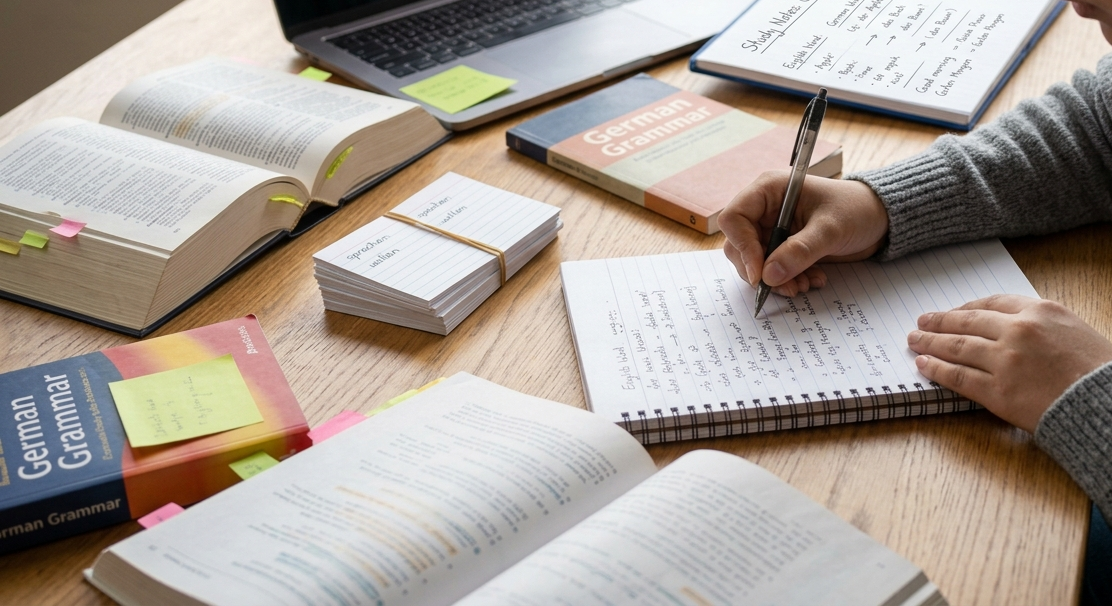
Most absolute beginners are incredibly surprised by how intuitive their first couple of lessons feel. You aren’t opening up a textbook to find an entirely new character script like you would with Japanese, Arabic, or Russian.
Instead, you’re walking into a language family that you technically already belong to. Because English evolved from the same linguistic roots as German, you’ll constantly run into structural setups that click instantly. If you look at global language metrics on the Ethnologue Insights Hub, you can see exactly how closely related these linguistic trees really are.
                  ┌────────────────────────────────────────┐
                  │        WEST GERMANIC LANGUAGE          │
                  └───────────────────┬────────────────────┘
                                      │
             ┌────────────────────────┴────────────────────────┐
             ▼                                                 ▼
          ENGLISH                                           GERMAN
   • 40% Vocabulary Overlap                          • Highly Phonetic & Logical
   • Shared Latin Alphabet                           • Predictable Sound Rules
   • Thousands of Direct Cognates                    • Structural Foundations
1. Shared Vocabulary (Thousands of Cognates)
Think about how much vocabulary you have to memorize when picking up a new language. With German, about 40% of the core words look or sound like what you use every day. Linguists call these pairs cognates.
When you see words like Haus, Wasser, or Freund, your brain doesn’t even need to consult a dictionary to figure out they mean house, water, and friend. You’ll literally be able to scan basic written passages during your first week and guess the general context without any formal training.
2. The Exact Same Alphabet
You get to use the exact same 26 letters you’ve been typing your entire life. There are no new alphabets to struggle through. German just adds a tiny handful of modifiers: the three umlaut vowels (ä, ö, ü) and that funky double-S character (ß). Once a teacher shows you the quick mouth shapes for those four symbols, you’re completely set to read.
3. Predictable Pronunciation and Logical Spelling
Compared with English, German pronunciation usually feels much more predictable once you’ve learned the basic rules. Think about how annoying English can be—words like “cough,” “through,” and “bough” look identical but sound entirely different. If you’ve ever looked into our own linguistic history, you might ask yourself: Is English One of the Hardest Languages to Learn? Because of our chaotic spelling rules, the answer is often a resounding yes.
German doesn’t play those games. It is an intensely logical, phonetic language. If you memorize that ei sounds like the “i” in “bite” and ie sounds like the “e” in “see,” you will be able to look at almost any word on a page and pronounce it correctly out loud on your very first try.
What Makes German Difficult?
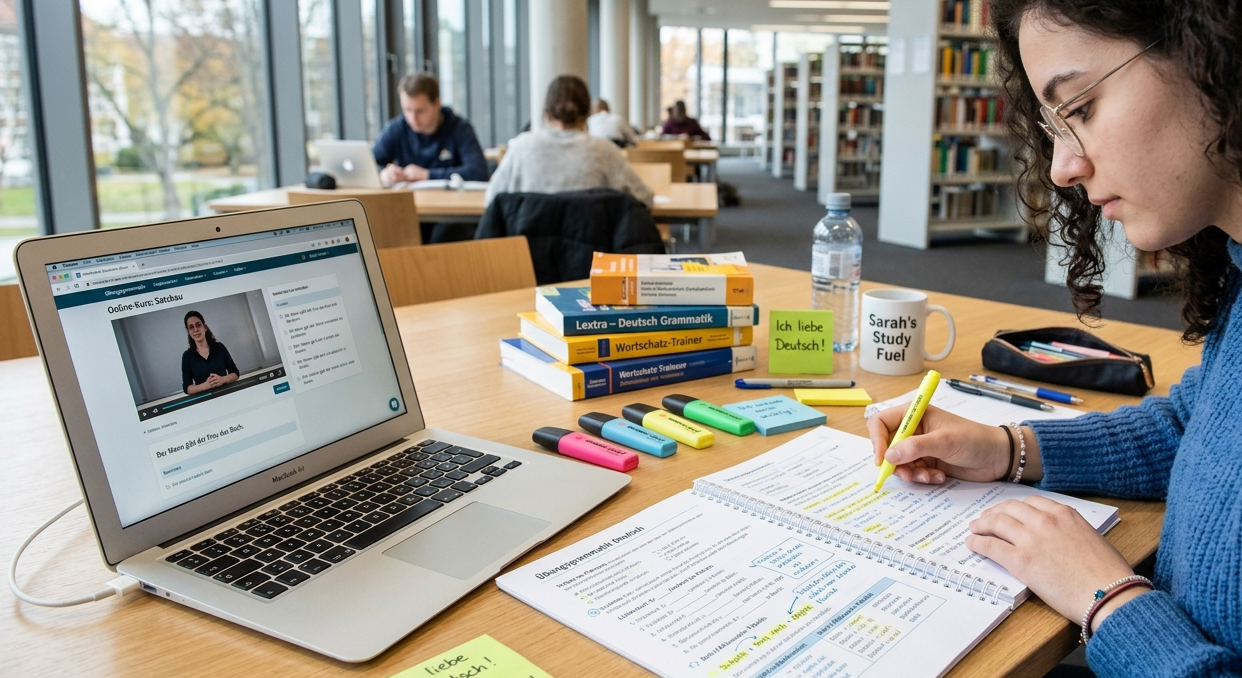
Let’s be completely honest, though: it isn’t all a walk in the park. If it were completely effortless, everyone would be walking around speaking fluent conversational German. When people ask how easy is german to learn for an english speaker, the honest response always shifts the moment you move past simple vocab and start building full, complex thoughts.
Here is where things get a bit tricky for native English minds.
1. The Four Grammatical Cases
Modern English lets you determine who is doing what based entirely on where the words sit in a sentence. German doesn’t do that. It uses a rigid case system that changes word endings depending on their specific role.
- Nominative: This is just the subject executing the action.
- Accusative: The direct object sitting there receiving the action.
- Dative: The indirect object that benefits from whatever is happening.
- Genitive: A specific formal structure used to show possession.
Because of these four setups, the word for “the” changes constantly. Der can turn into den or dem based on the sentence’s internal math. It takes some serious time and mental rewiring to get used to tracking this while speaking.
2. Three Noun Genders
Most learners eventually stop asking why a table is masculine and simply memorize the article. It sounds frustrating at first, but after a while it becomes part of the learning process. German assigns an active gender to every single noun in existence. You have masculine (der), feminine (die), and neuter (das).
A wooden table (der Tisch) is masculine, a room door (die Tür) is feminine, and a vehicle (das Auto) is neuter. The best piece of advice you’ll ever get is to stop looking for a pattern. Just memorize the article as if it’s part of the word’s actual spelling from day one.
3. Intimidating Compound Words
The first time you see a word like Rechtsschutzversicherungsgesellschaften, it’s easy to think you’ve made a terrible decision. Then someone breaks it into smaller pieces and suddenly it doesn’t look nearly as impossible.
German doesn’t like using spaces when creating a complex term—it just snaps smaller, basic concepts together into one giant train. Break that massive monster down into pieces and it literally just translates to “legal protection insurance companies.” Once you know how to decode them, they become fun rather than terrifying.
How Long Does It Take to Learn German?
According to the U.S. Foreign Service Institute, English speakers generally need around 750 to 900 classroom hours to reach professional working proficiency in German. That is a bit more time than you’d spend on Spanish, but considerably less than languages like Arabic, Chinese, or Japanese.
How study time translates to real-world fluency:
  • Casual App Sessions (15 mins/day) → Travel basics in a year or two.
  • Focused Learning (1 hr/day)       → Comfortable daily chats in 6–9 months.
  • Intensive Immersion (3+ hrs/day)  → High-level professional use in 5 months.
Your personal calendar completely depends on the quality of your daily study routine. If you just tap around on basic mobile games while watching TV, expect to spend a few years getting anywhere. But if you couple a structured curriculum like the Goethe-Institute paths with active conversation practice, you’ll find yourself handling everyday chat situations within about six months.
German vs. Other Popular Languages
Trying to figure out where German sits compared to other major global languages? This quick breakdown shows you exactly what you’re dealing with on the standard difficulty scale:
| Language | Difficulty for English Speakers | Major Advantages | Hidden Challenges |
| German | Moderate | Vocabulary overlap; logical pronunciation rules. | Grammatical cases; noun genders. |
| Spanish | Easier | Simple grammar; accessible media; no cases. | Fast speaking speeds; past tenses. |
| French | Moderate | Shared vocabulary via historical Norman French. | Tricky pronunciation; silent letters. |
| Dutch | Easiest | The closest major language to English structure. | Hard guttural sounds; native speakers switch to English. |
The old debate of whether French or German is easier comes down to what your brain prefers. French grammar can feel a little friendlier at the start, but its pronunciation rules are full of traps. German is the exact opposite. The grammar takes real patience, but the spelling and mouth movements follow clear, unbreaking laws. If you’re looking for a comparison points with other common options, check out our master list of the AP Spanish Language Vocabulary to see how root word tracking completely shifts between different European language branches.
German Words You Already Know
If you still need proof that is it easy for an english speaker to learn german, look at how many common nouns are basically identical. If you ignore the capitalization (German capitalizes every single noun, which is actually a massive help for reading tracking), you already know these:
- Hand → Hand
- Finger → Finger
- Winter → Winter
- Garten → Garden
- Haus → House
- Wasser → Water
- Buch → Book
- Apfel → Apple
Your very first week of reading simple stories will feel way more natural than you expect because your brain automatically fills in these blanks.
Common Mistakes English Speakers Make
Ask anyone who has actually gone through the process of learning German, and they will likely warn you about these exact same traps:
- Writing Down Nouns on Their Own: Never make a flashcard that just says Buch means book. If you leave out the gender, you’re setting yourself up to fail later. Always save it as das Buch.
- The Word-For-Word Translation Habit: German loves to kick verbs all the way to the absolute end of a sentence, especially when you are using helper verbs. Trying to force a German vocabulary into a standard English sentence shape will sound completely backwards to a native speaker.
- Freezing Up Over Cases: Plenty of beginners get so terrified of choosing the wrong modifier (dem versus den) that they completely lock up and stop talking. Don’t worry about being perfect. Native speakers will easily understand your context even if your word endings are messy.
- Hiding Inside a Textbook: Reading grammar charts won’t train your ears for the real world. You need to mix things up with authentic audio, native slang, and spoken practice early on.
Pro-Tips to Learn German Faster
- Color-Code Everything: When you create flashcards or notes, use bright colors to hack your visual memory for genders. Make masculine nouns blue, feminine ones red, and neuter ones green. It speeds up your memory recall dramatically.
- Jump Onto Spaced Repetition Tools: Download programs like Anki, Duolingo, or Babbel to build custom digital decks that test your brain right before a word starts slipping away.
- Ditch the Subtitles Gradually: Fire up your favorite shows on Netflix, flip the audio track over to German, and keep the text translation on. Eventually, switch the subtitles to German too so your eyes and ears connect the sounds directly.
- Start Conversing Immediately: Don’t tell yourself you’ll start speaking once you reach a certain level. Use platforms like Busuu or community exchange forums to talk to real humans immediately. Mistakes are just proof that you’re trying.
Is German Worth Learning?
Without a doubt. Beyond the personal achievement of speaking another language, it unlocks massive professional advantages. Germany is the dominant economic engine of Europe, making the language an incredible asset for careers in international business, tech, engineering, and global logistics.
On top of that, Germany’s public universities famously offer top-tier, tuition-free higher education to international students, provided you can pass their language entry tests. Whether your long-term plans focus on career growth, historical research, or European travel, putting in the hours to learn German pays massive dividends.
Frequently Asked Questions
Is german easy to learn for an english speaker?
It is highly accessible because both languages share deep branches on the West Germanic linguistic tree. This means you are working with an identical alphabet and thousands of shared words. The grammar rules require focus, but the massive amount of overlapping vocabulary makes it far more approachable for an English native than a language with zero shared history.
How easy is german to learn for an english speaker who has never studied a language?
First-time learners will find it to be a brilliant starting choice because it gives you a highly predictable, phonetic playground where things are spelled exactly how they sound. You won’t have to learn a brand new script, allowing you to focus your energy on learning how European grammar structures function.
Is it easy for an english speaker to learn german grammar?
This is easily the highest hurdle you’ll have to jump. Our modern English setup dropped complex noun endings a long time ago, whereas German kept its classic case system and its three distinct genders. Internalizing these patterns requires consistent drilling, which is why grammar is where most independent learners struggle.
Is German harder than Spanish for native English speakers?
Most language schools rank German as slightly more challenging than Spanish. Spanish features much simpler sentence structures, fewer past tense variations, and skips the case system entirely. That said, German pronunciation is much more logical and regular, meaning you’ll likely make fewer reading and spelling mistakes.
Can I become fluent in German in less than a year?
You can absolutely reach comfortable conversational fluency within a 6 to 12-month window. To make that happen, you have to look past casual vocabulary matching games and commit to an hour of daily focused practice that includes active speaking, real listening tracking, and interactive conversations.
Why do German words get so incredibly long?
The language uses a feature called compounding. Instead of using string phrases filled with extra prepositions to describe a complex concept, German writers simply link the individual nouns into a single, continuous word string. You can master these easily by breaking them down into their standalone pieces.
Conclusion
When you step back and look at the big picture, tracking down whether is it easy to learn german for an english speaker comes down to your personal study habits. The built-in vocabulary overlap, the familiar alphabet, and the absolute predictability of the pronunciation rules give you a massive structural advantage right out of the gate.
Grammar will take genuine patience, and memorizing noun genders is going to feel tedious at times. But those systems run on incredibly logical, repeating patterns. By building short, consistent daily habits, leaning on smart flashcard tools, and speaking out loud without worrying about mistakes, you’ll find that mastering the German language is entirely within your grasp.