

Got an NCCCO written test study guide open in one tab and an exam date circled on the calendar? Then you probably want to know where to start, and honestly, that’s the hardest part. I’ve seen plenty of candidates fail the crane operator written exam after weeks of reading. They weren’t lazy. They just began with the easy chapters, felt good about it, and hit the hard material with almost no time left.
So here’s the plan. First, what the exam actually asks. Second, the places where most people drop points. Third, a two-week schedule that doesn’t burn you out.
One thing before you dive in. NCCCO updates its handbooks now and then, and if you search Google today, you’ll find two different sets of Core exam numbers floating around. Use the numbers here as a rough guide only. Before you book anything, check the current candidate handbook on the official NCCCO website.
NCCCO Written Test Study Guide: The Quick Answer
Get the current candidate handbook and read the content outline for your exam. That’s step one. Then put most of your time into load charts and technical knowledge, because you can’t guess your way through those. Do timed practice questions, write down every miss and why you missed it, and take one full mock exam about two days before the real thing.
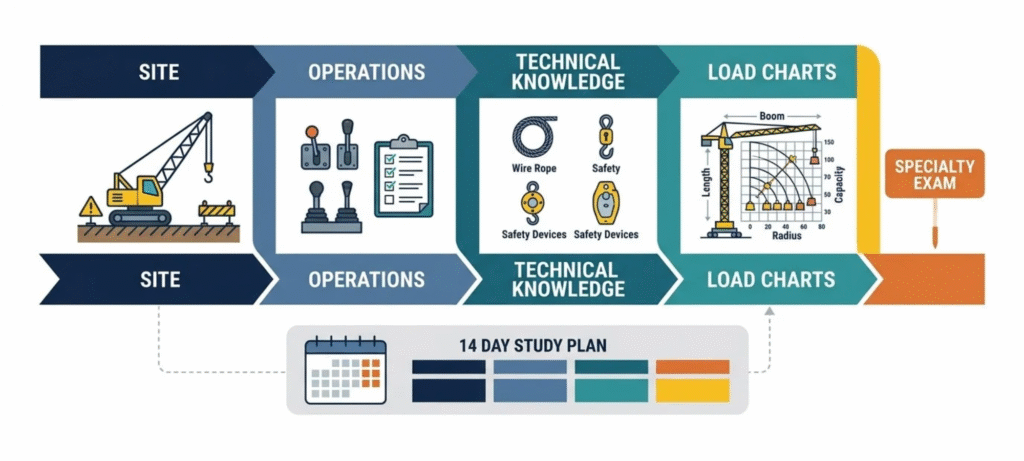
Most people do fine with two weeks of steady study. An hour or two a day is plenty.
What Is the NCCCO Written Test?
NCCCO is the National Commission for the Certification of Crane Operators. For mobile crane operator certification, you take a written exam and a practical exam. The written side has a Core exam, plus at least one specialty exam for the type of crane you run. That could be telescopic boom swing cab, telescopic boom fixed cab, or lattice boom.
The Core is the same for everyone. It covers the general knowledge any operator should have. The specialty exam is narrower. It’s about your machine: the controls, the setup, and the load charts that go with it. Pass both and you move on to the practical.
Some people treat the written test like a box to tick before the “real” hands-on exam. Big mistake. A lot of experienced operators get stuck here, and it’s usually on terminology or load charts, not on anything they do every day.
NCCCO Written Exam Structure
The recent mobile crane operator handbook lists the Core exam at 95 questions in 90 minutes. It also says no calculators. Older material, and plenty of study sites that are still floating around, say 90 questions. The weight of each section has shifted too. The table below shows the main areas. For the exact percentages, go by the handbook that matches your test date.
| Exam area | What it asks of you |
|---|---|
| Site | Reading the ground, the work area and the hazards around the crane |
| Operations | Safe operating practice, signals, inspections, special lifts |
| Technical Knowledge | Components, wire rope, hydraulics, operator aids |
| Load Charts | Capacity, radius, boom length, configuration, deductions |
| Specialty exam | Controls and charts specific to one crane type |
Passing is based on a scaled score, and most sources say 70. “Scaled” means it isn’t just the percentage you got right. So don’t bother working out how many questions you can afford to miss.
NCCCO Written Test Study Guide: Site Information
Site questions look easy until you read them. They usually describe a situation, like a crane set up next to an excavation, and ask what the operator should have checked first.
Ground Conditions and Stability
Honestly, most site questions come down to one thing: what’s under the crane? Voids, buried tanks, loose fill, slopes, depressions, a trench dug right next to the pad. All of these show up on the exam. Don’t just memorize the list, though. For each one, ask yourself why the ground can’t be trusted and who should fix it, the operator or the site controller. And remember that soft soil doesn’t care how good your crane is. A heavy machine can sink a few inches halfway through a lift, and by then it’s too late.
Mats, Blocking and Cribbing
Pads, mats and cribbing all do the same job. They give the load more ground to sit on. Simple. But sloppy blocking, say stacked unevenly or put in the wrong spot, can make things worse than having none. So when a question talks about soft ground, don’t pick “lift a lighter load.” Fix the support first. That’s almost always what they’re after.
Power-Line Hazards
Power lines pop up in a few different ways: setting up the crane, driving it around, or working near live lines. What you need to know is that there’s a minimum safe distance, and the higher the voltage, the more distance you need. The rules are in OSHA’s 29 CFR 1926 Subpart CC. In most study material the number you’ll see is 20 feet for lines up to 350 kV.
Also look at what to do if the crane actually touches a line. The usual guidance: stay in the cab if you can, warn everyone to keep away, and wait until the utility confirms the line is dead. Your employer’s procedure and your training come first here.
Site Access and Personnel Hazards
Think pinch and crush points around the counterweight, people standing inside the swing radius, and who’s responsible for the site. The controlling entity, the person running the lift and the operator all have their own duties. The exam likes to check whether you know whose duty is whose.
NCCCO Written Test Study Guide: Operations
Operations is where real-world experience helps most. But you still have to translate what you do on the job into the exam’s wording.
Crane Inspection
Know the difference between the checks done before a shift and the deeper periodic inspections. A question might describe a leaking hydraulic line or a damaged hoist rope and ask what happens next. Nearly all of these answers follow the same pattern. If a problem affects safe operation, the crane stops until someone evaluates it and fixes it.
Leveling and Radius
If the crane isn’t level, the radius changes under load and stability can drop. Review how leveling is checked. Also remember that you can’t just trust the load chart if the machine is out of level.
Load Weight and Center of Gravity
First, the weight. You need a number for it. If the real figure isn’t printed anywhere, you estimate. Next is the center of gravity. Put the hook anywhere other than directly over it and the load tips or swings the moment it leaves the ground. That’s the whole reason a lift gets unstable, and if you can say it plainly, you don’t need to memorize a rule for it.
Wire Rope and Reeving
Reeving is just how the rope gets threaded through the sheaves and blocks. Each part of line carries some of the load. Add parts and each one carries less, but the hook slows down. For inspection, open OSHA section 1926.1413. It has the discard rules and the broken wire counts. Don’t rely on someone’s summary of it, read the section. Kinking, crushing, corrosion and reduced diameter are fair game on the exam as well.
Signals
Think of signals as four groups: hand signals, voice or radio, audible ones like the horn, and what you do if somebody gives you a signal you don’t recognize. Hand signals stick better when you watch them than when you read about them. Emergency stop, for example, is both arms out, palms down, sweeping side to side. Exam writers like that one.
Special Operations
Competitor articles mostly skip these, so a little effort here goes a long way. The outline includes multi-crane lifts, personnel platforms, pick-and-carry work, barge-mounted cranes, multiple-drum operation and lifts below water. No one needs to be an expert in all of them. Know why each one needs extra planning and where it differs from a normal lift.
Operator Aids and Safety Devices You Should Know
These sit in the Technical Knowledge area, and a few are easy to mix up.
- Load moment indicator (LMI): shows how close the crane is to its rated capacity.
- Load moment limiter: goes a step further and stops crane functions that would add to the moment once the limit is hit.
- Anti-two-block device: warns of, or prevents, contact between the hook block and the boom tip.
- Boom angle and radius indicators: show the geometry that capacity depends on.
- Wind speed indicator, level indicator, horn, drum rotation indicator: each has a simple job, and you should be able to name it.
The exam also asks what happens when one of these aids stops working. Short answer: you don’t just carry on as normal. Alternate procedures from the manufacturer and the applicable rules kick in. Read that part of the outline closely.
Emergency Situations to Study
Take these emergencies one at a time: power-line contact, loss of stability, control malfunction, carrier or travel malfunction, two-blocking, overload, and fire. For every one, ask yourself three simple things. What do I do first? Who has to be warned right away? And what could make this situation worse?
Don’t bother memorizing some clever improvised fix. In an emergency, the best answer is almost always the safest and most cautious one, the one that sticks to the manufacturer’s instructions and the site rules.
NCCCO Load Charts: What You Need to Know
Load charts eat up the most study time for most people, and memorizing won’t help much here. You have to be able to use a chart you’ve never seen before.
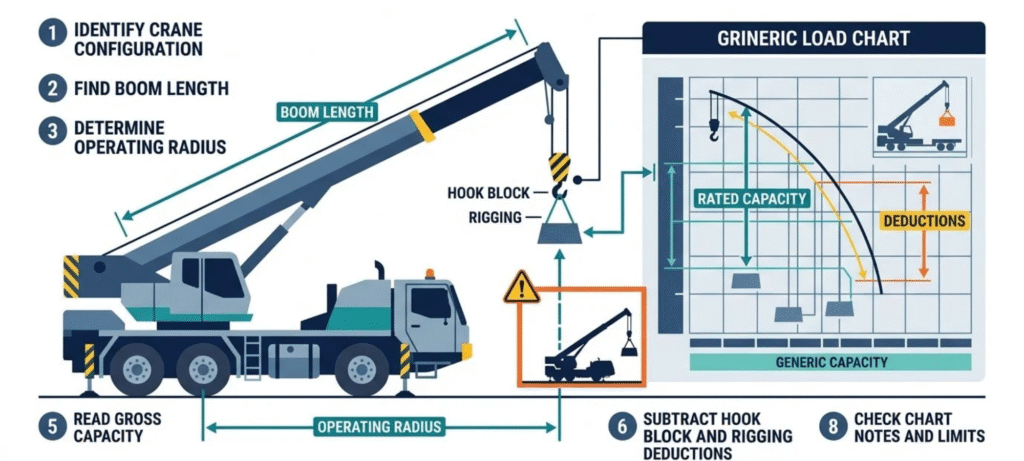
This sequence works for almost any chart:
- Identify the crane configuration: outriggers or tires, counterweight, boom type.
- Find the boom length you’re using.
- Work out the operating radius.
- Locate the correct chart or section for that configuration.
- Read the gross rated capacity.
- Subtract deductions such as the hook block, rigging and any attachments.
- Compare what’s left (the net capacity) with the weight of the load.
- Check the notes and limits printed on the chart.
If your radius lands between two numbers, use the larger radius. That gives the lower, safer capacity. If your boom length falls between two columns, same thinking.
It also helps to know why capacity drops as radius grows. The load is farther from the crane’s center of rotation, so the tipping effect gets bigger. Some chart values are limited by stability (the crane could tip) and others by structure (something could break). The exam may ask which one applies, so check how your charts mark them.
No calculators are allowed, so practice the subtraction and comparison by hand. If math under time pressure is your weak spot, the tips in this post on how to study for a math exam carry over nicely. One more thing: don’t invent universal formulas. Every manufacturer lays out its charts differently.
What Should You Memorize vs. What Should You Understand?
Some things you just have to know cold. Other things you have to be able to apply.
Memorize: the terminology, the standard hand signals, what each operator aid actually does, the wire rope vocabulary, and the main safety rules for working near power lines.
Understand: how radius and capacity are connected, how site conditions can change a lift, how to work through a load chart you’ve never seen before, and how to choose the safest response when an emergency hits.
Put all your study time into definitions and the load charts will probably catch you out. And if you’re around cranes every day, you may know the practical side well and still drop points on vocabulary or on situations you haven’t met before.
How Hard Is the NCCCO Written Test?few answers look right, and the clock.
People with field experience tend to find the operations questions familiar, but the load chart questions take longer than they expected. Those from a classroom or training background usually face the reverse. Charts come easily to them, yet they misjudge real site conditions.
So shape your study plan around the weaker side, not the one you enjoy.
How to Use NCCCO Practice Tests Properly
A practice test only pays off when you learn from the questions you got wrong. Don’t just watch the score. For every wrong answer, write down the reason and file it under one of three groups:
- You didn’t know the material.
- You knew it but misread the question.
- You understood the concept but slipped on the calculation.
Give it a week and a pattern will show. Mostly misreads? Slow down and underline the key words. Mostly calculation slips? Put in more chart drills. Mostly “didn’t know it”? Go back to the handbook outline.
A 14-Day NCCCO Study Plan
| Days | Focus |
|---|---|
| 1–2 | Read the handbook outline; study Site |
| 3–5 | Operations, including inspections and special lifts |
| 6–7 | Technical Knowledge: components, wire rope, hydraulics |
| 8–10 | Load charts, with timed drills and no calculator |
| 11 | Signals and operator aids |
| 12 | Emergency procedures |
| 13 | Full timed practice test |
| 14 | Review weak areas and rest |
Short on time? Squeeze Days 1–7 into three days, but don’t touch the load chart days. The idea behind a plan like this is the same one in this piece on a study schedule that balances structure and sanity. Short, regular sessions beat one exhausting weekend.
Where to Find NCCCO Study Materials
Start with the official candidate handbook, since it lists the knowledge areas the questions come from. After that, add your crane’s manufacturer charts and manuals, a good training course if you can get one, and original practice questions.
Watch out for sites offering “real NCCCO questions and answers” as a free PDF. A file like that can be outdated, unauthorized or just wrong, and studying wrong answers is worse than not studying. If you can check it against the handbook or the regulations, it’s safer.
NCCCO Written Test Practice Questions
These are original study examples. They are not actual NCCCO questions.
1. Picture a crane swinging its boom farther out from the center of rotation. What happens to its rated capacity?
A. It goes up
B. It goes down
C. It remains the same
D. It becomes unlimited
Answer: B. The farther out the load hangs, the more leverage it has against the crane, so the crane can safely lift less.
2. The radius you measured doesn’t match any single value on the load chart. It falls between two. Which value should you read from?
A. The smaller radius
B. An average of the two
C. The larger radius
D. Whichever one you prefer
Answer: C. A larger radius means a lower capacity. Reading from it keeps you on the safe side.
3. A crane has a gross capacity of 12,000 lb. The hook block and rigging together weigh 900 lb. What is the net capacity?
A. 12,900 lb
B. 11,100 lb
C. 10,500 lb
D. 12,000 lb
Answer: B. Anything the crane carries besides the load counts against it, so subtract 900 lb from 12,000 lb.
4. What is an anti-two-block device meant to protect against?
A. Overloading the outriggers
B. The hook block hitting the boom tip
C. Strong wind gusts
D. A drop in hydraulic pressure
Answer: B. Two-blocking can snap the hoist line and drop the load. This device warns the operator or stops the motion before the block reaches the tip.
5. Which type of loading is a boom least designed to handle?
A. Vertical
B. Side loading
C. Static
D. Rated
Answer: B. A boom is built for a load hanging straight below it, in line with the boom. Side pull can bend or damage it.
6. On which ground would you most clearly want extra support under the outriggers?
A. Dry, compacted gravel
B. Soft or loose fill
C. Level pavement
D. Gravel without voids
Answer: B. Soft ground can compress or shift under load, so cribbing or mats spread the weight over a larger area.
7. An operator watches a signal person extend both arms with palms down and move them from side to side. What does the signal mean?
A. Hoist
B. Swing
C. Emergency stop
D. Lower the boom
Answer: C. This signal means stop everything immediately.
8. Halfway through a shift, the load moment indicator stops working. What should the operator do?
A. Keep going and estimate the loads
B. Stop and follow the manufacturer’s alternate procedures
C. Only slow down the crane
D. Ignore it if the load looks light
Answer: B. The operator can’t judge capacity by eye. The manufacturer’s alternate procedures are the correct way to continue.
NCCCO Written Test Tips for Exam Day
Get there early, and bring the ID the testing center asks for. Read every question twice. The second read often changes your answer. Answer everything, since a blank can’t earn points. If a load chart question is eating your time, mark it and come back. Watch the clock, but don’t rush the ones you know.
Is the NCCCO Rigger Test the Same as the Crane Operator Test?
No. Crane operator certification and rigging qualifications are separate programs with different content, and passing one doesn’t cover the other. If you’re hunting for an NCCCO rigger written test study guide, you’ll need material built for the rigger level you’re going for. That means slings, hitches, load weight, inspection and signals, not the load charts and operating knowledge covered here. Check the handbook for the program you’re applying to.
FAQs
How many questions are on the NCCCO written test?
The recent mobile crane operator handbook lists 95 questions on the Core exam in 90 minutes. Older sources say 90, so check the handbook for your test date. Specialty exams are shorter.
What score do you need to pass?
Most sources say a scaled score of 70. Because the scoring is scaled, you can’t turn that into a fixed number of allowed misses.
How hard is the NCCCO test?
Moderately hard. Load charts, technical vocabulary and scenario questions cause the most trouble, and the time limit adds pressure.
Is a calculator allowed?
The recent handbook says no for the Core exam. Practice chart subtraction by hand, and double-check the policy before test day.
What should I study for NCCCO?
Site, Operations, Technical Knowledge and Load Charts for the Core, then the controls and charts for your specialty crane. An NCCCO written test study guide built around the official outline keeps you from wasting time on things that aren’t tested.
Where can I find an NCCCO study guide PDF?
The candidate handbook on the NCCCO website is the safest source. Be careful with unofficial PDFs that claim to include real questions.
Are there free NCCCO practice tests?
Some training providers and flashcard sites offer free sample questions. Treat them as practice only, and check anything doubtful against the handbook or the OSHA regulations.
Is the NCCCO rigger test the same as the crane operator test?
No. They’re separate programs with different content.
Final Thoughts
Good prep for the crane exam is more about order than volume. Read the official outline, give Site and Operations a solid pass, then spend your hardest hours on load charts and the technical material. Be honest when you log your mistakes, run one full timed mock exam, and double-check every figure against the current handbook. If you’re curious where this credential sits next to other lifting qualifications, this piece on overhead crane certification is a handy side read. Use this NCCCO written test study guide as your checklist for the next two weeks, and walk in knowing exactly what you’ve covered.