A teacher told me something last year that I still think about. She said the one guaranteed way to get a chaotic preschool classroom to go completely quiet is a riddle. Not music. Not clapping patterns. A riddle.
She stumbled on it by accident during a rough Tuesday. Room was loud, nothing was working, so she just leaned in and whispered — “I have four legs but I can’t walk. What am I?” The room stopped. Every single kid went still. Hands started shooting up within seconds.
Preschool riddles do that. They turn restless energy into focused thinking, and the kids don’t even notice the switch happening. They’re just trying to win. This collection has 50 of them across different formats — easy ones, rhyming ones, farm animals, food, funny jokes — so you can pick and choose based on the moment.
Quick Answers
What are preschool riddles?
Short questions with clues that point to a familiar object, animal, or food. Made for ages 3 to 5. Good ones help kids build vocabulary and listening skills without feeling like a lesson at all.
Why are riddles good for preschoolers?
Each clue has to stay in a child’s head while they process the next one. That’s working memory getting a workout. On top of that, riddles attach describing words to real things — which is exactly how young children grow their language.
What are the easiest riddles for preschoolers?
Start with animals, food, colors, and shapes. Kids already know these from breakfast, bedtime, and the backyard. Familiar ground makes it feel winnable.
Easy Preschool Riddles
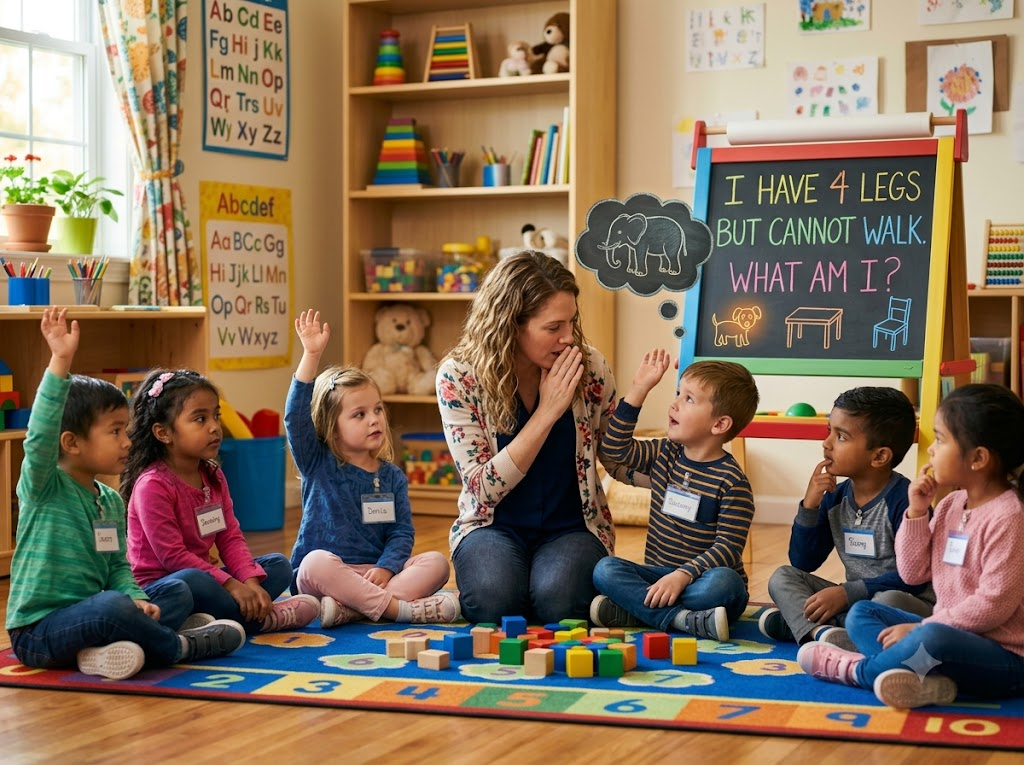
Good starting point if you’ve never tried riddles with a group before. Every answer here is something a child has seen, touched, or used that same week. That matters more than you’d think — kids light up when they actually know the answer.
Riddle: I have four wheels, a steering wheel, and your family drives me to the grocery store. What am I?
Answer: A car.
Riddle: I live in your house, I love to chase mice, and I say “meow” when I want attention. What am I?
Answer: A cat.
Riddle: I am big, round, and white, and I glow up in the dark sky every single night. What am I?
Answer: The moon.
Riddle: I have two hands but no arms. I have a face but no eyes. I tell you when it’s lunchtime. What am I?
Answer: A clock.
Riddle: I am cold, sweet, and you eat me on a stick or in a cone on hot summer days. What am I?
Answer: Ice cream.
Riddle: I live in the water, I swim with my fins, and I blow tiny bubbles. What am I?
Answer: A fish.
Riddle: I am full of colorful pictures and words. Your parents read me to you right before bedtime. What am I?
Answer: A book.
Riddle: I am long, yellow, and made of wood. You use me to draw and write your name. What am I?
Answer: A pencil.
Riddle: I fall from the sky when the clouds turn gray. I make puddles you can jump in with your rain boots. What am I?
Answer: Rain.
Riddle: You wear me on your feet inside your shoes every morning to keep your toes warm. What am I?
Answer: Socks.
What Am I Riddles for Preschoolers
Kids love this format. You drop clues one at a time, and they have to hold everything in their head before blurting something out. It sounds simple. But for a 4-year-old, waiting through three clues before guessing is genuinely hard — and great practice.
Riddle: I fly high in the sky. I am white and fluffy. I look a little like a giant piece of cotton. What am I?
Answer: A cloud.
Riddle: I have two wheels and pedals that you push with your feet. You need a helmet to ride me safely. What am I?
Answer: A bicycle.
Riddle: I live in the backyard, I bark when visitors arrive, and I love to wag my tail whenever I see you. What am I?
Answer: A dog.
Riddle: I am full of holes but I can still hold water when you scrub in the bathtub. What am I?
Answer: A sponge.
Riddle: I am round, smooth, and you bounce me on the floor or throw me to your friends at the park. What am I?
Answer: A ball.
Riddle: I have wings but I am not a bird. I glow in the dark and fly around your porch light at night. What am I?
Answer: A moth.
Riddle: I sit in the corner of your room, I have four legs, and you sleep on top of me every night. What am I?
Answer: A bed.
Riddle: I have bristles, I sit next to the sink, and you use me to keep your teeth clean and shiny. What am I?
Answer: A toothbrush.
Food Riddles for Preschoolers
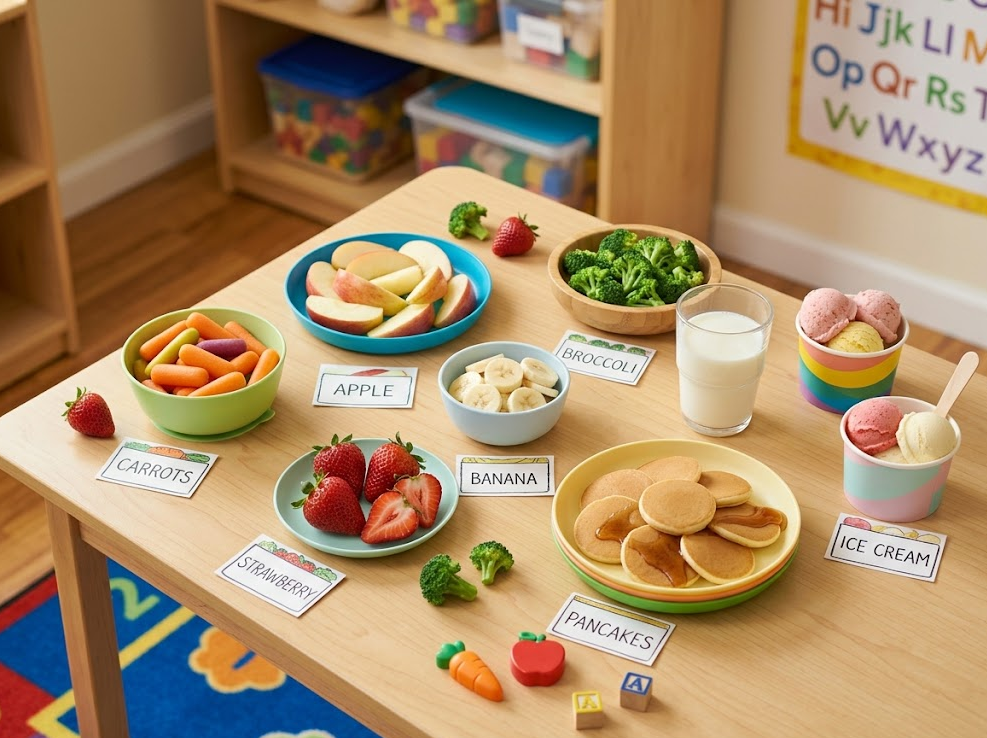
Snack prep, lunchtime, even the car ride home from the grocery store — these fit anywhere. Food is one of the first things kids learn to name, which makes food riddles for preschoolers almost impossible to get wrong on the first try. That confidence is the whole point.
Riddle: I am orange, long, crunchy, and I grow underground. Bunnies absolutely love to munch on me. What am I?
Answer: A carrot.
Riddle: I am red, round, and you can eat me fresh or bake me into a warm, sweet pie. What am I? Answer: An apple.
Riddle: I am yellow and sour. Squeeze me into water with a little sugar and you get a cold summer drink. What am I?
Answer: A lemon.
Riddle: I am white and cold and come from cows. You pour me into your cereal bowl every morning. What am I?
Answer: Milk.
Riddle: I look like a tiny green tree, but I’m actually a vegetable your parents want you to eat at dinner. What am I?
Answer: Broccoli.
Riddle: I am small, red, shaped like a heart, and covered in tiny seeds on the outside. What am I?
Answer: A strawberry.
Riddle: I am yellow, long, and monkeys are famous for peeling and eating me. What am I?
Answer: A banana.
Riddle: I am round, flat, and golden. You pour sweet syrup on top of me at breakfast. What am I?
Answer: A pancake.
Riddle: I come in many flavors, I’m frozen solid, and you scoop me into a bowl with a big spoon. What am I?
Answer: Ice cream.
Riddle: I am orange inside, round on the outside, and you carve a face into me every October. What am I?
Answer: A pumpkin.
Preschool Rhyming Riddles
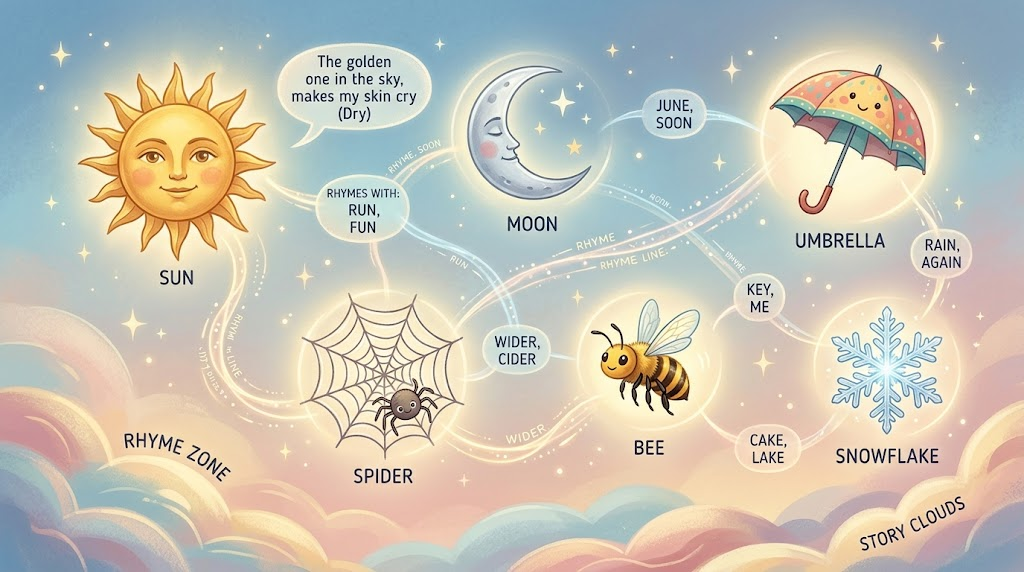
Rhyming changes how kids process clues. The sound pattern at the end of each line starts to feel like a puzzle on its own — they’re predicting the next word before they even think about the answer. That’s phonemic awareness building in real time. These rhyming riddles for preschoolers work well during morning circle or those quiet five minutes before nap.
I build a sticky web to catch a little fly, I have eight long legs but I cannot fly high. What am I?
Answer: A spider
I shine very bright up above through the day, When I go to sleep, the dark night comes to play. What am I?
Answer: The sun
Open me up when the rain starts to fall, I keep you dry whether you’re big or you’re small. What am I?
Answer: An umbrella
I have a long tail and I love to climb trees, I swing through the branches and catch the cool breeze. What am I?
Answer: A monkey
I hop through the meadow on two big strong feet, I carry my babies in a pouch, oh so neat. What am I?
Answer: A kangaroo
I melt in the summer, I fall in the winter, Catch me on your tongue — I’m just a cold glitter. What am I? Answer: A snowflake
I live in a hive and I work all day long, My buzzing may worry you, but my honey’s so strong. What am I?
Answer: A bee
I rise in the east and I set in the west, Of all the warm things in the sky, I am best. What am I?
Answer: The sun (save this one for a second round with older kids)
Who Am I — Farm Animal Riddles for Preschoolers
Animal sounds are usually the first descriptive thing toddlers learn. These farm riddles go a step further — they mix the sound with what the animal looks like and where it lives. So instead of just recalling “pig says oink,” kids have to pull together a few pieces at once.
Riddle: I am big, pink, and love to roll around in soft mud. I say “oink, oink” all day long. Who am I?
Answer: A pig.
Riddle: I have a fluffy white coat, I eat green grass in the pasture all afternoon, and I say “baa.” Who am I? Answer: A sheep.
Riddle: I live in the big red barn, I give fresh milk for your breakfast every morning, and I say “moo.” Who am I?
Answer: A cow.
Riddle: I have feathers, a yellow beak, and I love to paddle around the pond saying “quack, quack.” Who am I?
Answer: A duck.
Riddle: I have a long mane, a beautiful swishing tail, and I gallop fast across open fields saying “neigh.” Who am I?
Answer: A horse.
Riddle: I have a beard under my chin, I eat almost anything I find, and I say “maa” on the hillside. Who am I?
Answer: A goat.
Riddle: I wake everyone up at sunrise, I have colorful tail feathers, and I crow “cock-a-doodle-doo.” Who am I?
Answer: A rooster.
Funny Preschool Riddles
Once they’ve gotten a few serious ones right, switch gears. These joke-style riddles get a completely different reaction — the delayed groan, the “wait WHAT” face, the immediate demand to tell it to someone else. That’s the moment you know it landed. Great for dinner tables and long car rides too.
Riddle: Why did the teddy bear skip dessert?
Answer: Because it was already stuffed.
Riddle: What kind of tree fits in your hand?
Answer: A palm tree.
Riddle: What has ears but cannot hear a single thing?
Answer: A cornfield.
Riddle: Why did the banana go to the doctor?
Answer: Because it wasn’t peeling well.
Riddle: What gets wetter the more it dries?
Answer: A towel.
Riddle: Why did the sun go to school?
Answer: To get a little brighter.
Riddle: What do elves learn in school?
Answer: The elf-abet.
Riddle: Why did the clock get sent to the principal’s office?
Answer: Because it tocked too much.
Riddle: What has a neck but no head?
Answer: A bottle.
Riddle: Why did the cookie go to the doctor?
Answer: Because it was feeling a little crumbly.
Why Riddles Work So Well at This Age
People sometimes assume riddles are too tricky for 3-year-olds. Usually the issue isn’t the child — it’s the riddle. Pick something abstract and unfamiliar, yes, it’ll fall flat. Pick a banana, a dog, a sock — and most kids nail it on the first or second clue.
The reason they work isn’t magic. It’s just that riddles force actual listening. A worksheet doesn’t need a child’s attention. A riddle does. There’s a right answer somewhere and the child wants to find it before anyone else does. That competitive curiosity is the engine.
NAEYC — the National Association for the Education of Young Children — has long pointed to playful, language-rich back-and-forth as one of the strongest things you can do for early reading development. Riddles deliver exactly that. The child hears descriptive words, holds them in mind, and makes a logical jump. That’s genuine cognitive work.
Some kids, especially those who learn by doing rather than listening, respond even better when you let them act out the answer — jumping like a frog, pretending to fly. If that sounds like your child, it’s worth reading up on examples of tactile learning to understand why physical involvement deepens how they retain new vocabulary.
Tips for Parents and Teachers
Ham it up. Lower your voice on the clues, raise an eyebrow, pause before the reveal. Kids pick up on that performance energy and it makes the whole thing feel like an event.
Wrong answers are actually useful. If a child says “banana” when the answer is “lemon,” don’t just move on. Say — “bananas are yellow too, good thinking! But this one is really sour — what yellow fruit is sour?” That kind of redirect teaches reasoning, not just recall.
For teachers, riddles fill the awkward gaps beautifully. Transition time, the two minutes before snack is ready, those final restless minutes before pickup — no supplies needed, no setup, no mess. You can literally do this anywhere.
For older kids who’ve outgrown the basic guessing format, the same logical thinking transfers well into structured games. A mini golf trigonometry project is a good example of how spatial reasoning gets introduced through play — same principle, just a bit further down the road.
For more resources on language development and play-based learning, PBS KIDS for Parents has solid, practical guidance organized by age and developmental stage.
Frequently Asked Questions
What are the best riddles for preschoolers?
Animals, food, everyday objects. Anything a child already knows from home or the classroom. The more familiar the subject, the faster the connection clicks between clue and answer.
What are good rhyming riddles for preschoolers?
Ones where the rhyme scheme is simple and the answer is concrete. The rhyme gives kids an extra layer to work with — they’re predicting the sound while also thinking about the meaning. That double processing is really good for early phonemic awareness.
Why did the police go to the preschool riddle?
Because someone spotted a “little troublemaker” at playtime! Kids love this one — and the wordplay is sneakily clever. “Little troublemaker” works on two levels, which is more sophisticated than it looks for a 4-year-old joke.
Can riddles help children who struggle with listening?
Often yes. A child who zones out during group instruction will snap back the moment a riddle starts — especially if they’ve gotten one right before and want that feeling again. The guessing element creates real motivation to pay attention.
How many clues should you give for what am I riddles for preschoolers?
Two clues is a good starting point. One is usually too vague. Four or more and you’re basically handing them the answer. If they’re stuck after two, add a third — but let them struggle a little first. That’s where the thinking actually happens.