

Collegize AI is a college admissions platform that pulls your college list, essays, activities, deadlines and test prep into one place, with an AI assistant named Tassel sitting on top of it. That is the short answer. The longer one is more interesting, because the questions people actually type into Google are practical ones: is it free, is it legit, is it safe with my essays, and is it worth paying for?
I went through the official homepage, the free tools directory, the terms and the privacy policy, then compared them with what review sites and competing apps say. Here is what I found, including a few things quick reviews skip.
What Is Collegize AI?
Collegize AI, at collegize.ai, markets itself as an AI college counselor for students and parents. The pitch is that private counselors charge families thousands of dollars for a playbook, and Collegize tries to put that playbook to work on your essays, college list, activities and test prep for far less.
It is built mostly for high school students applying to US colleges, and the parents helping them keep track of it all.
One thing worth clearing up early. Collegize.ai is not Collegize.org. The .org site is a separate college readiness organization with its own app, founded by an educator years ago. Different company, different product. If you landed on a search result for one while looking for the other, that is why things might not match.
How Collegize AI Works
Everything runs through Tassel, the assistant. In the homepage demo, Tassel offers to plan, draft, update, navigate or find the next step from anywhere in the app, next to a college list with deadlines and a prompt for a “Why Michigan” essay.
The flow is simple. You enter your grades, interests and target schools, the platform builds a personal plan, and you work through essays, activities and preparation with Tassel. The company says it follows university AI policies, though as you will see below, that claim deserves a second look from you.
Collegize AI Features Explained
The feature set is wider than the name suggests. I think of it as five areas that match the stages of an application.
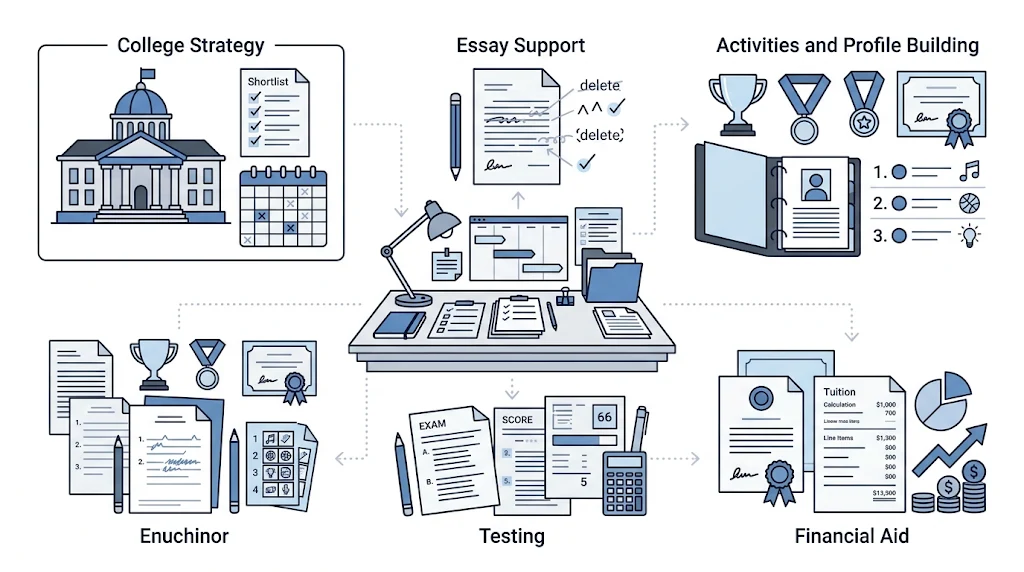
College list and strategy comes first. There is a college list balancer to sort reach, target and safety schools, a deadline calendar, a decision matrix, a major quiz and a transfer credit estimator. This fixes the “fourteen tabs open and no plan” problem, but any chance-style estimate is just that. No tool knows how a particular admissions office will read your file.
Essay support is the second area. Collegize offers brainstorming help, essay review and tools like an essay overlap finder, a “Why Us” generator, an application error checker and a LOCI builder. Brainstorming and checking for mistakes are the safe end of this. Anything that writes your sentences for you is the risky end, and I will come back to that.
Activities and profile building is the third. The activity densifier helps you fit more meaning into the tight character limits on application activity lists. There is also an extracurricular hours calculator, a tier rater and a brag sheet generator for when you need to ask teachers for recommendation letters and want to remind them what you actually did.
Testing is the fourth. Expect an SAT and ACT converter, a superscore calculator, a PSAT predictor and a test-optional analyzer, plus practice material for SAT, ACT and AP exams on the main platform.
Money is the fifth. Collegize lists 21 financial aid tools, including a net price comparison, a merit aid estimator and a scholarship matcher. Families who only look at sticker price tend to get surprised later, so this is a smart area to cover.
Is Collegize AI Free?
Partly, and the distinction matters.
The free part is real. The official tools page lists 100 free calculators and planners, and it says no sign-up is required. I counted the categories on the page and they add up: 15 for GPA and grades, 11 for testing and scores, 13 for essays, 10 for activities, 21 for financial aid, 24 for application strategy, 3 for study and productivity, and 3 for international students. That is a generous amount of useful stuff to hand out without asking for an email address.
The full platform, the personalized Tassel experience with your saved list and history, is a different story. The terms of service state that Collegize offers paid subscriptions, that prices are in US dollars, that payments go through a third-party processor like Stripe, and that subscriptions renew automatically unless you cancel. You can cancel anytime from account settings.
What the terms do not give is a price. One third-party directory lists $39.99 per month after a trial, but I could not confirm that on Collegize’s own pages, so treat it as a rumor until you see the checkout screen. The honest summary is this: the 100 tools are free, the full platform is not, and you should read the live pricing and trial details before you enter a card.
How to Use Collegize AI and Log In
Open collegize.ai and you will see Sign In and Get Started buttons at the top. The privacy policy mentions Google sign-in, so that is one route in.
If you are not ready for an account, go to the tools page first and pick the category that matches your biggest headache, probably the college list balancer or the GPA tools. When you want the full experience, create an account, enter your academic details and target schools, and let Tassel suggest next steps. Whatever it says about a deadline, confirm it on the college’s own admissions page. Treat the app as your organizer, not your source of truth.
Is Collegize AI Legit and Safe?
Legit first. There is an active website with working tools, a named co-founder introducing himself on the homepage, published terms and a privacy policy, and a product that does what it describes. The homepage also says it is trusted by over 140,000 students and parents, along with testimonials. That is a company claim, not an independent audit, and I would read it that way. I found no scam warnings, but I also found no independent body of reviews to lean on.
Safe is more nuanced, and this is where I would slow down if I were a parent.
To use the platform properly you hand over a lot of personal material. The privacy policy lists your name and email, GPA, test scores, demographic details, college preferences, essays and uploaded documents, along with how you interact with the AI tools. That is sensitive stuff for a teenager.
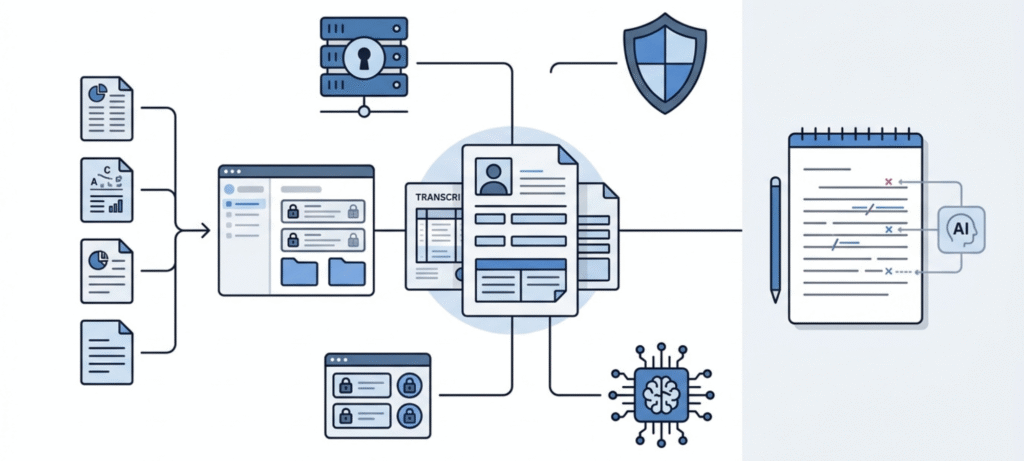
Here is what stood out when I read the documents. The terms of service, dated September 27, 2026, say you keep ownership of what you upload but grant Collegize a license to process it, and that the privacy policy explains how content and interactions are used for product improvement and language-model development. In other words, your essays and conversations may help improve its AI. The privacy page I could load was dated October 2025, and it describes using data to improve algorithms. It also says voluntary survey responses may be shared with partners such as independent admissions advisors, who may then match you with services. Because those two documents are dated differently and the policy may have been updated, read the live version before you sign up, and look for the data retention and training sections specifically.
On security, the policy mentions encryption and access controls, then adds that no system is fully secure. Fair, but it is not a promise.
Age rules are straightforward. You must be 13 or older, and anyone under 18 needs a parent’s or guardian’s consent. The terms also say AI suggestions, scores and explanations can be wrong, and that Collegize does not guarantee admission anywhere. You can ask for access, correction or deletion of your data by email.
My advice: use the free tools without an account for as long as they cover you, and have a parent read the privacy policy before a minor signs up.
Can You Use Collegize AI for College Essays?
This is the section I would not skip.
Collegize says it follows university AI policies and frames its essay tools as supporting your own writing. The trouble is that universities do not agree with each other. Cornell permits AI for researching colleges, brainstorming topics and checking grammar, but says it should not outline, draft or write your application responses. Yale allows limited grammar review and general topic suggestions, and says submitting substantive AI-generated content can count as application fraud. Caltech’s guidance for the Fall 2027 cycle lists AI-generated outlines, drafts and translations among its prohibited uses.
So an app cannot tell you what is allowed everywhere. A brainstorming prompt might be fine for one school and a line you should not cross for another. The safest approach is to use AI for the logistics, such as deadlines, school research and spotting typos, and to write every substantive sentence yourself. Keep your own notes and drafts so you can explain any part of your essay without the app open. Never invent an experience, and do not lean on an AI detector score as proof you are compliant. If you want to understand why, our guide to how Turnitin AI detection works and how accurate it is explains the limits.
Collegize AI Reddit and Reviews
People search for “collegize ai reddit” hoping for honest student opinions. I could not find a meaningful body of independent Reddit discussion about Collegize.ai. Results were mostly company pages and tool directories, which are not students describing real experiences, so I am not going to invent a sentiment for you. Testimonials on any admissions app, this one included, are chosen by the company.
Collegize AI Pros and Cons
On the plus side, the free tools are genuinely useful and need no sign-up. Everything from list building to financial aid sits in one place, and Tassel gives you a clear next step, which is half the battle when you are overwhelmed. The terms are also upfront that AI can be wrong.
On the downside, the full platform costs money and the price is not clearly published. The data policy asks for a lot of personal material. Admission estimates are guesses, and the line between brainstorming and something your target school bans is yours to police.
Is Collegize AI Worth It?
It depends on what you need. If you are juggling eight or ten schools, several essay prompts and a pile of deadlines, an all-in-one organizer could save real time and stress. If you mainly want to compare net price or convert a test score, the free tools may be all you ever need.
It is not a replacement for a school counselor or official admissions information. Spend the first hour on the free tools and see how much of your problem they solve before any card comes out.
Collegize AI Alternatives
Kollegio advertises a free, broad application workspace, though its published policy allows sharing some information with institutions, so read it closely. Rory by Prepory says its AI assistant is free after signup and works like a conversation. Sups focuses on supplemental essays, with plans listed at $9 and $29 a month, and Kolly offers one free full essay review before paid plans around $29 a month. Prices change, so check each official page. If you would rather compare a general academic writing assistant than an admissions tool, our Samwell AI review covers one.
FAQs
What is Collegize AI used for?
Planning your college list, tracking deadlines, reviewing essays, building activity descriptions and preparing for the SAT, ACT and AP exams.
Is Collegize AI free?
The 100 tools are free with no sign-up. The full platform is a paid, auto-renewing subscription.
Is Collegize AI legit and safe?
It is a working product with published terms, but its success claims are self-reported and it collects essays and personal details. Read the live privacy policy first.
Can Collegize AI write my college essay?
You should not rely on it to. Many colleges restrict AI drafting.
Does Collegize AI guarantee admission?
No. Its terms say so directly.
Is it the same as Collegize.org?
No. They are separate organizations.
Final Verdict
Collegize AI is a solid, useful organizer, and its 100 free tools are the best reason to try it. Just keep your expectations grounded. Do not pay before checking the current price, do not upload more than you are comfortable sharing, and do not let any app decide what counts as acceptable essay help. Used that way, it can make application season a lot less chaotic.