
So, is Polish hard to learn for English speakers? Short answer: yeah, it is. But the idea that it’s “the hardest language on Earth” is mostly an internet myth. which you’ll see thrown around constantly, isn’t really true. It’s more of an internet myth that’s stuck around because it sounds dramatic. The actual obstacles are pretty specific, and honestly, most of them are things you can work through. Seven grammatical cases. Word endings that change depending on context. Grammatical gender. A bunch of consonant sounds English just doesn’t have. That’s the hard part, in a nutshell.
But here’s the flip side nobody mentions enough. Polish uses the Latin alphabet, so you’re not learning a new writing system from scratch. There’s no “a” or “the” to worry about. And the spelling rules, once you actually learn them, are way more consistent than English’s ever been. Once you figure out which parts are genuinely tough and which parts just look scary at first glance, the whole thing stops feeling impossible.
Quick answer: Polish is tough for English speakers mainly because of cases, gender, and pronunciation. It’s not some unclimbable mountain though. A lot of what seems intimidating at first actually clicks within a few months.
The 5 Biggest Challenges for English Speakers
- Seven grammatical cases, which change how nouns, adjectives, and pronouns end depending on their job in a sentence
- Verb aspect and verbs of motion (Polish verbs shift depending on whether something’s finished, still happening, or tied to a specific way of getting somewhere)
- Pronunciation loaded with consonant clusters like szcz or rz that your mouth just isn’t used to making
- Grammatical gender, plus extra sub-categories like masculine personal vs. masculine inanimate, which affect plural forms
- Vocabulary that barely overlaps with English, aside from a handful of Latin-based words
How Hard Is Polish, Really?
The U.S. Foreign Service Institute puts Polish in the group of languages that take real, substantial effort for English speakers. The figure most often associated with this category is around 1,100 hours of intensive study., gets quoted everywhere. But it’s worth knowing where that figure actually comes from. It’s based on people in intensive training programs, studying for several hours every single day with native instructors sitting right there. It’s not some countdown clock ticking over your head.
If you’re doing fifteen minutes a day on an app before bed, your timeline is going to look completely different, and that’s totally fine.
Honestly, a better way to think about difficulty is by breaking it down skill by skill, since “hard” doesn’t mean the same thing across the board.
| Area | Difficulty for an English speaker |
|---|---|
| Alphabet and spelling | Easy — Latin letters, fairly consistent rules |
| Basic vocabulary | Moderate — few obvious cognates outside Latin-based words |
| Pronunciation | Moderate to hard — unfamiliar consonant clusters |
| Grammar and cases | Hard — the main long-term challenge |
| Listening comprehension | Hard — fast, connected speech |
| Speaking | Moderate to hard, improves quickly with practice |
| Reading | Moderate — spelling becomes predictable once the rules click |
That “easy” rating next to the alphabet throws people off. Show someone the word szczęście or a name like Grzegorz and they immediately assume the whole language must be built like that. Fair reaction, honestly. But the rules behind those letters are actually more forgiving than you’d think, and definitely more forgiving than English spelling, which can’t even settle on how to pronounce its own vowels half the time.
Is Polish Hard to Learn for English Speakers Specifically?
This is really what most people mean when they ask the question in the first place. And the honest answer lands in a specific spot: harder than French or Spanish, roughly in the same ballpark as Russian, but not off in some totally separate category the way clickbait articles love to claim. There isn’t one massive wall you have to climb. It’s more like a handful of specific features that just don’t exist in English at all.
Here’s where things usually get sticky:
- Grammatical cases that change how a noun ends depending on what it’s doing in the sentence
- Grammatical gender, which spreads into adjectives and past-tense verbs too
- Consonant clusters like szcz, rz, and ź that need your mouth to do something new
- Verb aspect, basically the idea that a verb has a separate form for “finished” versus “still going”
- Vocabulary that mostly won’t ring a bell, aside from the Latin-rooted words
And here’s what’s actually working in your favor:
- The alphabet already looks familiar, just with a few extra letters and marks tacked on
- No “a,” “an,” or “the” to remember
- Spelling is more predictable than English once you learn the sound rules
- Stress is consistent, it lands on the second-to-last syllable almost every single time
- Word order is flexible, since the case endings do a lot of the heavy lifting that word order handles in English
What Actually Makes Polish Difficult
The Seven Cases
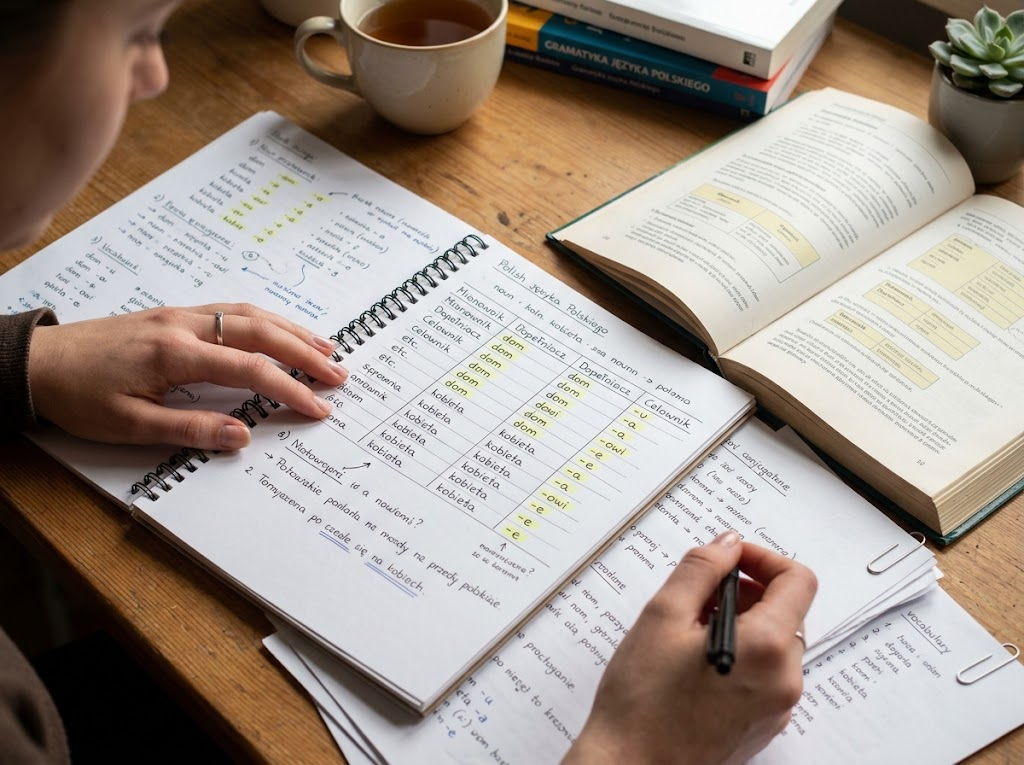
This is one of the things that catches many beginners off guard. Take a simple word like kawa, meaning coffee. It changes shape depending on whether you’re drinking it, ordering it, or just mentioning it in conversation: kawę, kawy, kawie. Looking at a full declension table for the first time can feel genuinely overwhelming. But give it a few months of actually using the language, and the patterns start feeling less random and more automatic. It’s kind of like how irregular English past tenses eventually stop requiring any real thought once you’ve used them enough.
Pronunciation
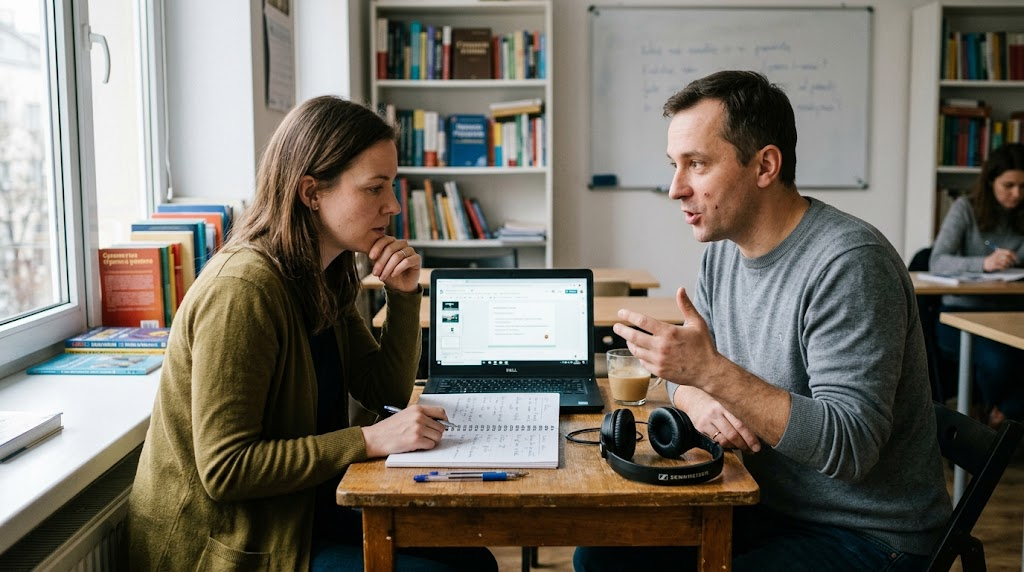
Polish stacks consonants together in ways English never does. A word with szcz or chrz in it looks flat-out unpronounceable the first time you see it written down. But once you actually hear it broken apart, most of those sounds map pretty closely onto ones you already make. Polish “sz” is close to the English “sh.” “Cz” isn’t too far from the “ch” in “church.” What’s genuinely unfamiliar is hearing several of these sounds crammed together back to back in the same word, not really the individual sounds themselves.
Poland’s official government guidance also describes Polish as having many consonant groups and notes that stress usually falls on the penultimate syllable. Polish Language and Pronunciation Guidelines — gov.pl
Grammatical Gender
Every noun in Polish is masculine, feminine, or neuter, and that gender then shapes the adjectives and past-tense verbs that go with it. Good news though, gender is usually predictable just from the noun’s ending. Words ending in -a tend to be feminine. A hard consonant ending usually means masculine. -o or -e usually points to neuter. There’s a bit more nuance too, since masculine nouns split further into personal and inanimate categories, and that distinction becomes more noticeable once you’re dealing with plurals at an intermediate level.
Verb Aspect
Polish verbs show up in pairs, one version for something completed, another for something ongoing or repeated. English just doesn’t have a real equivalent for this. That’s part of why aspect tends to be one of the last things that really clicks, even for learners who’ve already got solid vocabulary and can hold a conversation just fine.
Verbs of Motion
This is where things get genuinely tricky. Which verb you use depends on a few things: are you walking or traveling by vehicle, is this a one-time trip or something you do regularly, and is the movement finished or still happening. It’s a big reason Polish verbs stay a little challenging even after the core grammar starts feeling comfortable.
If you’re still weighing whether Polish is worth the time investment compared to other options, it helps to look at something a bit gentler for comparison. Our guide on whether German is easy to learn for an English speaker covers a language that most learners find noticeably more approachable, which puts Polish’s curve into better context.
What’s the Single Hardest Part for Most Beginners?
If you had to rank the main challenges, I’d put them roughly like this:
- Grammatical cases — the big structural challenge that touches nearly every sentence you’ll ever build
- Verb aspect and verbs of motion — subtle stuff that just takes time to feel natural
- Consonant-heavy pronunciation — scary at first, but mostly just needs practice
- Grammatical gender and its plural sub-categories — mostly predictable, with a handful of exceptions to memorize
- Vocabulary — not conceptually hard, just slow going since so little of it resembles English
Cases sit at the top for a good reason. The other challenges can be practiced more directly. Cases are different because they show up in almost every sentence. Cases don’t work like that. They show up in nearly every sentence, so getting comfortable with them is less like clearing one hurdle and more like a gradual shift that happens over months of actually using the language.
What’s Easier About Polish Than People Expect
- No articles. You’ll never have to stress over “a house” versus “the house.” Polish just says dom and moves on.
- Spelling that actually holds up. Learn the pronunciation rules once, and you can read most new words out loud correctly on the first try.
- Predictable stress. Almost every word gets stressed on the second-to-last syllable, so you’re rarely guessing.
- A tense system that isn’t overcomplicated. Polish sticks to past, present, and future, though verb aspect adds an extra layer on top that takes its own time to settle in.
- Latin-rooted vocabulary. Words like informacja, edukacja, and komunikacja look close enough to their English cousins that you’ll half-recognize them already.
Is Polish Harder Than Russian?
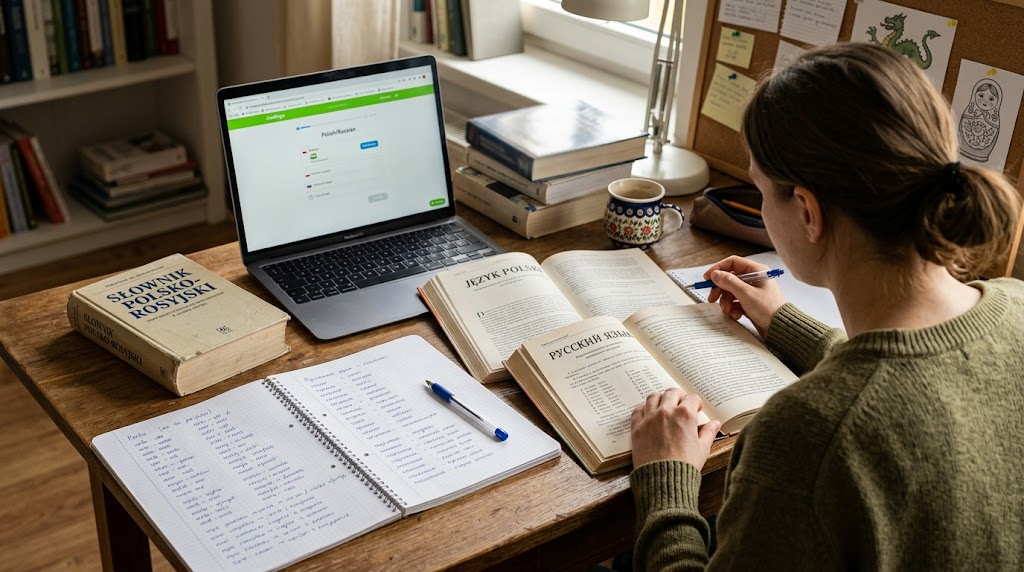
This comparison comes up all the time, and honestly, there’s no clean winner. Both are Slavic languages. Both lean heavily on grammatical case. Both assign gender to every noun. Both sit in the same general FSI difficulty bracket. Where they actually differ comes down to a few concrete things.
| Feature | Polish | Russian |
|---|---|---|
| Writing system | Latin alphabet | Cyrillic alphabet |
| Number of cases | 7 | 6 |
| Grammatical gender | Yes | Yes |
| Verb aspect | Yes | Yes |
| Beginner reading | Easier start (familiar letters) | New alphabet from zero |
| Pronunciation challenge | Dense consonant clusters | Vowel reduction and shifting stress |
Russian’s toughest early hurdle is the alphabet itself. You’re basically learning to read all over again before you can even sound out a menu. Polish skips that step entirely, but it makes up for it with denser consonant clusters that take a bit of getting used to. If the alphabet question is really what’s holding you back from picking one over the other, our roundup of popular Russian language learning apps is worth a quick look before you decide.
Who Finds Polish Easier to Learn?
Difficulty here really isn’t a fixed thing. English speakers starting completely from scratch are in for a genuine climb. But if you already speak Czech, Slovak, Ukrainian, Russian, or any other Slavic language, a lot of this is going to feel familiar right away. Vocabulary, case patterns, and verb habits carry over pretty directly, which can shave real time off those early, frustrating months.
Is Polish the Hardest Language in the World?
Nope, and this claim doesn’t hold up once you actually look past the headlines. Language difficulty isn’t some fixed property baked into a language. It’s always relative to whatever you already speak. Polish is genuinely tough for an English speaker starting cold. It’s a lot less tough for someone who already speaks Czech or Ukrainian. The FSI’s rankings are built specifically around English speakers. They were never meant to measure difficulty in some universal, one-size-fits-all way.
How Long Does It Actually Take?
- Basic survival Polish (greetings, ordering food, asking directions) — a few months of steady practice
- Everyday conversational Polish — usually around a year or more, assuming you’re consistent
- Comfortable intermediate Polish — one to two years, depending on how much immersion you’re getting
- Advanced, near-fluent Polish — that 1,100-hour figure again, spread across however long it takes you personally
These are ranges, not guarantees. Someone actually living in Poland, using the language every single day, is going to move through these stages way faster than someone squeezing in ten minutes on an app before falling asleep.
How to Make It Easier on Yourself
- Start with pronunciation and spelling rules before you dive headfirst into vocabulary lists
- Learn common phrases as whole chunks instead of translating word by word in your head
- Introduce the case system slowly, one or two cases at a time, not all at once
- Focus on the most frequent verbs early since you’ll use them constantly
- Get a little listening practice in daily, even if it’s just passive background listening
- Start speaking early and let yourself mess up rather than waiting until you feel “ready”
If you’re weighing Polish against something completely outside the Slavic family, our guide to the easiest Asian language to learn takes the comparison in a different direction entirely and might help you figure out what you’re actually looking for in a language.
Is Polish Worth Learning?
If you’re weighing the effort against what you’ll actually get out of it, yeah, it’s worth it, for the right reasons anyway. Polish opens up real conversations with family, friends, or colleagues who’d otherwise always be one translation app away. It’s also a genuinely solid gateway into other Slavic languages, since a decent grip on Polish grammar makes Czech, Slovak, and even Russian feel a lot less intimidating down the road. This isn’t really a language you pick up just for a two-week trip. It’s one you learn because you actually want a real connection to the culture behind it.
Polish earns its tough reputation, but not for the dramatic reasons the internet tends to push. There’s no single impossible wall here, just a handful of specific features, cases, gender, aspect, pronunciation, that simply don’t have an equivalent in English and take genuine time to sink in. Everything else, from the familiar alphabet to the predictable stress and spelling, is actually working in your favor. Stick with it consistently, and the grammar that felt impossible in month one starts feeling automatic by month six.
Frequently Asked Questions
Is Polish hard to learn?
Yeah. For native English speakers, Polish is generally seen as a tough European language, mainly because of the seven-case system, grammatical gender, verb aspect, and consonant-heavy pronunciation. It’s manageable with consistent practice though, and the alphabet and spelling are easier than most beginners expect going in.
Is Polish hard to learn for English speakers specifically?
It’s harder than Spanish or French and sits roughly on par with Russian. The alphabet feels familiar right away, but the grammar brings in concepts English just doesn’t have, like case endings, verb aspect, and fairly detailed verbs of motion.
Can I learn Polish if I only speak English?
Absolutely, plenty of monolingual English speakers pick up Polish successfully. The grammar concepts are new, sure, but learning them gradually with steady exposure makes them completely doable over time.
What is the hardest part of learning Polish?
Most learners point straight to the seven grammatical cases as the biggest long-term challenge. Cases touch nouns, adjectives, and pronouns in nearly every sentence, which means shifting away from relying on word order and leaning on word endings instead.
Why is Polish so hard to learn?
Mostly the seven-case system, grammatical gender with its sub-categories, verb aspect, and pronunciation packed with consonant clusters. Vocabulary adds to the workload too, since Polish shares very little everyday vocabulary with English outside of Latin-rooted terms.
Is Polish harder than Russian?
The two are pretty close overall. Russian’s biggest early obstacle is learning the Cyrillic alphabet completely from scratch. Polish sticks with familiar letters but throws denser consonant clusters and one extra grammatical case your way.
How long does it take to learn Polish?
Basic conversational ability often comes together within a year of steady practice. Reaching professional working proficiency is commonly estimated around 1,100 intensive classroom hours, though your actual timeline depends a lot on your study habits and how much immersion you’re getting.
Is Polish the hardest language to learn?
No. It’s tough for English speakers specifically, but difficulty is always relative to whatever language you grew up speaking. Someone who already knows another Slavic language is going to find Polish noticeably easier than an English speaker starting completely from zero.
Final Thoughts
So, is Polish hard to learn? For English speakers, yes, but it’s far from impossible. The seven cases, unfamiliar pronunciation, grammatical gender, and verb aspect will take time to get used to. The good news is that Polish also gives you some advantages, including a familiar alphabet, predictable spelling, and consistent stress. If you study regularly, practice speaking, and take the grammar one step at a time, the language becomes much less intimidating. The key isn’t learning everything at once; it’s sticking with it long enough for the patterns to start feeling natural.